 Add to Chrome
 Add to Firefox
 Add to Edge
Probabilistic Federated Learning on Uncertain and Heterogeneous Data with Model Personalization
Mar 18, 2026
Conventional federated learning (FL) frameworks often suffer from training degradation due to data uncertainty and heterogeneity across local clients. Probabilistic approaches such as Bayesian neural networks (BNNs) can mitigate this issue by explicitly modeling uncertainty, but they introduce additional runtime, latency, and bandwidth overhead that has rarely been studied in federated settings. To address these challenges, we propose Meta-BayFL, a personalized probabilistic FL method that combines meta-learning with BNNs to improve training under uncertain and heterogeneous data. The framework is characterized by three main features: (1) BNN-based client models incorporate uncertainty across hidden layers to stabilize training on small and noisy datasets, (2) meta-learning with adaptive learning rates enables personalized updates that enhance local training under non-IID conditions, and (3) a unified probabilistic and personalized design improves the robustness of global model aggregation. We provide a theoretical convergence analysis and characterize the upper bound of the global model over communication rounds. In addition, we evaluate computational costs (runtime, latency, and communication) and discuss the feasibility of deployment on resource-constrained devices such as edge nodes and IoT systems. Extensive experiments on CIFAR-10, CIFAR-100, and Tiny-ImageNet show that Meta-BayFL consistently outperforms state-of-the-art methods, including both standard and personalized FL approaches (e.g., pFedMe, Ditto, FedFomo), with up to 7.42\% higher test accuracy.

Communication-Efficient Quantum Federated Learning over Large-Scale Wireless Networks
Mar 01, 2026Quantum federated learning (QFL) combines the robust data processing of quantum computing with the privacy-preserving features of federated learning (FL). However, in large-scale wireless networks, optimizing sum-rate is crucial for unlocking the true potential of QFL, facilitating effective model sharing and aggregation as devices compete for limited bandwidth amid dynamic channel conditions and fluctuating power resources. This paper studies a novel sum-rate maximization problem within a muti-channel QFL framework, specifically designed for non-orthogonal multiple access (NOMA)-based large-scale wireless networks. We develop a sum-rate maximization problem by jointly considering quantum device's channel selection and transmit power. Our formulated problem is a non-convex, mixed-integer nonlinear programming (MINLP) challenge that remains non-deterministic polynomial time (NP)-hard even with specified channel selection parameters. The complexity of the problem motivates us to create an effective iterative optimization approach that utilizes the sophisticated quantum approximate optimization algorithm (QAOA) to derive high-quality approximate solutions. Additionally, our study presents the first theoretical exploration of QFL convergence properties under full device participation, rigorously analyzing real-world scenarios with nonconvex loss functions, diverse data distributions, and the effects of quantum shot noise. Extensive simulation results indicate that our multi-channel NOMA-based QFL framework enhances model training and convergence behavior, surpassing conventional algorithms in terms of accuracy and loss. Moreover, our quantum-centric joint optimization approach achieves more than a 100% increase in sum-rate while ensuring rapid convergence, significantly outperforming the state-of-the-arts.
Tackling Heterogeneity in Quantum Federated Learning: An Integrated Sporadic-Personalized Approach
Jan 11, 2026Quantum federated learning (QFL) emerges as a powerful technique that combines quantum computing with federated learning to efficiently process complex data across distributed quantum devices while ensuring data privacy in quantum networks. Despite recent research efforts, existing QFL frameworks struggle to achieve optimal model training performance primarily due to inherent heterogeneity in terms of (i) quantum noise where current quantum devices are subject to varying levels of noise due to varying device quality and susceptibility to quantum decoherence, and (ii) heterogeneous data distributions where data across participating quantum devices are naturally non-independent and identically distributed (non-IID). To address these challenges, we propose a novel integrated sporadic-personalized approach called SPQFL that simultaneously handles quantum noise and data heterogeneity in a single QFL framework. It is featured in two key aspects: (i) for quantum noise heterogeneity, we introduce a notion of sporadic learning to tackle quantum noise heterogeneity across quantum devices, and (ii) for quantum data heterogeneity, we implement personalized learning through model regularization to mitigate overfitting during local training on non-IID quantum data distributions, thereby enhancing the convergence of the global model. Moreover, we conduct a rigorous convergence analysis for the proposed SPQFL framework, with both sporadic and personalized learning considerations. Theoretical findings reveal that the upper bound of the SPQFL algorithm is strongly influenced by both the number of quantum devices and the number of quantum noise measurements. Extensive simulation results in real-world datasets also illustrate that the proposed SPQFL approach yields significant improvements in terms of training performance and convergence stability compared to the state-of-the-art methods.
Towards Personalized Quantum Federated Learning for Anomaly Detection
Nov 08, 2025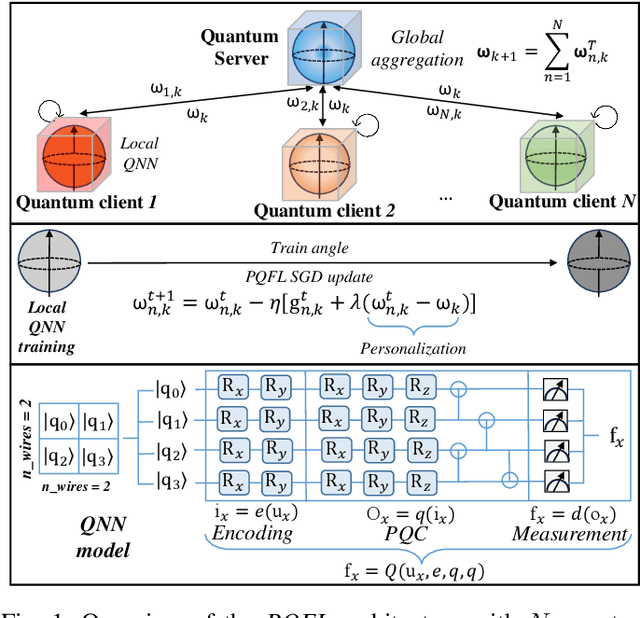
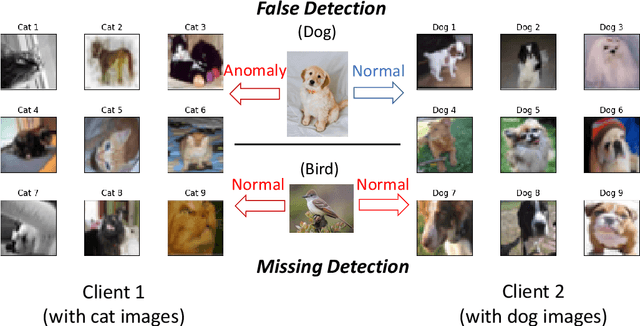
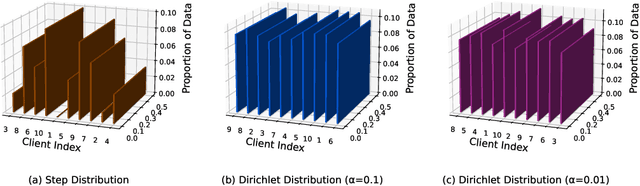
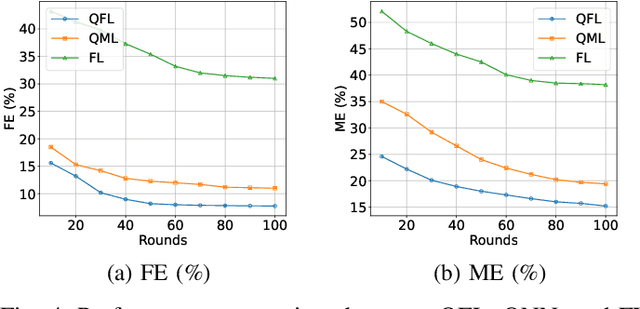
Anomaly detection has a significant impact on applications such as video surveillance, medical diagnostics, and industrial monitoring, where anomalies frequently depend on context and anomaly-labeled data are limited. Quantum federated learning (QFL) overcomes these concerns by distributing model training among several quantum clients, consequently eliminating the requirement for centralized quantum storage and processing. However, in real-life quantum networks, clients frequently differ in terms of hardware capabilities, circuit designs, noise levels, and how classical data is encoded or preprocessed into quantum states. These differences create inherent heterogeneity across clients - not just in their data distributions, but also in their quantum processing behaviors. As a result, training a single global model becomes ineffective, especially when clients handle imbalanced or non-identically distributed (non-IID) data. To address this, we propose a new framework called personalized quantum federated learning (PQFL) for anomaly detection. PQFL enhances local model training at quantum clients using parameterized quantum circuits and classical optimizers, while introducing a quantum-centric personalization strategy that adapts each client's model to its own hardware characteristics and data representation. Extensive experiments show that PQFL significantly improves anomaly detection accuracy under diverse and realistic conditions. Compared to state-of-the-art methods, PQFL reduces false errors by up to 23%, and achieves gains of 24.2% in AUROC and 20.5% in AUPR, highlighting its effectiveness and scalability in practical quantum federated settings.
Latency-aware Multimodal Federated Learning over UAV Networks
Oct 02, 2025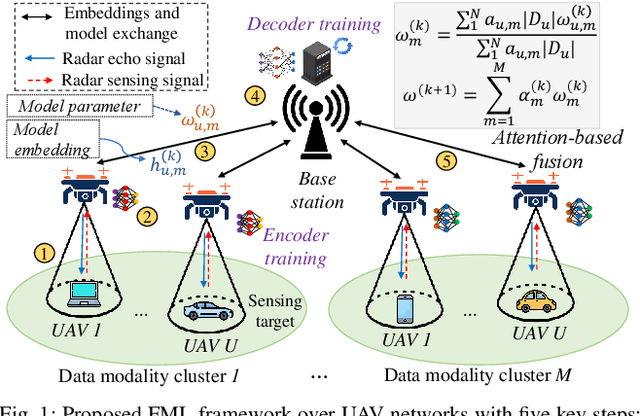
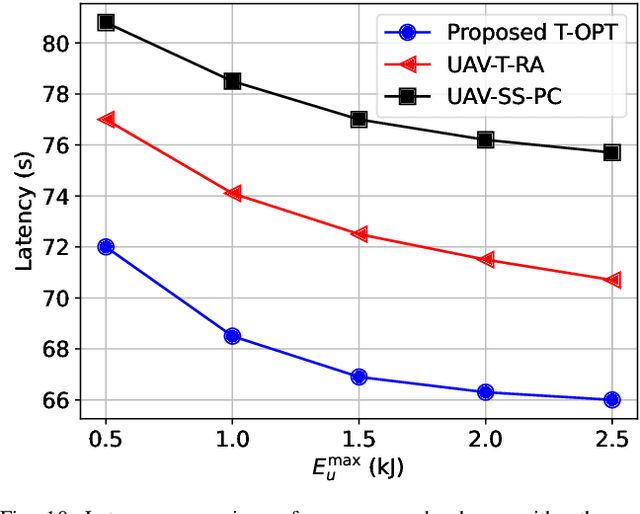
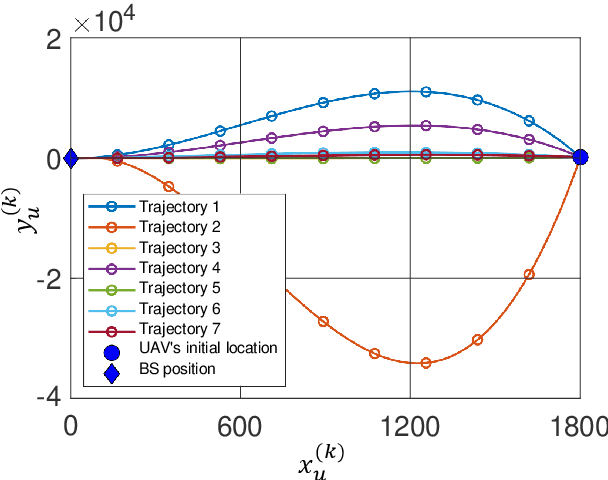
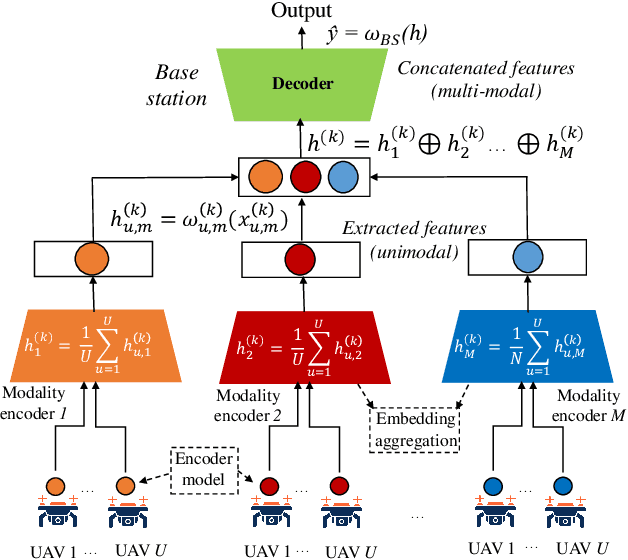
This paper investigates federated multimodal learning (FML) assisted by unmanned aerial vehicles (UAVs) with a focus on minimizing system latency and providing convergence analysis. In this framework, UAVs are distributed throughout the network to collect data, participate in model training, and collaborate with a base station (BS) to build a global model. By utilizing multimodal sensing, the UAVs overcome the limitations of unimodal systems, enhancing model accuracy, generalization, and offering a more comprehensive understanding of the environment. The primary objective is to optimize FML system latency in UAV networks by jointly addressing UAV sensing scheduling, power control, trajectory planning, resource allocation, and BS resource management. To address the computational complexity of our latency minimization problem, we propose an efficient iterative optimization algorithm combining block coordinate descent and successive convex approximation techniques, which provides high-quality approximate solutions. We also present a theoretical convergence analysis for the UAV-assisted FML framework under a non-convex loss function. Numerical experiments demonstrate that our FML framework outperforms existing approaches in terms of system latency and model training performance under different data settings.
SimQFL: A Quantum Federated Learning Simulator with Real-Time Visualization
Aug 17, 2025Quantum federated learning (QFL) is an emerging field that has the potential to revolutionize computation by taking advantage of quantum physics concepts in a distributed machine learning (ML) environment. However, the majority of available quantum simulators are primarily built for general quantum circuit simulation and do not include integrated support for machine learning tasks such as training, evaluation, and iterative optimization. Furthermore, designing and assessing quantum learning algorithms is still a difficult and resource-intensive task. Real-time updates are essential for observing model convergence, debugging quantum circuits, and making conscious choices during training with the use of limited resources. Furthermore, most current simulators fail to support the integration of user-specific data for training purposes, undermining the main purpose of using a simulator. In this study, we introduce SimQFL, a customized simulator that simplifies and accelerates QFL experiments in quantum network applications. SimQFL supports real-time, epoch-wise output development and visualization, allowing researchers to monitor the process of learning across each training round. Furthermore, SimQFL offers an intuitive and visually appealing interface that facilitates ease of use and seamless execution. Users can customize key variables such as the number of epochs, learning rates, number of clients, and quantum hyperparameters such as qubits and quantum layers, making the simulator suitable for various QFL applications. The system gives immediate feedback following each epoch by showing intermediate outcomes and dynamically illustrating learning curves. SimQFL is a practical and interactive platform enabling academics and developers to prototype, analyze, and tune quantum neural networks with greater transparency and control in distributed quantum networks.
Federated Learning for Cyber Physical Systems: A Comprehensive Survey
May 08, 2025The integration of machine learning (ML) in cyber physical systems (CPS) is a complex task due to the challenges that arise in terms of real-time decision making, safety, reliability, device heterogeneity, and data privacy. There are also open research questions that must be addressed in order to fully realize the potential of ML in CPS. Federated learning (FL), a distributed approach to ML, has become increasingly popular in recent years. It allows models to be trained using data from decentralized sources. This approach has been gaining popularity in the CPS field, as it integrates computer, communication, and physical processes. Therefore, the purpose of this work is to provide a comprehensive analysis of the most recent developments of FL-CPS, including the numerous application areas, system topologies, and algorithms developed in recent years. The paper starts by discussing recent advances in both FL and CPS, followed by their integration. Then, the paper compares the application of FL in CPS with its applications in the internet of things (IoT) in further depth to show their connections and distinctions. Furthermore, the article scrutinizes how FL is utilized in critical CPS applications, e.g., intelligent transportation systems, cybersecurity services, smart cities, and smart healthcare solutions. The study also includes critical insights and lessons learned from various FL-CPS implementations. The paper's concluding section delves into significant concerns and suggests avenues for further research in this fast-paced and dynamic era.
Adaptive Clipping for Privacy-Preserving Few-Shot Learning: Enhancing Generalization with Limited Data
Mar 27, 2025In the era of data-driven machine-learning applications, privacy concerns and the scarcity of labeled data have become paramount challenges. These challenges are particularly pronounced in the domain of few-shot learning, where the ability to learn from limited labeled data is crucial. Privacy-preserving few-shot learning algorithms have emerged as a promising solution to address such pronounced challenges. However, it is well-known that privacy-preserving techniques often lead to a drop in utility due to the fundamental trade-off between data privacy and model performance. To enhance the utility of privacy-preserving few-shot learning methods, we introduce a novel approach called Meta-Clip. This technique is specifically designed for meta-learning algorithms, including Differentially Private (DP) model-agnostic meta-learning, DP-Reptile, and DP-MetaSGD algorithms, with the objective of balancing data privacy preservation with learning capacity maximization. By dynamically adjusting clipping thresholds during the training process, our Adaptive Clipping method provides fine-grained control over the disclosure of sensitive information, mitigating overfitting on small datasets and significantly improving the generalization performance of meta-learning models. Through comprehensive experiments on diverse benchmark datasets, we demonstrate the effectiveness of our approach in minimizing utility degradation, showcasing a superior privacy-utility trade-off compared to existing privacy-preserving techniques. The adoption of Adaptive Clipping represents a substantial step forward in the field of privacy-preserving few-shot learning, empowering the development of secure and accurate models for real-world applications, especially in scenarios where there are limited data availability.
Electrical Load Forecasting over Multihop Smart Metering Networks with Federated Learning
Feb 24, 2025Electric load forecasting is essential for power management and stability in smart grids. This is mainly achieved via advanced metering infrastructure, where smart meters (SMs) record household energy data. Traditional machine learning (ML) methods are often employed for load forecasting but require data sharing which raises data privacy concerns. Federated learning (FL) can address this issue by running distributed ML models at local SMs without data exchange. However, current FL-based approaches struggle to achieve efficient load forecasting due to imbalanced data distribution across heterogeneous SMs. This paper presents a novel personalized federated learning (PFL) method for high-quality load forecasting in metering networks. A meta-learning-based strategy is developed to address data heterogeneity at local SMs in the collaborative training of local load forecasting models. Moreover, to minimize the load forecasting delays in our PFL model, we study a new latency optimization problem based on optimal resource allocation at SMs. A theoretical convergence analysis is also conducted to provide insights into FL design for federated load forecasting. Extensive simulations from real-world datasets show that our method outperforms existing approaches in terms of better load forecasting and reduced operational latency costs.
Digital Twin in Industries: A Comprehensive Survey
Nov 29, 2024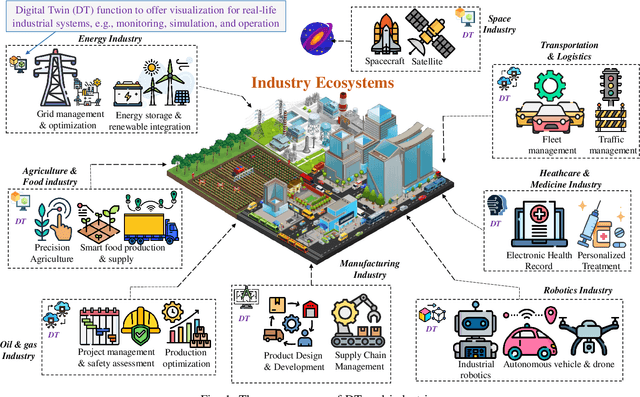
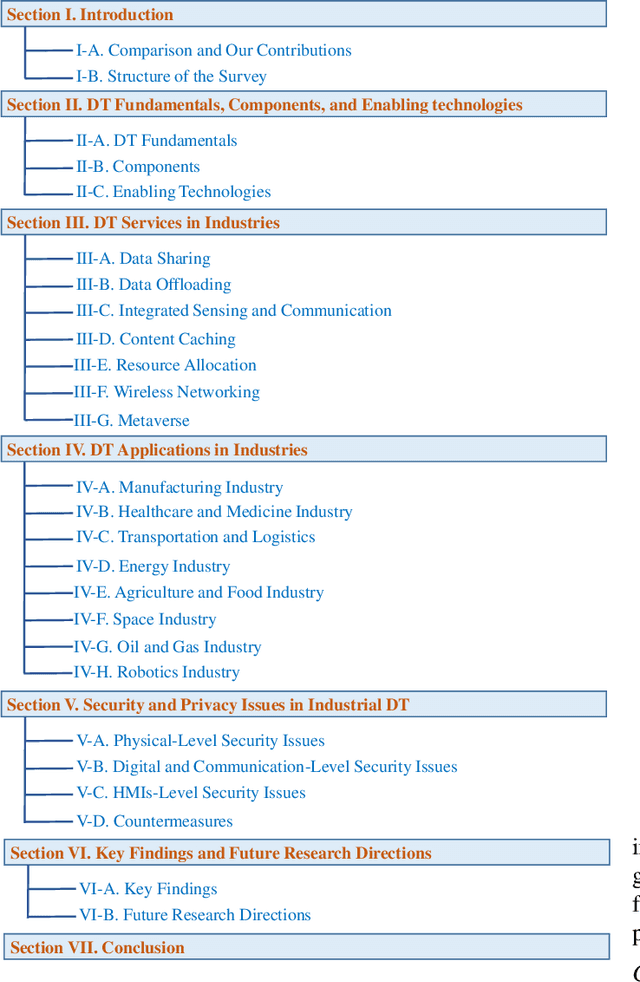
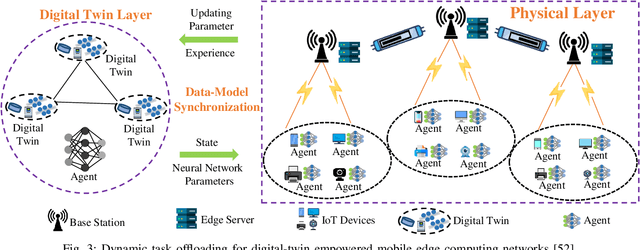
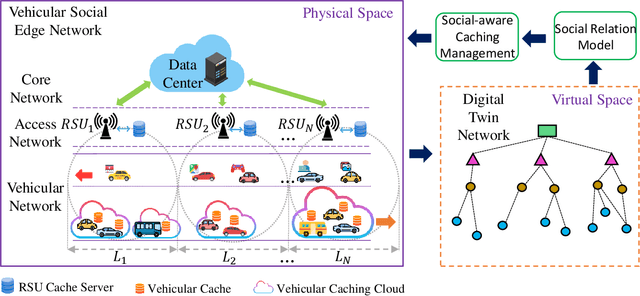
Industrial networks are undergoing rapid transformation driven by the convergence of emerging technologies that are revolutionizing conventional workflows, enhancing operational efficiency, and fundamentally redefining the industrial landscape across diverse sectors. Amidst this revolution, Digital Twin (DT) emerges as a transformative innovation that seamlessly integrates real-world systems with their virtual counterparts, bridging the physical and digital realms. In this article, we present a comprehensive survey of the emerging DT-enabled services and applications across industries, beginning with an overview of DT fundamentals and its components to a discussion of key enabling technologies for DT. Different from literature works, we investigate and analyze the capabilities of DT across a wide range of industrial services, including data sharing, data offloading, integrated sensing and communication, content caching, resource allocation, wireless networking, and metaverse. In particular, we present an in-depth technical discussion of the roles of DT in industrial applications across various domains, including manufacturing, healthcare, transportation, energy, agriculture, space, oil and gas, as well as robotics. Throughout the technical analysis, we delve into real-time data communications between physical and virtual platforms to enable industrial DT networking. Subsequently, we extensively explore and analyze a wide range of major privacy and security issues in DT-based industry. Taxonomy tables and the key research findings from the survey are also given, emphasizing important insights into the significance of DT in industries. Finally, we point out future research directions to spur further research in this promising area.