 Add to Chrome
 Add to Firefox
 Add to Edge
RcAE: Recursive Reconstruction Framework for Unsupervised Industrial Anomaly Detection
Dec 12, 2025
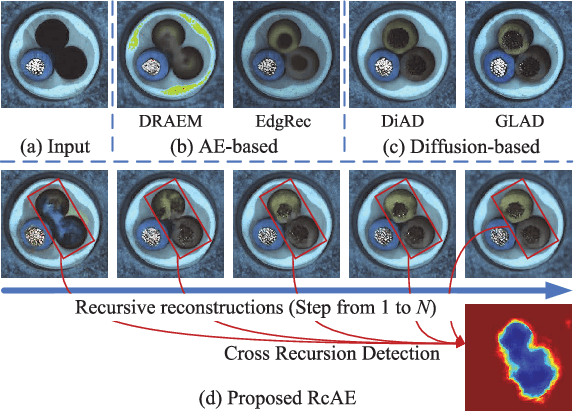
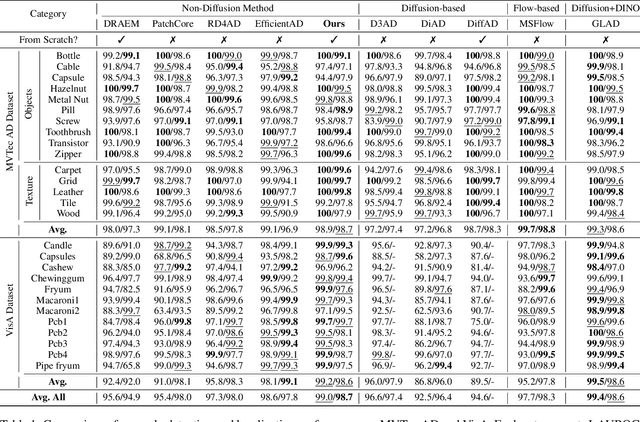
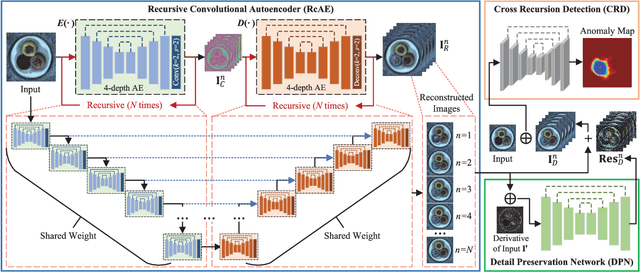
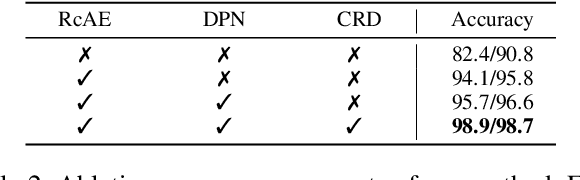
Unsupervised industrial anomaly detection requires accurately identifying defects without labeled data. Traditional autoencoder-based methods often struggle with incomplete anomaly suppression and loss of fine details, as their single-pass decoding fails to effectively handle anomalies with varying severity and scale. We propose a recursive architecture for autoencoder (RcAE), which performs reconstruction iteratively to progressively suppress anomalies while refining normal structures. Unlike traditional single-pass models, this recursive design naturally produces a sequence of reconstructions, progressively exposing suppressed abnormal patterns. To leverage this reconstruction dynamics, we introduce a Cross Recursion Detection (CRD) module that tracks inconsistencies across recursion steps, enhancing detection of both subtle and large-scale anomalies. Additionally, we incorporate a Detail Preservation Network (DPN) to recover high-frequency textures typically lost during reconstruction. Extensive experiments demonstrate that our method significantly outperforms existing non-diffusion methods, and achieves performance on par with recent diffusion models with only 10% of their parameters and offering substantially faster inference. These results highlight the practicality and efficiency of our approach for real-world applications.

Federated Learning in Intelligent Transportation Systems: Recent Applications and Open Problems
Sep 20, 2023Intelligent transportation systems (ITSs) have been fueled by the rapid development of communication technologies, sensor technologies, and the Internet of Things (IoT). Nonetheless, due to the dynamic characteristics of the vehicle networks, it is rather challenging to make timely and accurate decisions of vehicle behaviors. Moreover, in the presence of mobile wireless communications, the privacy and security of vehicle information are at constant risk. In this context, a new paradigm is urgently needed for various applications in dynamic vehicle environments. As a distributed machine learning technology, federated learning (FL) has received extensive attention due to its outstanding privacy protection properties and easy scalability. We conduct a comprehensive survey of the latest developments in FL for ITS. Specifically, we initially research the prevalent challenges in ITS and elucidate the motivations for applying FL from various perspectives. Subsequently, we review existing deployments of FL in ITS across various scenarios, and discuss specific potential issues in object recognition, traffic management, and service providing scenarios. Furthermore, we conduct a further analysis of the new challenges introduced by FL deployment and the inherent limitations that FL alone cannot fully address, including uneven data distribution, limited storage and computing power, and potential privacy and security concerns. We then examine the existing collaborative technologies that can help mitigate these challenges. Lastly, we discuss the open challenges that remain to be addressed in applying FL in ITS and propose several future research directions.