 Add to Chrome
 Add to Firefox
 Add to Edge
SJD++: Improved Speculative Jacobi Decoding for Training-free Acceleration of Discrete Auto-regressive Text-to-Image Generation
Dec 08, 2025
Large autoregressive models can generate high-quality, high-resolution images but suffer from slow generation speed, because these models require hundreds to thousands of sequential forward passes for next-token prediction during inference. To accelerate autoregressive text-to-image generation, we propose Speculative Jacobi Decoding++ (SJD++), a training-free probabilistic parallel decoding algorithm. Unlike traditional next-token prediction, SJD++ performs multi-token prediction in each forward pass, drastically reducing generation steps. Specifically, it integrates the iterative multi-token prediction mechanism from Jacobi decoding, with the probabilistic drafting-and-verification mechanism from speculative sampling. More importantly, for further acceleration, SJD++ reuses high-confidence draft tokens after each verification phase instead of resampling them all. We conduct extensive experiments on several representative autoregressive text-to-image generation models and demonstrate that SJD++ achieves $2\times$ to $3\times$ inference latency reduction and $2\times$ to $7\times$ step compression, while preserving visual quality with no observable degradation.

Rock Classification Based on Residual Networks
Feb 19, 2024Rock Classification is an essential geological problem since it provides important formation information. However, exploration on this problem using convolutional neural networks is not sufficient. To tackle this problem, we propose two approaches using residual neural networks. We first adopt data augmentation methods to enlarge our dataset. By modifying kernel sizes, normalization methods and composition based on ResNet34, we achieve an accuracy of 70.1% on the test dataset, with an increase of 3.5% compared to regular Resnet34. Furthermore, using a similar backbone like BoTNet that incorporates multihead self attention, we additionally use internal residual connections in our model. This boosts the model's performance, achieving an accuracy of 73.7% on the test dataset. We also explore how the number of bottleneck transformer blocks may influence model performance. We discover that models with more than one bottleneck transformer block may not further improve performance. Finally, we believe that our approach can inspire future work related to this problem and our model design can facilitate the development of new residual model architectures.
GPT Can Solve Mathematical Problems Without a Calculator
Sep 12, 2023
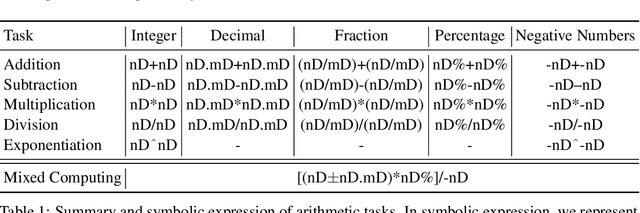
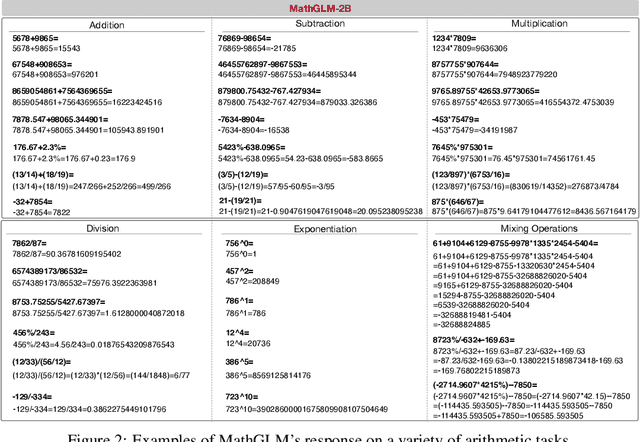
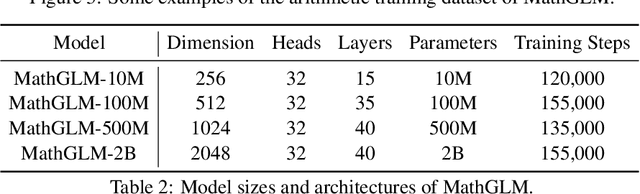
Previous studies have typically assumed that large language models are unable to accurately perform arithmetic operations, particularly multiplication of >8 digits, and operations involving decimals and fractions, without the use of calculator tools. This paper aims to challenge this misconception. With sufficient training data, a 2 billion-parameter language model can accurately perform multi-digit arithmetic operations with almost 100% accuracy without data leakage, significantly surpassing GPT-4 (whose multi-digit multiplication accuracy is only 4.3%). We also demonstrate that our MathGLM, fine-tuned from GLM-10B on a dataset with additional multi-step arithmetic operations and math problems described in text, achieves similar performance to GPT-4 on a 5,000-samples Chinese math problem test set. Our code and data are public at https://github.com/THUDM/MathGLM.