 Add to Chrome
 Add to Firefox
 Add to Edge
How does promoting the minority fraction affect generalization? A theoretical study of the one-hidden-layer neural network on group imbalance
Mar 19, 2024
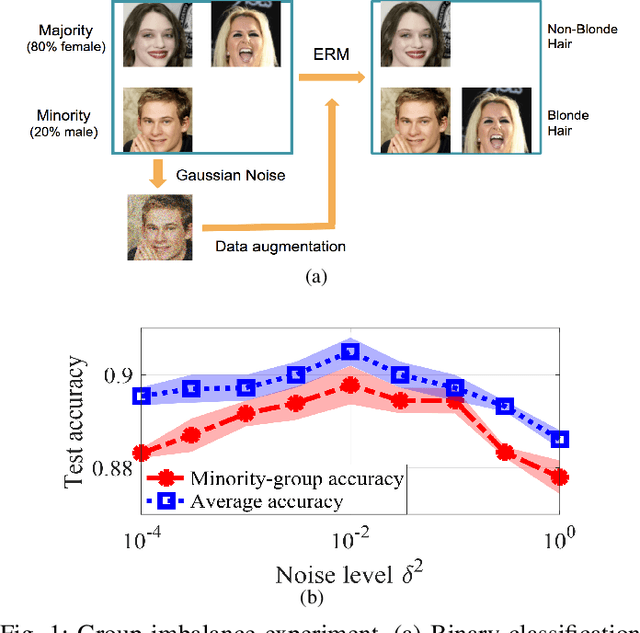
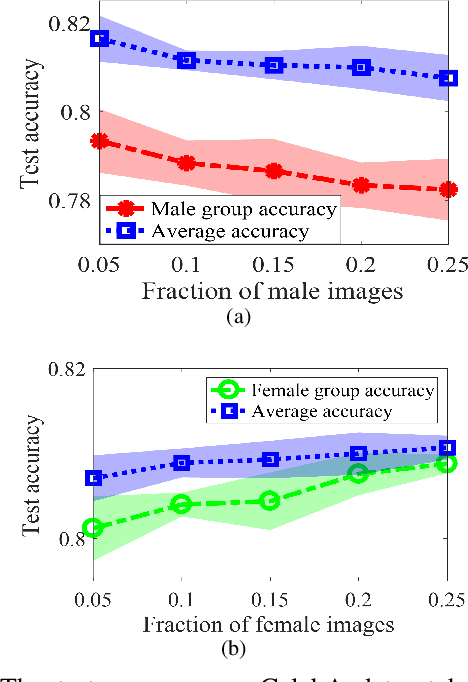
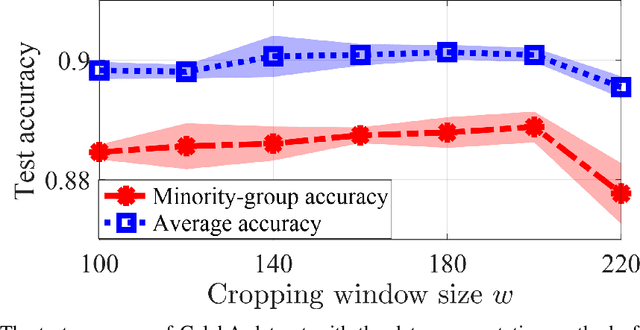
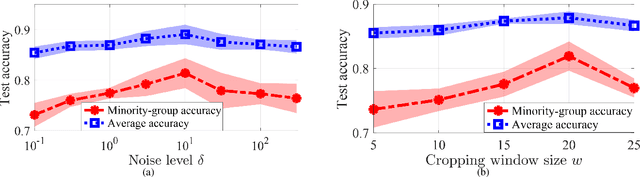
Group imbalance has been a known problem in empirical risk minimization (ERM), where the achieved high average accuracy is accompanied by low accuracy in a minority group. Despite algorithmic efforts to improve the minority group accuracy, a theoretical generalization analysis of ERM on individual groups remains elusive. By formulating the group imbalance problem with the Gaussian Mixture Model, this paper quantifies the impact of individual groups on the sample complexity, the convergence rate, and the average and group-level testing performance. Although our theoretical framework is centered on binary classification using a one-hidden-layer neural network, to the best of our knowledge, we provide the first theoretical analysis of the group-level generalization of ERM in addition to the commonly studied average generalization performance. Sample insights of our theoretical results include that when all group-level co-variance is in the medium regime and all mean are close to zero, the learning performance is most desirable in the sense of a small sample complexity, a fast training rate, and a high average and group-level testing accuracy. Moreover, we show that increasing the fraction of the minority group in the training data does not necessarily improve the generalization performance of the minority group. Our theoretical results are validated on both synthetic and empirical datasets, such as CelebA and CIFAR-10 in image classification.

Training A Small Emotional Vision Language Model for Visual Art Comprehension
Mar 17, 2024This paper develops small vision language models to understand visual art, which, given an art work, aims to identify its emotion category and explain this prediction with natural language. While small models are computationally efficient, their capacity is much limited compared with large models. To break this trade-off, this paper builds a small emotional vision language model (SEVLM) by emotion modeling and input-output feature alignment. On the one hand, based on valence-arousal-dominance (VAD) knowledge annotated by psychology experts, we introduce and fuse emotional features derived through VAD dictionary and a VAD head to align VAD vectors of predicted emotion explanation and the ground truth. This allows the vision language model to better understand and generate emotional texts, compared with using traditional text embeddings alone. On the other hand, we design a contrastive head to pull close embeddings of the image, its emotion class, and explanation, which aligns model outputs and inputs. On two public affective explanation datasets, we show that the proposed techniques consistently improve the visual art understanding performance of baseline SEVLMs. Importantly, the proposed model can be trained and evaluated on a single RTX 2080 Ti while exhibiting very strong performance: it not only outperforms the state-of-the-art small models but is also competitive compared with LLaVA 7B after fine-tuning and GPT4(V).
BlindDiff: Empowering Degradation Modelling in Diffusion Models for Blind Image Super-Resolution
Mar 15, 2024

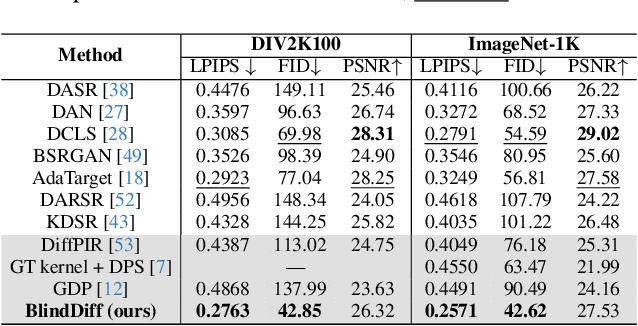

Diffusion models (DM) have achieved remarkable promise in image super-resolution (SR). However, most of them are tailored to solving non-blind inverse problems with fixed known degradation settings, limiting their adaptability to real-world applications that involve complex unknown degradations. In this work, we propose BlindDiff, a DM-based blind SR method to tackle the blind degradation settings in SISR. BlindDiff seamlessly integrates the MAP-based optimization into DMs, which constructs a joint distribution of the low-resolution (LR) observation, high-resolution (HR) data, and degradation kernels for the data and kernel priors, and solves the blind SR problem by unfolding MAP approach along with the reverse process. Unlike most DMs, BlindDiff firstly presents a modulated conditional transformer (MCFormer) that is pre-trained with noise and kernel constraints, further serving as a posterior sampler to provide both priors simultaneously. Then, we plug a simple yet effective kernel-aware gradient term between adjacent sampling iterations that guides the diffusion model to learn degradation consistency knowledge. This also enables to joint refine the degradation model as well as HR images by observing the previous denoised sample. With the MAP-based reverse diffusion process, we show that BlindDiff advocates alternate optimization for blur kernel estimation and HR image restoration in a mutual reinforcing manner. Experiments on both synthetic and real-world datasets show that BlindDiff achieves the state-of-the-art performance with significant model complexity reduction compared to recent DM-based methods. Code will be available at \url{https://github.com/lifengcs/BlindDiff}
Frequency Decoupling for Motion Magnification via Multi-Level Isomorphic Architecture
Mar 12, 2024Video Motion Magnification (VMM) aims to reveal subtle and imperceptible motion information of objects in the macroscopic world. Prior methods directly model the motion field from the Eulerian perspective by Representation Learning that separates shape and texture or Multi-domain Learning from phase fluctuations. Inspired by the frequency spectrum, we observe that the low-frequency components with stable energy always possess spatial structure and less noise, making them suitable for modeling the subtle motion field. To this end, we present FD4MM, a new paradigm of Frequency Decoupling for Motion Magnification with a Multi-level Isomorphic Architecture to capture multi-level high-frequency details and a stable low-frequency structure (motion field) in video space. Since high-frequency details and subtle motions are susceptible to information degradation due to their inherent subtlety and unavoidable external interference from noise, we carefully design Sparse High/Low-pass Filters to enhance the integrity of details and motion structures, and a Sparse Frequency Mixer to promote seamless recoupling. Besides, we innovatively design a contrastive regularization for this task to strengthen the model's ability to discriminate irrelevant features, reducing undesired motion magnification. Extensive experiments on both Real-world and Synthetic Datasets show that our FD4MM outperforms SOTA methods. Meanwhile, FD4MM reduces FLOPs by 1.63$\times$ and boosts inference speed by 1.68$\times$ than the latest method. Our code is available at https://github.com/Jiafei127/FD4MM.
Benchmarking Micro-action Recognition: Dataset, Methods, and Applications
Mar 08, 2024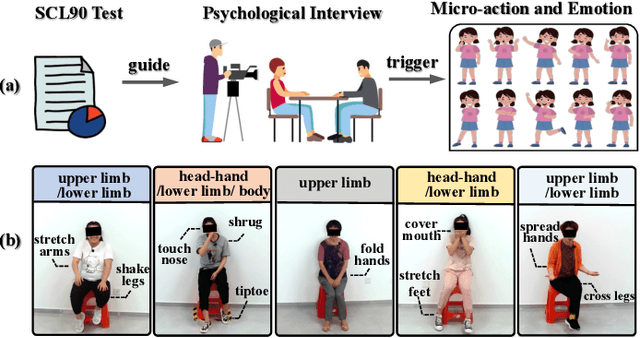
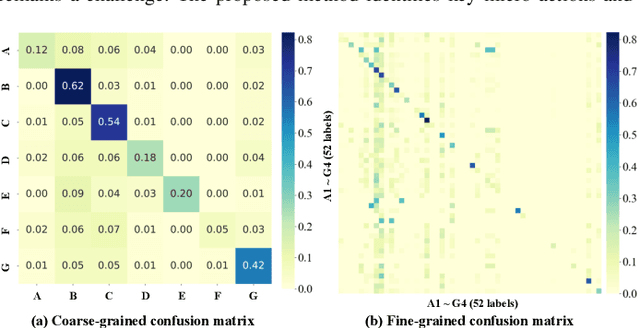
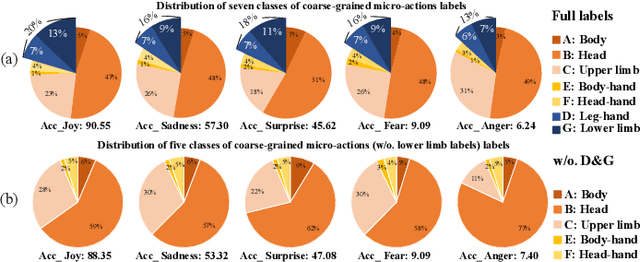
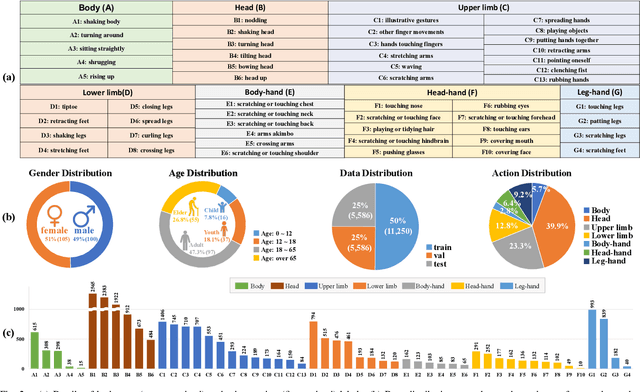
Micro-action is an imperceptible non-verbal behaviour characterised by low-intensity movement. It offers insights into the feelings and intentions of individuals and is important for human-oriented applications such as emotion recognition and psychological assessment. However, the identification, differentiation, and understanding of micro-actions pose challenges due to the imperceptible and inaccessible nature of these subtle human behaviors in everyday life. In this study, we innovatively collect a new micro-action dataset designated as Micro-action-52 (MA-52), and propose a benchmark named micro-action network (MANet) for micro-action recognition (MAR) task. Uniquely, MA-52 provides the whole-body perspective including gestures, upper- and lower-limb movements, attempting to reveal comprehensive micro-action cues. In detail, MA-52 contains 52 micro-action categories along with seven body part labels, and encompasses a full array of realistic and natural micro-actions, accounting for 205 participants and 22,422 video instances collated from the psychological interviews. Based on the proposed dataset, we assess MANet and other nine prevalent action recognition methods. MANet incorporates squeeze-and excitation (SE) and temporal shift module (TSM) into the ResNet architecture for modeling the spatiotemporal characteristics of micro-actions. Then a joint-embedding loss is designed for semantic matching between video and action labels; the loss is used to better distinguish between visually similar yet distinct micro-action categories. The extended application in emotion recognition has demonstrated one of the important values of our proposed dataset and method. In the future, further exploration of human behaviour, emotion, and psychological assessment will be conducted in depth. The dataset and source code are released at https://github.com/VUT-HFUT/Micro-Action.
Learning Dynamic Tetrahedra for High-Quality Talking Head Synthesis
Feb 27, 2024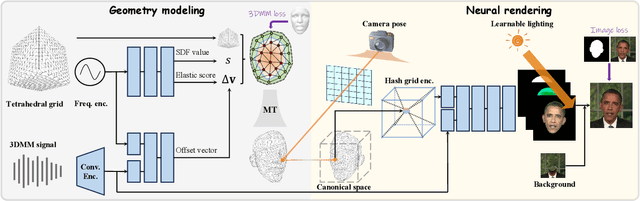
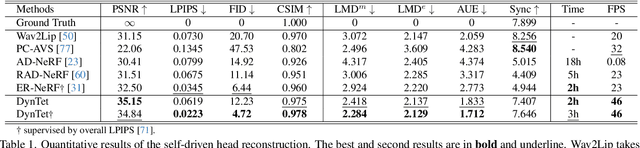
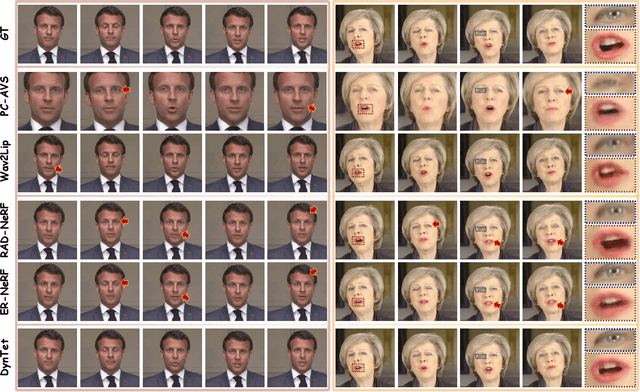
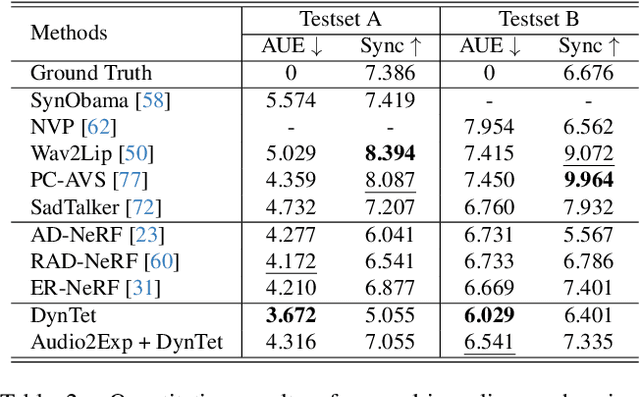
Recent works in implicit representations, such as Neural Radiance Fields (NeRF), have advanced the generation of realistic and animatable head avatars from video sequences. These implicit methods are still confronted by visual artifacts and jitters, since the lack of explicit geometric constraints poses a fundamental challenge in accurately modeling complex facial deformations. In this paper, we introduce Dynamic Tetrahedra (DynTet), a novel hybrid representation that encodes explicit dynamic meshes by neural networks to ensure geometric consistency across various motions and viewpoints. DynTet is parameterized by the coordinate-based networks which learn signed distance, deformation, and material texture, anchoring the training data into a predefined tetrahedra grid. Leveraging Marching Tetrahedra, DynTet efficiently decodes textured meshes with a consistent topology, enabling fast rendering through a differentiable rasterizer and supervision via a pixel loss. To enhance training efficiency, we incorporate classical 3D Morphable Models to facilitate geometry learning and define a canonical space for simplifying texture learning. These advantages are readily achievable owing to the effective geometric representation employed in DynTet. Compared with prior works, DynTet demonstrates significant improvements in fidelity, lip synchronization, and real-time performance according to various metrics. Beyond producing stable and visually appealing synthesis videos, our method also outputs the dynamic meshes which is promising to enable many emerging applications.
Diving Deep into Regions: Exploiting Regional Information Transformer for Single Image Deraining
Feb 25, 2024
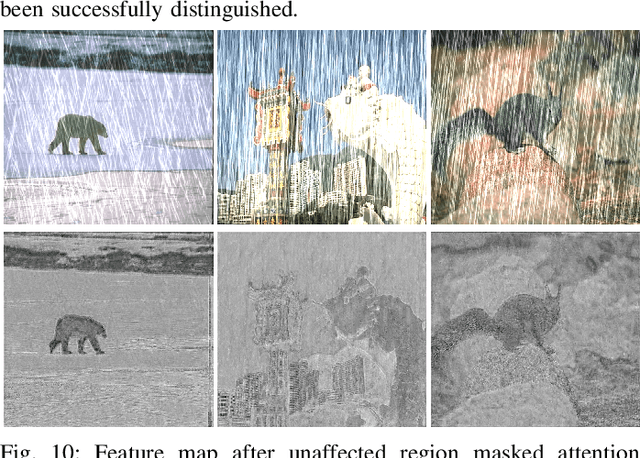
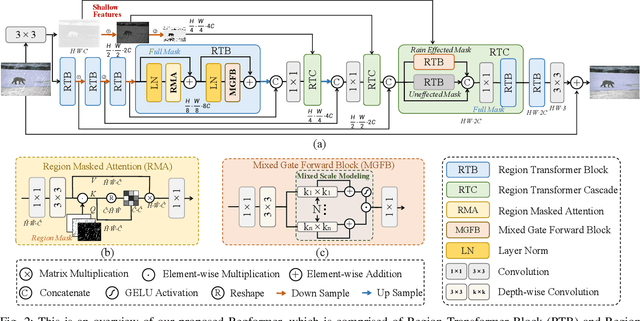
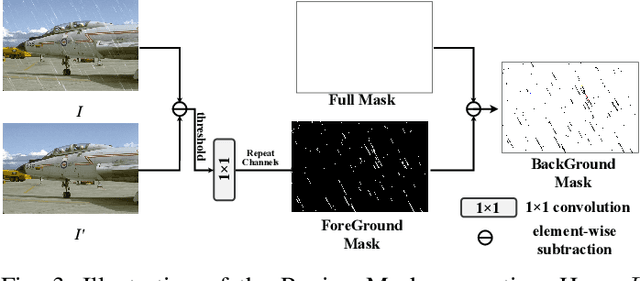
Transformer-based Single Image Deraining (SID) methods have achieved remarkable success, primarily attributed to their robust capability in capturing long-range interactions. However, we've noticed that current methods handle rain-affected and unaffected regions concurrently, overlooking the disparities between these areas, resulting in confusion between rain streaks and background parts, and inabilities to obtain effective interactions, ultimately resulting in suboptimal deraining outcomes. To address the above issue, we introduce the Region Transformer (Regformer), a novel SID method that underlines the importance of independently processing rain-affected and unaffected regions while considering their combined impact for high-quality image reconstruction. The crux of our method is the innovative Region Transformer Block (RTB), which integrates a Region Masked Attention (RMA) mechanism and a Mixed Gate Forward Block (MGFB). Our RTB is used for attention selection of rain-affected and unaffected regions and local modeling of mixed scales. The RMA generates attention maps tailored to these two regions and their interactions, enabling our model to capture comprehensive features essential for rain removal. To better recover high-frequency textures and capture more local details, we develop the MGFB as a compensation module to complete local mixed scale modeling. Extensive experiments demonstrate that our model reaches state-of-the-art performance, significantly improving the image deraining quality. Our code and trained models are publicly available.
Training Nonlinear Transformers for Efficient In-Context Learning: A Theoretical Learning and Generalization Analysis
Feb 23, 2024Transformer-based large language models have displayed impressive in-context learning capabilities, where a pre-trained model can handle new tasks without fine-tuning by simply augmenting the query with some input-output examples from that task. Despite the empirical success, the mechanics of how to train a Transformer to achieve ICL and the corresponding ICL capacity is mostly elusive due to the technical challenges of analyzing the nonconvex training problems resulting from the nonlinear self-attention and nonlinear activation in Transformers. To the best of our knowledge, this paper provides the first theoretical analysis of the training dynamics of Transformers with nonlinear self-attention and nonlinear MLP, together with the ICL generalization capability of the resulting model. Focusing on a group of binary classification tasks, we train Transformers using data from a subset of these tasks and quantify the impact of various factors on the ICL generalization performance on the remaining unseen tasks with and without data distribution shifts. We also analyze how different components in the learned Transformers contribute to the ICL performance. Furthermore, we provide the first theoretical analysis of how model pruning affects the ICL performance and prove that proper magnitude-based pruning can have a minimal impact on ICL while reducing inference costs. These theoretical findings are justified through numerical experiments.
Large Language Model-driven Meta-structure Discovery in Heterogeneous Information Network
Feb 18, 2024


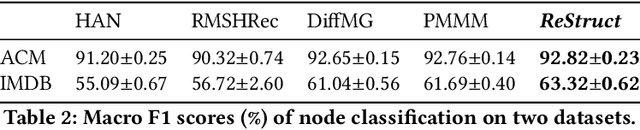
Heterogeneous information networks (HIN) have gained increasing popularity for being able to capture complex relations between nodes of diverse types. Meta-structure was proposed to identify important patterns of relations on HIN, which has been proven effective for extracting rich semantic information and facilitating graph neural networks to learn expressive representations. However, hand-crafted meta-structures pose challenges for scaling up, which draws wide research attention for developing automatic meta-structure search algorithms. Previous efforts concentrate on searching for meta-structures with good empirical prediction performance, overlooking explainability. Thus, they often produce meta-structures prone to overfitting and incomprehensible to humans. To address this, we draw inspiration from the emergent reasoning abilities of large language models (LLMs). We propose a novel REasoning meta-STRUCTure search (ReStruct) framework that integrates LLM reasoning into the evolutionary procedure. ReStruct uses a grammar translator to encode meta-structures into natural language sentences, and leverages the reasoning power of LLMs to evaluate semantically feasible meta-structures. ReStruct also employs performance-oriented evolutionary operations. These two competing forces jointly optimize for semantic explainability and empirical performance of meta-structures. We also design a differential LLM explainer that can produce natural language explanations for the discovered meta-structures, and refine the explanation by reasoning through the search history. Experiments on five datasets demonstrate ReStruct achieve SOTA performance in node classification and link recommendation tasks. Additionally, a survey study involving 73 graduate students shows that the meta-structures and natural language explanations generated by ReStruct are substantially more comprehensible.
Neighborhood-Enhanced Supervised Contrastive Learning for Collaborative Filtering
Feb 18, 2024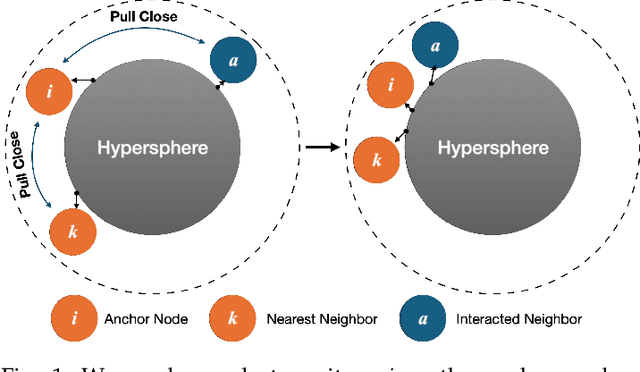

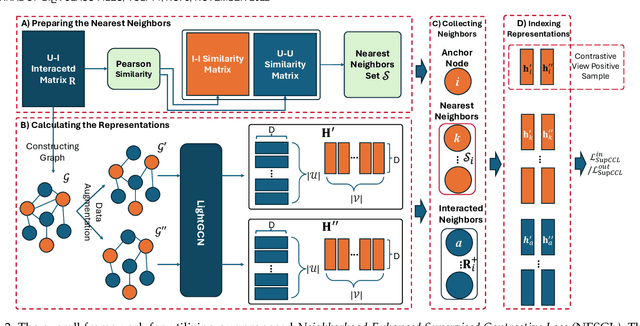
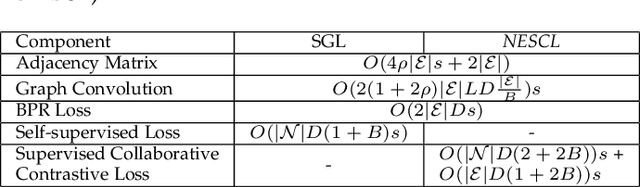
While effective in recommendation tasks, collaborative filtering (CF) techniques face the challenge of data sparsity. Researchers have begun leveraging contrastive learning to introduce additional self-supervised signals to address this. However, this approach often unintentionally distances the target user/item from their collaborative neighbors, limiting its efficacy. In response, we propose a solution that treats the collaborative neighbors of the anchor node as positive samples within the final objective loss function. This paper focuses on developing two unique supervised contrastive loss functions that effectively combine supervision signals with contrastive loss. We analyze our proposed loss functions through the gradient lens, demonstrating that different positive samples simultaneously influence updating the anchor node's embeddings. These samples' impact depends on their similarities to the anchor node and the negative samples. Using the graph-based collaborative filtering model as our backbone and following the same data augmentation methods as the existing contrastive learning model SGL, we effectively enhance the performance of the recommendation model. Our proposed Neighborhood-Enhanced Supervised Contrastive Loss (NESCL) model substitutes the contrastive loss function in SGL with our novel loss function, showing marked performance improvement. On three real-world datasets, Yelp2018, Gowalla, and Amazon-Book, our model surpasses the original SGL by 10.09%, 7.09%, and 35.36% on NDCG@20, respectively.