 Add to Chrome
 Add to Firefox
 Add to Edge
UniPhysGen: Unified Physical Grounding for Simulation-Ready 3D Assets
Jul 15, 2026
Physically grounded 3D assets are increasingly important for embodied AI and robotic simulation. However, most existing 3D assets lack unified physical semantics, including articulation semantics and intrinsic physical properties, required for realistic interaction. Current approaches either treat these semantics independently or rely on canonicalized object structures, limiting robustness across heterogeneous 3D assets. We present UniPhys, a scalable framework for automatically transforming raw 3D assets into simulation-ready assets with unified physical semantics. Based on UniPhys, we construct UniPhys-40K, a large-scale physically grounded dataset, together with UniPhys-Bench, a carefully verified benchmark for unified physical grounding evaluation. We further introduce UniPhysGen, a unified physical grounding model that jointly reasons over articulation semantics and intrinsic physical properties. UniPhysGen incorporates geometry-robust articulation grounding to mitigate geometric shortcut bias under heterogeneous part decompositions. Extensive experiments demonstrate state-of-the-art performance across articulation grounding and intrinsic physical property estimation tasks, while the resulting assets can be directly deployed in robotic simulation environments for realistic physical interaction. Our code and dataset will be available at https://github.com/breezexian/UniPhysGen.

A Minimalist Retargeting-Guided Reinforcement Learning Recipe for Dexterous Manipulation
Jul 13, 2026Recent work in humanoid whole-body control has found success with a simple recipe: retarget human motion to robot kinematic references, then train policies via reinforcement learning (RL) to track them. But how does this recipe transfer to dexterous manipulation? The answer is not obvious, as manipulation involves complex, contact-rich dynamics and requires delicate regulation of contact modes and forces. We present REGRIND, a minimalist retargeting-guided RL pipeline that learns dexterous manipulation policies from a single human demonstration. REGRIND retargets human hand-object motion to a robot reference that preserves hand-object spatial and contact relationships, trains a residual RL policy in simulation to track object-centric keypoints along that reference, and transfers the resulting policy zero-shot to hardware with careful system identification. The resulting policies produce fluid, human-like behavior on two different multi-fingered hands across contact-rich tool-use tasks, including operating a pair of scissors and turning a screwdriver. Through systematic hardware experiments, we identify and analyze the key factors that govern sim-to-real transfer in dexterous manipulation, offering practical guidance for retargeting-based learning in contact-rich settings. Videos and code are available at https://yunhaifeng.com/REGRIND.
Robustness of Robotic Manipulation: Foundations and Frontiers
Jun 30, 2026Humans and animals exhibit remarkable robustness in physical manipulation, yet robots remain far behind. Progress toward human-level manipulation robustness is hindered by the absence of a unified and systematic understanding: different subfields frame robustness in distinct ways, often leaving the concept ambiguous and limiting deeper analysis as well as communication across research areas. This paper presents a systematic study of manipulation robustness. We begin with a formal definition, characterizing robustness as the degree to which a manipulation system can achieve its goal in the presence of uncertainty and variation. Building on this definition, we introduce general formulations of manipulation robustness from probabilistic and control-theoretic perspectives. We then synthesize the guiding principles and concrete mechanisms of manipulation robustness across perception, planning, control, policy learning, and hardware, illustrating each mechanism through representative works, including foundational and recent studies. In addition, we revisit existing metrics and evaluation methods for quantifying manipulation robustness. Finally, we distill broader lessons for designing robust manipulation systems and discuss open problems and future directions toward achieving human-level robustness in robotic manipulation.
Perceptive Humanoid Parkour: Chaining Dynamic Human Skills via Motion Matching
Feb 17, 2026While recent advances in humanoid locomotion have achieved stable walking on varied terrains, capturing the agility and adaptivity of highly dynamic human motions remains an open challenge. In particular, agile parkour in complex environments demands not only low-level robustness, but also human-like motion expressiveness, long-horizon skill composition, and perception-driven decision-making. In this paper, we present Perceptive Humanoid Parkour (PHP), a modular framework that enables humanoid robots to autonomously perform long-horizon, vision-based parkour across challenging obstacle courses. Our approach first leverages motion matching, formulated as nearest-neighbor search in a feature space, to compose retargeted atomic human skills into long-horizon kinematic trajectories. This framework enables the flexible composition and smooth transition of complex skill chains while preserving the elegance and fluidity of dynamic human motions. Next, we train motion-tracking reinforcement learning (RL) expert policies for these composed motions, and distill them into a single depth-based, multi-skill student policy, using a combination of DAgger and RL. Crucially, the combination of perception and skill composition enables autonomous, context-aware decision-making: using only onboard depth sensing and a discrete 2D velocity command, the robot selects and executes whether to step over, climb onto, vault or roll off obstacles of varying geometries and heights. We validate our framework with extensive real-world experiments on a Unitree G1 humanoid robot, demonstrating highly dynamic parkour skills such as climbing tall obstacles up to 1.25m (96% robot height), as well as long-horizon multi-obstacle traversal with closed-loop adaptation to real-time obstacle perturbations.
OmniRetarget: Interaction-Preserving Data Generation for Humanoid Whole-Body Loco-Manipulation and Scene Interaction
Sep 30, 2025A dominant paradigm for teaching humanoid robots complex skills is to retarget human motions as kinematic references to train reinforcement learning (RL) policies. However, existing retargeting pipelines often struggle with the significant embodiment gap between humans and robots, producing physically implausible artifacts like foot-skating and penetration. More importantly, common retargeting methods neglect the rich human-object and human-environment interactions essential for expressive locomotion and loco-manipulation. To address this, we introduce OmniRetarget, an interaction-preserving data generation engine based on an interaction mesh that explicitly models and preserves the crucial spatial and contact relationships between an agent, the terrain, and manipulated objects. By minimizing the Laplacian deformation between the human and robot meshes while enforcing kinematic constraints, OmniRetarget generates kinematically feasible trajectories. Moreover, preserving task-relevant interactions enables efficient data augmentation, from a single demonstration to different robot embodiments, terrains, and object configurations. We comprehensively evaluate OmniRetarget by retargeting motions from OMOMO, LAFAN1, and our in-house MoCap datasets, generating over 8-hour trajectories that achieve better kinematic constraint satisfaction and contact preservation than widely used baselines. Such high-quality data enables proprioceptive RL policies to successfully execute long-horizon (up to 30 seconds) parkour and loco-manipulation skills on a Unitree G1 humanoid, trained with only 5 reward terms and simple domain randomization shared by all tasks, without any learning curriculum.
A New Semidefinite Relaxation for Linear and Piecewise-Affine Optimal Control with Time Scaling
Apr 17, 2025We introduce a semidefinite relaxation for optimal control of linear systems with time scaling. These problems are inherently nonconvex, since the system dynamics involves bilinear products between the discretization time step and the system state and controls. The proposed relaxation is closely related to the standard second-order semidefinite relaxation for quadratic constraints, but we carefully select a subset of the possible bilinear terms and apply a change of variables to achieve empirically tight relaxations while keeping the computational load light. We further extend our method to handle piecewise-affine (PWA) systems by formulating the PWA optimal-control problem as a shortest-path problem in a graph of convex sets (GCS). In this GCS, different paths represent different mode sequences for the PWA system, and the convex sets model the relaxed dynamics within each mode. By combining a tight convex relaxation of the GCS problem with our semidefinite relaxation with time scaling, we can solve PWA optimal-control problems through a single semidefinite program.
Physics-Driven Data Generation for Contact-Rich Manipulation via Trajectory Optimization
Feb 27, 2025


We present a low-cost data generation pipeline that integrates physics-based simulation, human demonstrations, and model-based planning to efficiently generate large-scale, high-quality datasets for contact-rich robotic manipulation tasks. Starting with a small number of embodiment-flexible human demonstrations collected in a virtual reality simulation environment, the pipeline refines these demonstrations using optimization-based kinematic retargeting and trajectory optimization to adapt them across various robot embodiments and physical parameters. This process yields a diverse, physically consistent dataset that enables cross-embodiment data transfer, and offers the potential to reuse legacy datasets collected under different hardware configurations or physical parameters. We validate the pipeline's effectiveness by training diffusion policies from the generated datasets for challenging contact-rich manipulation tasks across multiple robot embodiments, including a floating Allegro hand and bimanual robot arms. The trained policies are deployed zero-shot on hardware for bimanual iiwa arms, achieving high success rates with minimal human input. Project website: https://lujieyang.github.io/physicsgen/.
Lyapunov-stable Neural Control for State and Output Feedback: A Novel Formulation for Efficient Synthesis and Verification
Apr 11, 2024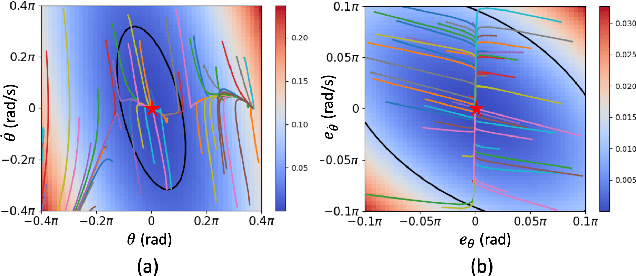
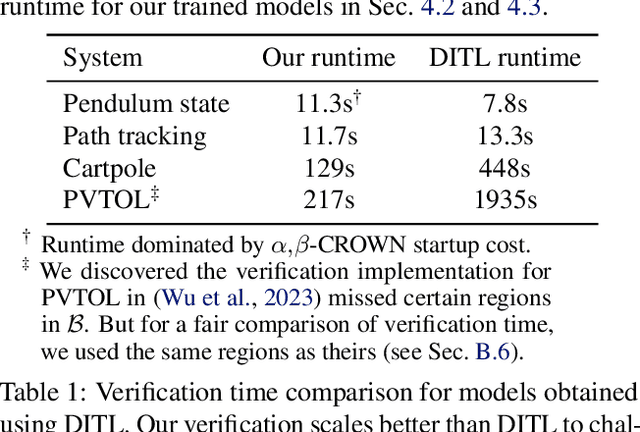
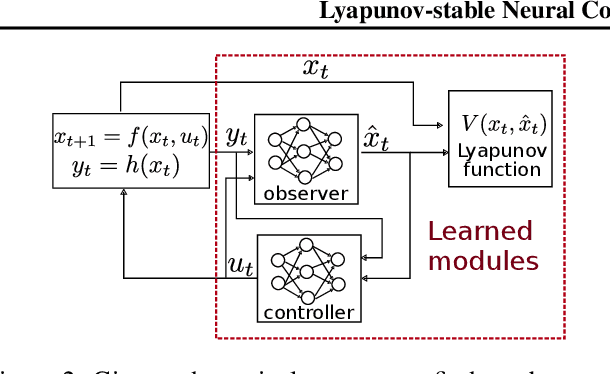
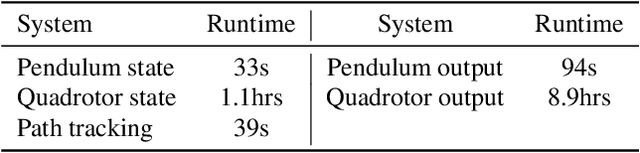
Learning-based neural network (NN) control policies have shown impressive empirical performance in a wide range of tasks in robotics and control. However, formal (Lyapunov) stability guarantees over the region-of-attraction (ROA) for NN controllers with nonlinear dynamical systems are challenging to obtain, and most existing approaches rely on expensive solvers such as sums-of-squares (SOS), mixed-integer programming (MIP), or satisfiability modulo theories (SMT). In this paper, we demonstrate a new framework for learning NN controllers together with Lyapunov certificates using fast empirical falsification and strategic regularizations. We propose a novel formulation that defines a larger verifiable region-of-attraction (ROA) than shown in the literature, and refines the conventional restrictive constraints on Lyapunov derivatives to focus only on certifiable ROAs. The Lyapunov condition is rigorously verified post-hoc using branch-and-bound with scalable linear bound propagation-based NN verification techniques. The approach is efficient and flexible, and the full training and verification procedure is accelerated on GPUs without relying on expensive solvers for SOS, MIP, nor SMT. The flexibility and efficiency of our framework allow us to demonstrate Lyapunov-stable output feedback control with synthesized NN-based controllers and NN-based observers with formal stability guarantees, for the first time in literature. Source code at https://github.com/Verified-Intelligence/Lyapunov_Stable_NN_Controllers.
Fighting Uncertainty with Gradients: Offline Reinforcement Learning via Diffusion Score Matching
Jun 24, 2023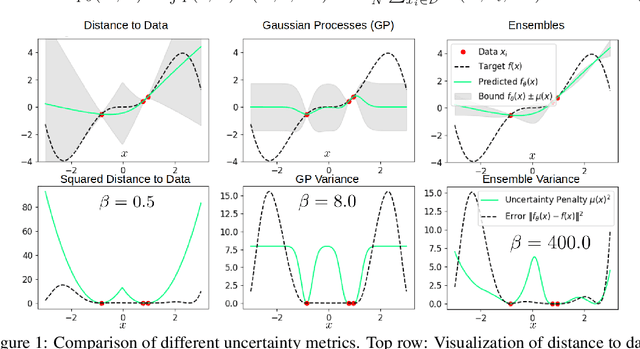
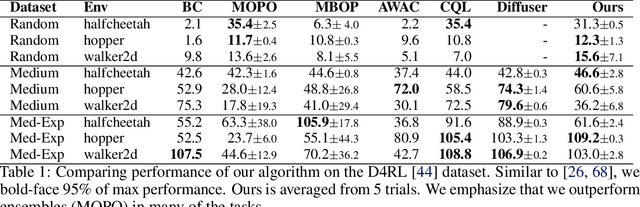
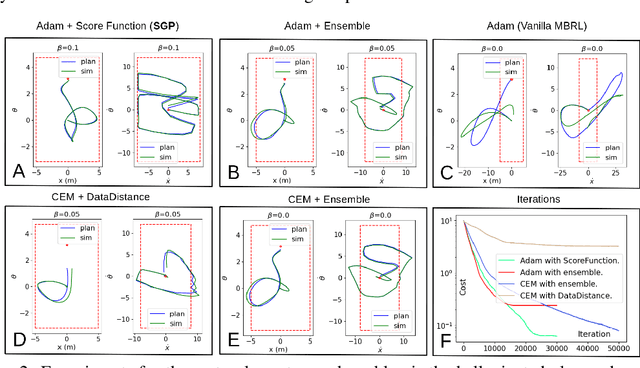

Offline optimization paradigms such as offline Reinforcement Learning (RL) or Imitation Learning (IL) allow policy search algorithms to make use of offline data, but require careful incorporation of uncertainty in order to circumvent the challenges of distribution shift. Gradient-based policy search methods are a promising direction due to their effectiveness in high dimensions; however, we require a more careful consideration of how these methods interplay with uncertainty estimation. We claim that in order for an uncertainty metric to be amenable for gradient-based optimization, it must be (i) stably convergent to data when uncertainty is minimized with gradients, and (ii) not prone to underestimation of true uncertainty. We investigate smoothed distance to data as a metric, and show that it not only stably converges to data, but also allows us to analyze model bias with Lipschitz constants. Moreover, we establish an equivalence between smoothed distance to data and data likelihood, which allows us to use score-matching techniques to learn gradients of distance to data. Importantly, we show that offline model-based policy search problems that maximize data likelihood do not require values of likelihood; but rather only the gradient of the log likelihood (the score function). Using this insight, we propose Score-Guided Planning (SGP), a planning algorithm for offline RL that utilizes score-matching to enable first-order planning in high-dimensional problems, where zeroth-order methods were unable to scale, and ensembles were unable to overcome local minima. Website: https://sites.google.com/view/score-guided-planning/home
Suboptimal Controller Synthesis for Cart-Poles and Quadrotors via Sums-of-Squares
Apr 25, 2023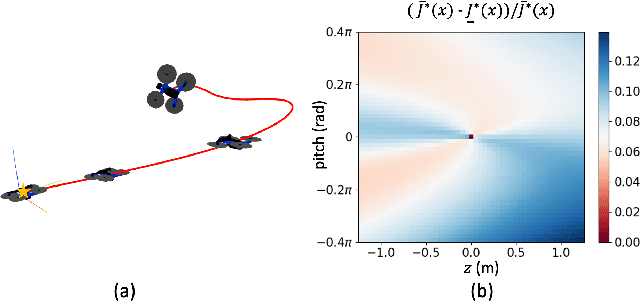
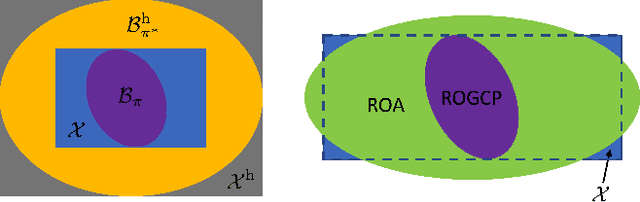
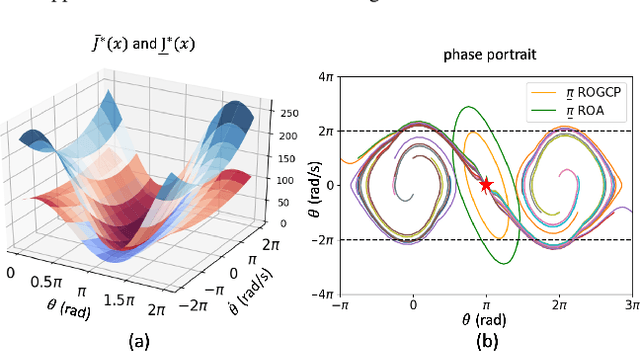
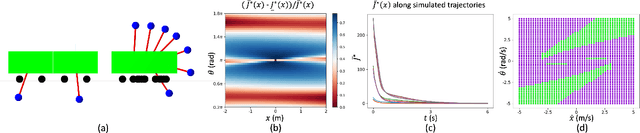
Sums-of-squares (SOS) optimization is a promising tool to synthesize certifiable controllers, but most examples to date have been limited to relatively simple systems. Here we demonstrate that SOS can synthesize controllers with bounded suboptimal performance for various underactuated robotic systems by finding good approximations of the value function. We summarize a unified SOS framework to synthesize both under- and over- approximations of the value function for continuous-time, control-affine systems, use these approximations to generate suboptimal controllers, and perform regional analysis on the closed-loop system driven by these controllers. We then extend the formulation to handle hybrid systems with contacts. We demonstrate that our method can generate tight under- and over- approximations of the value function with low-degree polynomials, which are used to provide stabilizing controllers for continuous-time systems including the inverted pendulum, the cart-pole, and the 3D quadrotor as well as a hybrid system, the planar pusher. To the best of our knowledge, this is the first time that a SOS-based time-invariant controller can swing up and stabilize a cart-pole, and push the planar slider to the desired pose.