 Add to Chrome
 Add to Firefox
 Add to Edge
3UR-LLM: An End-to-End Multimodal Large Language Model for 3D Scene Understanding
Jan 14, 2025
Multi-modal Large Language Models (MLLMs) exhibit impressive capabilities in 2D tasks, yet encounter challenges in discerning the spatial positions, interrelations, and causal logic in scenes when transitioning from 2D to 3D representations. We find that the limitations mainly lie in: i) the high annotation cost restricting the scale-up of volumes of 3D scene data, and ii) the lack of a straightforward and effective way to perceive 3D information which results in prolonged training durations and complicates the streamlined framework. To this end, we develop pipeline based on open-source 2D MLLMs and LLMs to generate high-quality 3D-text pairs and construct 3DS-160K , to enhance the pre-training process. Leveraging this high-quality pre-training data, we introduce the 3UR-LLM model, an end-to-end 3D MLLM designed for precise interpretation of 3D scenes, showcasing exceptional capability in navigating the complexities of the physical world. 3UR-LLM directly receives 3D point cloud as input and project 3D features fused with text instructions into a manageable set of tokens. Considering the computation burden derived from these hybrid tokens, we design a 3D compressor module to cohesively compress the 3D spatial cues and textual narrative. 3UR-LLM achieves promising performance with respect to the previous SOTAs, for instance, 3UR-LLM exceeds its counterparts by 7.1\% CIDEr on ScanQA, while utilizing fewer training resources. The code and model weights for 3UR-LLM and the 3DS-160K benchmark are available at 3UR-LLM.

AVS-Mamba: Exploring Temporal and Multi-modal Mamba for Audio-Visual Segmentation
Jan 14, 2025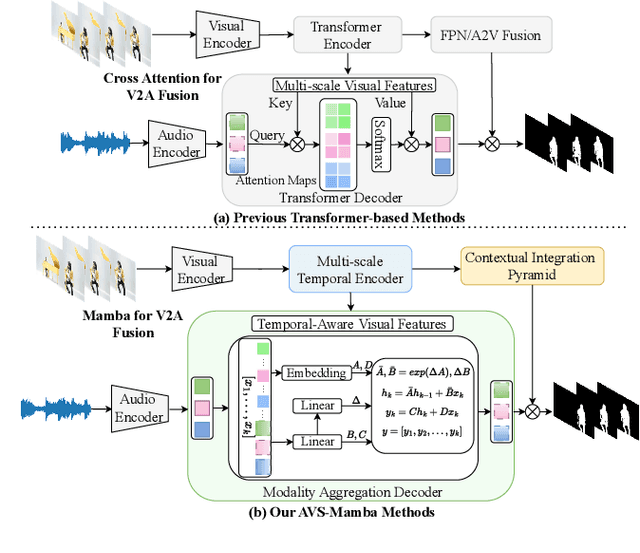


The essence of audio-visual segmentation (AVS) lies in locating and delineating sound-emitting objects within a video stream. While Transformer-based methods have shown promise, their handling of long-range dependencies struggles due to quadratic computational costs, presenting a bottleneck in complex scenarios. To overcome this limitation and facilitate complex multi-modal comprehension with linear complexity, we introduce AVS-Mamba, a selective state space model to address the AVS task. Our framework incorporates two key components for video understanding and cross-modal learning: Temporal Mamba Block for sequential video processing and Vision-to-Audio Fusion Block for advanced audio-vision integration. Building on this, we develop the Multi-scale Temporal Encoder, aimed at enhancing the learning of visual features across scales, facilitating the perception of intra- and inter-frame information. To perform multi-modal fusion, we propose the Modality Aggregation Decoder, leveraging the Vision-to-Audio Fusion Block to integrate visual features into audio features across both frame and temporal levels. Further, we adopt the Contextual Integration Pyramid to perform audio-to-vision spatial-temporal context collaboration. Through these innovative contributions, our approach achieves new state-of-the-art results on the AVSBench-object and AVSBench-semantic datasets. Our source code and model weights are available at AVS-Mamba.
Evaluating Human Perception of Novel View Synthesis: Subjective Quality Assessment of Gaussian Splatting and NeRF in Dynamic Scenes
Jan 13, 2025Gaussian Splatting (GS) and Neural Radiance Fields (NeRF) are two groundbreaking technologies that have revolutionized the field of Novel View Synthesis (NVS), enabling immersive photorealistic rendering and user experiences by synthesizing multiple viewpoints from a set of images of sparse views. The potential applications of NVS, such as high-quality virtual and augmented reality, detailed 3D modeling, and realistic medical organ imaging, underscore the importance of quality assessment of NVS methods from the perspective of human perception. Although some previous studies have explored subjective quality assessments for NVS technology, they still face several challenges, especially in NVS methods selection, scenario coverage, and evaluation methodology. To address these challenges, we conducted two subjective experiments for the quality assessment of NVS technologies containing both GS-based and NeRF-based methods, focusing on dynamic and real-world scenes. This study covers 360{\deg}, front-facing, and single-viewpoint videos while providing a richer and greater number of real scenes. Meanwhile, it's the first time to explore the impact of NVS methods in dynamic scenes with moving objects. The two types of subjective experiments help to fully comprehend the influences of different viewing paths from a human perception perspective and pave the way for future development of full-reference and no-reference quality metrics. In addition, we established a comprehensive benchmark of various state-of-the-art objective metrics on the proposed database, highlighting that existing methods still struggle to accurately capture subjective quality. The results give us some insights into the limitations of existing NVS methods and may promote the development of new NVS methods.
Large Language Models for Bioinformatics
Jan 10, 2025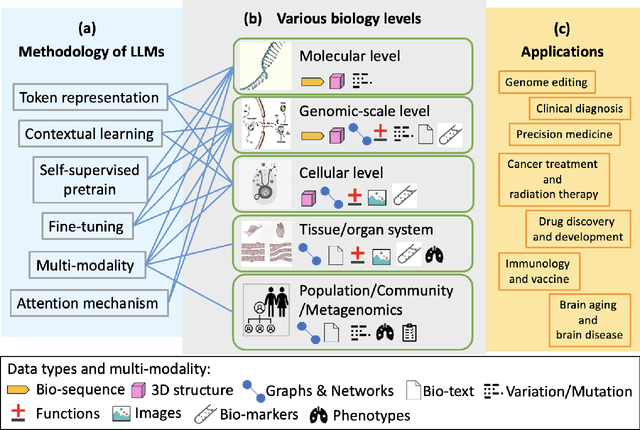
With the rapid advancements in large language model (LLM) technology and the emergence of bioinformatics-specific language models (BioLMs), there is a growing need for a comprehensive analysis of the current landscape, computational characteristics, and diverse applications. This survey aims to address this need by providing a thorough review of BioLMs, focusing on their evolution, classification, and distinguishing features, alongside a detailed examination of training methodologies, datasets, and evaluation frameworks. We explore the wide-ranging applications of BioLMs in critical areas such as disease diagnosis, drug discovery, and vaccine development, highlighting their impact and transformative potential in bioinformatics. We identify key challenges and limitations inherent in BioLMs, including data privacy and security concerns, interpretability issues, biases in training data and model outputs, and domain adaptation complexities. Finally, we highlight emerging trends and future directions, offering valuable insights to guide researchers and clinicians toward advancing BioLMs for increasingly sophisticated biological and clinical applications.
From Dense to Sparse: Event Response for Enhanced Residential Load Forecasting
Jan 08, 2025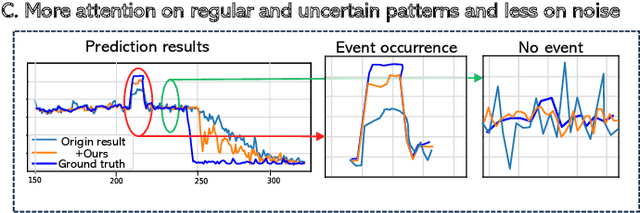


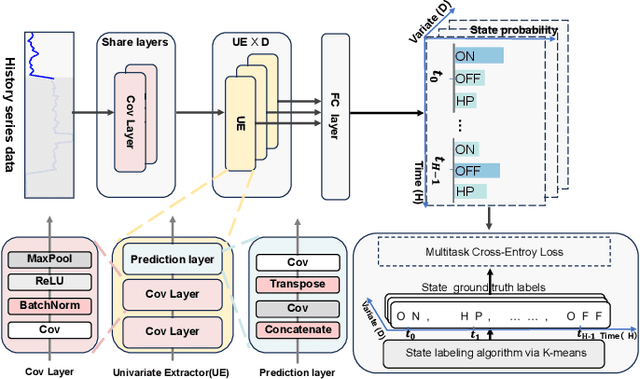
Residential load forecasting (RLF) is crucial for resource scheduling in power systems. Most existing methods utilize all given load records (dense data) to indiscriminately extract the dependencies between historical and future time series. However, there exist important regular patterns residing in the event-related associations among different appliances (sparse knowledge), which have yet been ignored. In this paper, we propose an Event-Response Knowledge Guided approach (ERKG) for RLF by incorporating the estimation of electricity usage events for different appliances, mining event-related sparse knowledge from the load series. With ERKG, the event-response estimation enables portraying the electricity consumption behaviors of residents, revealing regular variations in appliance operational states. To be specific, ERKG consists of knowledge extraction and guidance: i) a forecasting model is designed for the electricity usage events by estimating appliance operational states, aiming to extract the event-related sparse knowledge; ii) a novel knowledge-guided mechanism is established by fusing such state estimates of the appliance events into the RLF model, which can give particular focuses on the patterns of users' electricity consumption behaviors. Notably, ERKG can flexibly serve as a plug-in module to boost the capability of existing forecasting models by leveraging event response. In numerical experiments, extensive comparisons and ablation studies have verified the effectiveness of our ERKG, e.g., over 8% MAE can be reduced on the tested state-of-the-art forecasting models.
SAT-LDM: Provably Generalizable Image Watermarking for Latent Diffusion Models with Self-Augmented Training
Dec 31, 2024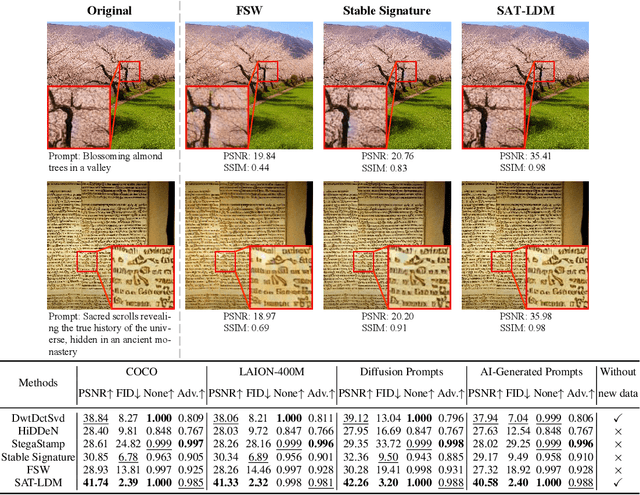
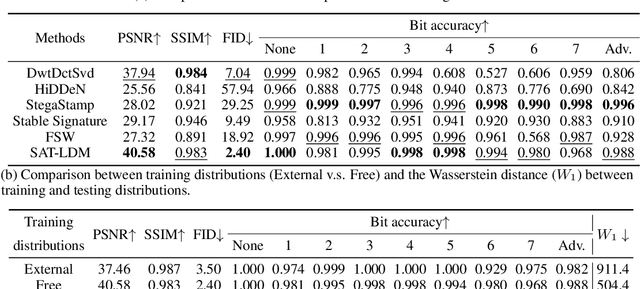
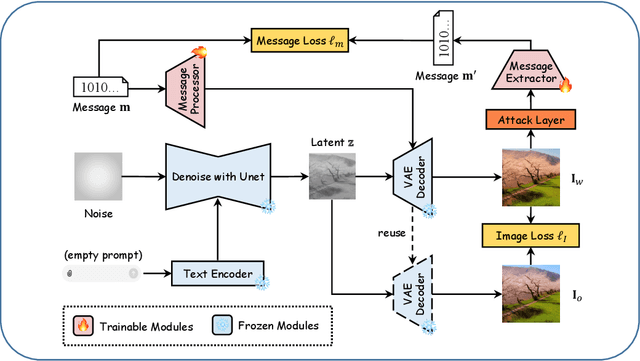
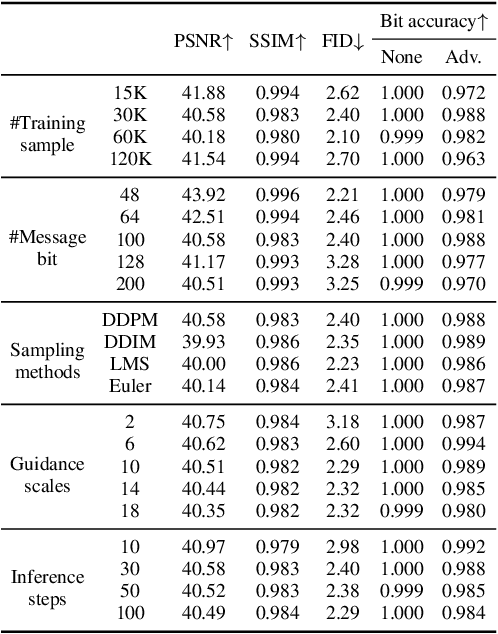
The proliferation of AI-generated images necessitates effective watermarking to protect intellectual property and identify fake content. While existing training-based watermarking methods show promise, they often struggle with generalization across diverse prompts and tend to produce noticeable artifacts. To this end, we introduce a provably generalizable image watermarking method for Latent Diffusion Models with Self-Augmented Training (SAT-LDM), which aligns the training and testing phases by a free generation distribution to bolster the watermarking module's generalization capabilities. We theoretically consolidate our method by proving that the free generation distribution contributes to its tight generalization bound without the need to collect new data. Extensive experimental results show that SAT-LDM achieves robust watermarking while significantly improving the quality of watermarked images across diverse prompts. Furthermore, we conduct experimental analyses to demonstrate the strong generalization abilities of SAT-LDM. We hope our method offers a practical and convenient solution for securing high-fidelity AI-generated content.
MRP-LLM: Multitask Reflective Large Language Models for Privacy-Preserving Next POI Recommendation
Dec 03, 2024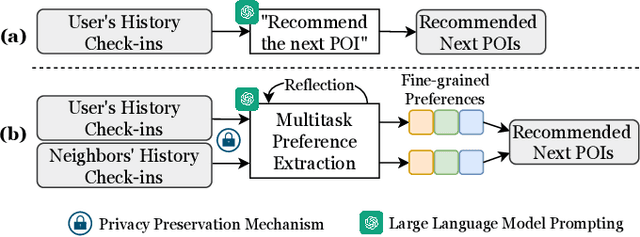
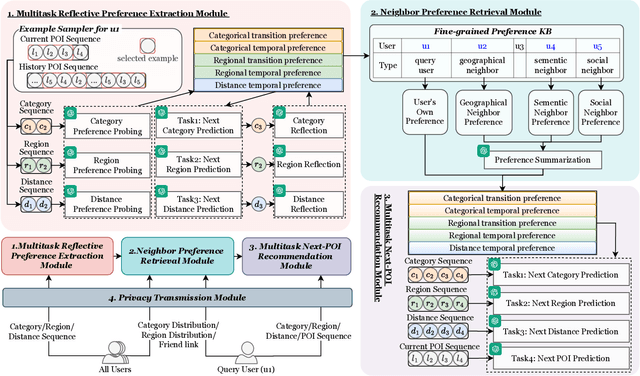
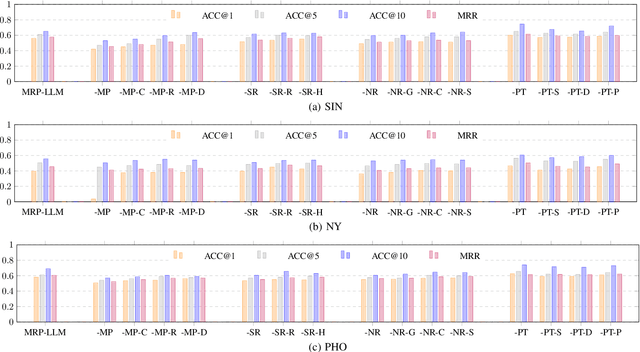
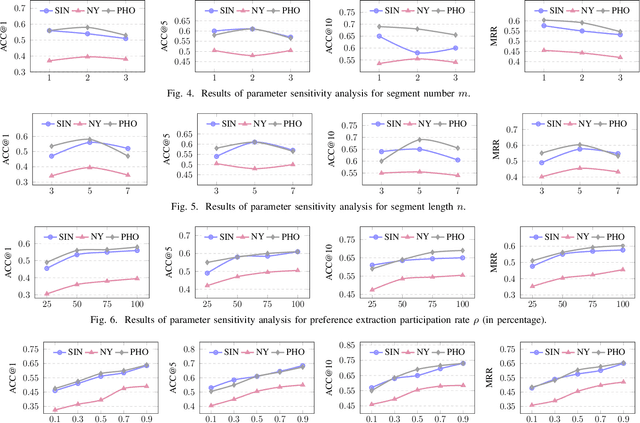
Large language models (LLMs) have shown promising potential for next Point-of-Interest (POI) recommendation. However, existing methods only perform direct zero-shot prompting, leading to ineffective extraction of user preferences, insufficient injection of collaborative signals, and a lack of user privacy protection. As such, we propose a novel Multitask Reflective Large Language Model for Privacy-preserving Next POI Recommendation (MRP-LLM), aiming to exploit LLMs for better next POI recommendation while preserving user privacy. Specifically, the Multitask Reflective Preference Extraction Module first utilizes LLMs to distill each user's fine-grained (i.e., categorical, temporal, and spatial) preferences into a knowledge base (KB). The Neighbor Preference Retrieval Module retrieves and summarizes the preferences of similar users from the KB to obtain collaborative signals. Subsequently, aggregating the user's preferences with those of similar users, the Multitask Next POI Recommendation Module generates the next POI recommendations via multitask prompting. Meanwhile, during data collection, a Privacy Transmission Module is specifically devised to preserve sensitive POI data. Extensive experiments on three real-world datasets demonstrate the efficacy of our proposed MRP-LLM in providing more accurate next POI recommendations with user privacy preserved.
Bootstraping Clustering of Gaussians for View-consistent 3D Scene Understanding
Nov 29, 2024Injecting semantics into 3D Gaussian Splatting (3DGS) has recently garnered significant attention. While current approaches typically distill 3D semantic features from 2D foundational models (e.g., CLIP and SAM) to facilitate novel view segmentation and semantic understanding, their heavy reliance on 2D supervision can undermine cross-view semantic consistency and necessitate complex data preparation processes, therefore hindering view-consistent scene understanding. In this work, we present FreeGS, an unsupervised semantic-embedded 3DGS framework that achieves view-consistent 3D scene understanding without the need for 2D labels. Instead of directly learning semantic features, we introduce the IDentity-coupled Semantic Field (IDSF) into 3DGS, which captures both semantic representations and view-consistent instance indices for each Gaussian. We optimize IDSF with a two-step alternating strategy: semantics help to extract coherent instances in 3D space, while the resulting instances regularize the injection of stable semantics from 2D space. Additionally, we adopt a 2D-3D joint contrastive loss to enhance the complementarity between view-consistent 3D geometry and rich semantics during the bootstrapping process, enabling FreeGS to uniformly perform tasks such as novel-view semantic segmentation, object selection, and 3D object detection. Extensive experiments on LERF-Mask, 3D-OVS, and ScanNet datasets demonstrate that FreeGS performs comparably to state-of-the-art methods while avoiding the complex data preprocessing workload.
DreamMix: Decoupling Object Attributes for Enhanced Editability in Customized Image Inpainting
Nov 26, 2024Subject-driven image inpainting has emerged as a popular task in image editing alongside recent advancements in diffusion models. Previous methods primarily focus on identity preservation but struggle to maintain the editability of inserted objects. In response, this paper introduces DreamMix, a diffusion-based generative model adept at inserting target objects into given scenes at user-specified locations while concurrently enabling arbitrary text-driven modifications to their attributes. In particular, we leverage advanced foundational inpainting models and introduce a disentangled local-global inpainting framework to balance precise local object insertion with effective global visual coherence. Additionally, we propose an Attribute Decoupling Mechanism (ADM) and a Textual Attribute Substitution (TAS) module to improve the diversity and discriminative capability of the text-based attribute guidance, respectively. Extensive experiments demonstrate that DreamMix effectively balances identity preservation and attribute editability across various application scenarios, including object insertion, attribute editing, and small object inpainting. Our code is publicly available at https://github.com/mycfhs/DreamMix.
Towards Next-Generation Medical Agent: How o1 is Reshaping Decision-Making in Medical Scenarios
Nov 16, 2024

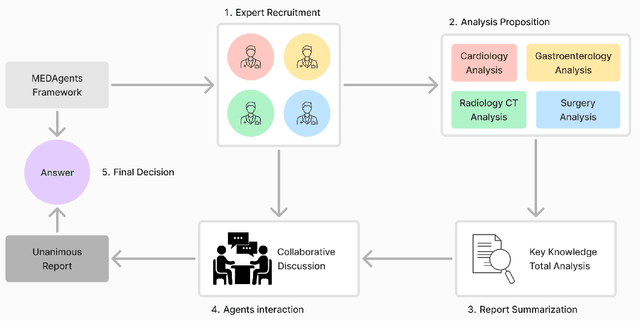

Artificial Intelligence (AI) has become essential in modern healthcare, with large language models (LLMs) offering promising advances in clinical decision-making. Traditional model-based approaches, including those leveraging in-context demonstrations and those with specialized medical fine-tuning, have demonstrated strong performance in medical language processing but struggle with real-time adaptability, multi-step reasoning, and handling complex medical tasks. Agent-based AI systems address these limitations by incorporating reasoning traces, tool selection based on context, knowledge retrieval, and both short- and long-term memory. These additional features enable the medical AI agent to handle complex medical scenarios where decision-making should be built on real-time interaction with the environment. Therefore, unlike conventional model-based approaches that treat medical queries as isolated questions, medical AI agents approach them as complex tasks and behave more like human doctors. In this paper, we study the choice of the backbone LLM for medical AI agents, which is the foundation for the agent's overall reasoning and action generation. In particular, we consider the emergent o1 model and examine its impact on agents' reasoning, tool-use adaptability, and real-time information retrieval across diverse clinical scenarios, including high-stakes settings such as intensive care units (ICUs). Our findings demonstrate o1's ability to enhance diagnostic accuracy and consistency, paving the way for smarter, more responsive AI tools that support better patient outcomes and decision-making efficacy in clinical practice.