 Add to Chrome
 Add to Firefox
 Add to Edge
Memento: Reconstruct to Remember for Consistent Long Video Generation
Jun 12, 2026
Long-form video generation requires recurring subjects to remain consistent across various shots, viewpoints, motions, and scene transitions. Existing temporal decomposition methods improve scalability by generating videos shot by shot. However, they mainly focus on optimizing plausible next-shot continuations without verifying whether the historical memory preserves identity-critical subject evidence. Consequently, as generation proceeds, recurring subjects may be diluted, overwritten, or forgotten. In this paper, we propose Memento, a subject-reconstruction-guided framework that treats subject preservation as an explicit identity grounding problem, based on the premise that a memory bank faithfully preserving a subject should support reconstructing that subject from memory alone. Specifically, Memento jointly trains autoregressive next-shot generation with memory-based subject reconstruction, recovering target appearances using historical memory and global story captions. To disentangle long-range subject evidence from short-range cues, Memento introduces a dual-query memory mechanism, where one query retrieves identity-relevant memory and the other selects short-context keyframes for coherent continuation. Additionally, a subject-aware cinematic data pipeline provides precise reconstruction supervision via consistent, pronoun-free subject descriptions. Experiments demonstrate that Memento achieves state-of-the-art performance in long-term subject consistency, cross-shot coherence, and visual quality.

Native Audio-Visual Alignment for Generation
May 28, 2026Joint audio-video generation aims to synthesize temporally synchronized and semantically coherent visual-acoustic content. However, existing open-source methods mainly rely on either dual-tower designs with posterior alignment or fully unified tri-modal designs that mix textual context, audio and video in one shared space. The former weakens fine-grained audio-video co-evolution, while the latter couples semantic conditioning with low-level synchronization. To address these limitations, we propose NAVA, a Native Audio-Visual Alignment framework for joint audio-video generation. NAVA is built upon context-conditioned native audio-visual alignment: it first establishes audio-video correspondence in a dedicated interaction space, and then uses external context to condition the joint denoising process. Specifically, NAVA is instantiated with an Align-then-Fuse MMDiT architecture, which transitions from modality-aware audio-video alignment to modality-shared joint denoising. Furthermore, we introduce Timbre-in-Context Conditioning to associate reference timbre cues with corresponding speech spans to achieve controllable speech timbre. Experiments on Verse-Bench and Seed-TTS, together with a user study, demonstrate that NAVA achieves superior video quality, precise audio-visual synchronization, competitive audio quality, and stronger reference-timbre controllability using only 6.3B parameters.
ERNIE 5.0 Technical Report
Feb 04, 2026In this report, we introduce ERNIE 5.0, a natively autoregressive foundation model desinged for unified multimodal understanding and generation across text, image, video, and audio. All modalities are trained from scratch under a unified next-group-of-tokens prediction objective, based on an ultra-sparse mixture-of-experts (MoE) architecture with modality-agnostic expert routing. To address practical challenges in large-scale deployment under diverse resource constraints, ERNIE 5.0 adopts a novel elastic training paradigm. Within a single pre-training run, the model learns a family of sub-models with varying depths, expert capacities, and routing sparsity, enabling flexible trade-offs among performance, model size, and inference latency in memory- or time-constrained scenarios. Moreover, we systematically address the challenges of scaling reinforcement learning to unified foundation models, thereby guaranteeing efficient and stable post-training under ultra-sparse MoE architectures and diverse multimodal settings. Extensive experiments demonstrate that ERNIE 5.0 achieves strong and balanced performance across multiple modalities. To the best of our knowledge, among publicly disclosed models, ERNIE 5.0 represents the first production-scale realization of a trillion-parameter unified autoregressive model that supports both multimodal understanding and generation. To facilitate further research, we present detailed visualizations of modality-agnostic expert routing in the unified model, alongside comprehensive empirical analysis of elastic training, aiming to offer profound insights to the community.
VideoAR: Autoregressive Video Generation via Next-Frame & Scale Prediction
Jan 09, 2026Recent advances in video generation have been dominated by diffusion and flow-matching models, which produce high-quality results but remain computationally intensive and difficult to scale. In this work, we introduce VideoAR, the first large-scale Visual Autoregressive (VAR) framework for video generation that combines multi-scale next-frame prediction with autoregressive modeling. VideoAR disentangles spatial and temporal dependencies by integrating intra-frame VAR modeling with causal next-frame prediction, supported by a 3D multi-scale tokenizer that efficiently encodes spatio-temporal dynamics. To improve long-term consistency, we propose Multi-scale Temporal RoPE, Cross-Frame Error Correction, and Random Frame Mask, which collectively mitigate error propagation and stabilize temporal coherence. Our multi-stage pretraining pipeline progressively aligns spatial and temporal learning across increasing resolutions and durations. Empirically, VideoAR achieves new state-of-the-art results among autoregressive models, improving FVD on UCF-101 from 99.5 to 88.6 while reducing inference steps by over 10x, and reaching a VBench score of 81.74-competitive with diffusion-based models an order of magnitude larger. These results demonstrate that VideoAR narrows the performance gap between autoregressive and diffusion paradigms, offering a scalable, efficient, and temporally consistent foundation for future video generation research.
PoseTraj: Pose-Aware Trajectory Control in Video Diffusion
Mar 20, 2025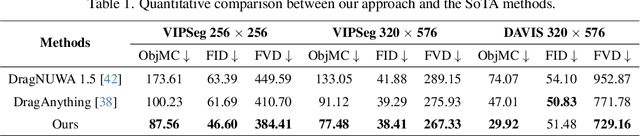
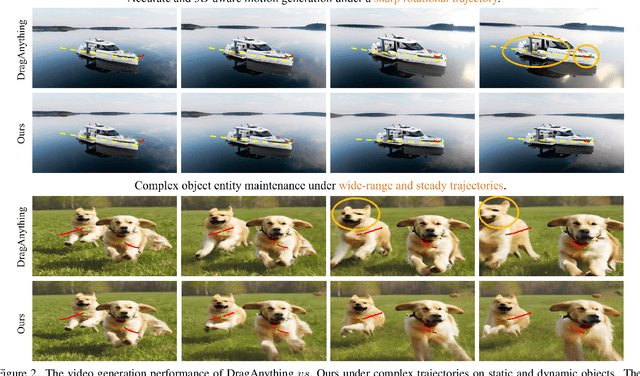
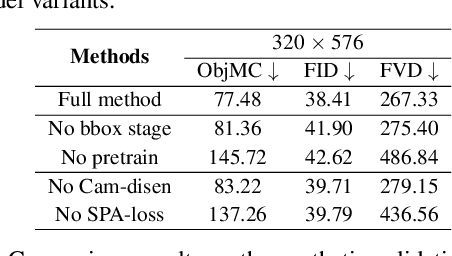
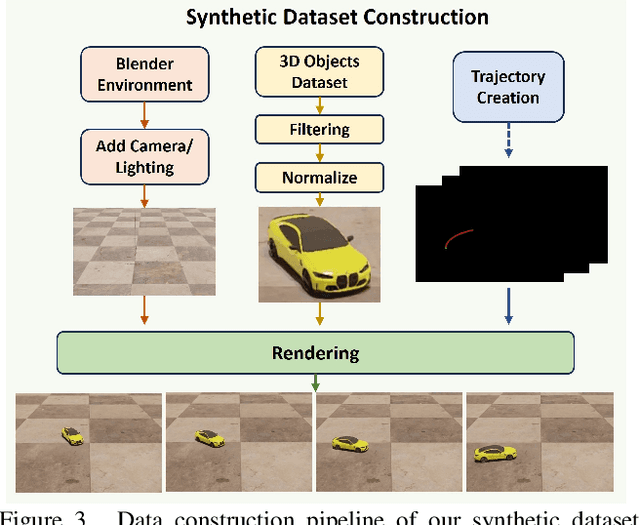
Recent advancements in trajectory-guided video generation have achieved notable progress. However, existing models still face challenges in generating object motions with potentially changing 6D poses under wide-range rotations, due to limited 3D understanding. To address this problem, we introduce PoseTraj, a pose-aware video dragging model for generating 3D-aligned motion from 2D trajectories. Our method adopts a novel two-stage pose-aware pretraining framework, improving 3D understanding across diverse trajectories. Specifically, we propose a large-scale synthetic dataset PoseTraj-10K, containing 10k videos of objects following rotational trajectories, and enhance the model perception of object pose changes by incorporating 3D bounding boxes as intermediate supervision signals. Following this, we fine-tune the trajectory-controlling module on real-world videos, applying an additional camera-disentanglement module to further refine motion accuracy. Experiments on various benchmark datasets demonstrate that our method not only excels in 3D pose-aligned dragging for rotational trajectories but also outperforms existing baselines in trajectory accuracy and video quality.
C2G2: Controllable Co-speech Gesture Generation with Latent Diffusion Model
Aug 29, 2023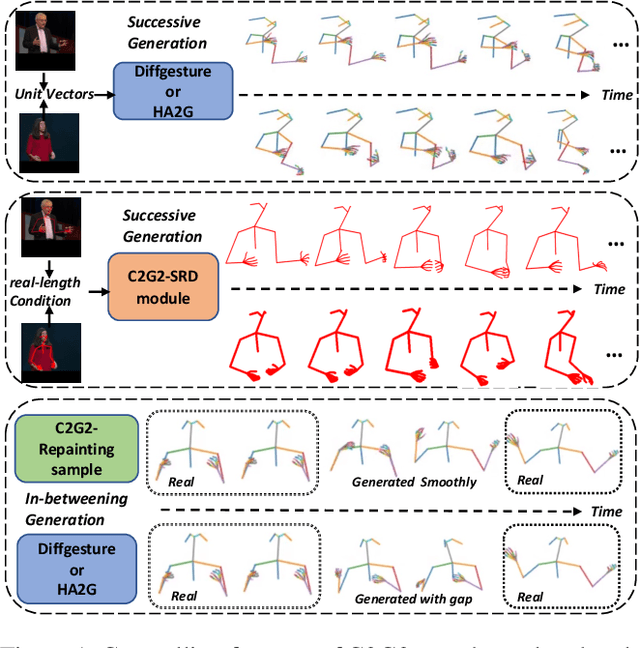
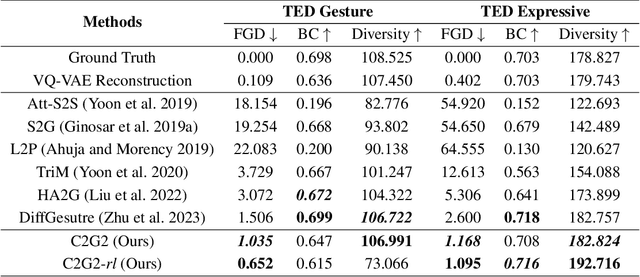

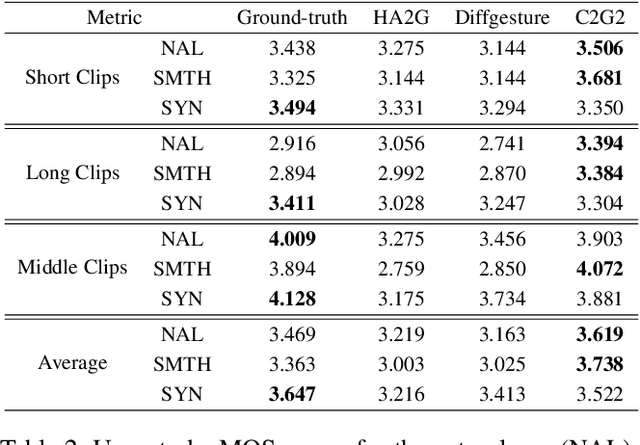
Co-speech gesture generation is crucial for automatic digital avatar animation. However, existing methods suffer from issues such as unstable training and temporal inconsistency, particularly in generating high-fidelity and comprehensive gestures. Additionally, these methods lack effective control over speaker identity and temporal editing of the generated gestures. Focusing on capturing temporal latent information and applying practical controlling, we propose a Controllable Co-speech Gesture Generation framework, named C2G2. Specifically, we propose a two-stage temporal dependency enhancement strategy motivated by latent diffusion models. We further introduce two key features to C2G2, namely a speaker-specific decoder to generate speaker-related real-length skeletons and a repainting strategy for flexible gesture generation/editing. Extensive experiments on benchmark gesture datasets verify the effectiveness of our proposed C2G2 compared with several state-of-the-art baselines. The link of the project demo page can be found at https://c2g2-gesture.github.io/c2_gesture