 Add to Chrome
 Add to Firefox
 Add to Edge
Hybrid Uncertainty Sensitivity Analysis Based on the HSIC for High-Dimensional Responses with Aleatory--Epistemic Separation
Jun 12, 2026
Quantifying the influence of hybrid aleatory and epistemic uncertainties on high-dimensional system responses remains a major challenge in global sensitivity analysis (GSA). Existing Hilbert--Schmidt Independence Criterion (HSIC)-based approaches are primarily restricted to single-output settings and lack a rigorous decomposition of heterogeneous uncertainty sources and their interactions. To address this limitation, a novel double-space tensor-product RKHS framework is proposed for sensitivity analysis under hybrid uncertainty. By constructing factorized kernels over both the latent input space and the multidimensional output space, a concurrent double Möbius inversion is derived to orthogonally decompose the global dependence measure into pure aleatory effects, pure epistemic effects, and their interaction contributions. The resulting dimension-wise sensitivity indices preserve the uncertainty attribution structure across all output dimensions. To satisfy the independence assumptions required by the decomposition, an auxiliary-variable representation based on the inverse probability integral transform is introduced, enabling the treatment of hierarchical uncertainties and Copula-induced correlations within a unified latent space. A fully vectorized single-loop implementation is further developed to avoid the computational burden of nested Monte Carlo simulation. Statistical significance and estimation uncertainty are quantified through permutation testing and Bootstrap confidence intervals. Numerical studies on a modified multi-output Ishigami function and an aerodynamic pressure-field problem demonstrate the accuracy, scalability, and practical applicability of the proposed framework.

Return of Frustratingly Easy Unsupervised Video Domain Adaptation
May 19, 2026Unsupervised video domain adaptation (UVDA) is a practical but under-explored problem. In this paper, we propose a frustratingly easy UVDA method, called MetaTrans. Specifically, MetaTrans adopts a concise learning objective that contains only two fundamental loss terms. Despite the simplicity of the learning objective, MetaTrans embodies an advanced UVDA idea, that is, handling the spatial and temporal divergence of cross-domain videos separately, through a subtle model architecture design. By implementing a temporal-static subtraction module, MetaTrans effectively removes spatial and temporal divergence. Extensive empirical evaluations, particularly on various cross-domain action recognition tasks, show substantial absolute adaptation performance enhancement and significantly superior relative performance gain compared with state-of-the-art UVDA baselines.
Very Efficient Listwise Multimodal Reranking for Long Documents
May 12, 2026Listwise reranking is a key yet computationally expensive component in vision-centric retrieval and multimodal retrieval-augmented generation (M-RAG) over long documents. While recent VLM-based rerankers achieve strong accuracy, their practicality is often limited by long visual-token sequences and multi-step autoregressive decoding. We propose ZipRerank, a highly efficient listwise multimodal reranker that directly addresses both bottlenecks. It reduces input length via a lightweight query-image early interaction mechanism and eliminates autoregressive decoding by scoring all candidates in a single forward pass. To enable effective learning, ZipRerank adopts a two-stage training strategy: (i) listwise pretraining on large-scale text data rendered as images, and (ii) multimodal finetuning with VLM-teacher-distilled soft-ranking supervision. Extensive experiments on the MMDocIR benchmark show that ZipRerank matches or surpasses state-of-the-art multimodal rerankers while reducing LLM inference latency by up to an order of magnitude, making it well-suited for latency-sensitive real-world systems. The code is available at https://github.com/dukesun99/ZipRerank.
Rethinking Random Transformers as Adaptive Sequence Smoothers for Sleep Staging
May 11, 2026Automatic sleep staging commonly adopts Transformers under the assumption that they learn complex long-range dependencies. We challenge this view by revealing a neglected property of sleep sequences: strong local temporal continuity. We show that a randomly initialized Transformer, without any training, substantially improves sleep staging performance and consistently outperforms heuristic smoothing. We formalize this effect via a Random Attention Prior Kernel (RAPK), showing that random self-attention acts as an adaptive smoother by balancing global averaging and content-based similarity while preserving stage transitions. Using two metrics, the Local Smoothness Influence Index (LSII) and the Weighted Transition Entropy (WTE), we provide evidence that most performance gains in Transformer-based sleep staging arise from architectural inductive bias rather than parameter learning. Our results suggest that sleep staging can be effectively addressed with structure-driven smoothing mechanisms rather than complex dependency modeling, enabling more efficient and edge-deployable healthcare systems for large-scale physiological monitoring.
Don't Retrieve, Navigate: Distilling Enterprise Knowledge into Navigable Agent Skills for QA and RAG
Apr 16, 2026Retrieval-Augmented Generation (RAG) grounds LLM responses in external evidence but treats the model as a passive consumer of search results: it never sees how the corpus is organized or what it has not yet retrieved, limiting its ability to backtrack or combine scattered evidence. We present Corpus2Skill, which distills a document corpus into a hierarchical skill directory offline and lets an LLM agent navigate it at serve time. The compilation pipeline iteratively clusters documents, generates LLM-written summaries at each level, and materializes the result as a tree of navigable skill files. At serve time, the agent receives a bird's-eye view of the corpus, drills into topic branches via progressively finer summaries, and retrieves full documents by ID. Because the hierarchy is explicitly visible, the agent can reason about where to look, backtrack from unproductive paths, and combine evidence across branches. On WixQA, an enterprise customer-support benchmark for RAG, Corpus2Skill outperforms dense retrieval, RAPTOR, and agentic RAG baselines across all quality metrics.
A Rapid Instrument Exchange System for Humanoid Robots in Minimally Invasive Surgery
Apr 03, 2026Humanoid robot technologies have demonstrated immense potential for minimally invasive surgery (MIS). Unlike dedicated multi-arm surgical platforms, the inherent dual-arm configuration of humanoid robots necessitates an efficient instrument exchange capability to perform complex procedures, mimicking the natural workflow where surgeons manually switch instruments. To address this, this paper proposes an immersive teleoperated rapid instrument exchange system. The system utilizes a low-latency mechanism based on single-axis compliant docking and environmental constraint release. Integrated with real-time first-person view (FPV) perception via a head-mounted display (HMD), this framework significantly reduces operational complexity and cognitive load during the docking process. Comparative evaluations between experts and novices demonstrate high operational robustness and a rapidly converging learning curve; novice performance in instrument attachment and detachment improved substantially after brief training. While long-distance spatial alignment still presents challenges in time cost and collaborative stability, this study successfully validates the technical feasibility of humanoid robots executing stable instrument exchanges within constrained clinical environments.
OrchMAS: Orchestrated Reasoning with Multi Collaborative Heterogeneous Scientific Expert Structured Agents
Mar 03, 2026Multi-agent large language model frameworks are promising for complex multi step reasoning, yet existing systems remain weak for scientific and knowledge intensive domains due to static prompts and agent roles, rigid workflows, and homogeneous model reliance, leading to poor domain adaptation, limited reasoning flexibility, and high latency on heterogeneous or long-horizon scientific tasks. They also struggle to revise earlier decisions when intermediate reasoning diverges, reducing reliability in structured and calculation heavy settings. To address these limitations, we propose a scientific domain oriented interactive two tier multi model orchestration framework. A dedicated orchestration model analyzes each task, dynamically constructs a domain aware reasoning pipeline, and instantiates specialized expert agents with tailored prompts, while an execution model performs each step under generated role and instruction specifications. The orchestrator iteratively updates the pipeline based on intermediate feedback, enabling dynamic replanning, role reallocation, and prompt refinement across multi turn interactions, strengthening robustness and specialization for scientific reasoning through structured heterogeneous model collaboration. The framework is model agnostic and supports heterogeneous LLM integration with different capacities or costs, enabling flexible performance efficiency trade offs in practical scientific deployments. Experiments show consistent improvements over existing multi agent systems and strong baselines across diverse reasoning and scientific style benchmarks.
PoseTraj: Pose-Aware Trajectory Control in Video Diffusion
Mar 20, 2025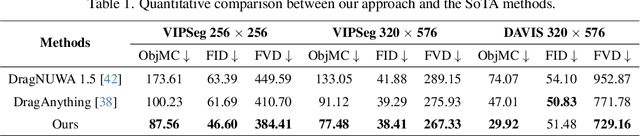
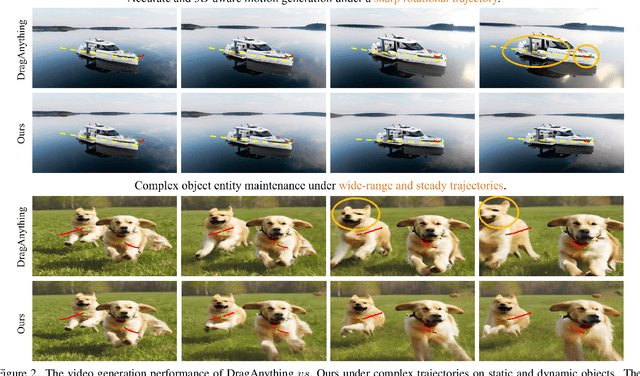
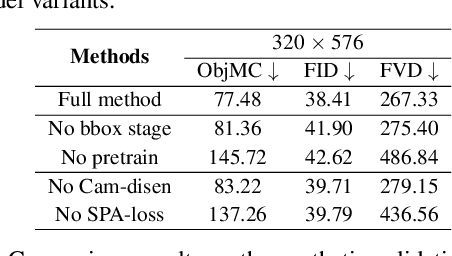
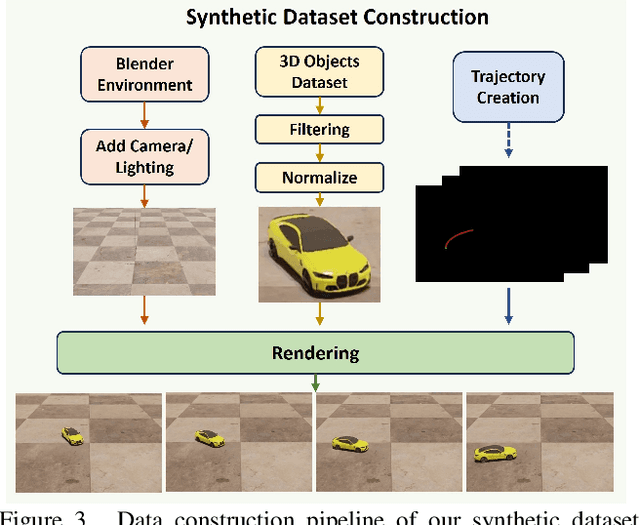
Recent advancements in trajectory-guided video generation have achieved notable progress. However, existing models still face challenges in generating object motions with potentially changing 6D poses under wide-range rotations, due to limited 3D understanding. To address this problem, we introduce PoseTraj, a pose-aware video dragging model for generating 3D-aligned motion from 2D trajectories. Our method adopts a novel two-stage pose-aware pretraining framework, improving 3D understanding across diverse trajectories. Specifically, we propose a large-scale synthetic dataset PoseTraj-10K, containing 10k videos of objects following rotational trajectories, and enhance the model perception of object pose changes by incorporating 3D bounding boxes as intermediate supervision signals. Following this, we fine-tune the trajectory-controlling module on real-world videos, applying an additional camera-disentanglement module to further refine motion accuracy. Experiments on various benchmark datasets demonstrate that our method not only excels in 3D pose-aligned dragging for rotational trajectories but also outperforms existing baselines in trajectory accuracy and video quality.
C2G2: Controllable Co-speech Gesture Generation with Latent Diffusion Model
Aug 29, 2023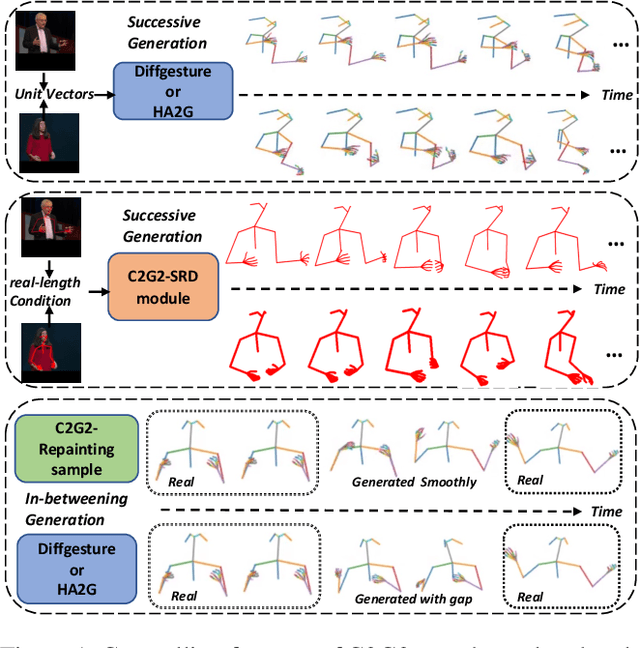
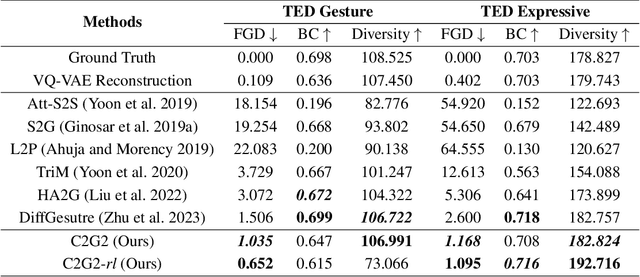

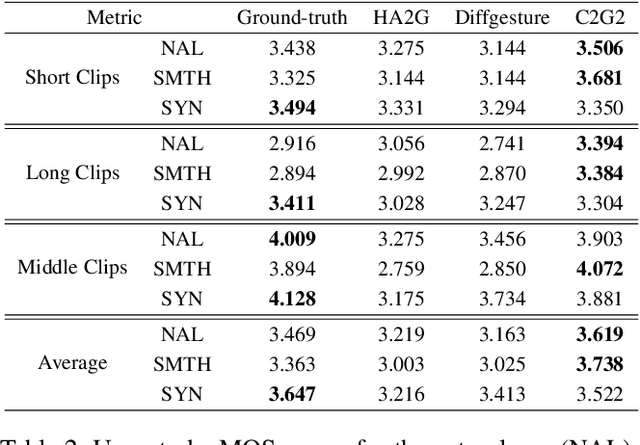
Co-speech gesture generation is crucial for automatic digital avatar animation. However, existing methods suffer from issues such as unstable training and temporal inconsistency, particularly in generating high-fidelity and comprehensive gestures. Additionally, these methods lack effective control over speaker identity and temporal editing of the generated gestures. Focusing on capturing temporal latent information and applying practical controlling, we propose a Controllable Co-speech Gesture Generation framework, named C2G2. Specifically, we propose a two-stage temporal dependency enhancement strategy motivated by latent diffusion models. We further introduce two key features to C2G2, namely a speaker-specific decoder to generate speaker-related real-length skeletons and a repainting strategy for flexible gesture generation/editing. Extensive experiments on benchmark gesture datasets verify the effectiveness of our proposed C2G2 compared with several state-of-the-art baselines. The link of the project demo page can be found at https://c2g2-gesture.github.io/c2_gesture
SR-R$^2$KAC: Improving Single Image Defocus Deblurring
Jul 30, 2023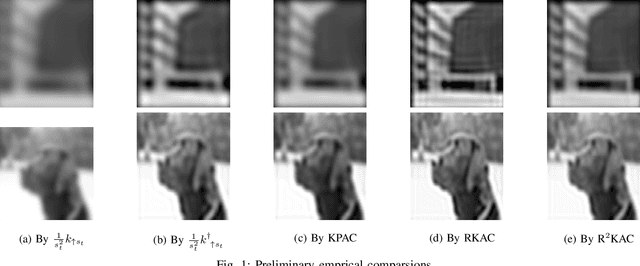
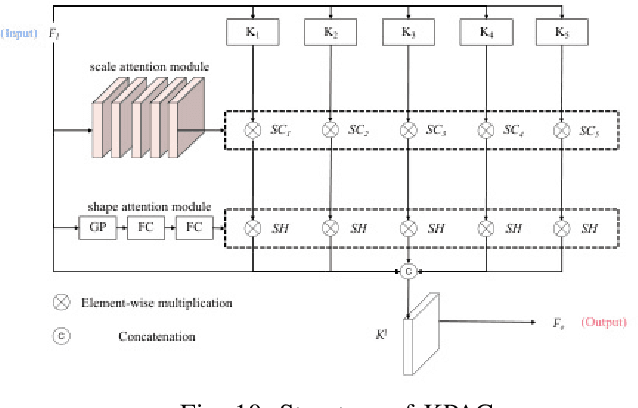
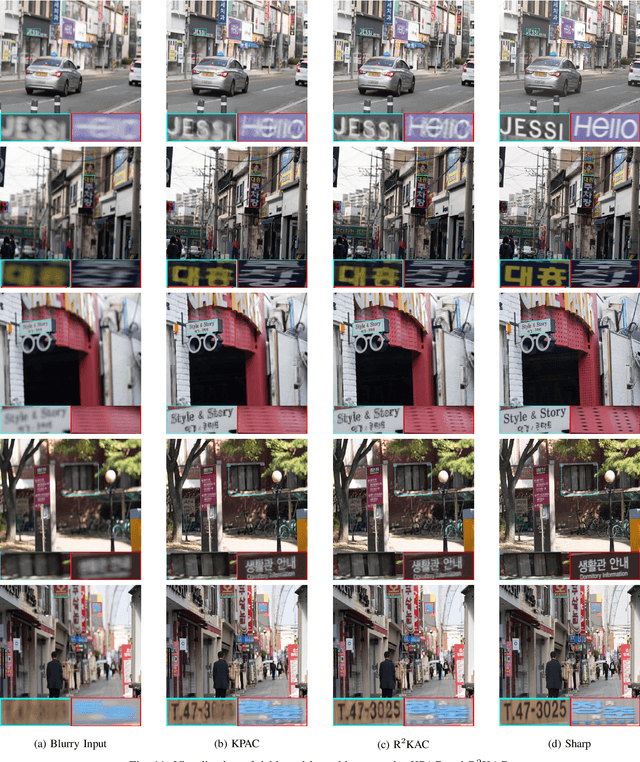
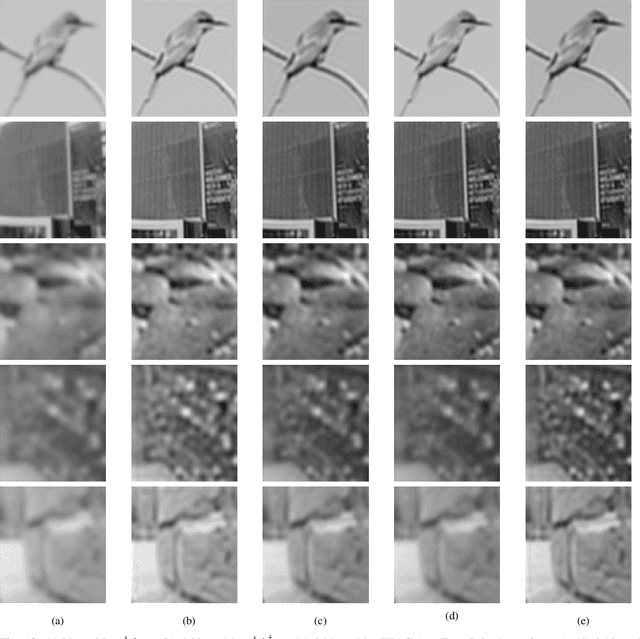
We propose an efficient deep learning method for single image defocus deblurring (SIDD) by further exploring inverse kernel properties. Although the current inverse kernel method, i.e., kernel-sharing parallel atrous convolution (KPAC), can address spatially varying defocus blurs, it has difficulty in handling large blurs of this kind. To tackle this issue, we propose a Residual and Recursive Kernel-sharing Atrous Convolution (R$^2$KAC). R$^2$KAC builds on a significant observation of inverse kernels, that is, successive use of inverse-kernel-based deconvolutions with fixed size helps remove unexpected large blurs but produces ringing artifacts. Specifically, on top of kernel-sharing atrous convolutions used to simulate multi-scale inverse kernels, R$^2$KAC applies atrous convolutions recursively to simulate a large inverse kernel. Specifically, on top of kernel-sharing atrous convolutions, R$^2$KAC stacks atrous convolutions recursively to simulate a large inverse kernel. To further alleviate the contingent effect of recursive stacking, i.e., ringing artifacts, we add identity shortcuts between atrous convolutions to simulate residual deconvolutions. Lastly, a scale recurrent module is embedded in the R$^2$KAC network, leading to SR-R$^2$KAC, so that multi-scale information from coarse to fine is exploited to progressively remove the spatially varying defocus blurs. Extensive experimental results show that our method achieves the state-of-the-art performance.