 Add to Chrome
 Add to Firefox
 Add to Edge
Q-BridgeNet: A Quantization Network for Cross-Lingual Sign Language Translation
Jul 13, 2026
Most sign language translation (SLT) methods focus on isolated native sign-spoken pairs (e.g., American Sign Language - English). Extending language-specific SLT models to multilingual translation would improve accessibility by enabling communication across diverse sign and spoken language communities. However, existing multilingual SLT approaches still struggle to learn a unified model that minimizes cross-lingual conflicts while capturing shared cross-lingual semantics and preserving language-specific variations across different sign languages. Therefore, we propose Q-BridgeNet, a unified framework for multilingual SLT that jointly mitigates cross-lingual conflicts across both the sign language and spoken language sides. On the sign language side, Q-BridgeNet learns discrete Q-units via adaptive segmentation and residual vector quantization: a shared base codebook provides language-agnostic semantic primitives, while language-specific residual codebooks refine heterogeneous signing semantics. On the spoken language side, a multilingual LLM is fine-tuned to operate in the Q-unit space, leveraging cross-lingual priors to enable a unified SLT model. Experiments on PHOENIX14T, How2Sign, and CSL-Daily show that Q-BridgeNet effectively mitigates cross-lingual conflicts, achieving state-of-the-art performance on native sign-spoken pairs while also demonstrating strong generalization to non-native pairs. Our source code is publicly available at: https://github.com/FengLiQ/Q-BridgeNet

PaperRouter-Agent: A Content-Grounded LLM Agent for Personalized Hierarchical Paper Routing
Jul 13, 2026Researchers organize the papers they collect into personal folder hierarchies in reference managers, and route each new paper into the folder where it belongs. This task differs from standard hierarchical text classification. A user's folder hierarchy is not a fixed, shared taxonomy but a private and evolving folksonomy whose folder meanings may be topical, shorthand, venue-based, or process-oriented, and are often defined by the papers already stored inside them. We formalize this setting as personalized hierarchical paper routing (PHPR): assigning an incoming paper to folders in a user-specific hierarchy without per-user training. We propose PaperRouter-Agent, a training-free LLM agent that grounds routing decisions in folder members rather than folder names alone. The agent first narrows the candidate hierarchy, retrieves folder-specific evidence, verifies fit by inspecting member papers, and incorporates similarity-gated feedback from past user rejections. A formative study on real personal libraries shows that PaperRouter-Agent raises overall Recall@1 from 0.39 to 0.61 and Recall@3 from 0.57 to 0.83, with the largest gains on organizational folders defined by metadata such as venue or year, where single-shot methods collapses (Recall@1 0.09 to 0.50). On the public LaMP-2 benchmark, the same approach improves accuracy from 44.5% to 51.5% (+9.0 macro-F1) over a single-shot baseline, while remaining low-cost for practical use.
Accurate, Interdisciplinary and Transparent Structure-property Understanding with Deep Native Structural Reasoning
Jul 08, 2026Structure-property relationships are foundational to biology, chemistry and materials science, where function, reactivity and physical response emerge from spatial, chemical and periodic organization. Mechanistically explaining these relationships requires interpreting structural evidence through scientific principles and physical constraints, from stereochemistry and bonding to symmetry, energetics and periodic order. However, applying artificial intelligence to this process presents a joint challenge of representation and reasoning: models must preserve domain-native structural information while showing how specific evidence supports predictions under these constraints. Here we introduce SciReasoner, a multimodal scientific foundation model for native structural reasoning across proteins, small molecules and inorganic crystals. SciReasoner discretizes coordinates, topologies and periodic connectivities into a unified structure-aware vocabulary, treating structural tokens as addressable evidence units during reasoning. In homology-controlled Gene Ontology prediction, SciReasoner improves Cellular Component annotation for low-homology and orphan-like proteins, increasing $F_{\max}$ from 0.42 to 0.55. In chemistry, it raises single-step retrosynthesis accuracy from 0.63 to 0.72 while generating fragment-level disconnection and precursor-verification traces. In materials science, its representations separate elemental and compound phases and resolve high- and low-band-gap regimes. Across 86 benchmarks, SciReasoner achieves state-of-the-art performance on 67 tasks. Double-blind expert evaluation rates its reasoning traces as preferred or at least comparable to those of a frontier large language model in 98% of cases. By making structure an inspectable substrate for reasoning under scientific constraints, SciReasoner connects accurate prediction with interpretable scientific inference.
GE-Sim 2.0: A Roadmap Towards Comprehensive Closed-loop Video World Simulators for Robotic Manipulation
May 26, 2026We introduce GE-Sim 2.0 (Genie Envisioner World Simulator 2.0), a closed-loop video world simulator for robotic manipulation. Building on the action-conditioned video generation framework of Genie Envisioner, GE-Sim 2.0 is re-trained on thousands of hours of real-world robot data spanning teleoperation, contact-rich interaction, and on-robot policy deployment, substantially improving action-following fidelity and trajectory coverage. On top of this foundation, three new modules close the loop from video simulation to policy learning: a state expert that decodes proprioceptive state from video latents to support next-chunk prediction by downstream VLA policies; a world judge that scores generated rollouts against task instructions, yielding machine-verifiable success signals and rewards in place of manual inspection; and an acceleration framework that delivers a 25-frame rollout in 2.3 seconds on a single H100, with up to 4* frame skipping at inference for long-horizon evaluation. GE-Sim 2.0 tops the public WorldArena leaderboard at only 2B parameters, outperforming both dedicated robotic world models and closed-source general video generators, and policies trained against its rollouts and rewards translate into measurable real-world gains, establishing GE-Sim 2.0 as a practical platform for scalable evaluation and closed-loop learning of manipulation policies.
McCast: Memory-Guided Latent Drift Correction for Long-Horizon Precipitation Nowcasting
May 13, 2026Existing precipitation nowcasting methods typically adopt an autoregressive formulation, where future states are predicted from previous outputs. However, such an approach accumulates errors over long rollouts, causing forecasts to drift away from physically plausible evolution trajectories. Although various studies have attempted to alleviate this problem by improving step-wise prediction accuracy, they largely neglect the global temporal evolution of meteorological systems and lack mechanisms to actively correct drift during rollouts. To address this issue, we propose McCast, a memory-guided latent drift correction method for precipitation nowcasting. Rather than treating memory as an unordered dictionary of latent states for passive conditioning, McCast leverages temporally organized memory to actively correct autoregressive latent evolution. Specifically, McCast introduces a Drift-Corrective Memory Bank (DCBank) that explicitly estimates the temporally consistent drift corrections to calibrate the divergent trajectory. DCBank performs drift correction in two stages: a Corrective Latent Extractor first predicts an initial correction from the current prediction and a reference latent state, and a Correction-Aware Memory Retrieval module then refines the initial correction using temporally organized historical memory. By explicitly correcting latent evolution, instead of improving step-wise prediction accuracy only, McCast produces more temporally coherent and reliable long-horizon forecasts. Experiments on two widely used benchmarks, SEVIR and MeteoNet, show that McCast achieves state-of-the-art performance, particularly in challenging long-horizon forecasting scenarios.
KAN Text to Vision? The Exploration of Kolmogorov-Arnold Networks for Multi-Scale Sequence-Based Pose Animation from Sign Language Notation
May 10, 2026Sign language production from symbolic notation offers a scalable route to accessible sign animation. We present KANMultiSign, a multi-scale sequence generator that translates HamNoSys notation into two-dimensional human pose sequences. Our framework makes two complementary contributions. First, we introduce a coarse-to-fine generation strategy with multi-scale supervision: the model is first guided by an intermediate body--hand--face scaffold to encourage global structural coherence, and then refines fine-grained hand articulation to improve finger-level detail. Second, we investigate integrating Kolmogorov--Arnold Network modules into a Transformer backbone, using learnable univariate function primitives to model the highly non-linear mapping from discrete phonological symbols to continuous body kinematics with a compact parameterization. Experiments on multiple public corpora spanning Polish, German, Greek, and French sign languages show consistent reductions in dynamic time warping based joint error compared with a strong notation-to-pose baseline, while using substantially fewer parameters. Controlled ablations further indicate that KAN-based variants substantially reduce parameter count while maintaining competitive performance when coupled with multi-scale supervision, rather than serving as the main driver of accuracy gains. These findings position multi-scale supervision as the key mechanism for improving notation-conditioned pose generation, with KAN offering a compact alternative for efficient modeling. Our code will be publicly available.
Intern-S1-Pro: Scientific Multimodal Foundation Model at Trillion Scale
Mar 26, 2026We introduce Intern-S1-Pro, the first one-trillion-parameter scientific multimodal foundation model. Scaling to this unprecedented size, the model delivers a comprehensive enhancement across both general and scientific domains. Beyond stronger reasoning and image-text understanding capabilities, its intelligence is augmented with advanced agent capabilities. Simultaneously, its scientific expertise has been vastly expanded to master over 100 specialized tasks across critical science fields, including chemistry, materials, life sciences, and earth sciences. Achieving this massive scale is made possible by the robust infrastructure support of XTuner and LMDeploy, which facilitates highly efficient Reinforcement Learning (RL) training at the 1-trillion parameter level while ensuring strict precision consistency between training and inference. By seamlessly integrating these advancements, Intern-S1-Pro further fortifies the fusion of general and specialized intelligence, working as a Specializable Generalist, demonstrating its position in the top tier of open-source models for general capabilities, while outperforming proprietary models in the depth of specialized scientific tasks.
Charting Empirical Laws for LLM Fine-Tuning in Scientific Multi-Discipline Learning
Feb 11, 2026While large language models (LLMs) have achieved strong performance through fine-tuning within individual scientific domains, their learning dynamics in multi-disciplinary contexts remains poorly understood, despite the promise of improved generalization and broader applicability through cross-domain knowledge synergy. In this work, we present the first systematic study of multi-disciplinary LLM fine-tuning, constructing a five-discipline corpus and analyzing learning patterns of full fine-tuning, LoRA, LoRA-MoE, and LoRA compositions. Particularly, our study shows that multi-disciplinary learning is substantially more variable than single-discipline training and distills four consistent empirical laws: (1) Balance-then-Diversity: low-resource disciplines degrade performance unless mitigated via diversity-aware upsampling; (2) Merge-then-Align: restoring instruction-following ability is critical for cross-discipline synergy; (3) Optimize-then-Scale: parameter scaling offers limited gains without prior design optimization; and (4) Share-then-Specialize: asymmetric LoRA-MoE yields robust gains with minimal trainable parameters via shared low-rank projection. Together, these laws form a practical recipe for principled multi-discipline fine-tuning and provide actionable guidance for developing generalizable scientific LLMs.
SciIF: Benchmarking Scientific Instruction Following Towards Rigorous Scientific Intelligence
Jan 08, 2026As large language models (LLMs) transition from general knowledge retrieval to complex scientific discovery, their evaluation standards must also incorporate the rigorous norms of scientific inquiry. Existing benchmarks exhibit a critical blind spot: general instruction-following metrics focus on superficial formatting, while domain-specific scientific benchmarks assess only final-answer correctness, often rewarding models that arrive at the right result with the wrong reasons. To address this gap, we introduce scientific instruction following: the capability to solve problems while strictly adhering to the constraints that establish scientific validity. Specifically, we introduce SciIF, a multi-discipline benchmark that evaluates this capability by pairing university-level problems with a fixed catalog of constraints across three pillars: scientific conditions (e.g., boundary checks and assumptions), semantic stability (e.g., unit and symbol conventions), and specific processes(e.g., required numerical methods). Uniquely, SciIF emphasizes auditability, requiring models to provide explicit evidence of constraint satisfaction rather than implicit compliance. By measuring both solution correctness and multi-constraint adherence, SciIF enables finegrained diagnosis of compositional reasoning failures, ensuring that LLMs can function as reliable agents within the strict logical frameworks of science.
SITransformer: Shared Information-Guided Transformer for Extreme Multimodal Summarization
Aug 29, 2024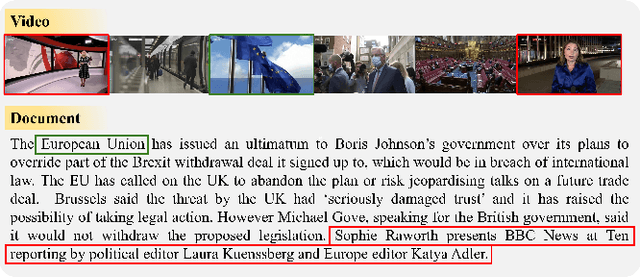

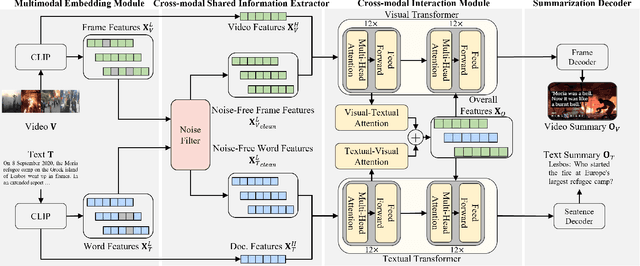
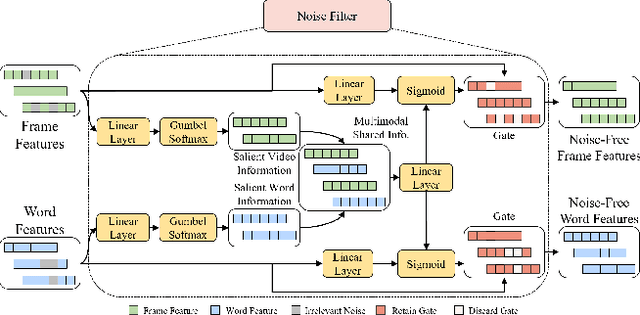
Extreme Multimodal Summarization with Multimodal Output (XMSMO) becomes an attractive summarization approach by integrating various types of information to create extremely concise yet informative summaries for individual modalities. Existing methods overlook the issue that multimodal data often contains more topic irrelevant information, which can mislead the model into producing inaccurate summaries especially for extremely short ones. In this paper, we propose SITransformer, a Shared Information-guided Transformer for extreme multimodal summarization. It has a shared information guided pipeline which involves a cross-modal shared information extractor and a cross-modal interaction module. The extractor formulates semantically shared salient information from different modalities by devising a novel filtering process consisting of a differentiable top-k selector and a shared-information guided gating unit. As a result, the common, salient, and relevant contents across modalities are identified. Next, a transformer with cross-modal attentions is developed for intra- and inter-modality learning with the shared information guidance to produce the extreme summary. Comprehensive experiments demonstrate that SITransformer significantly enhances the summarization quality for both video and text summaries for XMSMO. Our code will be publicly available at https://github.com/SichengLeoLiu/MMAsia24-XMSMO.