 Add to Chrome
 Add to Firefox
 Add to Edge
GeoRoPE: Ground-Aware Rotary Adaptation for Remote Sensing Foundation Models
Jun 08, 2026
Remote-sensing foundation models (RSFMs) benefit from pretraining on imagery from multiple sensors and ground sampling distances (GSDs), but such exposure alone does not resolve scale mismatch during downstream adaptation. A fixed token-grid offset can correspond to different ground distances across sensors, making grid-based positional priors physically inconsistent. Meanwhile, heterogeneous spatial granularity means that compact urban regions and homogeneous landscapes may require different positional sensitivities even under the same GSD. Therefore, we propose {GeoRoPE}, a ground-aware, RoPE-compatible, and parameter-efficient spatial adaptation method for RSFMs. GeoRoPE recalibrates token-level positional interactions from two complementary aspects. First, \textit{Geo-Coordinate Calibration (GCC)} rescales raw token-grid offsets according to the ground distance represented by one token-grid step, producing geo-calibrated relative coordinates across GSDs. Second, \textit{Geo-Frequency Calibration (GFC)} adjusts the native RoPE frequency with a relation-specific factor, enabling position sensitive adaptation to scene-dependent spatial granularity. GeoRoPE is injected into pretrained RSFMs through a lightweight adapter, preserving the frozen spatial prior while adding geo-aware positional corrections. Experiments across multiple RSFMs, sensors, resolutions, and downstream tasks demonstrate that GeoRoPE improves cross-resolution robustness and scale-sensitive representation learning.

PhenoYieldNet: Learning Crop-Aware Phenological Responses for Multi-Crop Yield Prediction
May 22, 2026Accurate crop yield prediction is crucial for sustainable agriculture and global food security. While existing methods are predominantly developed for single-crop prediction, they often struggle to generalize across diverse crop types, without addressing the unique crop phenological responses that are dynamically modulated by complex weather patterns. In this paper, we propose PhenoYieldNet, a multi-crop yield prediction framework that learns crop-specific phenology by explicitly modeling their responses with temporal drivers. Specifically, we develop a crop-aware temporal decoder consisting of a Crop Phenology Bank (CPB) and a Crop Phenology Attention (CPA) module. The CPB integrates a set of learnable embeddings, which leverage a query to guide the CPA module to learn the most relevant phenology patterns for the specific crop. And the CPA module explicitly captures multi-scale trend and variation components to construct temporal contexts, enabling the model to dynamically adjust the attention across different phenological stages. To learn robust and generalizable features for multi-crop prediction, the encoder is initialized with a pre-trained foundation model, and further adapted via a self-supervised Temporal Contrastive Adaptation strategy to align with agricultural temporal dynamics. Extensive experiments conducted on multi-crop datasets indicate that our proposed method significantly outperforms state-of-the-art methods, exhibiting strong generalization capabilities across different regions and crops.
McCast: Memory-Guided Latent Drift Correction for Long-Horizon Precipitation Nowcasting
May 13, 2026Existing precipitation nowcasting methods typically adopt an autoregressive formulation, where future states are predicted from previous outputs. However, such an approach accumulates errors over long rollouts, causing forecasts to drift away from physically plausible evolution trajectories. Although various studies have attempted to alleviate this problem by improving step-wise prediction accuracy, they largely neglect the global temporal evolution of meteorological systems and lack mechanisms to actively correct drift during rollouts. To address this issue, we propose McCast, a memory-guided latent drift correction method for precipitation nowcasting. Rather than treating memory as an unordered dictionary of latent states for passive conditioning, McCast leverages temporally organized memory to actively correct autoregressive latent evolution. Specifically, McCast introduces a Drift-Corrective Memory Bank (DCBank) that explicitly estimates the temporally consistent drift corrections to calibrate the divergent trajectory. DCBank performs drift correction in two stages: a Corrective Latent Extractor first predicts an initial correction from the current prediction and a reference latent state, and a Correction-Aware Memory Retrieval module then refines the initial correction using temporally organized historical memory. By explicitly correcting latent evolution, instead of improving step-wise prediction accuracy only, McCast produces more temporally coherent and reliable long-horizon forecasts. Experiments on two widely used benchmarks, SEVIR and MeteoNet, show that McCast achieves state-of-the-art performance, particularly in challenging long-horizon forecasting scenarios.
DuoCast: Duo-Probabilistic Meteorology-Aware Model for Extended Precipitation Nowcasting
Dec 03, 2024
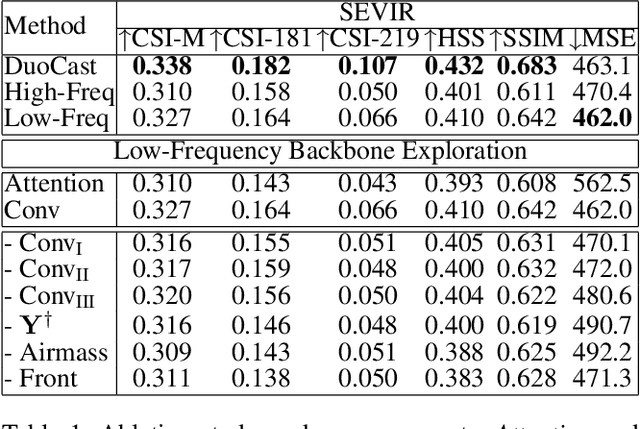
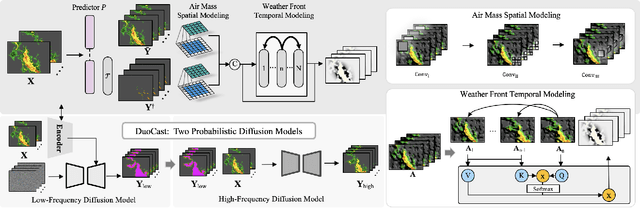
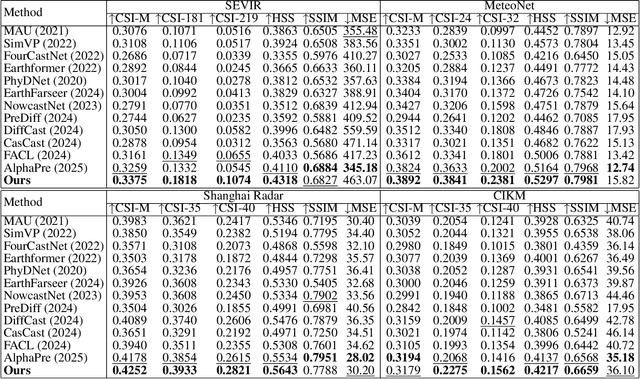
Recently, extended short-term precipitation nowcasting struggles with decreasing precision because of insufficient consideration of meteorological knowledge, such as weather fronts which significantly influence precipitation intensity, duration, and spatial distribution. Therefore, in this paper, we present DuoCast, a novel dual-probabilistic meteorology-aware model designed to address both broad weather evolution and micro-scale fluctuations using two diffusion models, PrecipFlow and MicroDynamic, respectively. Our PrecipFlow model captures evolution trends through an Extreme Precipitation-Aware Encoder (EPA-Encoder), which includes AirConvolution and FrontAttention blocks to process two levels of precipitation data: general and extreme. The output conditions a UNet-based diffusion to produce prediction maps enriched with weather front information. The MicroDynamic model further refines the results to capture micro-scale variability. Extensive experiments on four public benchmarks demonstrate the effectiveness of our DuoCast, achieving superior performance over state-of-the-art methods. Our code is available at https://github.com/ph-w2000/DuoCast.