 Add to Chrome
 Add to Firefox
 Add to Edge
Accurate, Interdisciplinary and Transparent Structure-property Understanding with Deep Native Structural Reasoning
Jul 08, 2026
Structure-property relationships are foundational to biology, chemistry and materials science, where function, reactivity and physical response emerge from spatial, chemical and periodic organization. Mechanistically explaining these relationships requires interpreting structural evidence through scientific principles and physical constraints, from stereochemistry and bonding to symmetry, energetics and periodic order. However, applying artificial intelligence to this process presents a joint challenge of representation and reasoning: models must preserve domain-native structural information while showing how specific evidence supports predictions under these constraints. Here we introduce SciReasoner, a multimodal scientific foundation model for native structural reasoning across proteins, small molecules and inorganic crystals. SciReasoner discretizes coordinates, topologies and periodic connectivities into a unified structure-aware vocabulary, treating structural tokens as addressable evidence units during reasoning. In homology-controlled Gene Ontology prediction, SciReasoner improves Cellular Component annotation for low-homology and orphan-like proteins, increasing $F_{\max}$ from 0.42 to 0.55. In chemistry, it raises single-step retrosynthesis accuracy from 0.63 to 0.72 while generating fragment-level disconnection and precursor-verification traces. In materials science, its representations separate elemental and compound phases and resolve high- and low-band-gap regimes. Across 86 benchmarks, SciReasoner achieves state-of-the-art performance on 67 tasks. Double-blind expert evaluation rates its reasoning traces as preferred or at least comparable to those of a frontier large language model in 98% of cases. By making structure an inspectable substrate for reasoning under scientific constraints, SciReasoner connects accurate prediction with interpretable scientific inference.

Quantity Convergence, Quality Divergence: Disentangling Fluency and Accuracy in L2 Mandarin Prosody
Feb 26, 2026While second language (L2) learners may acquire target syntactic word order, mapping this syntax onto appropriate prosodic structures remains a persistent challenge. This study investigates the fossilization and stability of the L2 syntax-prosody interface by comparing 67 native Mandarin speakers with 67 Vietnamese learners using the BLCU-SAIT corpus. By integrating C-ToBI boundary annotation with Dependency Grammar analysis, we examined both the quantity of prosodic boundaries and their mapping to syntactic relations. Results reveal a non-linear acquisition: although high-proficiency learners (VNH) converge to the native baseline in boundary quantity at the Major Phrase level (B3), their structural mapping significantly diverges. Specifically, VNH demote the prosodic boundary at the Subject-Verb (SBV) interface (Major Phrase B3 -> Prosodic Word B1), while erroneously promoting the boundary at the Verb-Object (VOB) interface (Prosodic Word B1 -> Major Phrase B3). This strategy allows learners to maintain high long phrasal output at the expense of structural accuracy. This results in a distorted prosodic hierarchy where the native pattern is inverted.
Mask-informed Deep Contrastive Incomplete Multi-view Clustering
Feb 04, 2025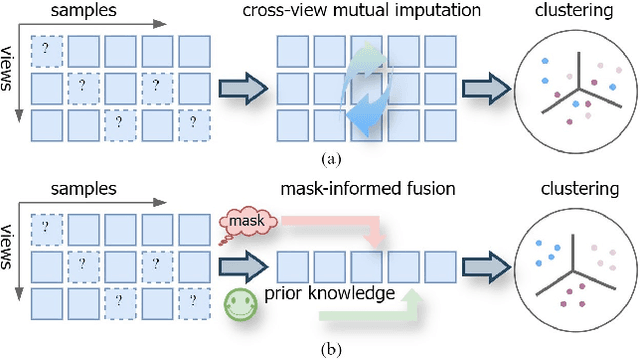
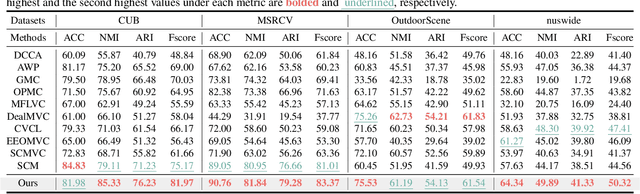
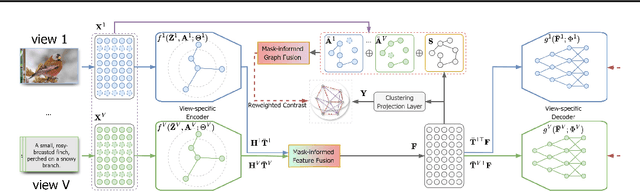
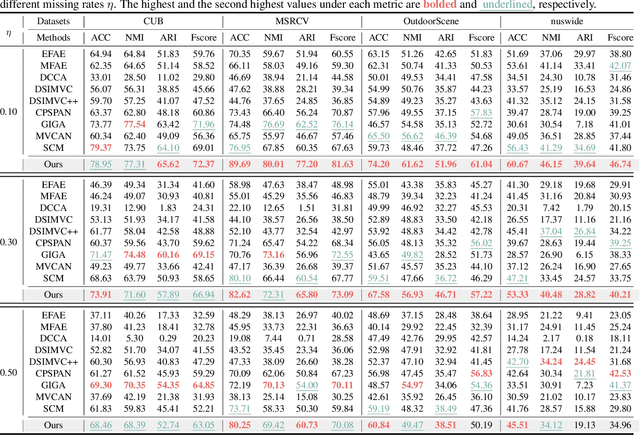
Multi-view clustering (MvC) utilizes information from multiple views to uncover the underlying structures of data. Despite significant advancements in MvC, mitigating the impact of missing samples in specific views on the integration of knowledge from different views remains a critical challenge. This paper proposes a novel Mask-informed Deep Contrastive Incomplete Multi-view Clustering (Mask-IMvC) method, which elegantly identifies a view-common representation for clustering. Specifically, we introduce a mask-informed fusion network that aggregates incomplete multi-view information while considering the observation status of samples across various views as a mask, thereby reducing the adverse effects of missing values. Additionally, we design a prior knowledge-assisted contrastive learning loss that boosts the representation capability of the aggregated view-common representation by injecting neighborhood information of samples from different views. Finally, extensive experiments are conducted to demonstrate the superiority of the proposed Mask-IMvC method over state-of-the-art approaches across multiple MvC datasets, both in complete and incomplete scenarios.