 Add to Chrome
 Add to Firefox
 Add to Edge
Stable Attention Response for Reliable Precipitation Nowcasting
May 13, 2026
Precipitation nowcasting remains challenging due to the highly localized, rapidly evolving, and heterogeneous nature of atmospheric dynamics. Although recent methods increasingly adopt attention-based architectures in both unimodal and multimodal settings, they mainly emphasize stronger representation learning and prediction capacity, while paying less attention to the stability of attention responses across samples. In this work, we show that cross-sample instability of attention-response energy is an important and previously underexplored source of forecasting unreliability. Empirically, inaccurate forecasts are associated with larger attention-response energy variance across heads and layers. Theoretically, we show that cross-sample variability can propagate through self-attention, and enlarge a lower bound on prediction error. Based on this insight, we propose HARECast, a Head-wise Attention Response Energy-regulated framework for precipitation nowcasting. HARECast explicitly models head-wise attention-response energy and stabilizes it through a group-wise regularization objective that reduces cross-sample fluctuations. The proposed formulation is generic and applicable to both unimodal and multimodal nowcasting architectures. We instantiate HARECast in a standard forecasting pipeline with reconstruction branches and a diffusion-based predictor, and evaluate it on commonly used benchmarks--SEVIR and MeteoNet. Experimental results demonstrate that HARECast achieves state-of-the-art performance.

McCast: Memory-Guided Latent Drift Correction for Long-Horizon Precipitation Nowcasting
May 13, 2026Existing precipitation nowcasting methods typically adopt an autoregressive formulation, where future states are predicted from previous outputs. However, such an approach accumulates errors over long rollouts, causing forecasts to drift away from physically plausible evolution trajectories. Although various studies have attempted to alleviate this problem by improving step-wise prediction accuracy, they largely neglect the global temporal evolution of meteorological systems and lack mechanisms to actively correct drift during rollouts. To address this issue, we propose McCast, a memory-guided latent drift correction method for precipitation nowcasting. Rather than treating memory as an unordered dictionary of latent states for passive conditioning, McCast leverages temporally organized memory to actively correct autoregressive latent evolution. Specifically, McCast introduces a Drift-Corrective Memory Bank (DCBank) that explicitly estimates the temporally consistent drift corrections to calibrate the divergent trajectory. DCBank performs drift correction in two stages: a Corrective Latent Extractor first predicts an initial correction from the current prediction and a reference latent state, and a Correction-Aware Memory Retrieval module then refines the initial correction using temporally organized historical memory. By explicitly correcting latent evolution, instead of improving step-wise prediction accuracy only, McCast produces more temporally coherent and reliable long-horizon forecasts. Experiments on two widely used benchmarks, SEVIR and MeteoNet, show that McCast achieves state-of-the-art performance, particularly in challenging long-horizon forecasting scenarios.
DuoCast: Duo-Probabilistic Meteorology-Aware Model for Extended Precipitation Nowcasting
Dec 03, 2024
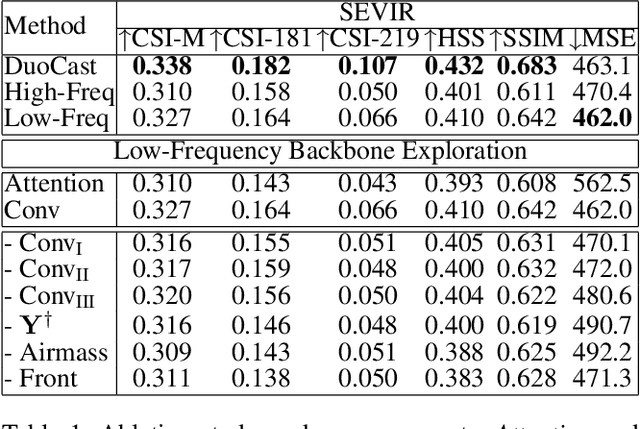
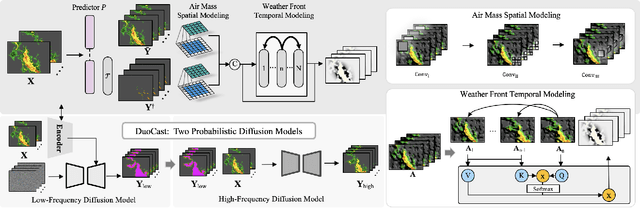
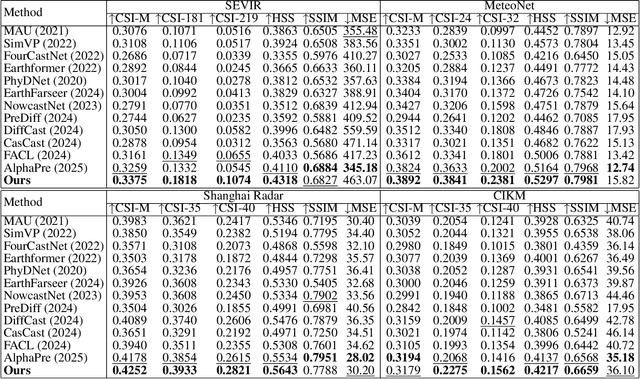
Recently, extended short-term precipitation nowcasting struggles with decreasing precision because of insufficient consideration of meteorological knowledge, such as weather fronts which significantly influence precipitation intensity, duration, and spatial distribution. Therefore, in this paper, we present DuoCast, a novel dual-probabilistic meteorology-aware model designed to address both broad weather evolution and micro-scale fluctuations using two diffusion models, PrecipFlow and MicroDynamic, respectively. Our PrecipFlow model captures evolution trends through an Extreme Precipitation-Aware Encoder (EPA-Encoder), which includes AirConvolution and FrontAttention blocks to process two levels of precipitation data: general and extreme. The output conditions a UNet-based diffusion to produce prediction maps enriched with weather front information. The MicroDynamic model further refines the results to capture micro-scale variability. Extensive experiments on four public benchmarks demonstrate the effectiveness of our DuoCast, achieving superior performance over state-of-the-art methods. Our code is available at https://github.com/ph-w2000/DuoCast.
Radio Frequency Signal based Human Silhouette Segmentation: A Sequential Diffusion Approach
Jul 27, 2024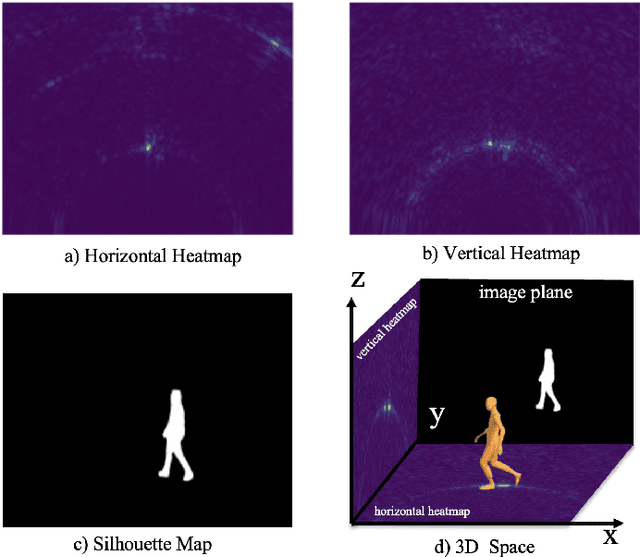
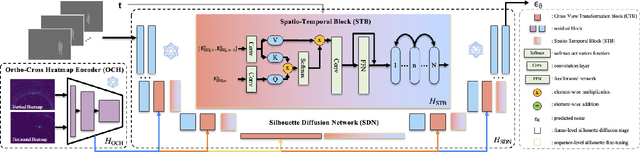
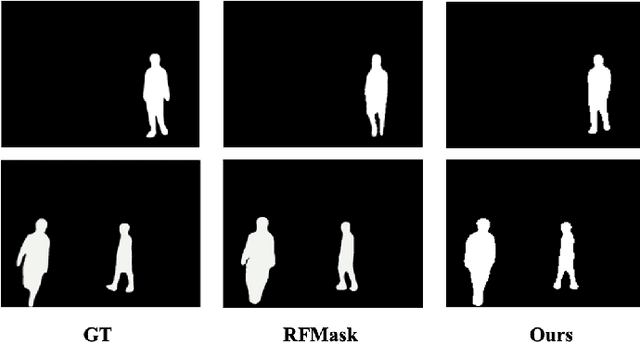
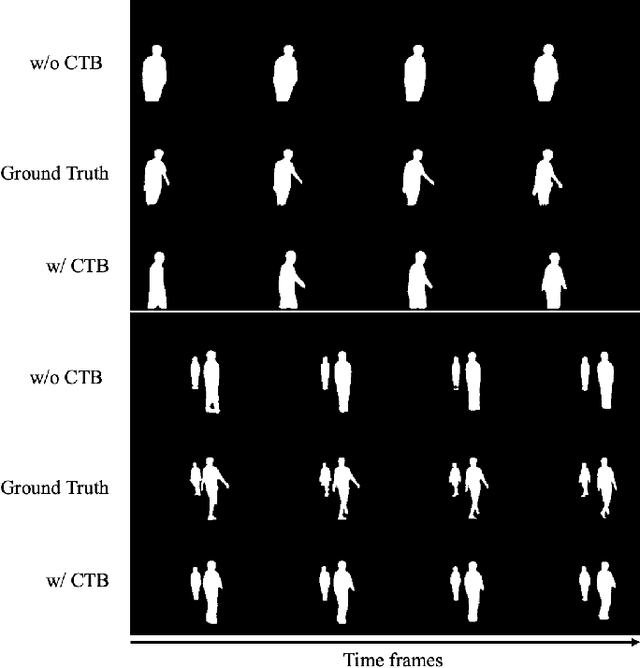
Radio frequency (RF) signals have been proved to be flexible for human silhouette segmentation (HSS) under complex environments. Existing studies are mainly based on a one-shot approach, which lacks a coherent projection ability from the RF domain. Additionally, the spatio-temporal patterns have not been fully explored for human motion dynamics in HSS. Therefore, we propose a two-stage Sequential Diffusion Model (SDM) to progressively synthesize high-quality segmentation jointly with the considerations on motion dynamics. Cross-view transformation blocks are devised to guide the diffusion model in a multi-scale manner for comprehensively characterizing human related patterns in an individual frame such as directional projection from signal planes. Moreover, spatio-temporal blocks are devised to fine-tune the frame-level model to incorporate spatio-temporal contexts and motion dynamics, enhancing the consistency of the segmentation maps. Comprehensive experiments on a public benchmark -- HIBER demonstrate the state-of-the-art performance of our method with an IoU 0.732. Our code is available at https://github.com/ph-w2000/SDM.
Robust Audio Anti-Spoofing with Fusion-Reconstruction Learning on Multi-Order Spectrograms
Aug 18, 2023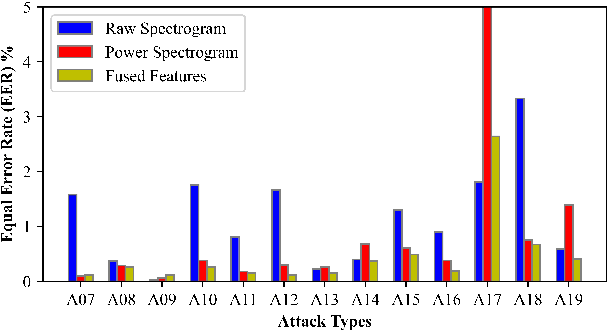
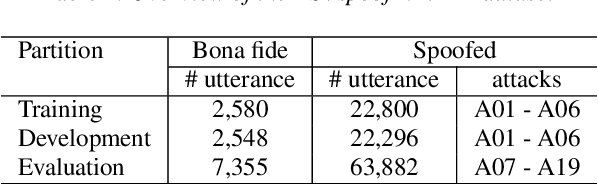
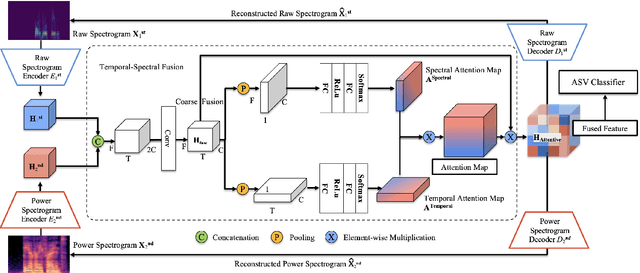
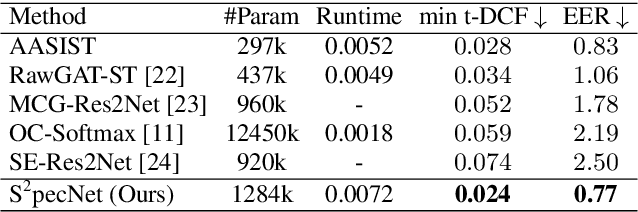
Robust audio anti-spoofing has been increasingly challenging due to the recent advancements on deepfake techniques. While spectrograms have demonstrated their capability for anti-spoofing, complementary information presented in multi-order spectral patterns have not been well explored, which limits their effectiveness for varying spoofing attacks. Therefore, we propose a novel deep learning method with a spectral fusion-reconstruction strategy, namely S2pecNet, to utilise multi-order spectral patterns for robust audio anti-spoofing representations. Specifically, spectral patterns up to second-order are fused in a coarse-to-fine manner and two branches are designed for the fine-level fusion from the spectral and temporal contexts. A reconstruction from the fused representation to the input spectrograms further reduces the potential fused information loss. Our method achieved the state-of-the-art performance with an EER of 0.77% on a widely used dataset: ASVspoof2019 LA Challenge.