 Add to Chrome
 Add to Firefox
 Add to Edge
Q-BridgeNet: A Quantization Network for Cross-Lingual Sign Language Translation
Jul 13, 2026
Most sign language translation (SLT) methods focus on isolated native sign-spoken pairs (e.g., American Sign Language - English). Extending language-specific SLT models to multilingual translation would improve accessibility by enabling communication across diverse sign and spoken language communities. However, existing multilingual SLT approaches still struggle to learn a unified model that minimizes cross-lingual conflicts while capturing shared cross-lingual semantics and preserving language-specific variations across different sign languages. Therefore, we propose Q-BridgeNet, a unified framework for multilingual SLT that jointly mitigates cross-lingual conflicts across both the sign language and spoken language sides. On the sign language side, Q-BridgeNet learns discrete Q-units via adaptive segmentation and residual vector quantization: a shared base codebook provides language-agnostic semantic primitives, while language-specific residual codebooks refine heterogeneous signing semantics. On the spoken language side, a multilingual LLM is fine-tuned to operate in the Q-unit space, leveraging cross-lingual priors to enable a unified SLT model. Experiments on PHOENIX14T, How2Sign, and CSL-Daily show that Q-BridgeNet effectively mitigates cross-lingual conflicts, achieving state-of-the-art performance on native sign-spoken pairs while also demonstrating strong generalization to non-native pairs. Our source code is publicly available at: https://github.com/FengLiQ/Q-BridgeNet

VideoPulse: Neonatal heart rate and peripheral capillary oxygen saturation (SpO2) estimation from contact free video
Feb 27, 2026Remote photoplethysmography (rPPG) enables contact free monitoring of vital signs and is especially valuable for neonates, since conventional methods often require sustained skin contact with adhesive probes that can irritate fragile skin and increase infection control burden. We present VideoPulse, a neonatal dataset and an end to end pipeline that estimates neonatal heart rate and peripheral capillary oxygen saturation (SpO2) from facial video. VideoPulse contains 157 recordings totaling 2.6 hours from 52 neonates with diverse face orientations. Our pipeline performs face alignment and artifact aware supervision using denoised pulse oximeter signals, then applies 3D CNN backbones for heart rate and SpO2 regression with label distribution smoothing and weighted regression for SpO2. Predictions are produced in 2 second windows. On the NBHR neonatal dataset, we obtain heart rate MAE 2.97 bpm using 2 second windows (2.80 bpm at 6 second windows) and SpO2 MAE 1.69 percent. Under cross dataset evaluation, the NBHR trained heart rate model attains 5.34 bpm MAE on VideoPulse, and fine tuning an NBHR pretrained SpO2 model on VideoPulse yields MAE 1.68 percent. These results indicate that short unaligned neonatal video segments can support accurate heart rate and SpO2 estimation, enabling low cost non invasive monitoring in neonatal intensive care.
Neonatal Bowel Sound Detection Using Convolutional Neural Network and Laplace Hidden Semi-Markov Model
Aug 17, 2021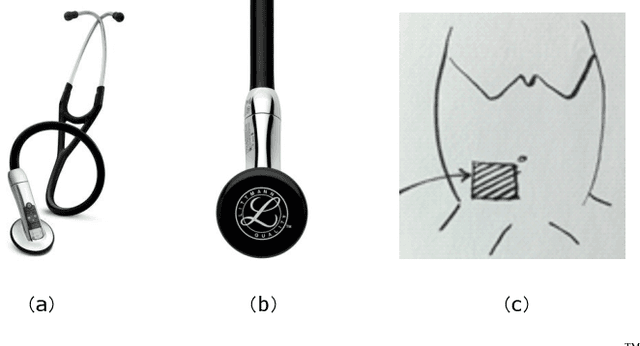
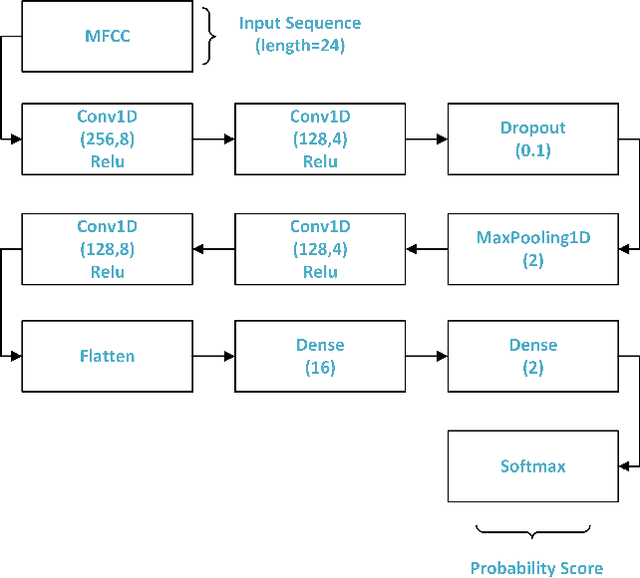
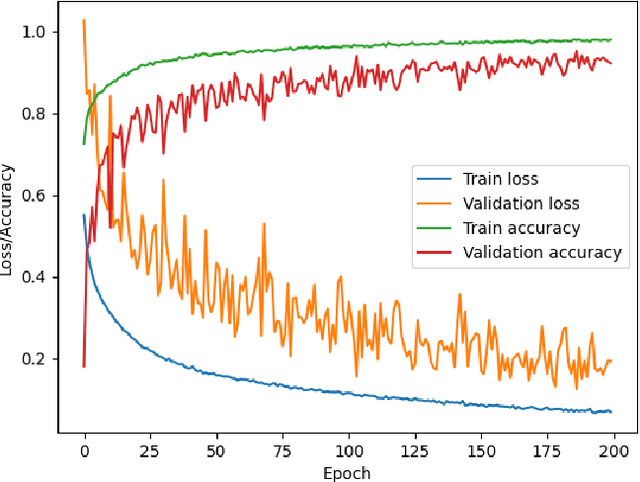
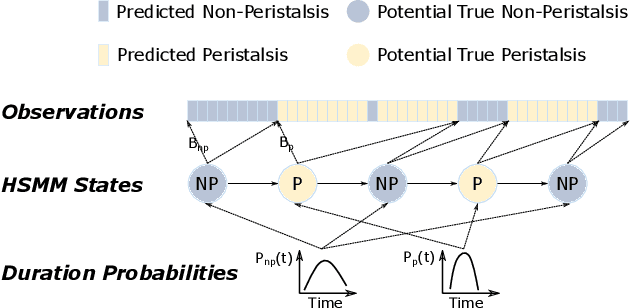
Abdominal auscultation is a convenient, safe and inexpensive method to assess bowel conditions, which is essential in neonatal care. It helps early detection of neonatal bowel dysfunctions and allows timely intervention. This paper presents a neonatal bowel sound detection method to assist the auscultation. Specifically, a Convolutional Neural Network (CNN) is proposed to classify peristalsis and non-peristalsis sounds. The classification is then optimized using a Laplace Hidden Semi-Markov Model (HSMM). The proposed method is validated on abdominal sounds from 49 newborn infants admitted to our tertiary Neonatal Intensive Care Unit (NICU). The results show that the method can effectively detect bowel sounds with accuracy and area under curve (AUC) score being 89.81% and 83.96% respectively, outperforming 13 baseline methods. Furthermore, the proposed Laplace HSMM refinement strategy is proven capable to enhance other bowel sound detection models. The outcomes of this work have the potential to facilitate future telehealth applications for neonatal care. The source code of our work can be found at: https://bitbucket.org/chirudeakin/neonatal-bowel-sound-classification/