 Add to Chrome
 Add to Firefox
 Add to Edge
MQM-APE: Toward High-Quality Error Annotation Predictors with Automatic Post-Editing in LLM Translation Evaluators
Sep 22, 2024
Large Language Models (LLMs) have shown significant potential as judges for Machine Translation (MT) quality assessment, providing both scores and fine-grained feedback. Although approaches such as GEMBA-MQM has shown SOTA performance on reference-free evaluation, the predicted errors do not align well with those annotated by human, limiting their interpretability as feedback signals. To enhance the quality of error annotations predicted by LLM evaluators, we introduce a universal and training-free framework, $\textbf{MQM-APE}$, based on the idea of filtering out non-impactful errors by Automatically Post-Editing (APE) the original translation based on each error, leaving only those errors that contribute to quality improvement. Specifically, we prompt the LLM to act as 1) $\textit{evaluator}$ to provide error annotations, 2) $\textit{post-editor}$ to determine whether errors impact quality improvement and 3) $\textit{pairwise quality verifier}$ as the error filter. Experiments show that our approach consistently improves both the reliability and quality of error spans against GEMBA-MQM, across eight LLMs in both high- and low-resource languages. Orthogonal to trained approaches, MQM-APE complements translation-specific evaluators such as Tower, highlighting its broad applicability. Further analysis confirm the effectiveness of each module and offer valuable insights into evaluator design and LLMs selection. The code will be released to facilitate the community.

$\mathbb{USCD}$: Improving Code Generation of LLMs by Uncertainty-Aware Selective Contrastive Decoding
Sep 09, 2024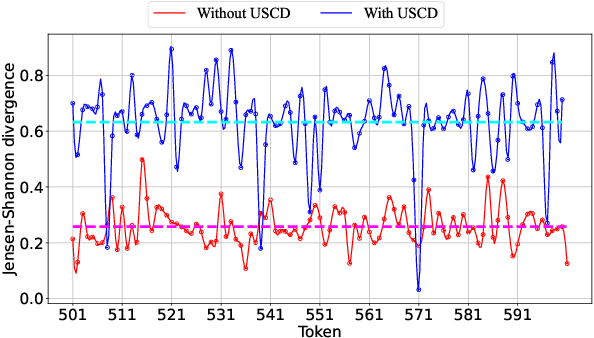
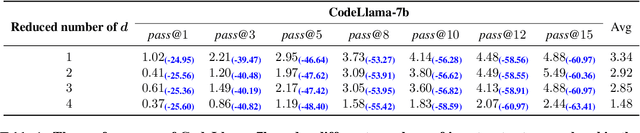
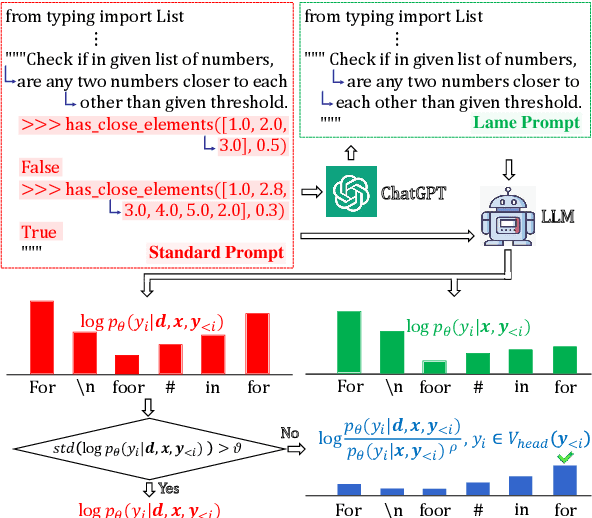
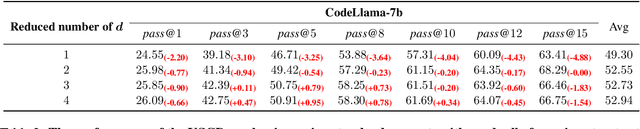
Large language models (LLMs) have shown remarkable capabilities in code generation. However, the effects of hallucinations (e.g., output noise) make it particularly challenging for LLMs to generate high-quality code in one pass. In this work, we propose a simple and effective \textbf{u}ncertainty-aware \textbf{s}elective \textbf{c}ontrastive \textbf{d}ecoding ($\mathbb{USCD}$) mechanism to improve the quality of one-pass code generation in LLMs and reduce the impact of output noise. To be specific, we first elaborately designed a negative prompt (namely lame prompt) to output noise by removing input-output examples from the standard few-shot prompt. Our preliminary study shows that the Jensen-Shannon divergence (JS divergence) between token distribution uncertainty and the output noise is relatively low (approximately $0.25$), indicating their high relevance. Then, we selectively eliminate output noise induced by lame prompts based on the uncertainty of the prediction distribution from the standard prompt. Notably, our proposed plug-and-play mechanism is an inference-only method, enjoying appealing flexibility. Extensive experiments on widely used benchmarks, e.g., HumanEval, MBPP, and MultiPL-E, upon several LLMs (i.e., Inocder-6b, CodeLlama-7b, WizardCoder-15b, StarCoder, and Llama2-7b), demonstrate that our proposed USCD significantly improves one-pass code generation, with an average \textit{pass@$1$} scores increase of 16.59\%. We will release code and data on GitHub.
Divide, Conquer and Combine: A Training-Free Framework for High-Resolution Image Perception in Multimodal Large Language Models
Aug 28, 2024Multimodal large language models (MLLMs) have experienced significant advancements recently, but still struggle to recognize and interpret intricate details in high-resolution (HR) images effectively. While state-of-the-art (SOTA) MLLMs claim to process images at 4K resolution, existing MLLM benchmarks only support up to 2K, leaving the capabilities of SOTA models on true HR images largely untested. Furthermore, existing methods for enhancing HR image perception in MLLMs rely on computationally expensive visual instruction tuning. To address these limitations, we introduce HR-Bench, the first deliberately designed benchmark to rigorously evaluate MLLM performance on 4K&8K images. Through extensive experiments, we demonstrate that while downsampling HR images leads to vision information loss, leveraging complementary modalities, e.g., text, can effectively compensate for this loss. Building upon this insight, we propose Divide, Conquer and Combine (DC$^2$), a novel training-free framework for enhancing MLLM perception of HR images. DC$^2$ follows a three-staged approach: 1) Divide: recursively partitioning the HR image into patches and merging similar patches to minimize computational overhead, 2) Conquer: leveraging the MLLM to generate accurate textual descriptions for each image patch, and 3) Combine: utilizing the generated text descriptions to enhance the MLLM's understanding of the overall HR image. Extensive experiments show that: 1) the SOTA MLLM achieves 63% accuracy, which is markedly lower than the 87% accuracy achieved by humans on HR-Bench; 2) our DC$^2$ brings consistent and significant improvements (a relative increase of +6% on HR-Bench and +8% on general multimodal benchmarks). The benchmark and code will be released to facilitate the multimodal R&D community.
Aligning Large Language Models from Self-Reference AI Feedback with one General Principle
Jun 17, 2024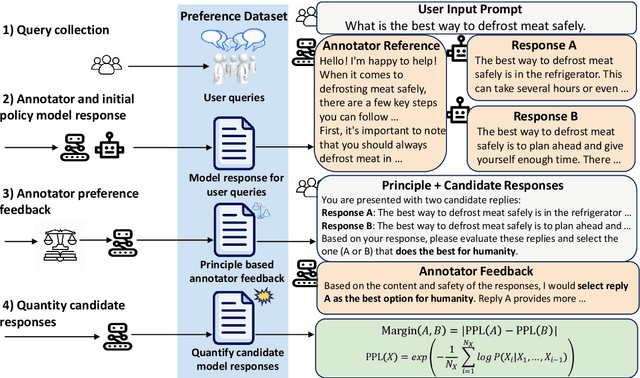
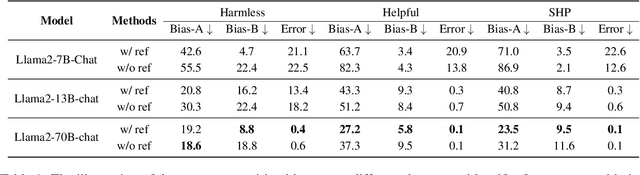
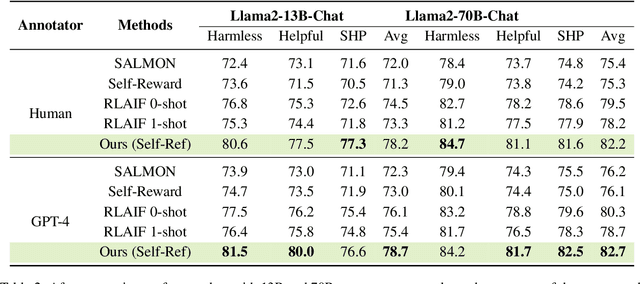
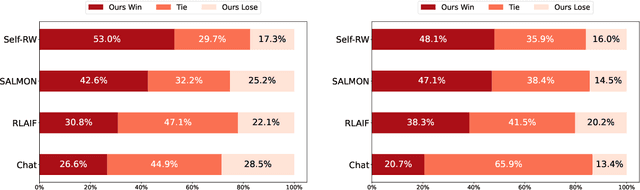
In aligning large language models (LLMs), utilizing feedback from existing advanced AI rather than humans is an important method to scale supervisory signals. However, it is highly challenging for AI to understand human intentions and societal values, and provide accurate preference feedback based on these. Current AI feedback methods rely on powerful LLMs, carefully designed specific principles to describe human intentions, and are easily influenced by position bias. To address these issues, we propose a self-reference-based AI feedback framework that enables a 13B Llama2-Chat to provide high-quality feedback under simple and general principles such as ``best for humanity``. Specifically, we allow the AI to first respond to the user's instructions, then generate criticism of other answers based on its own response as a reference, and finally determine which answer better fits human preferences according to the criticism. Additionally, we use a self-consistency method to further reduce the impact of position bias, and employ semantic perplexity to calculate the preference strength differences between different answers. Experimental results show that our method enables 13B and 70B Llama2-Chat annotators to provide high-quality preference feedback, and the policy models trained based on these preference data achieve significant advantages in benchmark datasets through reinforcement learning.
Revisiting Catastrophic Forgetting in Large Language Model Tuning
Jun 07, 2024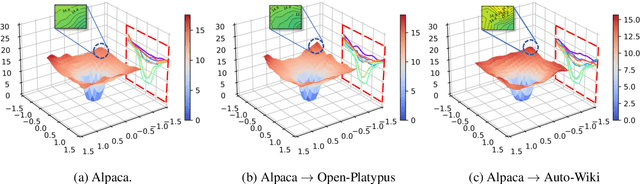
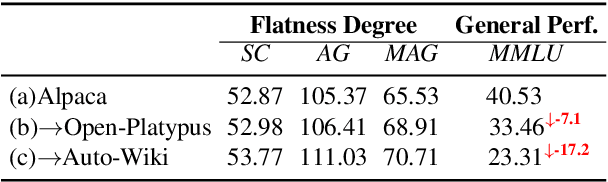
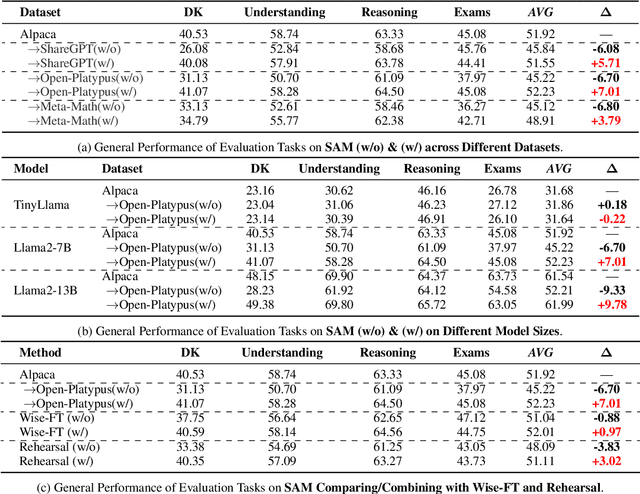
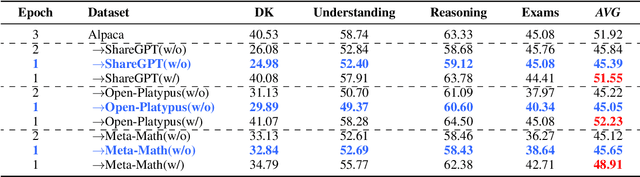
Catastrophic Forgetting (CF) means models forgetting previously acquired knowledge when learning new data. It compromises the effectiveness of large language models (LLMs) during fine-tuning, yet the underlying causes have not been thoroughly investigated. This paper takes the first step to reveal the direct link between the flatness of the model loss landscape and the extent of CF in the field of LLMs. Based on this, we introduce the sharpness-aware minimization to mitigate CF by flattening the loss landscape. Experiments on three widely-used fine-tuning datasets, spanning different model scales, demonstrate the effectiveness of our method in alleviating CF. Analyses show that we nicely complement the existing anti-forgetting strategies, further enhancing the resistance of LLMs to CF.
Uncertainty Aware Learning for Language Model Alignment
Jun 07, 2024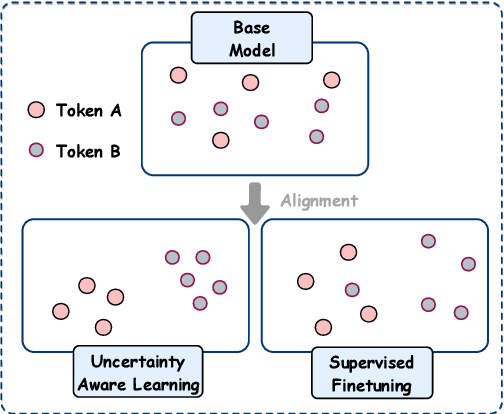


As instruction-tuned large language models (LLMs) evolve, aligning pretrained foundation models presents increasing challenges. Existing alignment strategies, which typically leverage diverse and high-quality data sources, often overlook the intrinsic uncertainty of tasks, learning all data samples equally. This may lead to suboptimal data efficiency and model performance. In response, we propose uncertainty-aware learning (UAL) to improve the model alignment of different task scenarios, by introducing the sample uncertainty (elicited from more capable LLMs). We implement UAL in a simple fashion -- adaptively setting the label smoothing value of training according to the uncertainty of individual samples. Analysis shows that our UAL indeed facilitates better token clustering in the feature space, validating our hypothesis. Extensive experiments on widely used benchmarks demonstrate that our UAL significantly and consistently outperforms standard supervised fine-tuning. Notably, LLMs aligned in a mixed scenario have achieved an average improvement of 10.62\% on high-entropy tasks (i.e., AlpacaEval leaderboard), and 1.81\% on complex low-entropy tasks (i.e., MetaMath and GSM8K).
Demystifying the Compression of Mixture-of-Experts Through a Unified Framework
Jun 04, 2024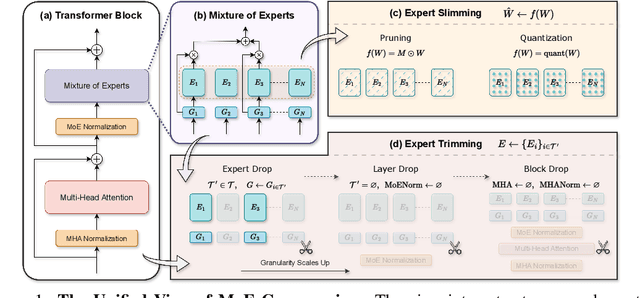
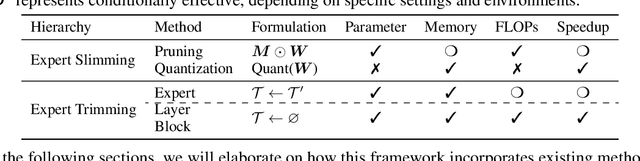
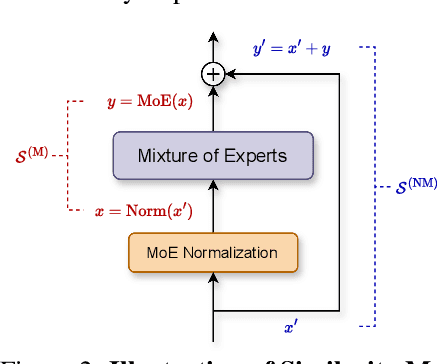
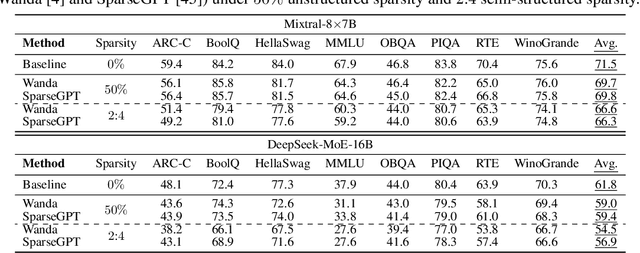
Scaling large language models has revolutionized the performance across diverse domains, yet the continual growth in model size poses significant challenges for real-world deployment. The Mixture of Experts (MoE) approach addresses this by dynamically selecting and activating only a subset of experts, significantly reducing computational costs while maintaining high performance. However, MoE introduces potential redundancy (e.g., parameters) and extra costs (e.g., communication overhead). Despite numerous compression techniques developed for mitigating the redundancy in dense models, the compression of MoE remains under-explored. We first bridge this gap with a cutting-edge unified framework that not only seamlessly integrates mainstream compression methods but also helps systematically understand MoE compression. This framework approaches compression from two perspectives: Expert Slimming which compresses individual experts and Expert Trimming which removes structured modules. Within this framework, we explore the optimization space unexplored by existing methods,and further introduce aggressive Expert Trimming techniques, i.e., Layer Drop and Block Drop, to eliminate redundancy at larger scales. Based on these insights,we present a comprehensive recipe to guide practitioners in compressing MoE effectively. Extensive experimental results demonstrate the effectiveness of the compression methods under our framework and the proposed recipe, achieving a 6.05x speedup and only 20.0GB memory usage while maintaining over 92% of performance on Mixtral-8x7B.
Improving Complex Reasoning over Knowledge Graph with Logic-Aware Curriculum Tuning
May 07, 2024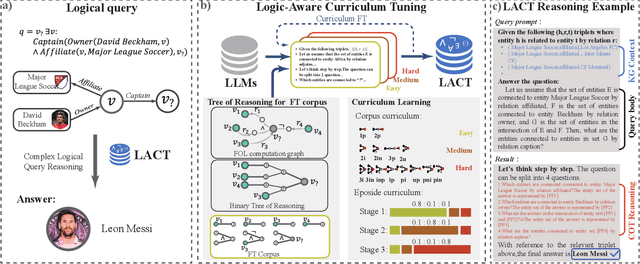
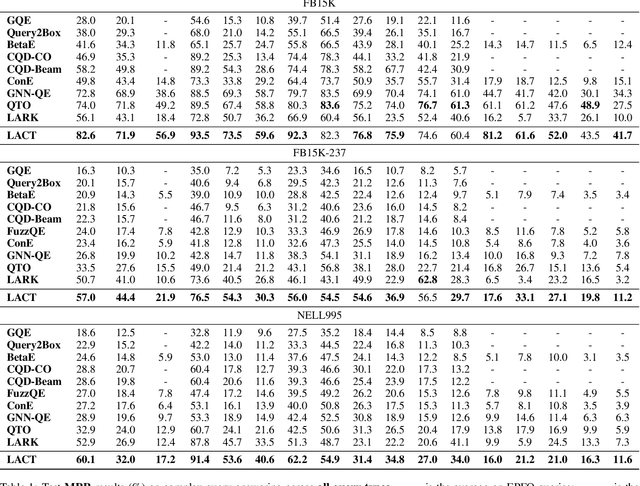
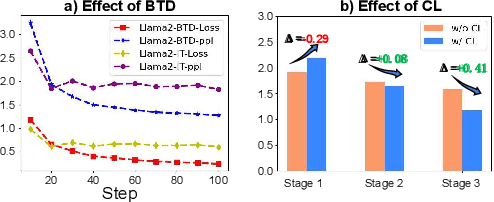
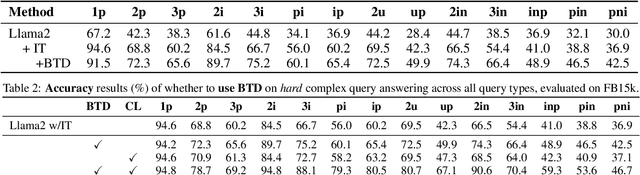
Answering complex logical queries over incomplete knowledge graphs (KGs) is challenging. Most previous works have focused on learning entity/relation embeddings and simulating first-order logic operators with various neural networks. However, they are bottlenecked by the inability to share world knowledge to improve logical reasoning, thus resulting in suboptimal performance. In this paper, we propose a complex logical reasoning schema over knowledge graphs upon large language models (LLMs), containing a curriculum-based logical-aware instruction tuning framework, named LACT. Specifically, we augment the arbitrary first-order logical queries via binary tree decomposition, to stimulate the reasoning capability of LLMs. To address the difficulty gap among different types of complex queries, we design a simple and flexible logic-aware curriculum learning framework. Experiments across widely used datasets demonstrate that LACT has substantial improvements~(brings an average +5.5% MRR score) over advanced methods, achieving the new state-of-the-art. Our code and model will be released at GitHub and huggingface soon.
3AM: An Ambiguity-Aware Multi-Modal Machine Translation Dataset
Apr 29, 2024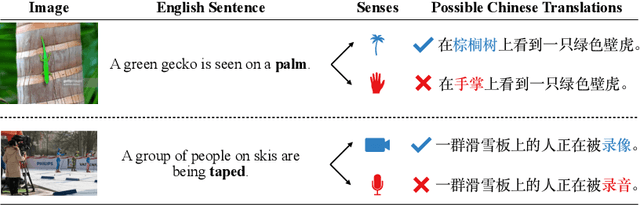
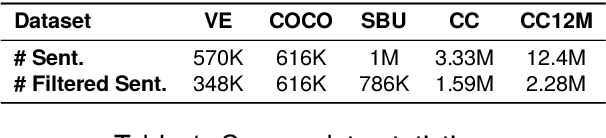
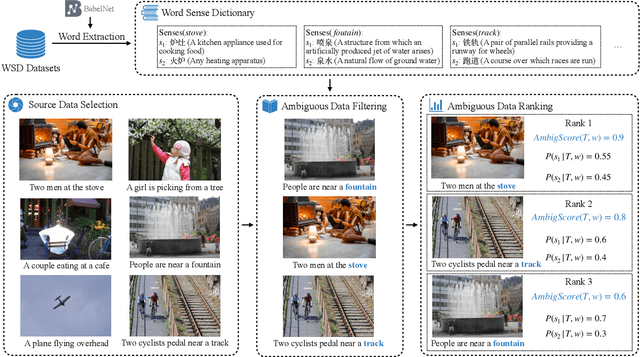

Multimodal machine translation (MMT) is a challenging task that seeks to improve translation quality by incorporating visual information. However, recent studies have indicated that the visual information provided by existing MMT datasets is insufficient, causing models to disregard it and overestimate their capabilities. This issue presents a significant obstacle to the development of MMT research. This paper presents a novel solution to this issue by introducing 3AM, an ambiguity-aware MMT dataset comprising 26,000 parallel sentence pairs in English and Chinese, each with corresponding images. Our dataset is specifically designed to include more ambiguity and a greater variety of both captions and images than other MMT datasets. We utilize a word sense disambiguation model to select ambiguous data from vision-and-language datasets, resulting in a more challenging dataset. We further benchmark several state-of-the-art MMT models on our proposed dataset. Experimental results show that MMT models trained on our dataset exhibit a greater ability to exploit visual information than those trained on other MMT datasets. Our work provides a valuable resource for researchers in the field of multimodal learning and encourages further exploration in this area. The data, code and scripts are freely available at https://github.com/MaxyLee/3AM.
Achieving >97% on GSM8K: Deeply Understanding the Problems Makes LLMs Better Reasoners
Apr 28, 2024
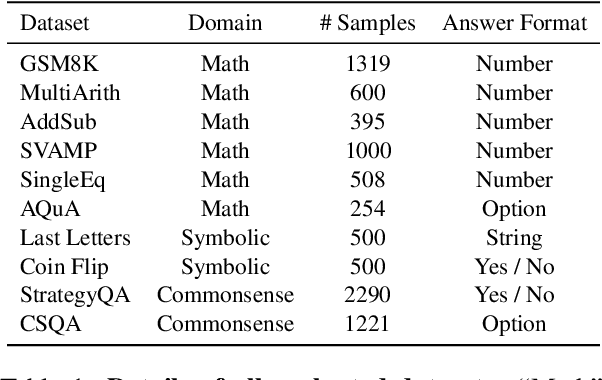

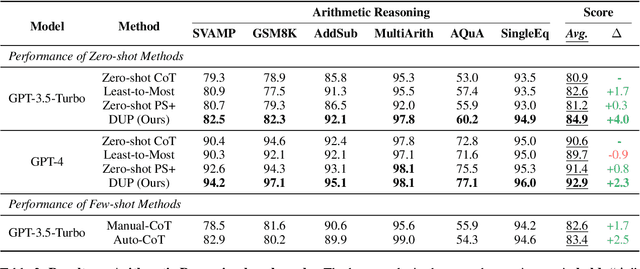
Chain of Thought prompting strategy has enhanced the performance of Large Language Models (LLMs) across various NLP tasks. However, it still has shortcomings when dealing with complex reasoning tasks, including understanding errors, calculation errors and process errors (e.g., missing-step and hallucinations). Subsequently, our in-depth analyses among various error types show that deeply understanding the whole problem is critical in addressing complicated reasoning tasks. Motivated by this, we propose a simple-yet-effective method, namely Deeply Understanding the Problems (DUP), to enhance the LLMs' reasoning abilities. The core of our method is to encourage the LLMs to deeply understand the problems and leverage the key problem-solving information for better reasoning. Extensive experiments on 10 diverse reasoning benchmarks show that our DUP method consistently outperforms the other counterparts by a large margin. More encouragingly, DUP achieves a new SOTA result on the GSM8K benchmark, with an accuracy of 97.1% in a zero-shot setting.