 Add to Chrome
 Add to Firefox
 Add to Edge
When Self-Evolution Backfires: Pre-Commit Gating against Skill Contamination in LLM Agents
Aug 06, 2026
Self-evolving agents accumulate capability by distilling reusable skills from their execution trajectories, but we find this process is not monotonic: past a critical pool size, newly added skills degrade performance instead of improving it. We formalize this capability-contamination phase transition and trace it to a structural cause: once a defective skill enters the decision context, it becomes reference material for distilling later skills, forming cross-round contamination chains. We further show the contamination is structurally irreversible: removing a source skill after the fact cannot erase the flawed reasoning its descendants have already inherited, so post-hoc rollback recovers only a small fraction of the lost performance. This makes skill admission a pre-commit necessity rather than a post-hoc fix, and motivates Verifier-as-Gatekeeper (VaG): a progressive trust hierarchy whose three heterogeneous critics - structural validity, behavioral harmlessness, and semantic consistency - filter each skill individually, coupled with a marginal-gain subset selection that removes combinatorial contamination at the top tier before skills reach the runtime context. On Terminal-Bench 2, unconditional accumulation rises to a peak and then degrades, giving back most of its gains as the pool keeps growing, and post-hoc removal of the culprit skills recovers only a small part of the drop - the empirical signature of irreversibility. In contrast, VaG improves every round, reaching 72% pass@1 with a pool roughly 5x smaller, and its frozen skill pool transfers positively to four other backbones and a second benchmark without re-evolution. Ablations confirm the three critics are complementary and mutually non-substitutable, each intercepting a largely disjoint class of harmful skills.

GraSP: Graph-Structured Skill Compositions for LLM Agents
Apr 20, 2026Skill ecosystems for LLM agents have matured rapidly, yet recent benchmarks show that providing agents with more skills does not monotonically improve performance -- focused sets of 2-3 skills outperform comprehensive documentation, and excessive skills actually hurt. The bottleneck has shifted from skill availability to skill orchestration: agents need not more skills, but a structural mechanism to select, compose, and execute them with explicit causal dependencies. We propose GraSP, the first executable skill graph architecture that introduces a compilation layer between skill retrieval and execution. GraSP transforms flat skill sets into typed directed acyclic graphs (DAGs) with precondition-effect edges, executes them with node-level verification, and performs locality-bounded repair through five typed operators -- reducing replanning from O(N) to O(d^h). Across ALFWorld, ScienceWorld, WebShop, and InterCode with eight LLM backbones, GraSP outperforms ReAct, Reflexion, ExpeL, and flat skill baselines in every configuration, improving reward by up to +19 points over the strongest baseline while cutting environment steps by up to 41%. GraSP's advantage grows with task complexity and is robust to both skill over-retrieval and quality degradation, confirming that structured orchestration -- not larger skill libraries -- is the key to reliable agent execution.
Search-P1: Path-Centric Reward Shaping for Stable and Efficient Agentic RAG Training
Feb 26, 2026Retrieval-Augmented Generation (RAG) enhances large language models (LLMs) by incorporating external knowledge, yet traditional single-round retrieval struggles with complex multi-step reasoning. Agentic RAG addresses this by enabling LLMs to dynamically decide when and what to retrieve, but current RL-based training methods suffer from sparse outcome rewards that discard intermediate signals and low sample efficiency where failed samples contribute nothing. We propose Search-P1, a framework that introduces path-centric reward shaping for agentic RAG training, comprising two key components: (1) Path-Centric Reward, which evaluates the structural quality of reasoning trajectories through order-agnostic step coverage and soft scoring that extracts learning signals even from failed samples, and (2) Dual-Track Path Scoring with offline-generated reference planners that assesses paths from both self-consistency and reference-alignment perspectives. Experiments on multiple QA benchmarks demonstrate that Search-P1 achieves significant improvements over Search-R1 and other strong baselines, with an average accuracy gain of 7.7 points.
Towards Faithful Industrial RAG: A Reinforced Co-adaptation Framework for Advertising QA
Feb 26, 2026Industrial advertising question answering (QA) is a high-stakes task in which hallucinated content, particularly fabricated URLs, can lead to financial loss, compliance violations, and legal risk. Although Retrieval-Augmented Generation (RAG) is widely adopted, deploying it in production remains challenging because industrial knowledge is inherently relational, frequently updated, and insufficiently aligned with generation objectives. We propose a reinforced co-adaptation framework that jointly optimizes retrieval and generation through two components: (1) Graph-aware Retrieval (GraphRAG), which models entity-relation structure over a high-citation knowledge subgraph for multi-hop, domain-specific evidence selection; and (2) evidence-constrained reinforcement learning via Group Relative Policy Optimization (GRPO) with multi-dimensional rewards covering faithfulness, style compliance, safety, and URL validity. Experiments on an internal advertising QA dataset show consistent gains across expert-judged dimensions including accuracy, completeness, and safety, while reducing the hallucination rate by 72\%. A two-week online A/B test demonstrates a 28.6\% increase in like rate, a 46.2\% decrease in dislike rate, and a 92.7\% reduction in URL hallucination. The system has been running in production for over half a year and has served millions of QA interactions.
AD-Bench: A Real-World, Trajectory-Aware Advertising Analytics Benchmark for LLM Agents
Feb 15, 2026While Large Language Model (LLM) agents have achieved remarkable progress in complex reasoning tasks, evaluating their performance in real-world environments has become a critical problem. Current benchmarks, however, are largely restricted to idealized simulations, failing to address the practical demands of specialized domains like advertising and marketing analytics. In these fields, tasks are inherently more complex, often requiring multi-round interaction with professional marketing tools. To address this gap, we propose AD-Bench, a benchmark designed based on real-world business requirements of advertising and marketing platforms. AD-Bench is constructed from real user marketing analysis requests, with domain experts providing verifiable reference answers and corresponding reference tool-call trajectories. The benchmark categorizes requests into three difficulty levels (L1-L3) to evaluate agents' capabilities under multi-round, multi-tool collaboration. Experiments show that on AD-Bench, Gemini-3-Pro achieves Pass@1 = 68.0% and Pass@3 = 83.0%, but performance drops significantly on L3 to Pass@1 = 49.4% and Pass@3 = 62.1%, with a trajectory coverage of 70.1%, indicating that even state-of-the-art models still exhibit substantial capability gaps in complex advertising and marketing analysis scenarios. AD-Bench provides a realistic benchmark for evaluating and improving advertising marketing agents, the leaderboard and code can be found at https://github.com/Emanual20/adbench-leaderboard.
Improving Complex Reasoning over Knowledge Graph with Logic-Aware Curriculum Tuning
May 07, 2024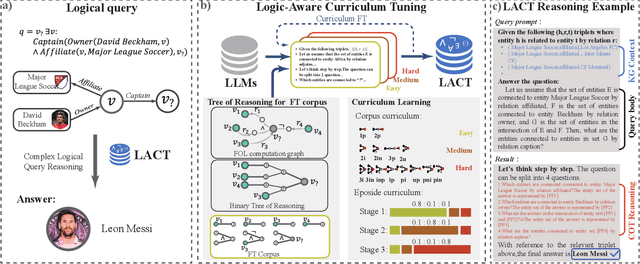
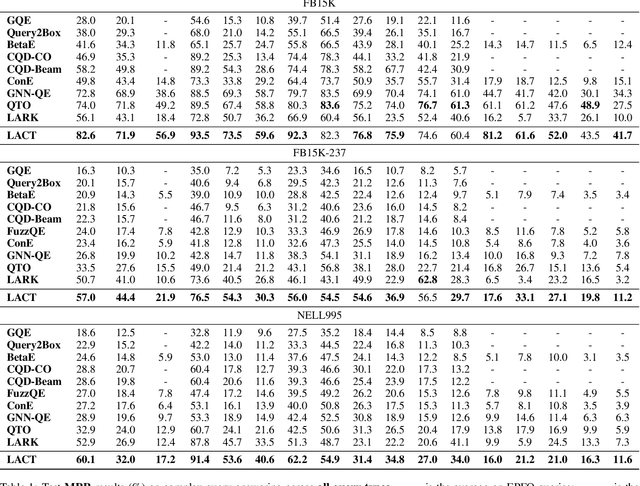
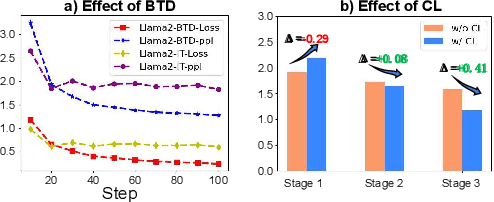
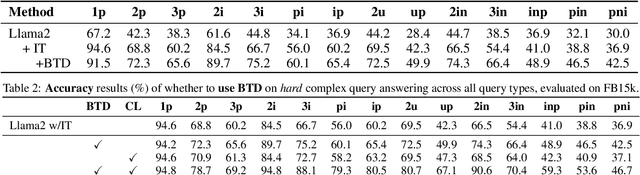
Answering complex logical queries over incomplete knowledge graphs (KGs) is challenging. Most previous works have focused on learning entity/relation embeddings and simulating first-order logic operators with various neural networks. However, they are bottlenecked by the inability to share world knowledge to improve logical reasoning, thus resulting in suboptimal performance. In this paper, we propose a complex logical reasoning schema over knowledge graphs upon large language models (LLMs), containing a curriculum-based logical-aware instruction tuning framework, named LACT. Specifically, we augment the arbitrary first-order logical queries via binary tree decomposition, to stimulate the reasoning capability of LLMs. To address the difficulty gap among different types of complex queries, we design a simple and flexible logic-aware curriculum learning framework. Experiments across widely used datasets demonstrate that LACT has substantial improvements~(brings an average +5.5% MRR score) over advanced methods, achieving the new state-of-the-art. Our code and model will be released at GitHub and huggingface soon.