 Add to Chrome
 Add to Firefox
 Add to Edge
Diff-VPS: Video Polyp Segmentation via a Multi-task Diffusion Network with Adversarial Temporal Reasoning
Sep 11, 2024
Diffusion Probabilistic Models have recently attracted significant attention in the community of computer vision due to their outstanding performance. However, while a substantial amount of diffusion-based research has focused on generative tasks, no work introduces diffusion models to advance the results of polyp segmentation in videos, which is frequently challenged by polyps' high camouflage and redundant temporal cues.In this paper, we present a novel diffusion-based network for video polyp segmentation task, dubbed as Diff-VPS. We incorporate multi-task supervision into diffusion models to promote the discrimination of diffusion models on pixel-by-pixel segmentation. This integrates the contextual high-level information achieved by the joint classification and detection tasks. To explore the temporal dependency, Temporal Reasoning Module (TRM) is devised via reasoning and reconstructing the target frame from the previous frames. We further equip TRM with a generative adversarial self-supervised strategy to produce more realistic frames and thus capture better dynamic cues. Extensive experiments are conducted on SUN-SEG, and the results indicate that our proposed Diff-VPS significantly achieves state-of-the-art performance. Code is available at https://github.com/lydia-yllu/Diff-VPS.

Serp-Mamba: Advancing High-Resolution Retinal Vessel Segmentation with Selective State-Space Model
Sep 06, 2024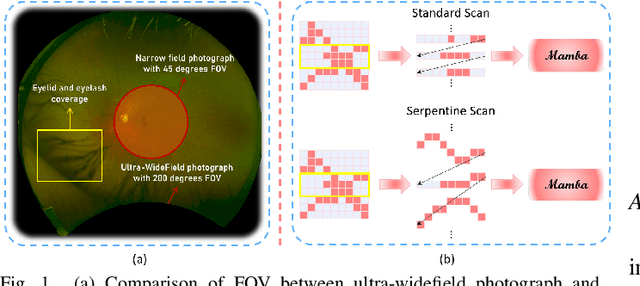
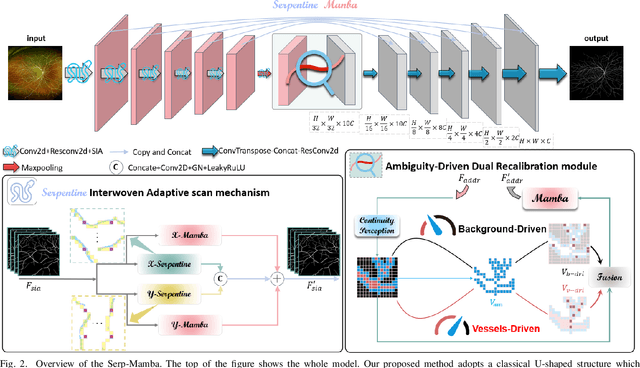
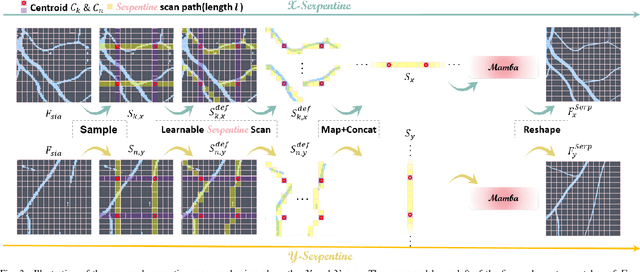
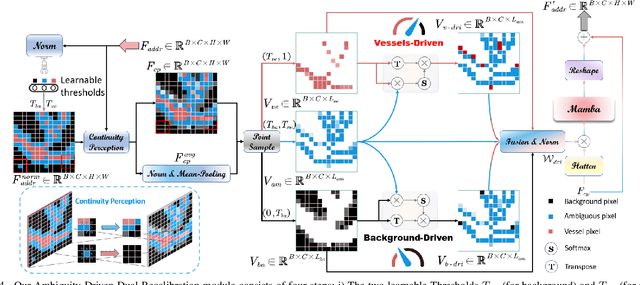
Ultra-Wide-Field Scanning Laser Ophthalmoscopy (UWF-SLO) images capture high-resolution views of the retina with typically 200 spanning degrees. Accurate segmentation of vessels in UWF-SLO images is essential for detecting and diagnosing fundus disease. Recent studies have revealed that the selective State Space Model (SSM) in Mamba performs well in modeling long-range dependencies, which is crucial for capturing the continuity of elongated vessel structures. Inspired by this, we propose the first Serpentine Mamba (Serp-Mamba) network to address this challenging task. Specifically, we recognize the intricate, varied, and delicate nature of the tubular structure of vessels. Furthermore, the high-resolution of UWF-SLO images exacerbates the imbalance between the vessel and background categories. Based on the above observations, we first devise a Serpentine Interwoven Adaptive (SIA) scan mechanism, which scans UWF-SLO images along curved vessel structures in a snake-like crawling manner. This approach, consistent with vascular texture transformations, ensures the effective and continuous capture of curved vascular structure features. Second, we propose an Ambiguity-Driven Dual Recalibration (ADDR) module to address the category imbalance problem intensified by high-resolution images. Our ADDR module delineates pixels by two learnable thresholds and refines ambiguous pixels through a dual-driven strategy, thereby accurately distinguishing vessels and background regions. Experiment results on three datasets demonstrate the superior performance of our Serp-Mamba on high-resolution vessel segmentation. We also conduct a series of ablation studies to verify the impact of our designs. Our code shall be released upon publication of this work.
SegTalker: Segmentation-based Talking Face Generation with Mask-guided Local Editing
Sep 05, 2024


Audio-driven talking face generation aims to synthesize video with lip movements synchronized to input audio. However, current generative techniques face challenges in preserving intricate regional textures (skin, teeth). To address the aforementioned challenges, we propose a novel framework called SegTalker to decouple lip movements and image textures by introducing segmentation as intermediate representation. Specifically, given the mask of image employed by a parsing network, we first leverage the speech to drive the mask and generate talking segmentation. Then we disentangle semantic regions of image into style codes using a mask-guided encoder. Ultimately, we inject the previously generated talking segmentation and style codes into a mask-guided StyleGAN to synthesize video frame. In this way, most of textures are fully preserved. Moreover, our approach can inherently achieve background separation and facilitate mask-guided facial local editing. In particular, by editing the mask and swapping the region textures from a given reference image (e.g. hair, lip, eyebrows), our approach enables facial editing seamlessly when generating talking face video. Experiments demonstrate that our proposed approach can effectively preserve texture details and generate temporally consistent video while remaining competitive in lip synchronization. Quantitative and qualitative results on the HDTF and MEAD datasets illustrate the superior performance of our method over existing methods.
Timeline and Boundary Guided Diffusion Network for Video Shadow Detection
Aug 21, 2024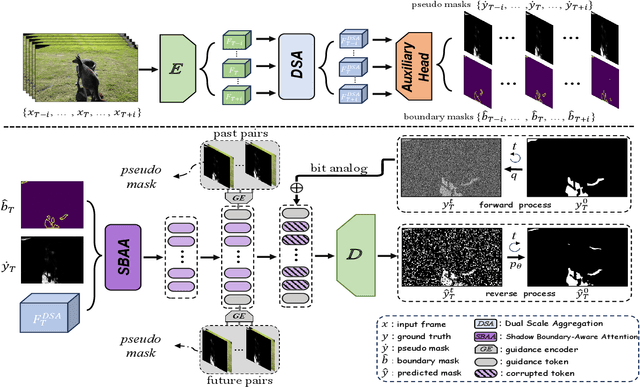
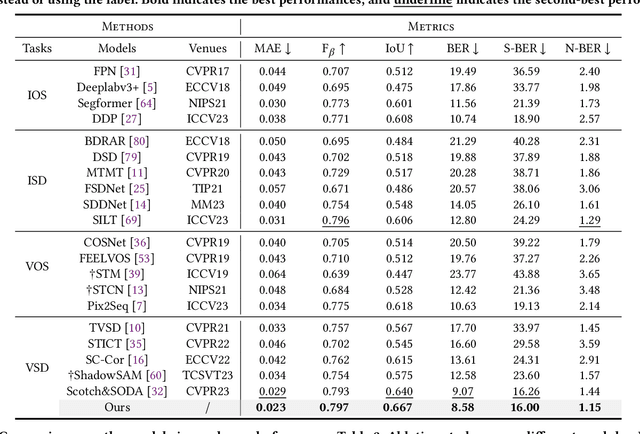
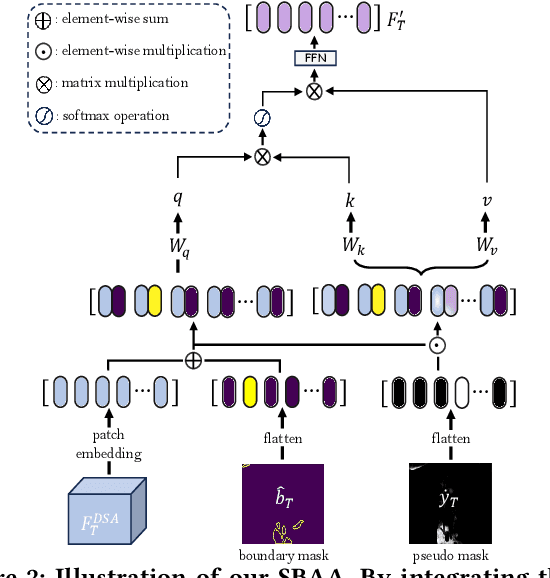
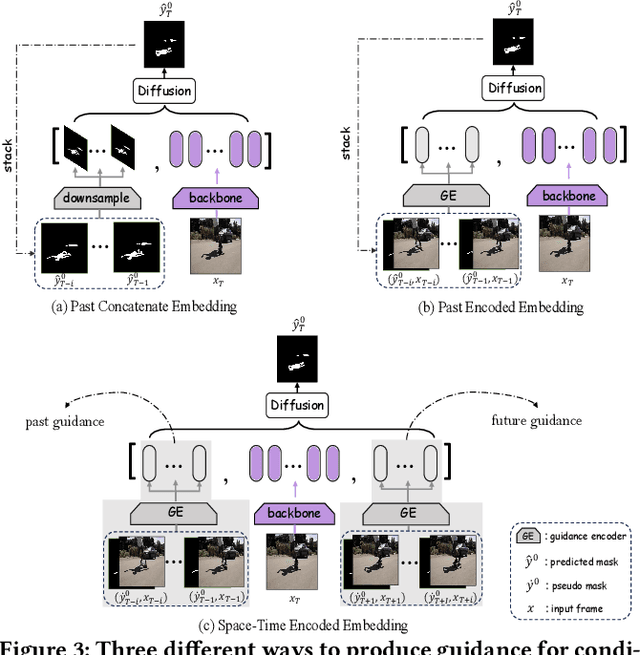
Video Shadow Detection (VSD) aims to detect the shadow masks with frame sequence. Existing works suffer from inefficient temporal learning. Moreover, few works address the VSD problem by considering the characteristic (i.e., boundary) of shadow. Motivated by this, we propose a Timeline and Boundary Guided Diffusion (TBGDiff) network for VSD where we take account of the past-future temporal guidance and boundary information jointly. In detail, we design a Dual Scale Aggregation (DSA) module for better temporal understanding by rethinking the affinity of the long-term and short-term frames for the clipped video. Next, we introduce Shadow Boundary Aware Attention (SBAA) to utilize the edge contexts for capturing the characteristics of shadows. Moreover, we are the first to introduce the Diffusion model for VSD in which we explore a Space-Time Encoded Embedding (STEE) to inject the temporal guidance for Diffusion to conduct shadow detection. Benefiting from these designs, our model can not only capture the temporal information but also the shadow property. Extensive experiments show that the performance of our approach overtakes the state-of-the-art methods, verifying the effectiveness of our components. We release the codes, weights, and results at \url{https://github.com/haipengzhou856/TBGDiff}.
Language-Driven Interactive Shadow Detection
Aug 16, 2024Traditional shadow detectors often identify all shadow regions of static images or video sequences. This work presents the Referring Video Shadow Detection (RVSD), which is an innovative task that rejuvenates the classic paradigm by facilitating the segmentation of particular shadows in videos based on descriptive natural language prompts. This novel RVSD not only achieves segmentation of arbitrary shadow areas of interest based on descriptions (flexibility) but also allows users to interact with visual content more directly and naturally by using natural language prompts (interactivity), paving the way for abundant applications ranging from advanced video editing to virtual reality experiences. To pioneer the RVSD research, we curated a well-annotated RVSD dataset, which encompasses 86 videos and a rich set of 15,011 paired textual descriptions with corresponding shadows. To the best of our knowledge, this dataset is the first one for addressing RVSD. Based on this dataset, we propose a Referring Shadow-Track Memory Network (RSM-Net) for addressing the RVSD task. In our RSM-Net, we devise a Twin-Track Synergistic Memory (TSM) to store intra-clip memory features and hierarchical inter-clip memory features, and then pass these memory features into a memory read module to refine features of the current video frame for referring shadow detection. We also develop a Mixed-Prior Shadow Attention (MSA) to utilize physical priors to obtain a coarse shadow map for learning more visual features by weighting it with the input video frame. Experimental results show that our RSM-Net achieves state-of-the-art performance for RVSD with a notable Overall IOU increase of 4.4\%. Our code and dataset are available at https://github.com/whq-xxh/RVSD.
Landmark-guided Diffusion Model for High-fidelity and Temporally Coherent Talking Head Generation
Aug 03, 2024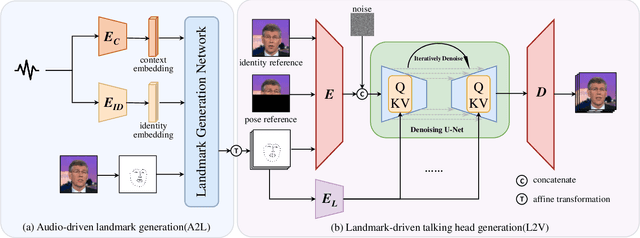
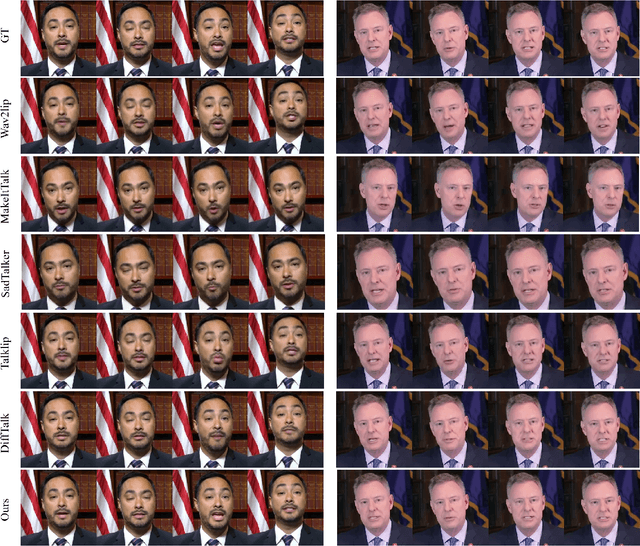
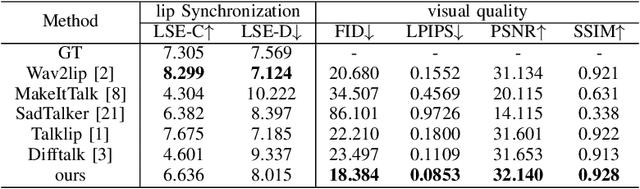
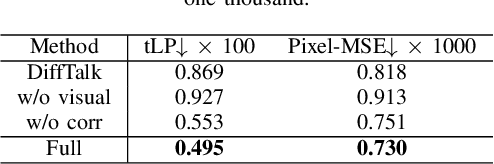
Audio-driven talking head generation is a significant and challenging task applicable to various fields such as virtual avatars, film production, and online conferences. However, the existing GAN-based models emphasize generating well-synchronized lip shapes but overlook the visual quality of generated frames, while diffusion-based models prioritize generating high-quality frames but neglect lip shape matching, resulting in jittery mouth movements. To address the aforementioned problems, we introduce a two-stage diffusion-based model. The first stage involves generating synchronized facial landmarks based on the given speech. In the second stage, these generated landmarks serve as a condition in the denoising process, aiming to optimize mouth jitter issues and generate high-fidelity, well-synchronized, and temporally coherent talking head videos. Extensive experiments demonstrate that our model yields the best performance.
RainMamba: Enhanced Locality Learning with State Space Models for Video Deraining
Jul 31, 2024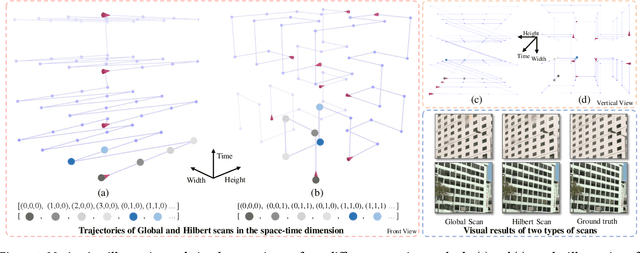
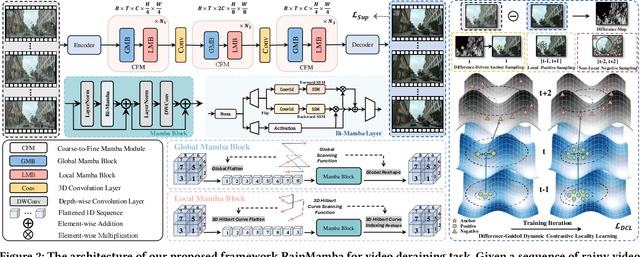

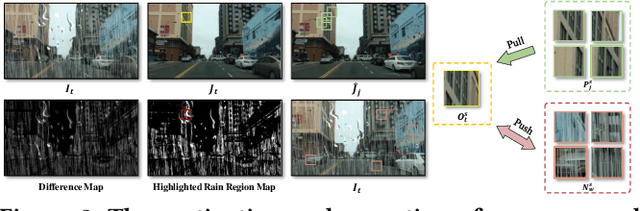
The outdoor vision systems are frequently contaminated by rain streaks and raindrops, which significantly degenerate the performance of visual tasks and multimedia applications. The nature of videos exhibits redundant temporal cues for rain removal with higher stability. Traditional video deraining methods heavily rely on optical flow estimation and kernel-based manners, which have a limited receptive field. Yet, transformer architectures, while enabling long-term dependencies, bring about a significant increase in computational complexity. Recently, the linear-complexity operator of the state space models (SSMs) has contrarily facilitated efficient long-term temporal modeling, which is crucial for rain streaks and raindrops removal in videos. Unexpectedly, its uni-dimensional sequential process on videos destroys the local correlations across the spatio-temporal dimension by distancing adjacent pixels. To address this, we present an improved SSMs-based video deraining network (RainMamba) with a novel Hilbert scanning mechanism to better capture sequence-level local information. We also introduce a difference-guided dynamic contrastive locality learning strategy to enhance the patch-level self-similarity learning ability of the proposed network. Extensive experiments on four synthesized video deraining datasets and real-world rainy videos demonstrate the superiority of our network in the removal of rain streaks and raindrops.
RestoreAgent: Autonomous Image Restoration Agent via Multimodal Large Language Models
Jul 25, 2024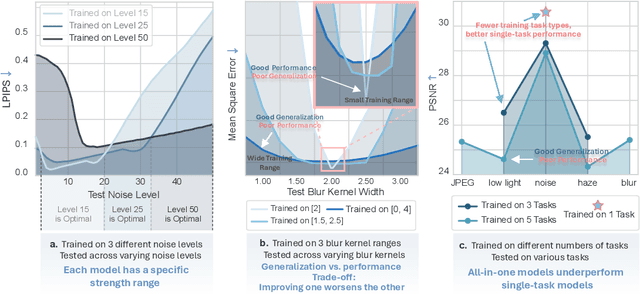
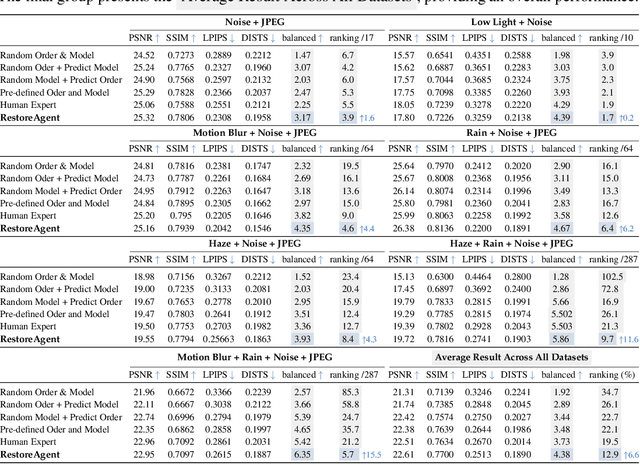
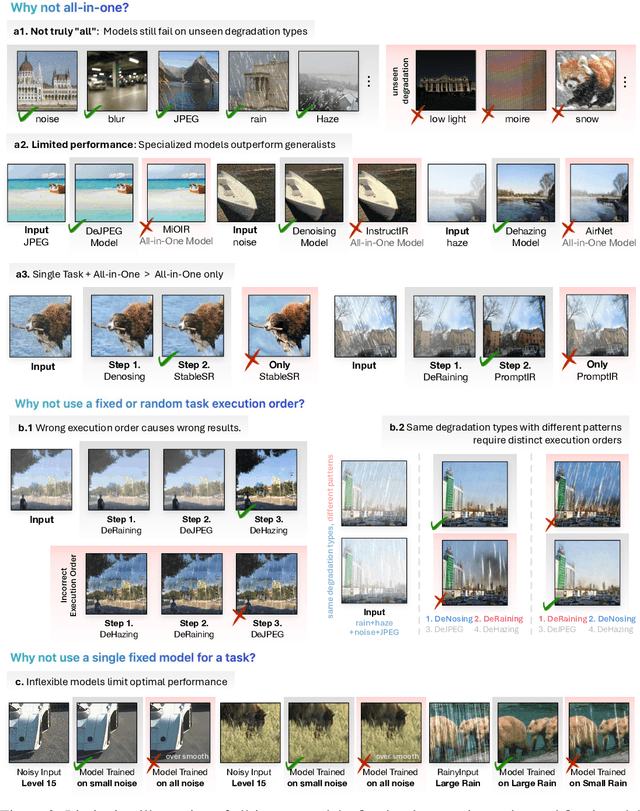
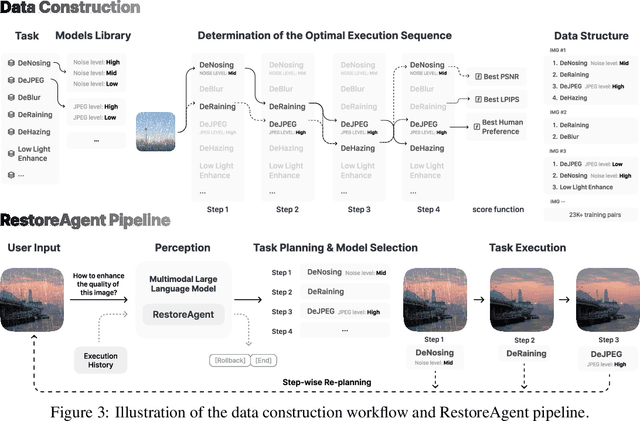
Natural images captured by mobile devices often suffer from multiple types of degradation, such as noise, blur, and low light. Traditional image restoration methods require manual selection of specific tasks, algorithms, and execution sequences, which is time-consuming and may yield suboptimal results. All-in-one models, though capable of handling multiple tasks, typically support only a limited range and often produce overly smooth, low-fidelity outcomes due to their broad data distribution fitting. To address these challenges, we first define a new pipeline for restoring images with multiple degradations, and then introduce RestoreAgent, an intelligent image restoration system leveraging multimodal large language models. RestoreAgent autonomously assesses the type and extent of degradation in input images and performs restoration through (1) determining the appropriate restoration tasks, (2) optimizing the task sequence, (3) selecting the most suitable models, and (4) executing the restoration. Experimental results demonstrate the superior performance of RestoreAgent in handling complex degradation, surpassing human experts. Furthermore, the system modular design facilitates the fast integration of new tasks and models, enhancing its flexibility and scalability for various applications.
AGLLDiff: Guiding Diffusion Models Towards Unsupervised Training-free Real-world Low-light Image Enhancement
Jul 23, 2024
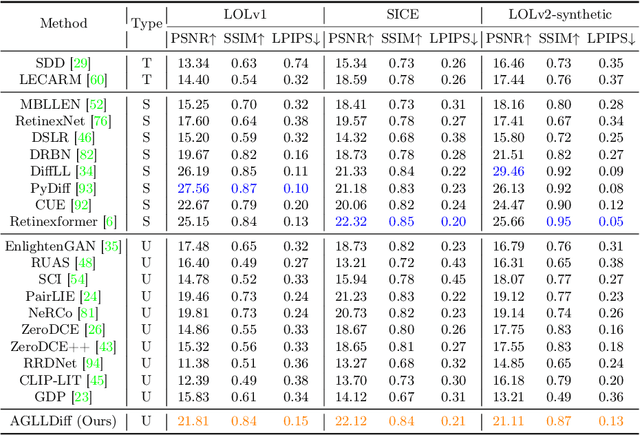
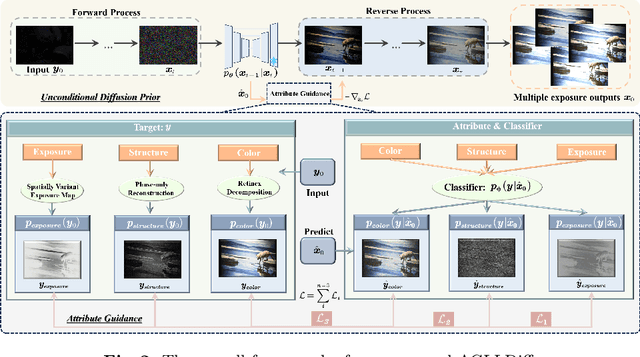
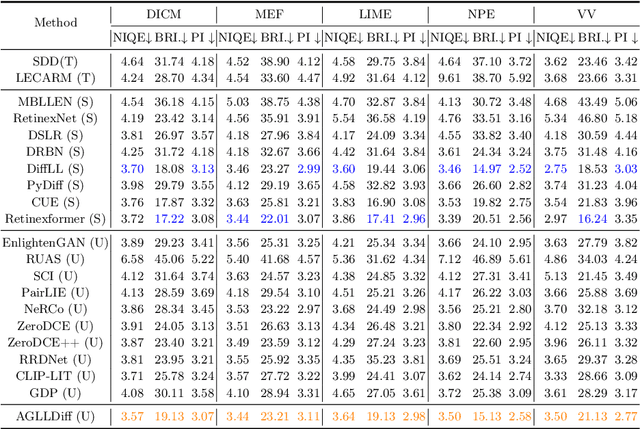
Existing low-light image enhancement (LIE) methods have achieved noteworthy success in solving synthetic distortions, yet they often fall short in practical applications. The limitations arise from two inherent challenges in real-world LIE: 1) the collection of distorted/clean image pairs is often impractical and sometimes even unavailable, and 2) accurately modeling complex degradations presents a non-trivial problem. To overcome them, we propose the Attribute Guidance Diffusion framework (AGLLDiff), a training-free method for effective real-world LIE. Instead of specifically defining the degradation process, AGLLDiff shifts the paradigm and models the desired attributes, such as image exposure, structure and color of normal-light images. These attributes are readily available and impose no assumptions about the degradation process, which guides the diffusion sampling process to a reliable high-quality solution space. Extensive experiments demonstrate that our approach outperforms the current leading unsupervised LIE methods across benchmarks in terms of distortion-based and perceptual-based metrics, and it performs well even in sophisticated wild degradation.
LGRNet: Local-Global Reciprocal Network for Uterine Fibroid Segmentation in Ultrasound Videos
Jul 08, 2024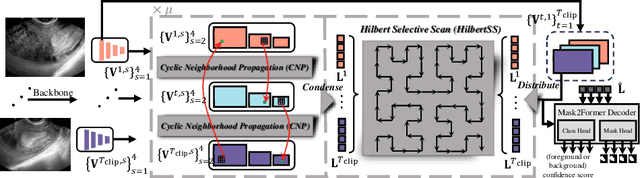
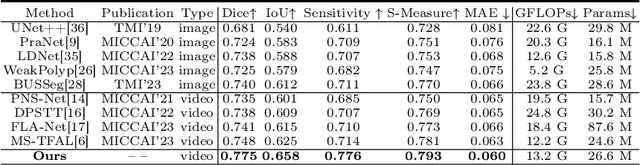
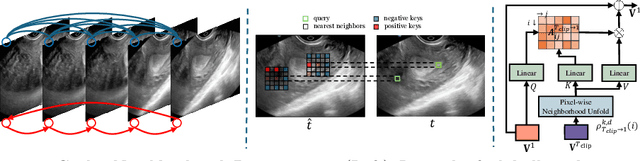
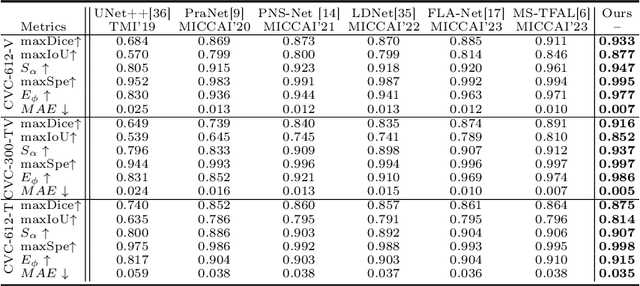
Regular screening and early discovery of uterine fibroid are crucial for preventing potential malignant transformations and ensuring timely, life-saving interventions. To this end, we collect and annotate the first ultrasound video dataset with 100 videos for uterine fibroid segmentation (UFUV). We also present Local-Global Reciprocal Network (LGRNet) to efficiently and effectively propagate the long-term temporal context which is crucial to help distinguish between uninformative noisy surrounding tissues and target lesion regions. Specifically, the Cyclic Neighborhood Propagation (CNP) is introduced to propagate the inter-frame local temporal context in a cyclic manner. Moreover, to aggregate global temporal context, we first condense each frame into a set of frame bottleneck queries and devise Hilbert Selective Scan (HilbertSS) to both efficiently path connect each frame and preserve the locality bias. A distribute layer is then utilized to disseminate back the global context for reciprocal refinement. Extensive experiments on UFUV and three public Video Polyp Segmentation (VPS) datasets demonstrate consistent improvements compared to state-of-the-art segmentation methods, indicating the effectiveness and versatility of LGRNet. Code, checkpoints, and dataset are available at https://github.com/bio-mlhui/LGRNet