 Add to Chrome
 Add to Firefox
 Add to Edge
Reactivity-Informed Machine Learning for Performance Prediction and Design Space Exploration of Alkali-Activated Slag
Jun 04, 2026
Establishing quantitative relationships among mix design, raw material properties, curing conditions, and performance remains a long-standing challenge in cementitious materials, particularly for alkali-activated materials with variable precursor and activator chemistry. Here, we curated the largest literature-derived alkali-activated slag (AAS) dataset to date, comprising over 3100 compressive strength records, 155 chemically distinct ground granulated blast-furnace slags (GGBSs), and 24 attributes incorporating precursor chemistry, fineness, and reactivity. Multiple machine learning (ML) algorithms were benchmarked across progressively enriched feature scenarios, demonstrating that integrating GGBS compositions, fineness, curing conditions, and specimen geometry improves predictive performance. The average metal oxide dissociation energy (AMODE), a physically interpretable representation of precursor reactivity, provides a compact alternative descriptor to explicit oxide compositions while enabling comparable predictive performance. Model interpretation revealed physically consistent trends from heterogeneous data, including non-monotonic effects of Na2O dosage and silicate modulus, reduced predicted strength at higher water content and larger specimen size, and coupled oxide-level effects more coherently represented by AMODE than by individual oxide contents. Statistically constrained design space exploration reveals reactivity-dependent trade-offs among strength, embodied CO2 emissions, and cost. The design maps identify high-strength regions with substantially lower CO2 emissions than OPC-based references at similar cost. Overall, this work demonstrates how reactivity-informed ML can extract physically meaningful trends from heterogeneous AAS data and guide source-dependent binder design. The curated dataset is publicly accessible to support advances in cement and concrete research.

Large language model-enabled automated data extraction for concrete materials informatics
Apr 24, 2026The promise of data-driven materials discovery remains constrained by the scarcity of large, high-quality, and accessible experimental datasets. Here, we introduce a generalizable large language model (LLM)-powered pipeline for automated extraction and structuring of materials data from unstructured scientific literature, using concrete materials as a representative and particularly challenging example. The pipeline exhibits robust performance across a broad range of LLMs and achieves an $F_1$ score of up to 0.97 for diverse composition--process--property attributes. Within one hour, it extracts nearly 9,000 high-quality records with over 100 attributes screened from more than 27,000 publications, enabling the construction of the largest open laboratory database for blended cement concrete. Machine learning analyses underscore the importance of large, diverse, and information-rich datasets for enhancing both in-distribution accuracy and out-of-distribution generalization to unseen materials. The proposed pipeline is readily adaptable to other materials domains and accelerates the development of scalable data infrastructures for materials informatics.
Landmark-guided Diffusion Model for High-fidelity and Temporally Coherent Talking Head Generation
Aug 03, 2024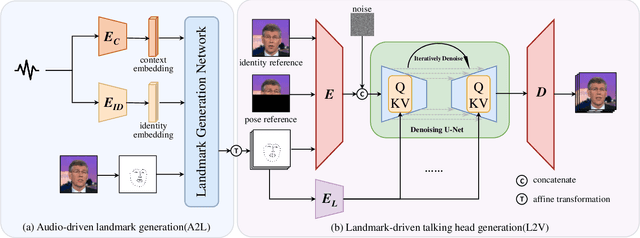
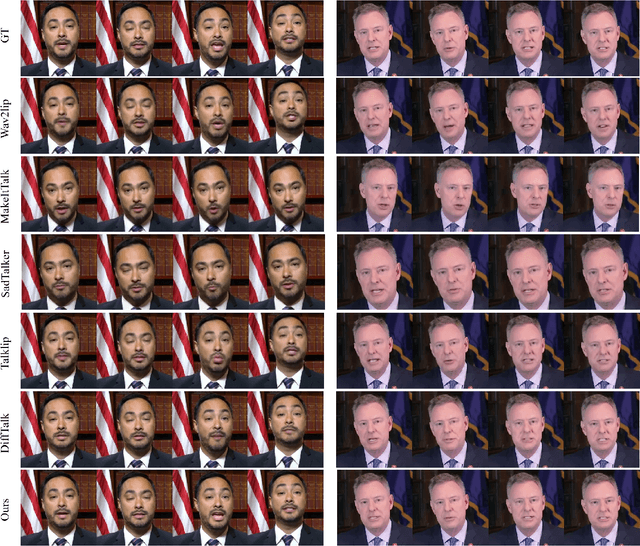
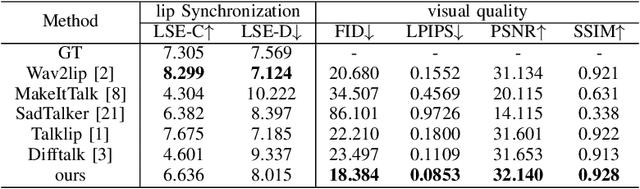
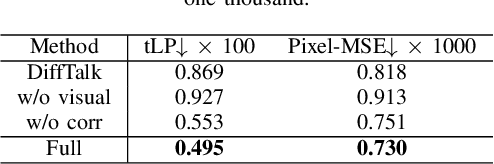
Audio-driven talking head generation is a significant and challenging task applicable to various fields such as virtual avatars, film production, and online conferences. However, the existing GAN-based models emphasize generating well-synchronized lip shapes but overlook the visual quality of generated frames, while diffusion-based models prioritize generating high-quality frames but neglect lip shape matching, resulting in jittery mouth movements. To address the aforementioned problems, we introduce a two-stage diffusion-based model. The first stage involves generating synchronized facial landmarks based on the given speech. In the second stage, these generated landmarks serve as a condition in the denoising process, aiming to optimize mouth jitter issues and generate high-fidelity, well-synchronized, and temporally coherent talking head videos. Extensive experiments demonstrate that our model yields the best performance.