 Add to Chrome
 Add to Firefox
 Add to Edge
C-MIG: Multi-view Information Gain-based Retrieval-Augmented Generation for Clinical Diagnosis Reasoning
May 27, 2026
Retrieval-augmented generation combined with reinforcement learning has shown promise for grounding large language models in trustworthy medical evidence. However, existing methods rely on exact-match binary rewards, which in clinical diagnosis cause two issues: (i) semantically relevant but non-verbatim steps receive zero signal, discarding valuable learning signals; and (ii) uni-dimensional rewards cannot effectively supervise heterogeneous reasoning capabilities. To address these issues, we propose C-MIG, a Multi-view Information Gain-based retrieval-augmented generation framework for Clinical diagnosis. C-MIG estimates information gain under a frozen reference model from two complementary views, retrieved-document and document-refinement, to jointly guide what to retrieve and how to refine, alleviating the issues of valuable reward signal loss and credit assignment. We further design a multi-subquery retrieval augmentation strategy that improves knowledge recall coverage in clinical diagnostic scenarios. Comprehensive experiments on four medical benchmarks demonstrate that C-MIG achieves the best performance among all RAG-RL methods on both in-domain and out-of-domain sets, and outperforms state-of-the-art general-purpose LLMs for clinical diagnosis.

EAPO: Entropy-Driven Adaptive Positive-Negative Sample Weighting for Policy Optimization in Open-Ended QA
May 27, 2026Large Reasoning Models are typically trained via reinforcement learning from verifiable rewards (RLVR). However, existing approaches adopt fixed weights for positive and negative samples, and the conclusions hardly generalize to open-ended question answering (QA). In this paper, we systematically investigate the roles of positive and negative samples in reinforcement learning for open-ended QA. We propose a reward-mean-based strategy for distinguishing positive from negative samples, and observe that negative samples predominantly govern response diversity and the performance upper bound, whereas positive samples primarily determine response quality and convergence stability. Building on these observations, we propose EAPO, an Entropy-driven Adaptive Policy Optimization method that adaptively computes the weighting coefficients of positive samples based on the ratio of the current policy entropy to the initial entropy. During the entropy-decreasing phase, the weight assigned to positive samples is reduced to preserve exploration, whereas during the entropy-increasing phase it is amplified to reinforce stability, thereby mitigating entropy collapse. Experiments on two publicly available open-ended medical QA datasets demonstrate that EAPO consistently and substantially outperforms fixed-weight baselines in both response diversity and stability.
M3DHMR: Monocular 3D Hand Mesh Recovery
May 26, 2025Monocular 3D hand mesh recovery is challenging due to high degrees of freedom of hands, 2D-to-3D ambiguity and self-occlusion. Most existing methods are either inefficient or less straightforward for predicting the position of 3D mesh vertices. Thus, we propose a new pipeline called Monocular 3D Hand Mesh Recovery (M3DHMR) to directly estimate the positions of hand mesh vertices. M3DHMR provides 2D cues for 3D tasks from a single image and uses a new spiral decoder consist of several Dynamic Spiral Convolution (DSC) Layers and a Region of Interest (ROI) Layer. On the one hand, DSC Layers adaptively adjust the weights based on the vertex positions and extract the vertex features in both spatial and channel dimensions. On the other hand, ROI Layer utilizes the physical information and refines mesh vertices in each predefined hand region separately. Extensive experiments on popular dataset FreiHAND demonstrate that M3DHMR significantly outperforms state-of-the-art real-time methods.
SegTalker: Segmentation-based Talking Face Generation with Mask-guided Local Editing
Sep 05, 2024


Audio-driven talking face generation aims to synthesize video with lip movements synchronized to input audio. However, current generative techniques face challenges in preserving intricate regional textures (skin, teeth). To address the aforementioned challenges, we propose a novel framework called SegTalker to decouple lip movements and image textures by introducing segmentation as intermediate representation. Specifically, given the mask of image employed by a parsing network, we first leverage the speech to drive the mask and generate talking segmentation. Then we disentangle semantic regions of image into style codes using a mask-guided encoder. Ultimately, we inject the previously generated talking segmentation and style codes into a mask-guided StyleGAN to synthesize video frame. In this way, most of textures are fully preserved. Moreover, our approach can inherently achieve background separation and facilitate mask-guided facial local editing. In particular, by editing the mask and swapping the region textures from a given reference image (e.g. hair, lip, eyebrows), our approach enables facial editing seamlessly when generating talking face video. Experiments demonstrate that our proposed approach can effectively preserve texture details and generate temporally consistent video while remaining competitive in lip synchronization. Quantitative and qualitative results on the HDTF and MEAD datasets illustrate the superior performance of our method over existing methods.
EmoFace: Emotion-Content Disentangled Speech-Driven 3D Talking Face with Mesh Attention
Aug 21, 2024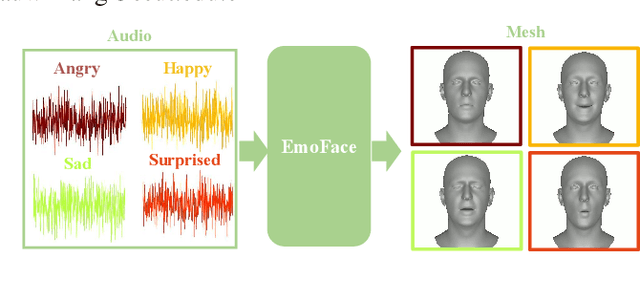


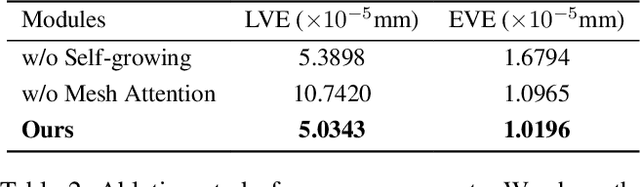
The creation of increasingly vivid 3D virtual digital humans has become a hot topic in recent years. Currently, most speech-driven work focuses on training models to learn the relationship between phonemes and visemes to achieve more realistic lips. However, they fail to capture the correlations between emotions and facial expressions effectively. To solve this problem, we propose a new model, termed EmoFace. EmoFace employs a novel Mesh Attention mechanism, which helps to learn potential feature dependencies between mesh vertices in time and space. We also adopt, for the first time to our knowledge, an effective self-growing training scheme that combines teacher-forcing and scheduled sampling in a 3D face animation task. Additionally, since EmoFace is an autoregressive model, there is no requirement that the first frame of the training data must be a silent frame, which greatly reduces the data limitations and contributes to solve the current dilemma of insufficient datasets. Comprehensive quantitative and qualitative evaluations on our proposed high-quality reconstructed 3D emotional facial animation dataset, 3D-RAVDESS ($5.0343\times 10^{-5}$mm for LVE and $1.0196\times 10^{-5}$mm for EVE), and publicly available dataset VOCASET ($2.8669\times 10^{-5}$mm for LVE and $0.4664\times 10^{-5}$mm for EVE), demonstrate that our algorithm achieves state-of-the-art performance.
Landmark-guided Diffusion Model for High-fidelity and Temporally Coherent Talking Head Generation
Aug 03, 2024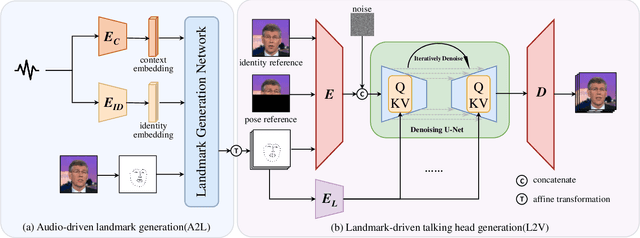
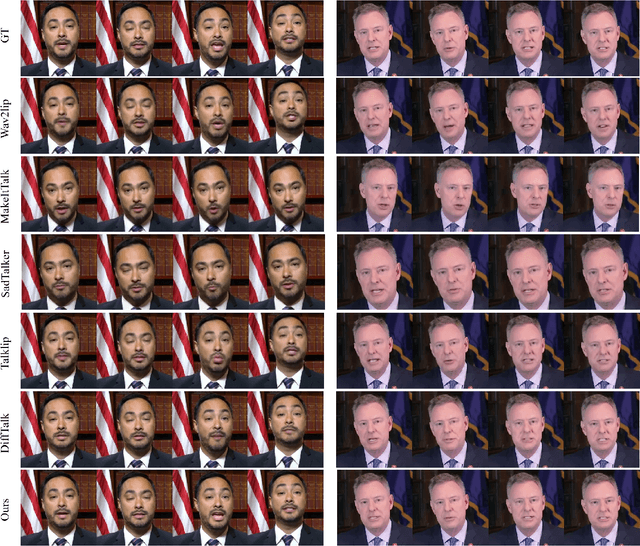
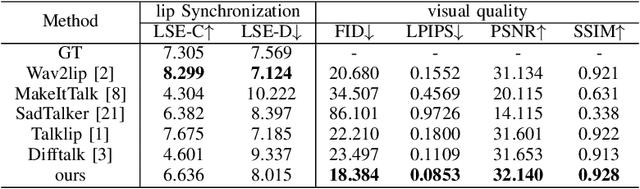
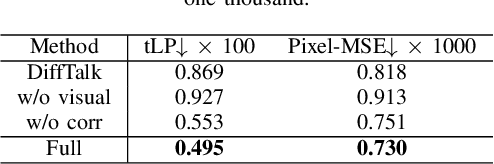
Audio-driven talking head generation is a significant and challenging task applicable to various fields such as virtual avatars, film production, and online conferences. However, the existing GAN-based models emphasize generating well-synchronized lip shapes but overlook the visual quality of generated frames, while diffusion-based models prioritize generating high-quality frames but neglect lip shape matching, resulting in jittery mouth movements. To address the aforementioned problems, we introduce a two-stage diffusion-based model. The first stage involves generating synchronized facial landmarks based on the given speech. In the second stage, these generated landmarks serve as a condition in the denoising process, aiming to optimize mouth jitter issues and generate high-fidelity, well-synchronized, and temporally coherent talking head videos. Extensive experiments demonstrate that our model yields the best performance.
GLDiTalker: Speech-Driven 3D Facial Animation with Graph Latent Diffusion Transformer
Aug 03, 2024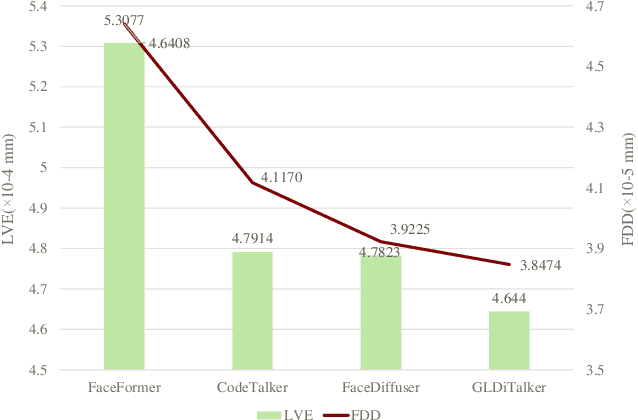

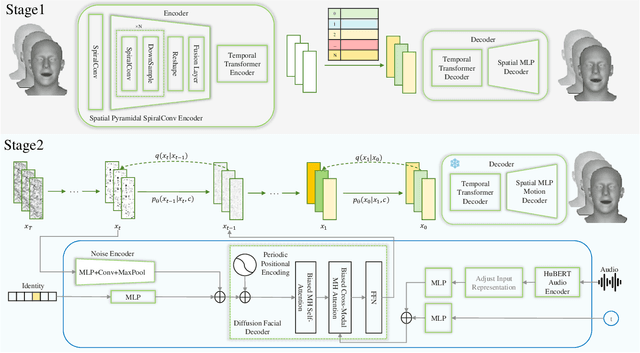

3D speech-driven facial animation generation has received much attention in both industrial applications and academic research. Since the non-verbal facial cues that exist across the face in reality are non-deterministic, the generated results should be diverse. However, most recent methods are deterministic models that cannot learn a many-to-many mapping between audio and facial motion to generate diverse facial animations. To address this problem, we propose GLDiTalker, which introduces a motion prior along with some stochasticity to reduce the uncertainty of cross-modal mapping while increasing non-determinacy of the non-verbal facial cues that reside throughout the face. Particularly, GLDiTalker uses VQ-VAE to map facial motion mesh sequences into latent space in the first stage, and then iteratively adds and removes noise to the latent facial motion features in the second stage. In order to integrate different levels of spatial information, the Spatial Pyramidal SpiralConv Encoder is also designed to extract multi-scale features. Extensive qualitative and quantitative experiments demonstrate that our method achieves the state-of-the-art performance.