 Add to Chrome
 Add to Firefox
 Add to Edge
CIF-Bench: A Chinese Instruction-Following Benchmark for Evaluating the Generalizability of Large Language Models
Feb 20, 2024
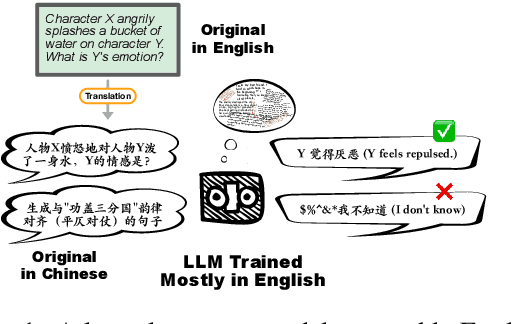
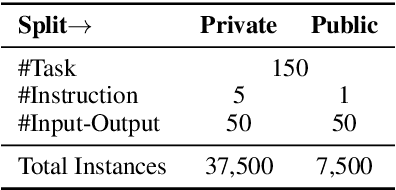
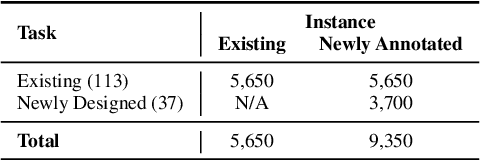
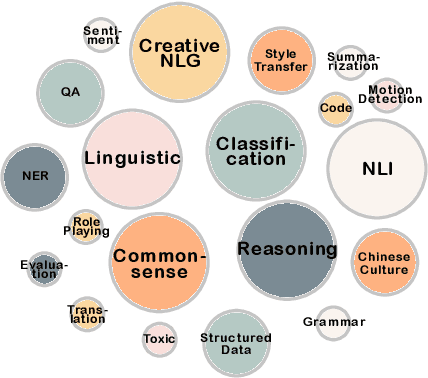
The advancement of large language models (LLMs) has enhanced the ability to generalize across a wide range of unseen natural language processing (NLP) tasks through instruction-following. Yet, their effectiveness often diminishes in low-resource languages like Chinese, exacerbated by biased evaluations from data leakage, casting doubt on their true generalizability to new linguistic territories. In response, we introduce the Chinese Instruction-Following Benchmark (CIF-Bench), designed to evaluate the zero-shot generalizability of LLMs to the Chinese language. CIF-Bench comprises 150 tasks and 15,000 input-output pairs, developed by native speakers to test complex reasoning and Chinese cultural nuances across 20 categories. To mitigate evaluation bias, we release only half of the dataset publicly, with the remainder kept private, and introduce diversified instructions to minimize score variance, totaling 45,000 data instances. Our evaluation of 28 selected LLMs reveals a noticeable performance gap, with the best model scoring only 52.9%, highlighting the limitations of LLMs in less familiar language and task contexts. This work aims to uncover the current limitations of LLMs in handling Chinese tasks, pushing towards the development of more culturally informed and linguistically diverse models with the released data and benchmark (https://yizhilll.github.io/CIF-Bench/).

EBFT: Effective and Block-Wise Fine-Tuning for Sparse LLMs
Feb 19, 2024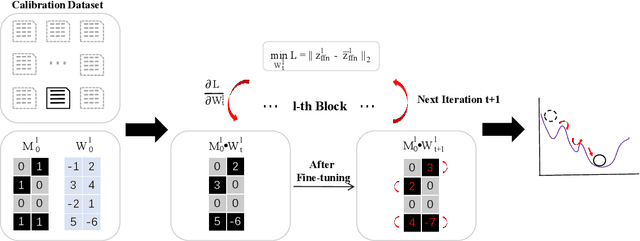
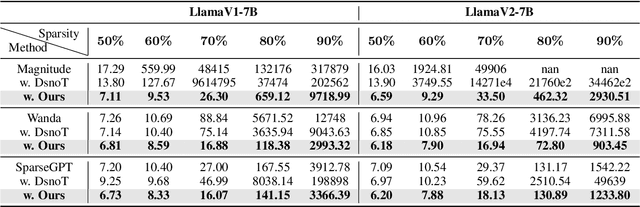
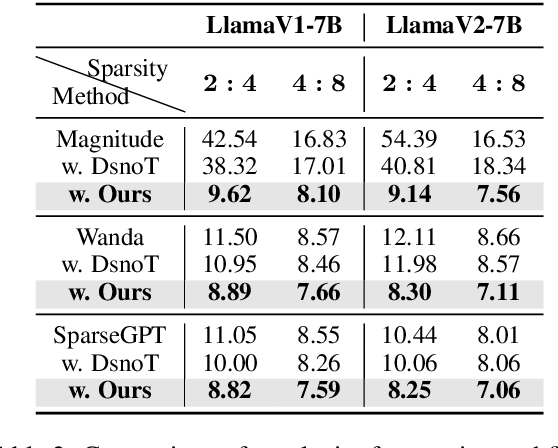
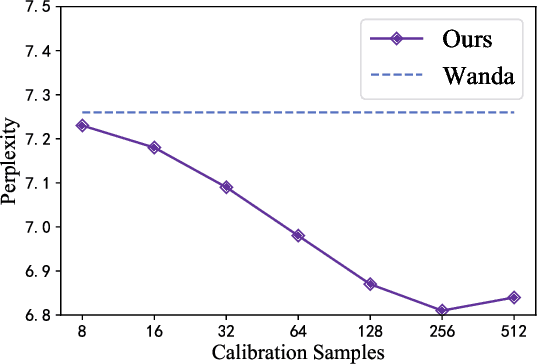
Existing methods for fine-tuning sparse LLMs often suffer from resource-intensive requirements and high retraining costs. Additionally, many fine-tuning methods often rely on approximations or heuristic optimization strategies, which may lead to suboptimal solutions. To address these issues, we propose an efficient and fast framework for fine-tuning sparse LLMs based on minimizing reconstruction error. Our approach involves sampling a small dataset for calibration and utilizing backpropagation to iteratively optimize block-wise reconstruction error, on a block-by-block basis, aiming for optimal solutions. Extensive experiments on various benchmarks consistently demonstrate the superiority of our method over other baselines. For instance, on the Wikitext2 dataset with LlamaV1-7B at 70% sparsity, our proposed EBFT achieves a perplexity of 16.88, surpassing the state-of-the-art DSnoT with a perplexity of 75.14. Moreover, with a structured sparsity ratio of 26\%, EBFT achieves a perplexity of 16.27, outperforming LoRA (perplexity 16.44). Furthermore, the fine-tuning process of EBFT for LlamaV1-7B only takes approximately 30 minutes, and the entire framework can be executed on a single 16GB GPU. The source code is available at https://github.com/sunggo/EBFT.
Invariance-powered Trustworthy Defense via Remove Then Restore
Feb 01, 2024Adversarial attacks pose a challenge to the deployment of deep neural networks (DNNs), while previous defense models overlook the generalization to various attacks. Inspired by targeted therapies for cancer, we view adversarial samples as local lesions of natural benign samples, because a key finding is that salient attack in an adversarial sample dominates the attacking process, while trivial attack unexpectedly provides trustworthy evidence for obtaining generalizable robustness. Based on this finding, a Pixel Surgery and Semantic Regeneration (PSSR) model following the targeted therapy mechanism is developed, which has three merits: 1) To remove the salient attack, a score-based Pixel Surgery module is proposed, which retains the trivial attack as a kind of invariance information. 2) To restore the discriminative content, a Semantic Regeneration module based on a conditional alignment extrapolator is proposed, which achieves pixel and semantic consistency. 3) To further harmonize robustness and accuracy, an intractable problem, a self-augmentation regularizer with adversarial R-drop is designed. Experiments on numerous benchmarks show the superiority of PSSR.
Grounded SAM: Assembling Open-World Models for Diverse Visual Tasks
Jan 25, 2024We introduce Grounded SAM, which uses Grounding DINO as an open-set object detector to combine with the segment anything model (SAM). This integration enables the detection and segmentation of any regions based on arbitrary text inputs and opens a door to connecting various vision models. As shown in Fig.1, a wide range of vision tasks can be achieved by using the versatile Grounded SAM pipeline. For example, an automatic annotation pipeline based solely on input images can be realized by incorporating models such as BLIP and Recognize Anything. Additionally, incorporating Stable-Diffusion allows for controllable image editing, while the integration of OSX facilitates promptable 3D human motion analysis. Grounded SAM also shows superior performance on open-vocabulary benchmarks, achieving 48.7 mean AP on SegInW (Segmentation in the wild) zero-shot benchmark with the combination of Grounding DINO-Base and SAM-Huge models.
LanDA: Language-Guided Multi-Source Domain Adaptation
Jan 25, 2024Multi-Source Domain Adaptation (MSDA) aims to mitigate changes in data distribution when transferring knowledge from multiple labeled source domains to an unlabeled target domain. However, existing MSDA techniques assume target domain images are available, yet overlook image-rich semantic information. Consequently, an open question is whether MSDA can be guided solely by textual cues in the absence of target domain images. By employing a multimodal model with a joint image and language embedding space, we propose a novel language-guided MSDA approach, termed LanDA, based on optimal transfer theory, which facilitates the transfer of multiple source domains to a new target domain, requiring only a textual description of the target domain without needing even a single target domain image, while retaining task-relevant information. We present extensive experiments across different transfer scenarios using a suite of relevant benchmarks, demonstrating that LanDA outperforms standard fine-tuning and ensemble approaches in both target and source domains.
CIM-MLC: A Multi-level Compilation Stack for Computing-In-Memory Accelerators
Jan 23, 2024In recent years, various computing-in-memory (CIM) processors have been presented, showing superior performance over traditional architectures. To unleash the potential of various CIM architectures, such as device precision, crossbar size, and crossbar number, it is necessary to develop compilation tools that are fully aware of the CIM architectural details and implementation diversity. However, due to the lack of architectural support in current popular open-source compiling stacks, existing CIM designs either manually deploy networks or build their own compilers, which is time-consuming and labor-intensive. Although some works expose the specific CIM device programming interfaces to compilers, they are often bound to a fixed CIM architecture, lacking the flexibility to support the CIM architectures with different computing granularity. On the other hand, existing compilation works usually consider the scheduling of limited operation types (such as crossbar-bound matrix-vector multiplication). Unlike conventional processors, CIM accelerators are featured by their diverse architecture, circuit, and device, which cannot be simply abstracted by a single level if we seek to fully explore the advantages brought by CIM. Therefore, we propose CIM-MLC, a universal multi-level compilation framework for general CIM architectures. We first establish a general hardware abstraction for CIM architectures and computing modes to represent various CIM accelerators. Based on the proposed abstraction, CIM-MLC can compile tasks onto a wide range of CIM accelerators having different devices, architectures, and programming interfaces. More importantly, compared with existing compilation work, CIM-MLC can explore the mapping and scheduling strategies across multiple architectural tiers, which form a tractable yet effective design space, to achieve better scheduling and instruction generation results.
PA-SAM: Prompt Adapter SAM for High-Quality Image Segmentation
Jan 23, 2024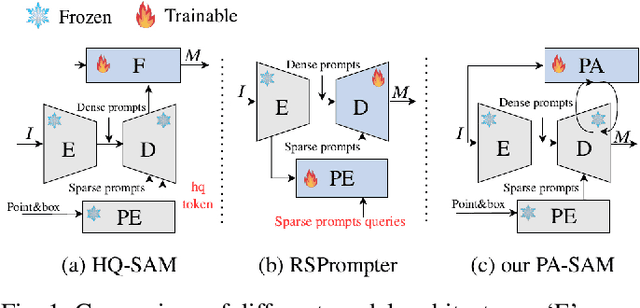
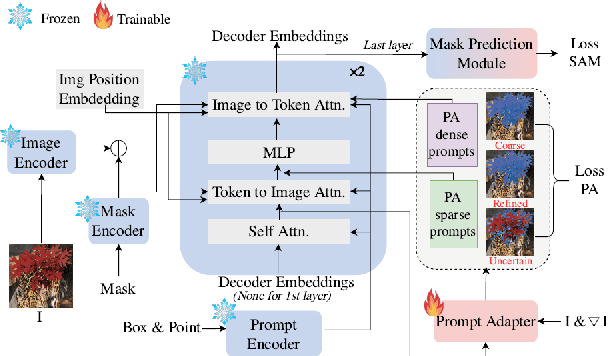
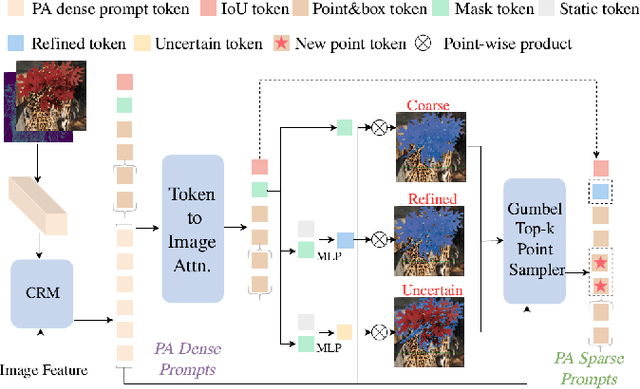

The Segment Anything Model (SAM) has exhibited outstanding performance in various image segmentation tasks. Despite being trained with over a billion masks, SAM faces challenges in mask prediction quality in numerous scenarios, especially in real-world contexts. In this paper, we introduce a novel prompt-driven adapter into SAM, namely Prompt Adapter Segment Anything Model (PA-SAM), aiming to enhance the segmentation mask quality of the original SAM. By exclusively training the prompt adapter, PA-SAM extracts detailed information from images and optimizes the mask decoder feature at both sparse and dense prompt levels, improving the segmentation performance of SAM to produce high-quality masks. Experimental results demonstrate that our PA-SAM outperforms other SAM-based methods in high-quality, zero-shot, and open-set segmentation. We're making the source code and models available at https://github.com/xzz2/pa-sam.
Symbol as Points: Panoptic Symbol Spotting via Point-based Representation
Jan 19, 2024This work studies the problem of panoptic symbol spotting, which is to spot and parse both countable object instances (windows, doors, tables, etc.) and uncountable stuff (wall, railing, etc.) from computer-aided design (CAD) drawings. Existing methods typically involve either rasterizing the vector graphics into images and using image-based methods for symbol spotting, or directly building graphs and using graph neural networks for symbol recognition. In this paper, we take a different approach, which treats graphic primitives as a set of 2D points that are locally connected and use point cloud segmentation methods to tackle it. Specifically, we utilize a point transformer to extract the primitive features and append a mask2former-like spotting head to predict the final output. To better use the local connection information of primitives and enhance their discriminability, we further propose the attention with connection module (ACM) and contrastive connection learning scheme (CCL). Finally, we propose a KNN interpolation mechanism for the mask attention module of the spotting head to better handle primitive mask downsampling, which is primitive-level in contrast to pixel-level for the image. Our approach, named SymPoint, is simple yet effective, outperforming recent state-of-the-art method GAT-CADNet by an absolute increase of 9.6% PQ and 10.4% RQ on the FloorPlanCAD dataset. The source code and models will be available at https://github.com/nicehuster/SymPoint.
PMFSNet: Polarized Multi-scale Feature Self-attention Network For Lightweight Medical Image Segmentation
Jan 15, 2024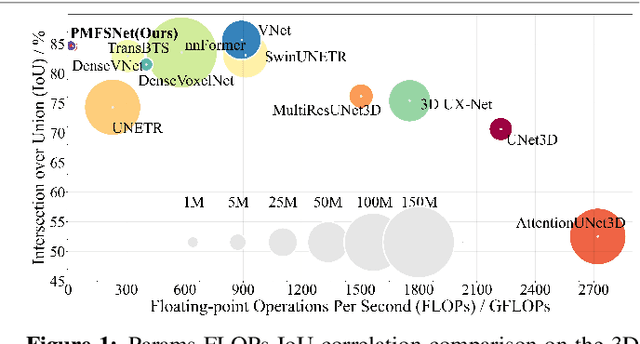
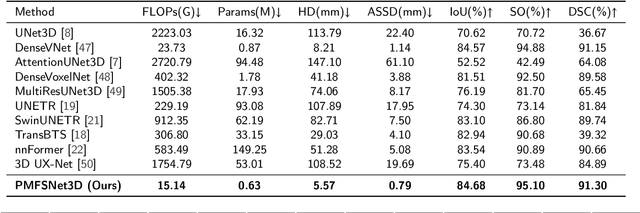
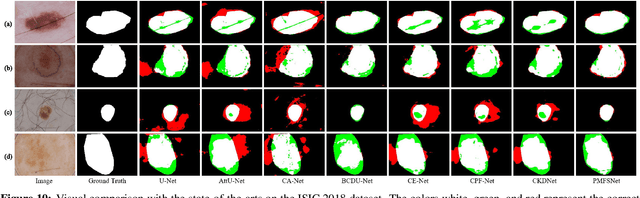
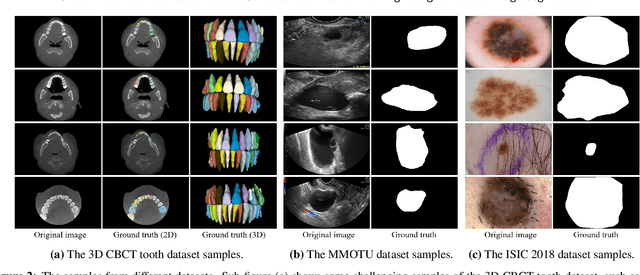
Current state-of-the-art medical image segmentation methods prioritize accuracy but often at the expense of increased computational demands and larger model sizes. Applying these large-scale models to the relatively limited scale of medical image datasets tends to induce redundant computation, complicating the process without the necessary benefits. This approach not only adds complexity but also presents challenges for the integration and deployment of lightweight models on edge devices. For instance, recent transformer-based models have excelled in 2D and 3D medical image segmentation due to their extensive receptive fields and high parameter count. However, their effectiveness comes with a risk of overfitting when applied to small datasets and often neglects the vital inductive biases of Convolutional Neural Networks (CNNs), essential for local feature representation. In this work, we propose PMFSNet, a novel medical imaging segmentation model that effectively balances global and local feature processing while avoiding the computational redundancy typical in larger models. PMFSNet streamlines the UNet-based hierarchical structure and simplifies the self-attention mechanism's computational complexity, making it suitable for lightweight applications. It incorporates a plug-and-play PMFS block, a multi-scale feature enhancement module based on attention mechanisms, to capture long-term dependencies. Extensive comprehensive results demonstrate that even with a model (less than 1 million parameters), our method achieves superior performance in various segmentation tasks across different data scales. It achieves (IoU) metrics of 84.68%, 82.02%, and 78.82% on public datasets of teeth CT (CBCT), ovarian tumors ultrasound(MMOTU), and skin lesions dermoscopy images (ISIC 2018), respectively. The source code is available at https://github.com/yykzjh/PMFSNet.
Towards Effective Multiple-in-One Image Restoration: A Sequential and Prompt Learning Strategy
Jan 07, 2024While single task image restoration (IR) has achieved significant successes, it remains a challenging issue to train a single model which can tackle multiple IR tasks. In this work, we investigate in-depth the multiple-in-one (MiO) IR problem, which comprises seven popular IR tasks. We point out that MiO IR faces two pivotal challenges: the optimization of diverse objectives and the adaptation to multiple tasks. To tackle these challenges, we present two simple yet effective strategies. The first strategy, referred to as sequential learning, attempts to address how to optimize the diverse objectives, which guides the network to incrementally learn individual IR tasks in a sequential manner rather than mixing them together. The second strategy, i.e., prompt learning, attempts to address how to adapt to the different IR tasks, which assists the network to understand the specific task and improves the generalization ability. By evaluating on 19 test sets, we demonstrate that the sequential and prompt learning strategies can significantly enhance the MiO performance of commonly used CNN and Transformer backbones. Our experiments also reveal that the two strategies can supplement each other to learn better degradation representations and enhance the model robustness. It is expected that our proposed MiO IR formulation and strategies could facilitate the research on how to train IR models with higher generalization capabilities.