 Add to Chrome
 Add to Firefox
 Add to Edge
BrickAnything: Geometry-Conditioned Buildable Brick Generation with Structure-Aware Tokenization
May 25, 2026
Generating physically buildable brick structures from 3D shapes requires more than geometric reconstruction: the output must also satisfy discrete part constraints and structural stability. Existing brick generation methods either rely on heuristic optimization, which can break down when the target 3D shape does not admit a feasible structure under predefined constraints, or generate brick sequences without explicitly modeling the underlying 3D geometry and assembly relations. In this work, we present BrickAnything, a geometry-conditioned autoregressive framework for generating buildable brick structures from diverse 3D representations. BrickAnything uses point clouds as a unified geometric interface and predicts brick sequences that reconstruct the target shape under assembly constraints. To model structural dependencies among bricks, we introduce a structure-aware tree tokenization, which represents brick structures through local attachment relations. This formulation makes sequence generation more consistent with the physical construction process, and reduces invalid intermediate states. We further introduce preference-based alignment post-training, validity-constrained decoding and adaptive rollback to improve buildability objectives such as stability and geometric fidelity. Extensive experiments demonstrate that BrickAnything produces geometrically faithful and physically realizable brick structures, and that the proposed tokenization effectively reduces rollback and regeneration compared with conventional ordering strategies.

PEML: Parameter-efficient Multi-Task Learning with Optimized Continuous Prompts
May 13, 2026Parameter-Efficient Fine-Tuning (PEFT) is widely used for adapting Large Language Models (LLMs) for various tasks. Recently, there has been an increasing demand for fine-tuning a single LLM for multiple tasks because it requires overall less data for fine-tuning thanks to the common features shared among tasks. More importantly, LLMs are resource demanding and deploying a single model for multiple tasks facilitates resource consolidation and consumes significantly less resources compared to deploying individual large model for each task. Existing PEFT methods like LoRA and Prefix Tuning are designed to adapt LLMs to a specific task. LoRA and its variation focus on aligning the model itself for tasks, overlooking the importance of prompt tuning in multi-task learning while Prefix Tuning only adopts a simple architecture to optimize prompts, which limits the adaption capabilities for multi-task. To enable efficient fine-tuning for multi-task learning, it is important to co-optimize prompt optimization and model adaptation. In this work, we propose a Parameter-Efficient Multi-task Learning (\PM), which employs a neural architecture engineering method for optimizing the continuous prompts while also performing low-rank adaption for model weights. We prototype PEML by creating an automated framework for optimizing the continuous prompts and adapting model weights. We evaluate PEML against state-of-the-arts multi-task learning methods MTL-LoRA, MultiLoRa, C-Poly, and MoE, on the GLUE, SuperGLUE, Massive Multitask Language Understanding, and commonsense reasoning benchmarks. The evaluation results present an average accuracy improvement of up to 6.67%, with individual tasks showing peak gains of up to 10.75%.
Know When To Fold 'Em: Token-Efficient LLM Synthetic Data Generation via Multi-Stage In-Flight Rejection
May 13, 2026While synthetic data generation with large language models (LLMs) is widely used in post-training pipelines, existing approaches typically generate full outputs before applying quality filters, leading to substantial token waste on samples that are ultimately discarded. To address this, we propose Multi-Stage In-Flight Rejection (MSIFR), a lightweight, training-free framework that detects and terminates low-quality generation trajectories at intermediate checkpoints before they reach full completion. MSIFR decomposes the generation process into sequential stages and applies fast rule-based validators to identify arithmetic inconsistencies, hallucination patterns, and formatting violations, enabling early rejection of faulty samples. We formalize in-flight rejection as a sequential decision process and show that any non-trivial discard policy reduces expected token consumption, with stage-wise savings increasing when rejection occurs earlier in the generation pipeline. We further demonstrate that conditional utility estimates form a martingale, ensuring that early, in-flight rejection does not bias the expected utility of retained samples. Across five instruction-tuned models and seven reasoning benchmarks, MSIFR reduces token consumption by 11%-77% as a standalone method, and up to 78.2% when combined with early-exit methods, while preserving or improving evaluation accuracy. These results confirm that MSIFR provides a practical mechanism for improving the efficiency of LLM-based synthetic data generation without additional training or architectural changes.
CF-VLA: Efficient Coarse-to-Fine Action Generation for Vision-Language-Action Policies
Apr 28, 2026Flow-based vision-language-action (VLA) policies offer strong expressivity for action generation, but suffer from a fundamental inefficiency: multi-step inference is required to recover action structure from uninformative Gaussian noise, leading to a poor efficiency-quality trade-off under real-time constraints. We address this issue by rethinking the role of the starting point in generative action modeling. Instead of shortening the sampling trajectory, we propose CF-VLA, a coarse-to-fine two-stage formulation that restructures action generation into a coarse initialization step that constructs an action-aware starting point, followed by a single-step local refinement that corrects residual errors. Concretely, the coarse stage learns a conditional posterior over endpoint velocity to transform Gaussian noise into a structured initialization, while the fine stage performs a fixed-time refinement from this initialization. To stabilize training, we introduce a stepwise strategy that first learns a controlled coarse predictor and then performs joint optimization. Experiments on CALVIN and LIBERO show that our method establishes a strong efficiency-performance frontier under low-NFE (Number of Function Evaluations) regimes: it consistently outperforms existing NFE=2 methods, matches or surpasses the NFE=10 $π_{0.5}$ baseline on several metrics, reduces action sampling latency by 75.4%, and achieves the best average real-robot success rate of 83.0%, outperforming MIP by 19.5 points and $π_{0.5}$ by 4.0 points. These results suggest that structured, coarse-to-fine generation enables both strong performance and efficient inference. Our code is available at https://github.com/EmbodiedAI-RoboTron/CF-VLA.
SOLAR: Communication-Efficient Model Adaptation via Subspace-Oriented Latent Adapter Reparametrization
Apr 09, 2026Parameter-efficient fine-tuning (PEFT) methods, such as LoRA, enable scalable adaptation of foundation models by injecting low-rank adapters. However, their communication and storage costs remain a major bottleneck in resource-constrained settings. We propose SOLAR (Subspace-Oriented Latent Adapter Reparameterization), a post-training compression framework that substantially reduces the communication cost (i.e., the number of parameters to transmit or store) of PEFT adapters. SOLAR expresses each PEFT update as a linear combination of basis vectors formed from the foundation model's singular vectors with controlled random perturbations. By exploiting the subspace similarity (the alignment of principal directions) between the foundation model and task-specific fine-tuned updates, SOLAR decouples the adapter size from PEFT structure and ensures compact yet expressive representations. It is model-agnostic and compatible with existing PEFT methods, including LoRA, AdaLoRA, and other adapter modules. We theoretically establish a bound on the reconstruction error. Experiments on language and vision tasks using LLaMA, GPT, and ViT models demonstrate that SOLAR preserves task performance while significantly reducing model representation sizes, offering an effective and communication-efficient solution for deployment in distributed systems and edge devices.
DARE-bench: Evaluating Modeling and Instruction Fidelity of LLMs in Data Science
Feb 27, 2026The fast-growing demands in using Large Language Models (LLMs) to tackle complex multi-step data science tasks create an emergent need for accurate benchmarking. There are two major gaps in existing benchmarks: (i) the lack of standardized, process-aware evaluation that captures instruction adherence and process fidelity, and (ii) the scarcity of accurately labeled training data. To bridge these gaps, we introduce DARE-bench, a benchmark designed for machine learning modeling and data science instruction following. Unlike many existing benchmarks that rely on human- or model-based judges, all tasks in DARE-bench have verifiable ground truth, ensuring objective and reproducible evaluation. To cover a broad range of tasks and support agentic tools, DARE-bench consists of 6,300 Kaggle-derived tasks and provides both large-scale training data and evaluation sets. Extensive evaluations show that even highly capable models such as gpt-o4-mini struggle to achieve good performance, especially in machine learning modeling tasks. Using DARE-bench training tasks for fine-tuning can substantially improve model performance. For example, supervised fine-tuning boosts Qwen3-32B's accuracy by 1.83x and reinforcement learning boosts Qwen3-4B's accuracy by more than 8x. These significant improvements verify the importance of DARE-bench both as an accurate evaluation benchmark and critical training data.
CRCC: Contrast-Based Robust Cross-Subject and Cross-Site Representation Learning for EEG
Feb 22, 2026EEG-based neural decoding models often fail to generalize across acquisition sites due to structured, site-dependent biases implicitly exploited during training. We reformulate cross-site clinical EEG learning as a bias-factorized generalization problem, in which domain shifts arise from multiple interacting sources. We identify three fundamental bias factors and propose a general training framework that mitigates their influence through data standardization and representation-level constraints. We construct a standardized multi-site EEG benchmark for Major Depressive Disorder and introduce CRCC, a two-stage training paradigm combining encoder-decoder pretraining with joint fine-tuning via cross-subject/site contrastive learning and site-adversarial optimization. CRCC consistently outperforms state-of-the-art baselines and achieves a 10.7 percentage-point improvement in balanced accuracy under strict zero-shot site transfer, demonstrating robust generalization to unseen environments.
On the Intrinsic Limits of Transformer Image Embeddings in Non-Solvable Spatial Reasoning
Jan 06, 2026Vision Transformers (ViTs) excel in semantic recognition but exhibit systematic failures in spatial reasoning tasks such as mental rotation. While often attributed to data scale, we propose that this limitation arises from the intrinsic circuit complexity of the architecture. We formalize spatial understanding as learning a Group Homomorphism: mapping image sequences to a latent space that preserves the algebraic structure of the underlying transformation group. We demonstrate that for non-solvable groups (e.g., the 3D rotation group $\mathrm{SO}(3)$), maintaining such a structure-preserving embedding is computationally lower-bounded by the Word Problem, which is $\mathsf{NC^1}$-complete. In contrast, we prove that constant-depth ViTs with polynomial precision are strictly bounded by $\mathsf{TC^0}$. Under the conjecture $\mathsf{TC^0} \subsetneq \mathsf{NC^1}$, we establish a complexity boundary: constant-depth ViTs fundamentally lack the logical depth to efficiently capture non-solvable spatial structures. We validate this complexity gap via latent-space probing, demonstrating that ViT representations suffer a structural collapse on non-solvable tasks as compositional depth increases.
TopoDiT-3D: Topology-Aware Diffusion Transformer with Bottleneck Structure for 3D Point Cloud Generation
May 14, 2025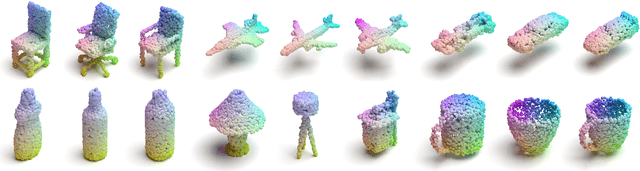
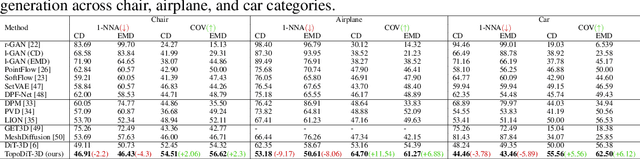
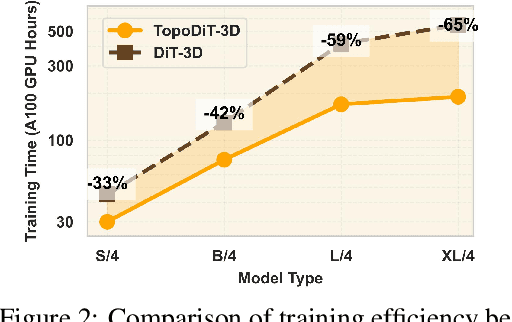
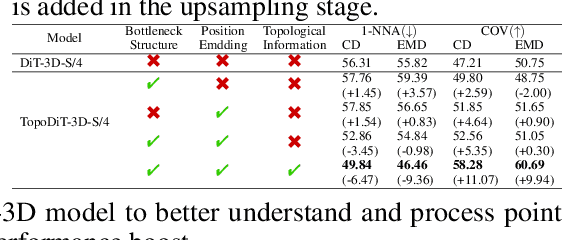
Recent advancements in Diffusion Transformer (DiT) models have significantly improved 3D point cloud generation. However, existing methods primarily focus on local feature extraction while overlooking global topological information, such as voids, which are crucial for maintaining shape consistency and capturing complex geometries. To address this limitation, we propose TopoDiT-3D, a Topology-Aware Diffusion Transformer with a bottleneck structure for 3D point cloud generation. Specifically, we design the bottleneck structure utilizing Perceiver Resampler, which not only offers a mode to integrate topological information extracted through persistent homology into feature learning, but also adaptively filters out redundant local features to improve training efficiency. Experimental results demonstrate that TopoDiT-3D outperforms state-of-the-art models in visual quality, diversity, and training efficiency. Furthermore, TopoDiT-3D demonstrates the importance of rich topological information for 3D point cloud generation and its synergy with conventional local feature learning. Videos and code are available at https://github.com/Zechao-Guan/TopoDiT-3D.
DataPlatter: Boosting Robotic Manipulation Generalization with Minimal Costly Data
Mar 25, 2025The growing adoption of Vision-Language-Action (VLA) models in embodied AI intensifies the demand for diverse manipulation demonstrations. However, high costs associated with data collection often result in insufficient data coverage across all scenarios, which limits the performance of the models. It is observed that the spatial reasoning phase (SRP) in large workspace dominates the failure cases. Fortunately, this data can be collected with low cost, underscoring the potential of leveraging inexpensive data to improve model performance. In this paper, we introduce the DataPlatter method, a framework that decouples training trajectories into distinct task stages and leverages abundant easily collectible SRP data to enhance VLA model's generalization. Through analysis we demonstrate that sub-task-specific training with additional SRP data with proper proportion can act as a performance catalyst for robot manipulation, maximizing the utilization of costly physical interaction phase (PIP) data. Experiments show that through introducing large proportion of cost-effective SRP trajectories into a limited set of PIP data, we can achieve a maximum improvement of 41\% on success rate in zero-shot scenes, while with the ability to transfer manipulation skill to novel targets.