 Add to Chrome
 Add to Firefox
 Add to Edge
One-Step Effective Diffusion Network for Real-World Image Super-Resolution
Jun 12, 2024
The pre-trained text-to-image diffusion models have been increasingly employed to tackle the real-world image super-resolution (Real-ISR) problem due to their powerful generative image priors. Most of the existing methods start from random noise to reconstruct the high-quality (HQ) image under the guidance of the given low-quality (LQ) image. While promising results have been achieved, such Real- ISR methods require multiple diffusion steps to reproduce the HQ image, increasing the computational cost. Meanwhile, the random noise introduces uncertainty in the output, which is unfriendly to image restoration tasks. To address these issues, we propose a one-step effective diffusion network, namely OSEDiff, for the Real- ISR problem. We argue that the LQ image contains rich information to restore its HQ counterpart, and hence the given LQ image can be directly taken as the starting point for diffusion, eliminating the uncertainty introduced by random noise sampling. We finetune the pre-trained diffusion network with trainable layers to adapt it to complex image degradations. To ensure that the one-step diffusion model could yield HQ Real-ISR output, we apply variational score distillation in the latent space to conduct KL-divergence regularization. As a result, our OSEDiff model can efficiently and effectively generate HQ images in just one diffusion step. Our experiments demonstrate that OSEDiff achieves comparable or even better Real-ISR results, in terms of both objective metrics and subjective evaluations, than previous diffusion model based Real-ISR methods that require dozens or hundreds of steps. The source codes will be released at https://github.com/cswry/OSEDiff.

Interference Analysis for Coexistence of UAVs and Civil Aircrafts Based on Automatic Dependent Surveillance-Broadcast
Jun 12, 2024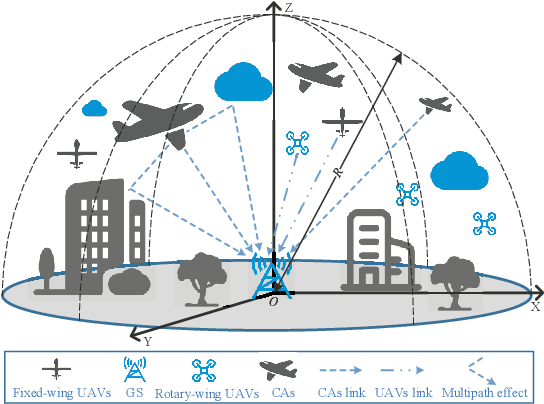
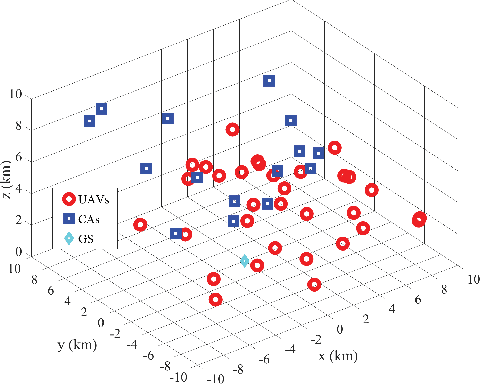
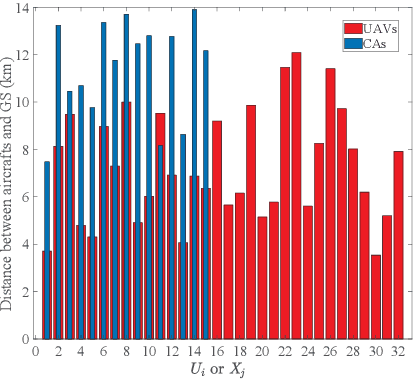
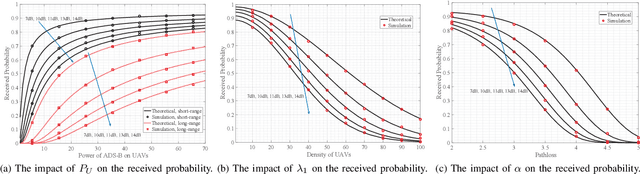
Due to the advantages of high mobility and easy deployment, unmanned aerial vehicles (UAVs) are widely applied in both military and civilian fields. In order to strengthen the flight surveillance of UAVs and guarantee the airspace safety, UAVs can be equipped with the automatic dependent surveillance-broadcast (ADS-B) system, which periodically sends flight information to other aircrafts and ground stations (GSs). However, due to the limited resource of channel capacity, UAVs equipped with ADS-B results in the interference between UAVs and civil aircrafts (CAs), which further impacts the accuracy of received information at GSs. In detail, the channel capacity is mainly affected by the density of aircrafts and the transmitting power of ADS-B. Hence, based on the three-dimensional poisson point process, this work leverages the stochastic geometry theory to build a model of the coexistence of UAVs and CAs and analyze the interference performance of ADS-B monitoring system. From simulation results, we reveal the effects of transmitting power, density, threshold and pathloss on the performance of the ADS-B monitoring system. Besides, we provide the suggested transmitting power and density for the safe coexistence of UAVs and CAs.
Autoregressive Pretraining with Mamba in Vision
Jun 11, 2024


The vision community has started to build with the recently developed state space model, Mamba, as the new backbone for a range of tasks. This paper shows that Mamba's visual capability can be significantly enhanced through autoregressive pretraining, a direction not previously explored. Efficiency-wise, the autoregressive nature can well capitalize on the Mamba's unidirectional recurrent structure, enabling faster overall training speed compared to other training strategies like mask modeling. Performance-wise, autoregressive pretraining equips the Mamba architecture with markedly higher accuracy over its supervised-trained counterparts and, more importantly, successfully unlocks its scaling potential to large and even huge model sizes. For example, with autoregressive pretraining, a base-size Mamba attains 83.2\% ImageNet accuracy, outperforming its supervised counterpart by 2.0\%; our huge-size Mamba, the largest Vision Mamba to date, attains 85.0\% ImageNet accuracy (85.5\% when finetuned with $384\times384$ inputs), notably surpassing all other Mamba variants in vision. The code is available at \url{https://github.com/OliverRensu/ARM}.
Open-World Human-Object Interaction Detection via Multi-modal Prompts
Jun 11, 2024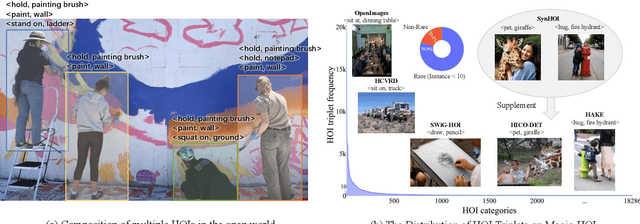
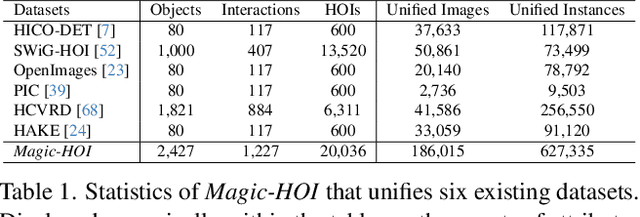
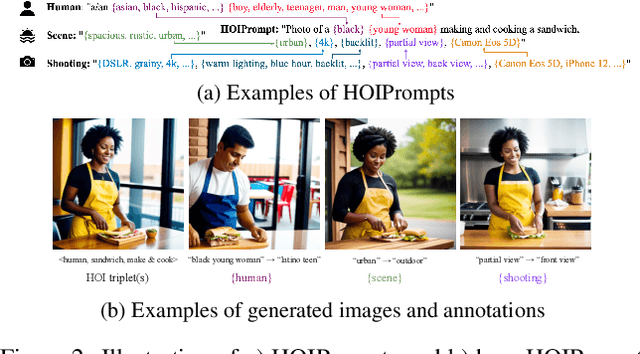
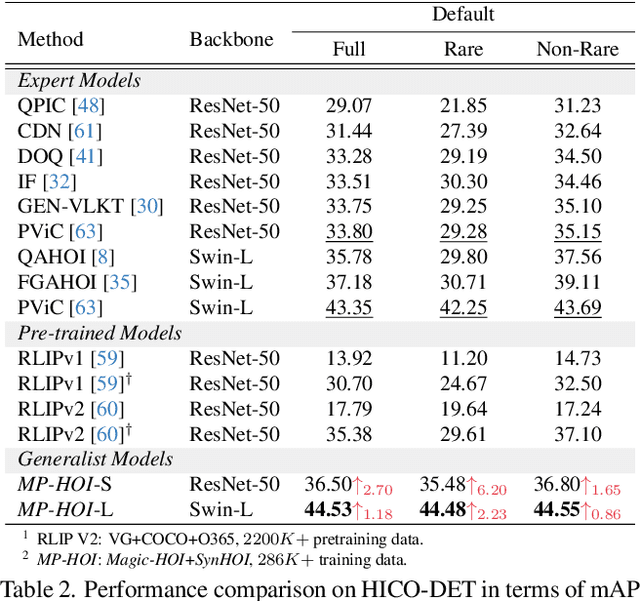
In this paper, we develop \textbf{MP-HOI}, a powerful Multi-modal Prompt-based HOI detector designed to leverage both textual descriptions for open-set generalization and visual exemplars for handling high ambiguity in descriptions, realizing HOI detection in the open world. Specifically, it integrates visual prompts into existing language-guided-only HOI detectors to handle situations where textual descriptions face difficulties in generalization and to address complex scenarios with high interaction ambiguity. To facilitate MP-HOI training, we build a large-scale HOI dataset named Magic-HOI, which gathers six existing datasets into a unified label space, forming over 186K images with 2.4K objects, 1.2K actions, and 20K HOI interactions. Furthermore, to tackle the long-tail issue within the Magic-HOI dataset, we introduce an automated pipeline for generating realistically annotated HOI images and present SynHOI, a high-quality synthetic HOI dataset containing 100K images. Leveraging these two datasets, MP-HOI optimizes the HOI task as a similarity learning process between multi-modal prompts and objects/interactions via a unified contrastive loss, to learn generalizable and transferable objects/interactions representations from large-scale data. MP-HOI could serve as a generalist HOI detector, surpassing the HOI vocabulary of existing expert models by more than 30 times. Concurrently, our results demonstrate that MP-HOI exhibits remarkable zero-shot capability in real-world scenarios and consistently achieves a new state-of-the-art performance across various benchmarks.
Methodology and Real-World Applications of Dynamic Uncertain Causality Graph for Clinical Diagnosis with Explainability and Invariance
Jun 09, 2024AI-aided clinical diagnosis is desired in medical care. Existing deep learning models lack explainability and mainly focus on image analysis. The recently developed Dynamic Uncertain Causality Graph (DUCG) approach is causality-driven, explainable, and invariant across different application scenarios, without problems of data collection, labeling, fitting, privacy, bias, generalization, high cost and high energy consumption. Through close collaboration between clinical experts and DUCG technicians, 46 DUCG models covering 54 chief complaints were constructed. Over 1,000 diseases can be diagnosed without triage. Before being applied in real-world, the 46 DUCG models were retrospectively verified by third-party hospitals. The verified diagnostic precisions were no less than 95%, in which the diagnostic precision for every disease including uncommon ones was no less than 80%. After verifications, the 46 DUCG models were applied in the real-world in China. Over one million real diagnosis cases have been performed, with only 17 incorrect diagnoses identified. Due to DUCG's transparency, the mistakes causing the incorrect diagnoses were found and corrected. The diagnostic abilities of the clinicians who applied DUCG frequently were improved significantly. Following the introduction to the earlier presented DUCG methodology, the recommendation algorithm for potential medical checks is presented and the key idea of DUCG is extracted.
MotionLLM: Understanding Human Behaviors from Human Motions and Videos
May 30, 2024This study delves into the realm of multi-modality (i.e., video and motion modalities) human behavior understanding by leveraging the powerful capabilities of Large Language Models (LLMs). Diverging from recent LLMs designed for video-only or motion-only understanding, we argue that understanding human behavior necessitates joint modeling from both videos and motion sequences (e.g., SMPL sequences) to capture nuanced body part dynamics and semantics effectively. In light of this, we present MotionLLM, a straightforward yet effective framework for human motion understanding, captioning, and reasoning. Specifically, MotionLLM adopts a unified video-motion training strategy that leverages the complementary advantages of existing coarse video-text data and fine-grained motion-text data to glean rich spatial-temporal insights. Furthermore, we collect a substantial dataset, MoVid, comprising diverse videos, motions, captions, and instructions. Additionally, we propose the MoVid-Bench, with carefully manual annotations, for better evaluation of human behavior understanding on video and motion. Extensive experiments show the superiority of MotionLLM in the caption, spatial-temporal comprehension, and reasoning ability.
Network Interdiction Goes Neural
May 26, 2024Network interdiction problems are combinatorial optimization problems involving two players: one aims to solve an optimization problem on a network, while the other seeks to modify the network to thwart the first player's objectives. Such problems typically emerge in an attacker-defender context, encompassing areas such as military operations, disease spread analysis, and communication network management. The primary bottleneck in network interdiction arises from the high time complexity of using conventional exact solvers and the challenges associated with devising efficient heuristic solvers. GNNs, recognized as a cutting-edge methodology, have shown significant effectiveness in addressing single-level CO problems on graphs, such as the traveling salesman problem, graph matching, and graph edit distance. Nevertheless, network interdiction presents a bi-level optimization challenge, which current GNNs find difficult to manage. To address this gap, we represent network interdiction problems as Mixed-Integer Linear Programming (MILP) instances, then apply a multipartite GNN with sufficient representational capacity to learn these formulations. This approach ensures that our neural network is more compatible with the mathematical algorithms designed to solve network interdiction problems, resulting in improved generalization. Through two distinct tasks, we demonstrate that our proposed method outperforms theoretical baseline models and provides advantages over traditional exact solvers.
Spiking Neural Network Phase Encoding for Cognitive Computing
May 25, 2024This paper presents a novel approach for signal reconstruction using Spiking Neural Networks (SNN) based on the principles of Cognitive Informatics and Cognitive Computing. The proposed SNN leverages the Discrete Fourier Transform (DFT) to represent and reconstruct arbitrary time series signals. By employing N spiking neurons, the SNN captures the frequency components of the input signal, with each neuron assigned a unique frequency. The relationship between the magnitude and phase of the spiking neurons and the DFT coefficients is explored, enabling the reconstruction of the original signal. Additionally, the paper discusses the encoding of impulse delays and the phase differences between adjacent frequency components. This research contributes to the field of signal processing and provides insights into the application of SNN for cognitive signal analysis and reconstruction.
DEEM: Diffusion Models Serve as the Eyes of Large Language Models for Image Perception
May 24, 2024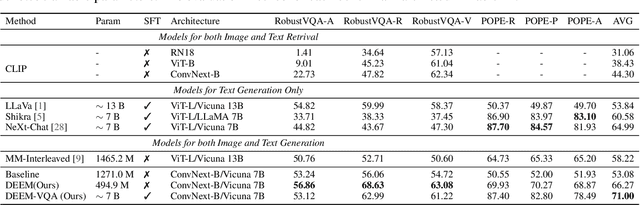


The development of large language models (LLMs) has significantly advanced the emergence of large multimodal models (LMMs). While LMMs have achieved tremendous success by promoting the synergy between multimodal comprehension and creation, they often face challenges when confronted with out-of-distribution data. This is primarily due to their reliance on image encoders trained to encode images into task-relevant features, which may lead them to disregard irrelevant details. Delving into the modeling capabilities of diffusion models for images naturally prompts the question: Can diffusion models serve as the eyes of large language models for image perception? In this paper, we propose DEEM, a simple and effective approach that utilizes the generative feedback of diffusion models to align the semantic distributions of the image encoder. This addresses the drawbacks of previous methods that solely relied on image encoders like ViT, thereby enhancing the model's resilience against out-of-distribution samples and reducing visual hallucinations. Importantly, this is achieved without requiring additional training modules and with fewer training parameters. We extensively evaluated DEEM on both our newly constructed RobustVQA benchmark and another well-known benchmark, POPE, for object hallucination. Compared to the state-of-the-art interleaved content generation models, DEEM exhibits enhanced robustness and a superior capacity to alleviate model hallucinations while utilizing fewer trainable parameters, less pre-training data (10%), and a smaller base model size.
LIRE: listwise reward enhancement for preference alignment
May 22, 2024


Recently, tremendous strides have been made to align the generation of Large Language Models (LLMs) with human values to mitigate toxic or unhelpful content. Leveraging Reinforcement Learning from Human Feedback (RLHF) proves effective and is widely adopted by researchers. However, implementing RLHF is complex, and its sensitivity to hyperparameters renders achieving stable performance and scalability challenging. Furthermore, prevailing approaches to preference alignment primarily concentrate on pairwise comparisons, with limited exploration into multi-response scenarios, thereby overlooking the potential richness within the candidate pool. For the above reasons, we propose a new approach: Listwise Reward Enhancement for Preference Alignment (LIRE), a gradient-based reward optimization approach that incorporates the offline rewards of multiple responses into a streamlined listwise framework, thus eliminating the need for online sampling during training. LIRE is straightforward to implement, requiring minimal parameter tuning, and seamlessly aligns with the pairwise paradigm while naturally extending to multi-response scenarios. Moreover, we introduce a self-enhancement algorithm aimed at iteratively refining the reward during training. Our experiments demonstrate that LIRE consistently outperforms existing methods across several benchmarks on dialogue and summarization tasks, with good transferability to out-of-distribution data, assessed using proxy reward models and human annotators.