 Add to Chrome
 Add to Firefox
 Add to Edge
JPEG-Inspired Cloud-Edge Holography
Dec 13, 2025
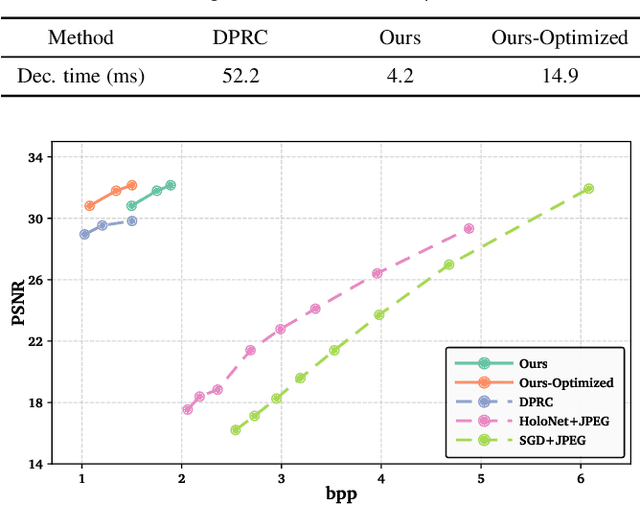

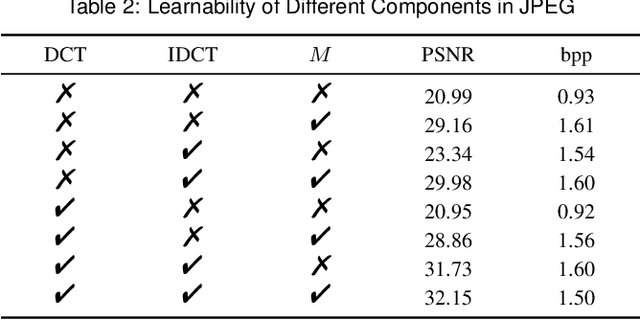
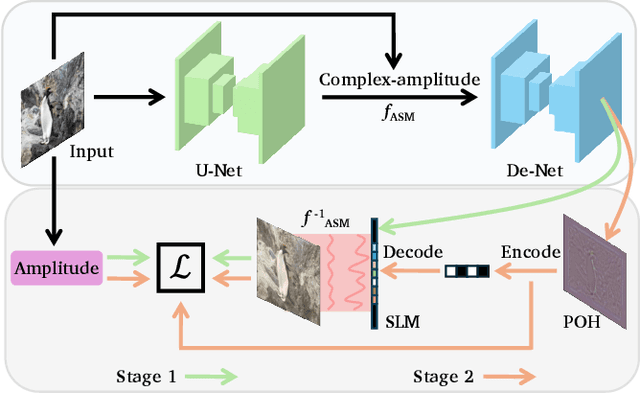
Computer-generated holography (CGH) presents a transformative solution for near-eye displays in augmented and virtual reality. Recent advances in deep learning have greatly improved CGH in reconstructed quality and computational efficiency. However, deploying neural CGH pipelines directly on compact, eyeglass-style devices is hindered by stringent constraints on computation and energy consumption, while cloud offloading followed by transmission with natural image codecs often distorts phase information and requires high bandwidth to maintain reconstruction quality. Neural compression methods can reduce bandwidth but impose heavy neural decoders at the edge, increasing inference latency and hardware demand. In this work, we introduce JPEG-Inspired Cloud-Edge Holography, an efficient pipeline designed around a learnable transform codec that retains the block-structured and hardware-friendly nature of JPEG. Our system shifts all heavy neural processing to the cloud, while the edge device performs only lightweight decoding without any neural inference. To further improve throughput, we implement custom CUDA kernels for entropy coding on both cloud and edge. This design achieves a peak signal-to-noise ratio of 32.15 dB at $<$ 2 bits per pixel with decode latency as low as 4.2 ms. Both numerical simulations and optical experiments confirm the high reconstruction quality of the holograms. By aligning CGH with a codec that preserves JPEG's structural efficiency while extending it with learnable components, our framework enables low-latency, bandwidth-efficient hologram streaming on resource-constrained wearable devices-using only simple block-based decoding readily supported by modern system-on-chips, without requiring neural decoders or specialized hardware.

See-Control: A Multimodal Agent Framework for Smartphone Interaction with a Robotic Arm
Dec 09, 2025Recent advances in Multimodal Large Language Models (MLLMs) have enabled their use as intelligent agents for smartphone operation. However, existing methods depend on the Android Debug Bridge (ADB) for data transmission and action execution, limiting their applicability to Android devices. In this work, we introduce the novel Embodied Smartphone Operation (ESO) task and present See-Control, a framework that enables smartphone operation via direct physical interaction with a low-DoF robotic arm, offering a platform-agnostic solution. See-Control comprises three key components: (1) an ESO benchmark with 155 tasks and corresponding evaluation metrics; (2) an MLLM-based embodied agent that generates robotic control commands without requiring ADB or system back-end access; and (3) a richly annotated dataset of operation episodes, offering valuable resources for future research. By bridging the gap between digital agents and the physical world, See-Control provides a concrete step toward enabling home robots to perform smartphone-dependent tasks in realistic environments.
GloTok: Global Perspective Tokenizer for Image Reconstruction and Generation
Nov 19, 2025Existing state-of-the-art image tokenization methods leverage diverse semantic features from pre-trained vision models for additional supervision, to expand the distribution of latent representations and thereby improve the quality of image reconstruction and generation. These methods employ a locally supervised approach for semantic supervision, which limits the uniformity of semantic distribution. However, VA-VAE proves that a more uniform feature distribution yields better generation performance. In this work, we introduce a Global Perspective Tokenizer (GloTok), which utilizes global relational information to model a more uniform semantic distribution of tokenized features. Specifically, a codebook-wise histogram relation learning method is proposed to transfer the semantics, which are modeled by pre-trained models on the entire dataset, to the semantic codebook. Then, we design a residual learning module that recovers the fine-grained details to minimize the reconstruction error caused by quantization. Through the above design, GloTok delivers more uniformly distributed semantic latent representations, which facilitates the training of autoregressive (AR) models for generating high-quality images without requiring direct access to pre-trained models during the training process. Experiments on the standard ImageNet-1k benchmark clearly show that our proposed method achieves state-of-the-art reconstruction performance and generation quality.
Virtual Width Networks
Nov 17, 2025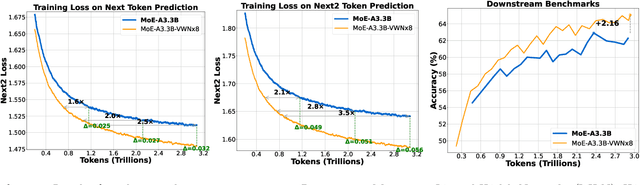
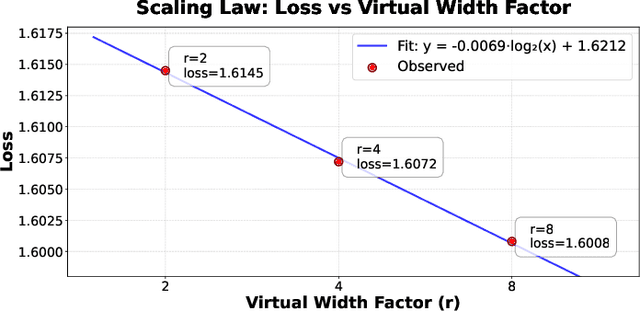
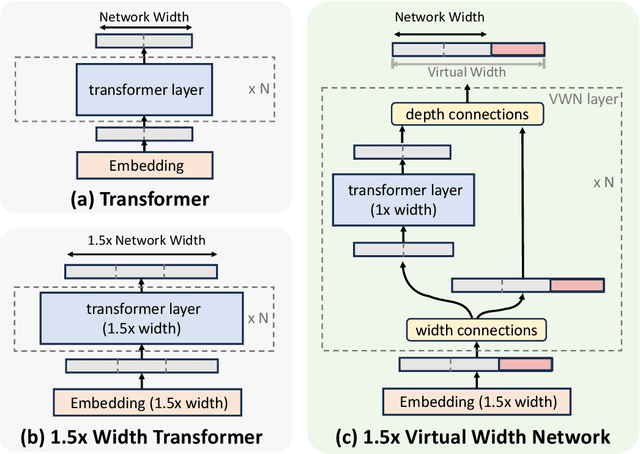
We introduce Virtual Width Networks (VWN), a framework that delivers the benefits of wider representations without incurring the quadratic cost of increasing the hidden size. VWN decouples representational width from backbone width, expanding the embedding space while keeping backbone compute nearly constant. In our large-scale experiment, an 8-times expansion accelerates optimization by over 2 times for next-token and 3 times for next-2-token prediction. The advantage amplifies over training as both the loss gap grows and the convergence-speedup ratio increases, showing that VWN is not only token-efficient but also increasingly effective with scale. Moreover, we identify an approximately log-linear scaling relation between virtual width and loss reduction, offering an initial empirical basis and motivation for exploring virtual-width scaling as a new dimension of large-model efficiency.
A General Anchor-Based Framework for Scalable Fair Clustering
Nov 13, 2025Fair clustering is crucial for mitigating bias in unsupervised learning, yet existing algorithms often suffer from quadratic or super-quadratic computational complexity, rendering them impractical for large-scale datasets. To bridge this gap, we introduce the Anchor-based Fair Clustering Framework (AFCF), a novel, general, and plug-and-play framework that empowers arbitrary fair clustering algorithms with linear-time scalability. Our approach first selects a small but representative set of anchors using a novel fair sampling strategy. Then, any off-the-shelf fair clustering algorithm can be applied to this small anchor set. The core of our framework lies in a novel anchor graph construction module, where we formulate an optimization problem to propagate labels while preserving fairness. This is achieved through a carefully designed group-label joint constraint, which we prove theoretically ensures that the fairness of the final clustering on the entire dataset matches that of the anchor clustering. We solve this optimization efficiently using an ADMM-based algorithm. Extensive experiments on multiple large-scale benchmarks demonstrate that AFCF drastically accelerates state-of-the-art methods, which reduces computational time by orders of magnitude while maintaining strong clustering performance and fairness guarantees.
Versatile and Risk-Sensitive Cardiac Diagnosis via Graph-Based ECG Signal Representation
Nov 11, 2025Despite the rapid advancements of electrocardiogram (ECG) signal diagnosis and analysis methods through deep learning, two major hurdles still limit their clinical adoption: the lack of versatility in processing ECG signals with diverse configurations, and the inadequate detection of risk signals due to sample imbalances. Addressing these challenges, we introduce VersAtile and Risk-Sensitive cardiac diagnosis (VARS), an innovative approach that employs a graph-based representation to uniformly model heterogeneous ECG signals. VARS stands out by transforming ECG signals into versatile graph structures that capture critical diagnostic features, irrespective of signal diversity in the lead count, sampling frequency, and duration. This graph-centric formulation also enhances diagnostic sensitivity, enabling precise localization and identification of abnormal ECG patterns that often elude standard analysis methods. To facilitate representation transformation, our approach integrates denoising reconstruction with contrastive learning to preserve raw ECG information while highlighting pathognomonic patterns. We rigorously evaluate the efficacy of VARS on three distinct ECG datasets, encompassing a range of structural variations. The results demonstrate that VARS not only consistently surpasses existing state-of-the-art models across all these datasets but also exhibits substantial improvement in identifying risk signals. Additionally, VARS offers interpretability by pinpointing the exact waveforms that lead to specific model outputs, thereby assisting clinicians in making informed decisions. These findings suggest that our VARS will likely emerge as an invaluable tool for comprehensive cardiac health assessment.
From Experience to Strategy: Empowering LLM Agents with Trainable Graph Memory
Nov 11, 2025Large Language Models (LLMs) based agents have demonstrated remarkable potential in autonomous task-solving across complex, open-ended environments. A promising approach for improving the reasoning capabilities of LLM agents is to better utilize prior experiences in guiding current decisions. However, LLMs acquire experience either through implicit memory via training, which suffers from catastrophic forgetting and limited interpretability, or explicit memory via prompting, which lacks adaptability. In this paper, we introduce a novel agent-centric, trainable, multi-layered graph memory framework and evaluate how context memory enhances the ability of LLMs to utilize parametric information. The graph abstracts raw agent trajectories into structured decision paths in a state machine and further distills them into high-level, human-interpretable strategic meta-cognition. In order to make memory adaptable, we propose a reinforcement-based weight optimization procedure that estimates the empirical utility of each meta-cognition based on reward feedback from downstream tasks. These optimized strategies are then dynamically integrated into the LLM agent's training loop through meta-cognitive prompting. Empirically, the learnable graph memory delivers robust generalization, improves LLM agents' strategic reasoning performance, and provides consistent benefits during Reinforcement Learning (RL) training.
CoFineLLM: Conformal Finetuning of LLMs for Language-Instructed Robot Planning
Nov 09, 2025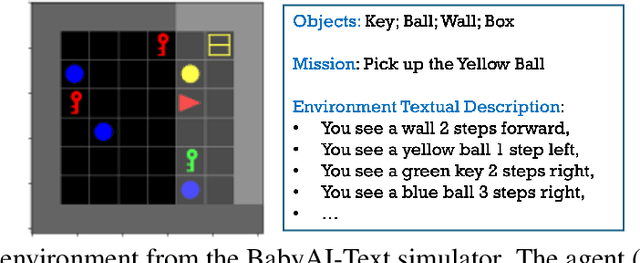

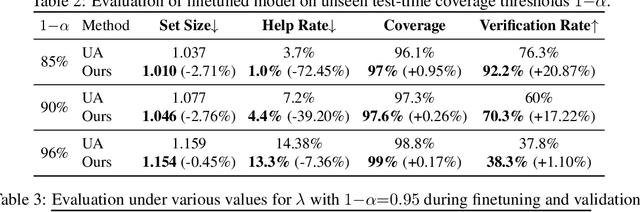
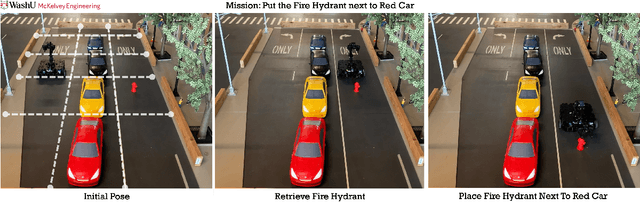
Large Language Models (LLMs) have recently emerged as planners for language-instructed agents, generating sequences of actions to accomplish natural language tasks. However, their reliability remains a challenge, especially in long-horizon tasks, since they often produce overconfident yet wrong outputs. Conformal Prediction (CP) has been leveraged to address this issue by wrapping LLM outputs into prediction sets that contain the correct action with a user-defined confidence. When the prediction set is a singleton, the planner executes that action; otherwise, it requests help from a user. This has led to LLM-based planners that can ensure plan correctness with a user-defined probability. However, as LLMs are trained in an uncertainty-agnostic manner, without awareness of prediction sets, they tend to produce unnecessarily large sets, particularly at higher confidence levels, resulting in frequent human interventions limiting autonomous deployment. To address this, we introduce CoFineLLM (Conformal Finetuning for LLMs), the first CP-aware finetuning framework for LLM-based planners that explicitly reduces prediction-set size and, in turn, the need for user interventions. We evaluate our approach on multiple language-instructed robot planning problems and show consistent improvements over uncertainty-aware and uncertainty-agnostic finetuning baselines in terms of prediction-set size, and help rates. Finally, we demonstrate robustness of our method to out-of-distribution scenarios in hardware experiments.
ColorEcosystem: Powering Personalized, Standardized, and Trustworthy Agentic Service in massive-agent Ecosystem
Oct 27, 2025With the rapid development of (multimodal) large language model-based agents, the landscape of agentic service management has evolved from single-agent systems to multi-agent systems, and now to massive-agent ecosystems. Current massive-agent ecosystems face growing challenges, including impersonal service experiences, a lack of standardization, and untrustworthy behavior. To address these issues, we propose ColorEcosystem, a novel blueprint designed to enable personalized, standardized, and trustworthy agentic service at scale. Concretely, ColorEcosystem consists of three key components: agent carrier, agent store, and agent audit. The agent carrier provides personalized service experiences by utilizing user-specific data and creating a digital twin, while the agent store serves as a centralized, standardized platform for managing diverse agentic services. The agent audit, based on the supervision of developer and user activities, ensures the integrity and credibility of both service providers and users. Through the analysis of challenges, transitional forms, and practical considerations, the ColorEcosystem is poised to power personalized, standardized, and trustworthy agentic service across massive-agent ecosystems. Meanwhile, we have also implemented part of ColorEcosystem's functionality, and the relevant code is open-sourced at https://github.com/opas-lab/color-ecosystem.
Switchable Token-Specific Codebook Quantization For Face Image Compression
Oct 27, 2025With the ever-increasing volume of visual data, the efficient and lossless transmission, along with its subsequent interpretation and understanding, has become a critical bottleneck in modern information systems. The emerged codebook-based solution utilize a globally shared codebook to quantize and dequantize each token, controlling the bpp by adjusting the number of tokens or the codebook size. However, for facial images, which are rich in attributes, such global codebook strategies overlook both the category-specific correlations within images and the semantic differences among tokens, resulting in suboptimal performance, especially at low bpp. Motivated by these observations, we propose a Switchable Token-Specific Codebook Quantization for face image compression, which learns distinct codebook groups for different image categories and assigns an independent codebook to each token. By recording the codebook group to which each token belongs with a small number of bits, our method can reduce the loss incurred when decreasing the size of each codebook group. This enables a larger total number of codebooks under a lower overall bpp, thereby enhancing the expressive capability and improving reconstruction performance. Owing to its generalizable design, our method can be integrated into any existing codebook-based representation learning approach and has demonstrated its effectiveness on face recognition datasets, achieving an average accuracy of 93.51% for reconstructed images at 0.05 bpp.