 Add to Chrome
 Add to Firefox
 Add to Edge
Editing Arbitrary Propositions in LLMs without Subject Labels
Jan 15, 2024
Large Language Model (LLM) editing modifies factual information in LLMs. Locate-and-Edit (L\&E) methods accomplish this by finding where relevant information is stored within the neural network, and editing the weights at that location. The goal of editing is to modify the response of an LLM to a proposition independently of its phrasing, while not modifying its response to other related propositions. Existing methods are limited to binary propositions, which represent straightforward binary relations between a subject and an object. Furthermore, existing methods rely on semantic subject labels, which may not be available or even be well-defined in practice. In this paper, we show that both of these issues can be effectively skirted with a simple and fast localization method called Gradient Tracing (GT). This localization method allows editing arbitrary propositions instead of just binary ones, and does so without the need for subject labels. As propositions always have a truth value, our experiments prompt an LLM as a boolean classifier, and edit its T/F response to propositions. Our method applies GT for location tracing, and then edit the model at that location using a mild variant of Rank-One Model Editing (ROME). On datasets of binary propositions derived from the CounterFact dataset, we show that our method -- without access to subject labels -- performs close to state-of-the-art L\&E methods which has access subject labels. We then introduce a new dataset, Factual Accuracy Classification Test (FACT), which includes non-binary propositions and for which subject labels are not generally applicable, and therefore is beyond the scope of existing L\&E methods. Nevertheless, we show that with our method editing is possible on FACT.

X-InstructBLIP: A Framework for aligning X-Modal instruction-aware representations to LLMs and Emergent Cross-modal Reasoning
Nov 30, 2023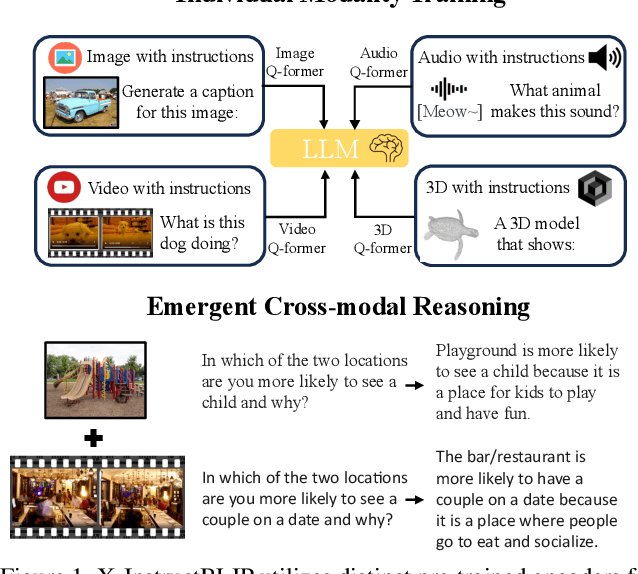
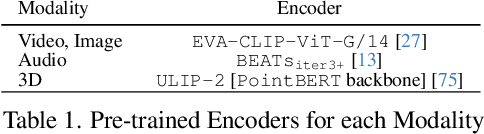

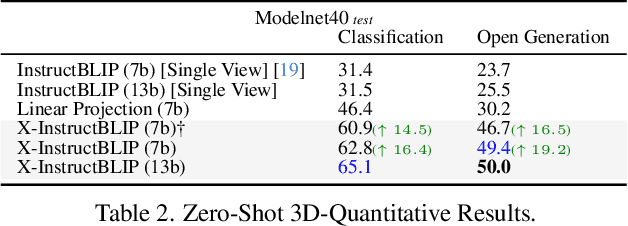
Vision-language pre-training and instruction tuning have demonstrated general-purpose capabilities in 2D visual reasoning tasks by aligning visual encoders with state-of-the-art large language models (LLMs). In this paper, we introduce a simple, yet effective, cross-modality framework built atop frozen LLMs that allows the integration of various modalities without extensive modality-specific customization. To facilitate instruction-modality fine-tuning, we collect high-quality instruction tuning data in an automatic and scalable manner, composed of 24K QA samples for audio and 250K QA samples for 3D. Leveraging instruction-aware representations, our model performs comparably with leading-edge counterparts without the need of extensive modality-specific pre-training or customization. Furthermore, our approach demonstrates cross-modal reasoning abilities across two or more input modalities, despite each modality projection being trained individually. To study the model's cross-modal abilities, we contribute a novel Discriminative Cross-modal Reasoning (DisCRn) evaluation task, comprising 9K audio-video QA samples and 28K image-3D QA samples that require the model to reason discriminatively across disparate input modalities.
Temporally Disentangled Representation Learning under Unknown Nonstationarity
Oct 28, 2023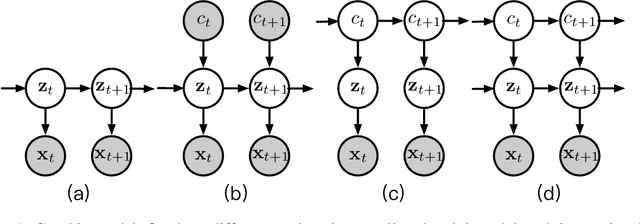

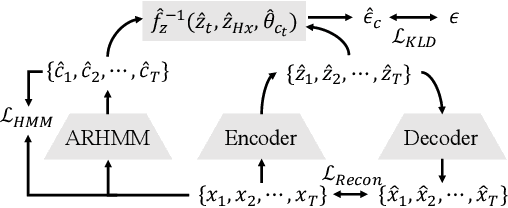

In unsupervised causal representation learning for sequential data with time-delayed latent causal influences, strong identifiability results for the disentanglement of causally-related latent variables have been established in stationary settings by leveraging temporal structure. However, in nonstationary setting, existing work only partially addressed the problem by either utilizing observed auxiliary variables (e.g., class labels and/or domain indexes) as side information or assuming simplified latent causal dynamics. Both constrain the method to a limited range of scenarios. In this study, we further explored the Markov Assumption under time-delayed causally related process in nonstationary setting and showed that under mild conditions, the independent latent components can be recovered from their nonlinear mixture up to a permutation and a component-wise transformation, without the observation of auxiliary variables. We then introduce NCTRL, a principled estimation framework, to reconstruct time-delayed latent causal variables and identify their relations from measured sequential data only. Empirical evaluations demonstrated the reliable identification of time-delayed latent causal influences, with our methodology substantially outperforming existing baselines that fail to exploit the nonstationarity adequately and then, consequently, cannot distinguish distribution shifts.
Artificial Intelligence Index Report 2023
Oct 05, 2023Welcome to the sixth edition of the AI Index Report. This year, the report introduces more original data than any previous edition, including a new chapter on AI public opinion, a more thorough technical performance chapter, original analysis about large language and multimodal models, detailed trends in global AI legislation records, a study of the environmental impact of AI systems, and more. The AI Index Report tracks, collates, distills, and visualizes data related to artificial intelligence. Our mission is to provide unbiased, rigorously vetted, broadly sourced data in order for policymakers, researchers, executives, journalists, and the general public to develop a more thorough and nuanced understanding of the complex field of AI. The report aims to be the world's most credible and authoritative source for data and insights about AI.
BOLAA: Benchmarking and Orchestrating LLM-augmented Autonomous Agents
Aug 11, 2023The massive successes of large language models (LLMs) encourage the emerging exploration of LLM-augmented Autonomous Agents (LAAs). An LAA is able to generate actions with its core LLM and interact with environments, which facilitates the ability to resolve complex tasks by conditioning on past interactions such as observations and actions. Since the investigation of LAA is still very recent, limited explorations are available. Therefore, we provide a comprehensive comparison of LAA in terms of both agent architectures and LLM backbones. Additionally, we propose a new strategy to orchestrate multiple LAAs such that each labor LAA focuses on one type of action, \textit{i.e.} BOLAA, where a controller manages the communication among multiple agents. We conduct simulations on both decision-making and multi-step reasoning environments, which comprehensively justify the capacity of LAAs. Our performance results provide quantitative suggestions for designing LAA architectures and the optimal choice of LLMs, as well as the compatibility of both. We release our implementation code of LAAs to the public at \url{https://github.com/salesforce/BOLAA}.
Retroformer: Retrospective Large Language Agents with Policy Gradient Optimization
Aug 04, 2023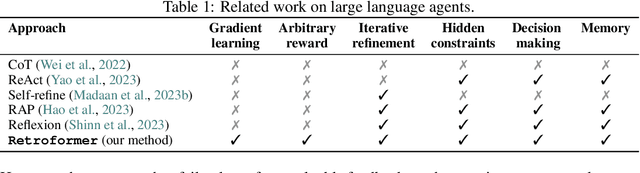
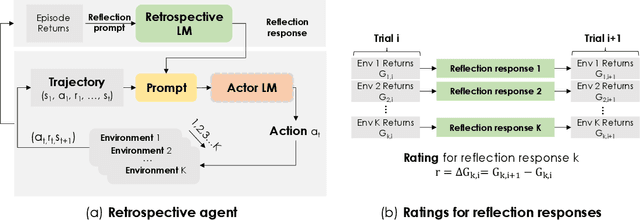
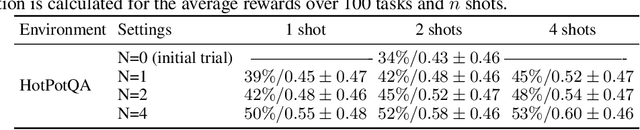
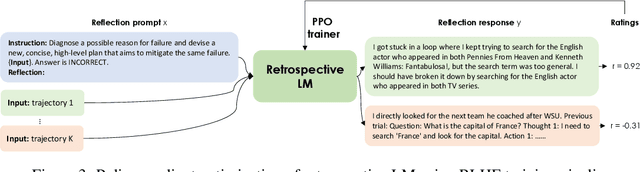
Recent months have seen the emergence of a powerful new trend in which large language models (LLMs) are augmented to become autonomous language agents capable of performing objective oriented multi-step tasks on their own, rather than merely responding to queries from human users. Most existing language agents, however, are not optimized using environment-specific rewards. Although some agents enable iterative refinement through verbal feedback, they do not reason and plan in ways that are compatible with gradient-based learning from rewards. This paper introduces a principled framework for reinforcing large language agents by learning a retrospective model, which automatically tunes the language agent prompts from environment feedback through policy gradient. Specifically, our proposed agent architecture learns from rewards across multiple environments and tasks, for fine-tuning a pre-trained language model which refines the language agent prompt by summarizing the root cause of prior failed attempts and proposing action plans. Experimental results on various tasks demonstrate that the language agents improve over time and that our approach considerably outperforms baselines that do not properly leverage gradients from the environment. This demonstrates that using policy gradient optimization to improve language agents, for which we believe our work is one of the first, seems promising and can be applied to optimize other models in the agent architecture to enhance agent performances over time.
REX: Rapid Exploration and eXploitation for AI Agents
Jul 18, 2023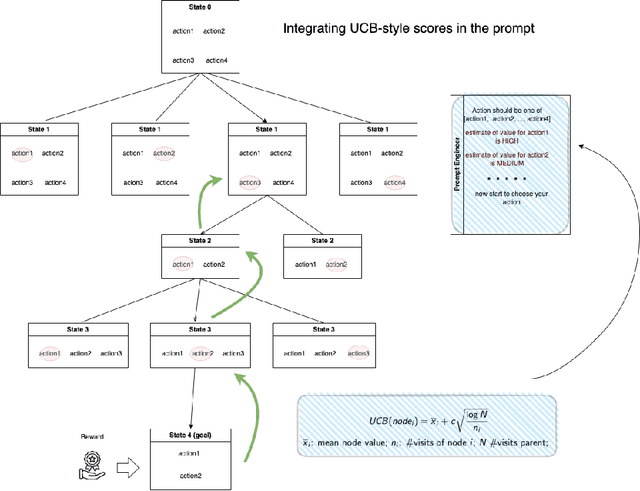
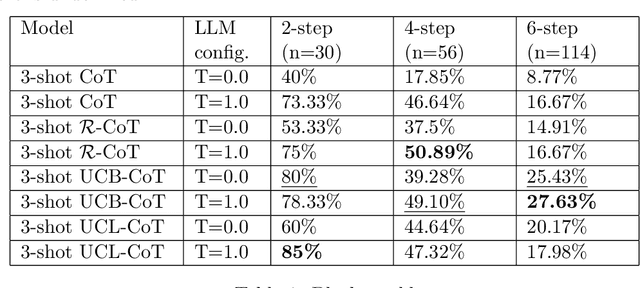
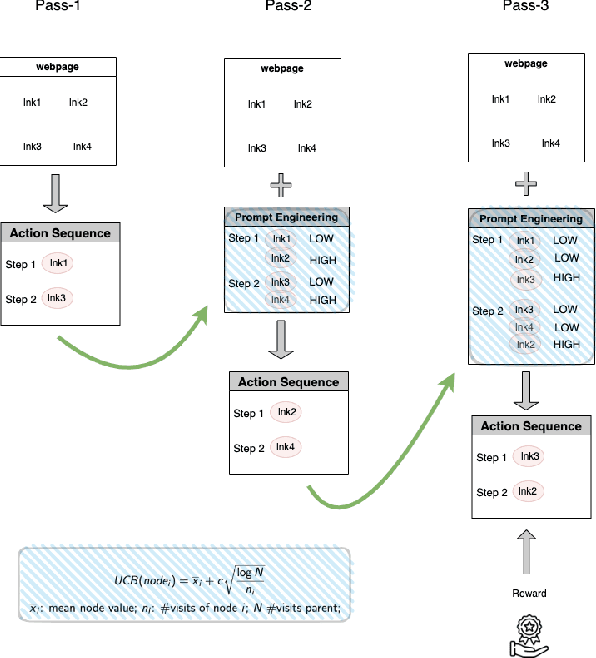
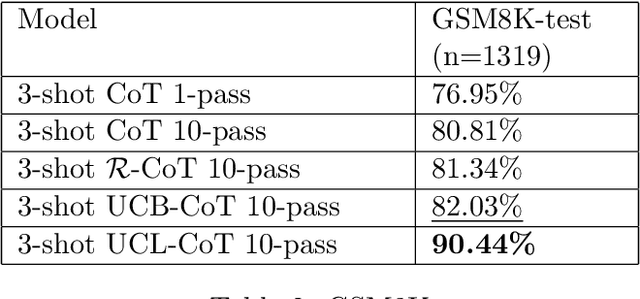
In this paper, we propose an enhanced approach for Rapid Exploration and eXploitation for AI Agents called REX. Existing AutoGPT-style techniques have inherent limitations, such as a heavy reliance on precise descriptions for decision-making, and the lack of a systematic approach to leverage try-and-fail procedures akin to traditional Reinforcement Learning (RL). REX introduces an additional layer of rewards and integrates concepts similar to Upper Confidence Bound (UCB) scores, leading to more robust and efficient AI agent performance. This approach has the advantage of enabling the utilization of offline behaviors from logs and allowing seamless integration with existing foundation models while it does not require any model fine-tuning. Through comparative analysis with existing methods such as Chain-of-Thoughts(CoT) and Reasoning viA Planning(RAP), REX-based methods demonstrate comparable performance and, in certain cases, even surpass the results achieved by these existing techniques. Notably, REX-based methods exhibit remarkable reductions in execution time, enhancing their practical applicability across a diverse set of scenarios.
HomE: Homography-Equivariant Video Representation Learning
Jun 02, 2023Recent advances in self-supervised representation learning have enabled more efficient and robust model performance without relying on extensive labeled data. However, most works are still focused on images, with few working on videos and even fewer on multi-view videos, where more powerful inductive biases can be leveraged for self-supervision. In this work, we propose a novel method for representation learning of multi-view videos, where we explicitly model the representation space to maintain Homography Equivariance (HomE). Our method learns an implicit mapping between different views, culminating in a representation space that maintains the homography relationship between neighboring views. We evaluate our HomE representation via action recognition and pedestrian intent prediction as downstream tasks. On action classification, our method obtains 96.4% 3-fold accuracy on the UCF101 dataset, better than most state-of-the-art self-supervised learning methods. Similarly, on the STIP dataset, we outperform the state-of-the-art by 6% for pedestrian intent prediction one second into the future while also obtaining an accuracy of 91.2% for pedestrian action (cross vs. not-cross) classification. Code is available at https://github.com/anirudhs123/HomE.
UniControl: A Unified Diffusion Model for Controllable Visual Generation In the Wild
May 25, 2023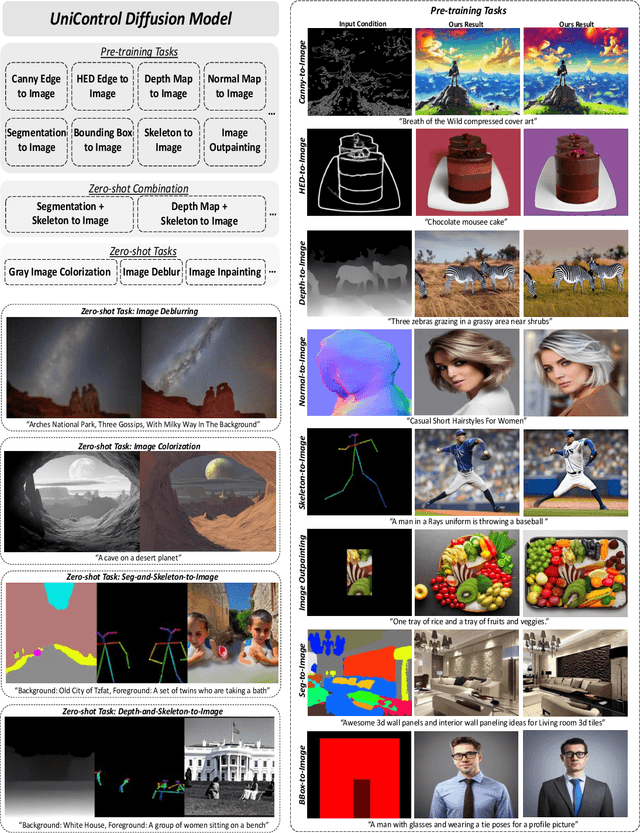

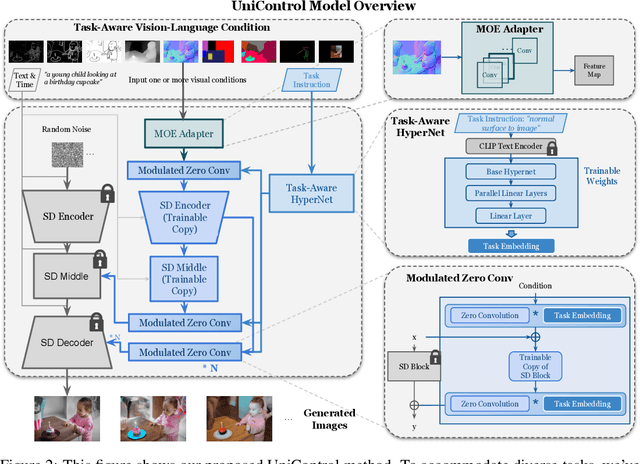

Achieving machine autonomy and human control often represent divergent objectives in the design of interactive AI systems. Visual generative foundation models such as Stable Diffusion show promise in navigating these goals, especially when prompted with arbitrary languages. However, they often fall short in generating images with spatial, structural, or geometric controls. The integration of such controls, which can accommodate various visual conditions in a single unified model, remains an unaddressed challenge. In response, we introduce UniControl, a new generative foundation model that consolidates a wide array of controllable condition-to-image (C2I) tasks within a singular framework, while still allowing for arbitrary language prompts. UniControl enables pixel-level-precise image generation, where visual conditions primarily influence the generated structures and language prompts guide the style and context. To equip UniControl with the capacity to handle diverse visual conditions, we augment pretrained text-to-image diffusion models and introduce a task-aware HyperNet to modulate the diffusion models, enabling the adaptation to different C2I tasks simultaneously. Trained on nine unique C2I tasks, UniControl demonstrates impressive zero-shot generation abilities with unseen visual conditions. Experimental results show that UniControl often surpasses the performance of single-task-controlled methods of comparable model sizes. This control versatility positions UniControl as a significant advancement in the realm of controllable visual generation.
ULIP-2: Towards Scalable Multimodal Pre-training for 3D Understanding
May 18, 2023Recent advancements in multimodal pre-training methods have shown promising efficacy in 3D representation learning by aligning multimodal features across 3D shapes, their 2D counterparts, and language descriptions. However, the methods used by existing multimodal pre-training frameworks to gather multimodal data for 3D applications lack scalability and comprehensiveness, potentially constraining the full potential of multimodal learning. The main bottleneck lies in the language modality's scalability and comprehensiveness. To address this, we introduce ULIP-2, a tri-modal pre-training framework that leverages state-of-the-art large multimodal models to automatically generate holistic language counterparts for 3D objects. It does not require any 3D annotations, and is therefore scalable to large datasets. We conduct experiments on two large-scale 3D datasets, Objaverse and ShapeNet, and augment them with tri-modal datasets of 3D point clouds, images, and language for training ULIP-2. ULIP-2 achieves significant improvements on downstream zero-shot classification on ModelNet40 (74.0% in top-1 accuracy); on the real-world ScanObjectNN benchmark, it obtains 91.5% in overall accuracy with only 1.4 million parameters, signifying a breakthrough in scalable multimodal 3D representation learning without human 3D annotations. The code, along with the generated tri-modal datasets, can be found at https://github.com/salesforce/ULIP.