 Add to Chrome
 Add to Firefox
 Add to Edge
M3imic: Learning a Versatile Whole-Body Controller for Multimodal Motion Mimicking
Jun 03, 2026
Building a general-purpose whole-body controller is essential for enabling diverse motion capabilities in humanoid robots across a wide range of downstream tasks, including locomotion and loco-manipulation. Different tasks rely on distinct motion reference modalities: locomotion primarily depends on coordinated robot joint trajectories, whereas manipulation requires precise end-effector trajectory tracking. Existing methods often overlook the representational mismatch between dense robot joint angles and sparse end-effector poses. To address this, we propose Multi-Modal Mimic (M3imic), a versatile multi-modal whole-body control framework that unifies heterogeneous motion reference modalities, including robot joint angles, human pose trajectories, and end-effector poses, using modality-specific encoders to map them into a shared latent space. Leveraging large-scale reinforcement learning in the simulator, we train a single policy that achieves sim-to-real transfer across multiple motion reference modalities without modality-specific retraining. Extensive simulation and real-world experiments on the Unitree G1 robot are conducted to evaluate the proposed framework. In simulation, the policy achieves a peak success rate of 98.42\% on an unseen test dataset, demonstrating its exceptional generalization capability. The code is available at https://github.com/Renforce-Dynamics/MultiModalWBC

GSFF-SLAM: 3D Semantic Gaussian Splatting SLAM via Feature Field
Apr 28, 2025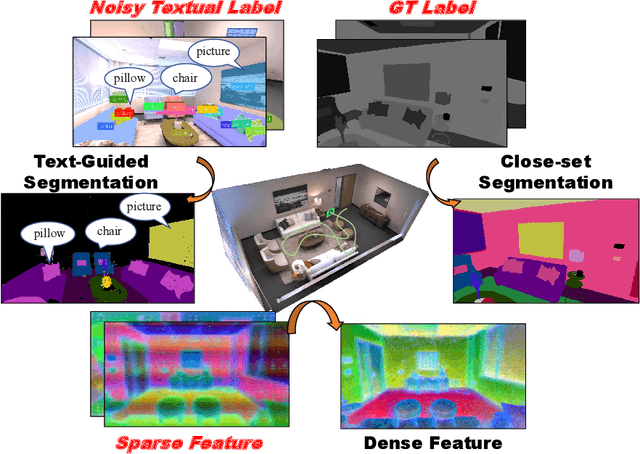
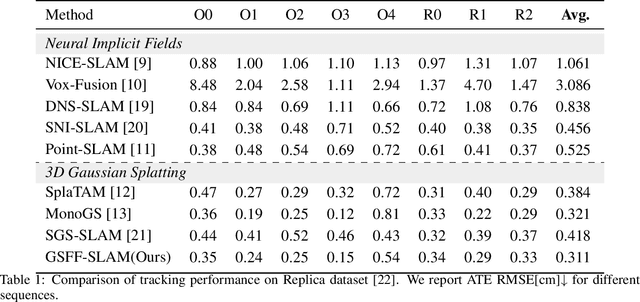
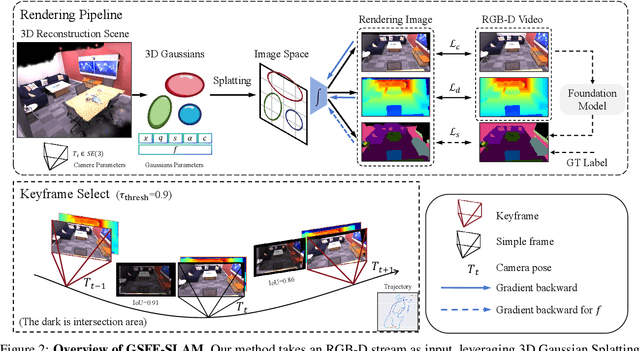
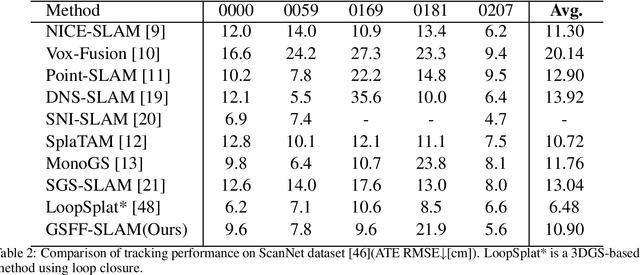
Semantic-aware 3D scene reconstruction is essential for autonomous robots to perform complex interactions. Semantic SLAM, an online approach, integrates pose tracking, geometric reconstruction, and semantic mapping into a unified framework, shows significant potential. However, existing systems, which rely on 2D ground truth priors for supervision, are often limited by the sparsity and noise of these signals in real-world environments. To address this challenge, we propose GSFF-SLAM, a novel dense semantic SLAM system based on 3D Gaussian Splatting that leverages feature fields to achieve joint rendering of appearance, geometry, and N-dimensional semantic features. By independently optimizing feature gradients, our method supports semantic reconstruction using various forms of 2D priors, particularly sparse and noisy signals. Experimental results demonstrate that our approach outperforms previous methods in both tracking accuracy and photorealistic rendering quality. When utilizing 2D ground truth priors, GSFF-SLAM achieves state-of-the-art semantic segmentation performance with 95.03\% mIoU, while achieving up to 2.9$\times$ speedup with only marginal performance degradation.