 Add to Chrome
 Add to Firefox
 Add to Edge
Latent graph encoding of multimodal neuroimaging features with generative AI architectures
Jul 08, 2026
While generative models enable encoding of complex neuroimaging data for feature generation and reconstruction, developing optimal architectural frameworks with appropriate encoding and latent space processes is crucial for studying structural and functional properties of the brain. We design a multimodal generative framework for structural and functional magnetic resonance imaging (MRI) features through systematic evaluation of encoding strategies, latent multimodal fusion, and generative model selection. Using structural gray matter volume (GMV) and static functional network connectivity (sFNC) features from a large neuroimaging dataset, we analyze generative frameworks involving variational autoencoders (VAEs), transformers, generative adversarial networks (GANs), and diffusion models. Architectures that employ modality-aware graph encoding of functional connectivity into a lower-dimensional latent space outperform vectorized encoders or direct data space approaches. The proposed multimodal graph VAE (gMMVAE) surpasses alternative generative variants across multiple metrics for generation fidelity, reconstruction quality, efficiency, and latent space discriminability, highlighting its potential for robust multimodal neuroimaging analysis.

A robust PPG foundation model using multimodal physiological supervision
Jun 05, 2026Photoplethysmography (PPG), a non-invasive measure of changes in blood volume, is widely used in both wearable devices and clinical settings. Recent PPG foundation models either use open-source ICU datasets with pretraining paradigms that require curated data and thus complicate generalization to field-like data, or use closed-source field-like PPG data. In contrast, we propose a PPG foundation model that does not require high-quality or field-like pretraining data, and instead leverages accompanying electrocardiogram and respiratory signals in ICU datasets to select contrastive samples during pretraining. Our approach allows the model to retain and learn from noisy PPG segments, improving robustness at inference. Our model, pretrained on 3x fewer subjects than existing state-of-the-art approaches, achieves performance improvements on 14 out of 15 diverse downstream tasks, including field-like daily activity and heart rate prediction. Our results demonstrate that multimodal supervision can integrate complementary physiological information to improve the robustness of PPG foundation models and enhance their generalization to consumer-grade data.
XMorph: Explainable Brain Tumor Analysis Via LLM-Assisted Hybrid Deep Intelligence
Feb 24, 2026Deep learning has significantly advanced automated brain tumor diagnosis, yet clinical adoption remains limited by interpretability and computational constraints. Conventional models often act as opaque ''black boxes'' and fail to quantify the complex, irregular tumor boundaries that characterize malignant growth. To address these challenges, we present XMorph, an explainable and computationally efficient framework for fine-grained classification of three prominent brain tumor types: glioma, meningioma, and pituitary tumors. We propose an Information-Weighted Boundary Normalization (IWBN) mechanism that emphasizes diagnostically relevant boundary regions alongside nonlinear chaotic and clinically validated features, enabling a richer morphological representation of tumor growth. A dual-channel explainable AI module combines GradCAM++ visual cues with LLM-generated textual rationales, translating model reasoning into clinically interpretable insights. The proposed framework achieves a classification accuracy of 96.0%, demonstrating that explainability and high performance can co-exist in AI-based medical imaging systems. The source code and materials for XMorph are all publicly available at: https://github.com/ALSER-Lab/XMorph.
Breast Cancer Detection in Thermographic Images via Diffusion-Based Augmentation and Nonlinear Feature Fusion
Sep 08, 2025Data scarcity hinders deep learning for medical imaging. We propose a framework for breast cancer classification in thermograms that addresses this using a Diffusion Probabilistic Model (DPM) for data augmentation. Our DPM-based augmentation is shown to be superior to both traditional methods and a ProGAN baseline. The framework fuses deep features from a pre-trained ResNet-50 with handcrafted nonlinear features (e.g., Fractal Dimension) derived from U-Net segmented tumors. An XGBoost classifier trained on these fused features achieves 98.0\% accuracy and 98.1\% sensitivity. Ablation studies and statistical tests confirm that both the DPM augmentation and the nonlinear feature fusion are critical, statistically significant components of this success. This work validates the synergy between advanced generative models and interpretable features for creating highly accurate medical diagnostic tools.
Causal Graph Recovery in Neuroimaging through Answer Set Programming
Jun 10, 2025Learning graphical causal structures from time series data presents significant challenges, especially when the measurement frequency does not match the causal timescale of the system. This often leads to a set of equally possible underlying causal graphs due to information loss from sub-sampling (i.e., not observing all possible states of the system throughout time). Our research addresses this challenge by incorporating the effects of sub-sampling in the derivation of causal graphs, resulting in more accurate and intuitive outcomes. We use a constraint optimization approach, specifically answer set programming (ASP), to find the optimal set of answers. ASP not only identifies the most probable underlying graph, but also provides an equivalence class of possible graphs for expert selection. In addition, using ASP allows us to leverage graph theory to further prune the set of possible solutions, yielding a smaller, more accurate answer set significantly faster than traditional approaches. We validate our approach on both simulated data and empirical structural brain connectivity, and demonstrate its superiority over established methods in these experiments. We further show how our method can be used as a meta-approach on top of established methods to obtain, on average, 12% improvement in F1 score. In addition, we achieved state of the art results in terms of precision and recall of reconstructing causal graph from sub-sampled time series data. Finally, our method shows robustness to varying degrees of sub-sampling on realistic simulations, whereas other methods perform worse for higher rates of sub-sampling.
Mapping minds not averages: a scalable subject-specific manifold learning framework for neuroimaging data
Apr 30, 2025Mental and cognitive representations are believed to reside on low-dimensional, non-linear manifolds embedded within high-dimensional brain activity. Uncovering these manifolds is key to understanding individual differences in brain function, yet most existing machine learning methods either rely on population-level spatial alignment or assume data that is temporally structured, either because data is aligned among subjects or because event timings are known. We introduce a manifold learning framework that can capture subject-specific spatial variations across both structured and temporally unstructured neuroimaging data. On simulated data and two naturalistic fMRI datasets (Sherlock and Forrest Gump), our framework outperforms group-based baselines by recovering more accurate and individualized representations. We further show that the framework scales efficiently to large datasets and generalizes well to new subjects. To test this, we apply the framework to temporally unstructured resting-state fMRI data from individuals with schizophrenia and healthy controls. We further apply our method to a large resting-state fMRI dataset comprising individuals with schizophrenia and controls. In this setting, we demonstrate that the framework scales efficiently to large populations and generalizes robustly to unseen subjects. The learned subject-specific spatial maps our model finds reveal clinically relevant patterns, including increased activation in the basal ganglia, visual, auditory, and somatosensory regions, and decreased activation in the insula, inferior frontal gyrus, and angular gyrus. These findings suggest that our framework can uncover clinically relevant subject-specific brain activity patterns. Our approach thus provides a scalable and individualized framework for modeling brain activity, with applications in computational neuroscience and clinical research.
Rethinking Functional Brain Connectome Analysis: Do Graph Deep Learning Models Help?
Jan 28, 2025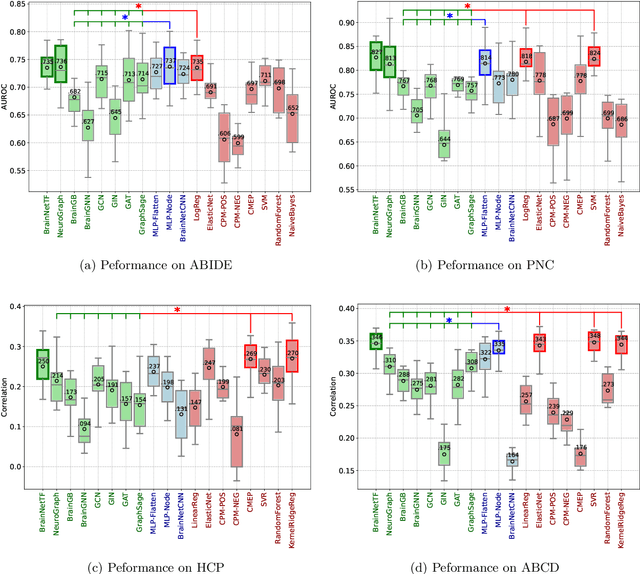
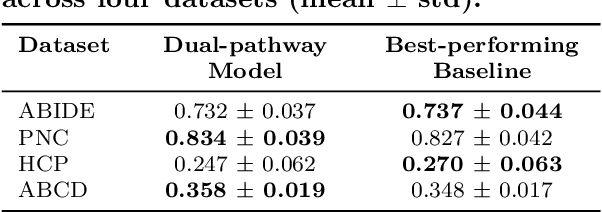
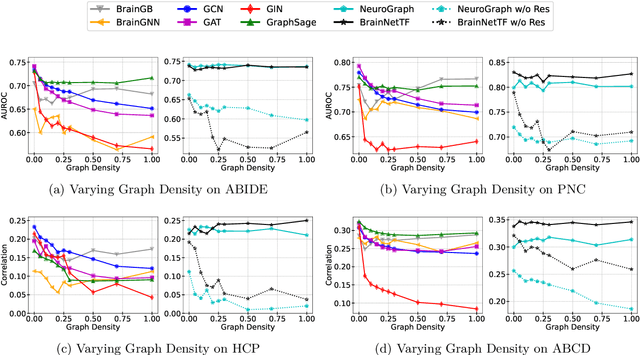
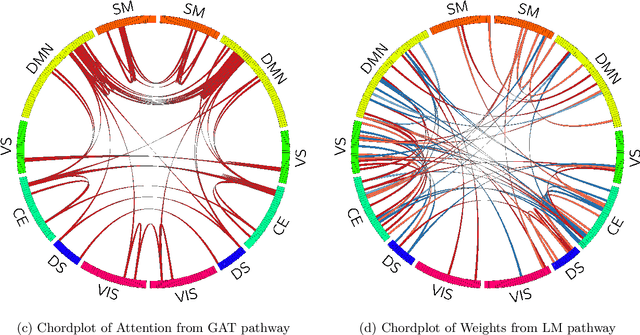
Functional brain connectome is crucial for deciphering the neural mechanisms underlying cognitive functions and neurological disorders. Graph deep learning models have recently gained tremendous popularity in this field. However, their actual effectiveness in modeling the brain connectome remains unclear. In this study, we re-examine graph deep learning models based on four large-scale neuroimaging studies encompassing diverse cognitive and clinical outcomes. Surprisingly, we find that the message aggregation mechanism, a hallmark of graph deep learning models, does not help with predictive performance as typically assumed, but rather consistently degrades it. To address this issue, we propose a hybrid model combining a linear model with a graph attention network through dual pathways, achieving robust predictions and enhanced interpretability by revealing both localized and global neural connectivity patterns. Our findings urge caution in adopting complex deep learning models for functional brain connectome analysis, emphasizing the need for rigorous experimental designs to establish tangible performance gains and perhaps more importantly, to pursue improvements in model interpretability.
Hierarchical Spatio-Temporal State-Space Modeling for fMRI Analysis
Aug 23, 2024


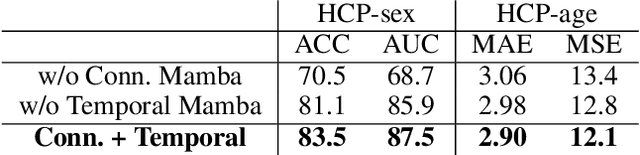
Recent advances in deep learning structured state space models, especially the Mamba architecture, have demonstrated remarkable performance improvements while maintaining linear complexity. In this study, we introduce functional spatiotemporal Mamba (FST-Mamba), a Mamba-based model designed for discovering neurological biomarkers using functional magnetic resonance imaging (fMRI). We focus on dynamic functional network connectivity (dFNC) derived from fMRI and propose a hierarchical spatiotemporal Mamba-based network that processes spatial and temporal information separately using Mamba-based encoders. Leveraging the topological uniqueness of the FNC matrix, we introduce a component-wise varied-scale aggregation (CVA) mechanism to aggregate connectivity across individual components within brain networks, enabling the model to capture both inter-component and inter-network information. To better handle the FNC data, we develop a new component-specific scanning order. Additionally, we propose symmetric rotary position encoding (SymRope) to encode the relative positions of each functional connection while considering the symmetric nature of the FNC matrix. Experimental results demonstrate significant improvements in the proposed FST-Mamba model on various brain-based classification and regression tasks. Our work reveals the substantial potential of attention-free sequence modeling in brain discovery.
Spatial Sequence Attention Network for Schizophrenia Classification from Structural Brain MR Images
Jun 18, 2024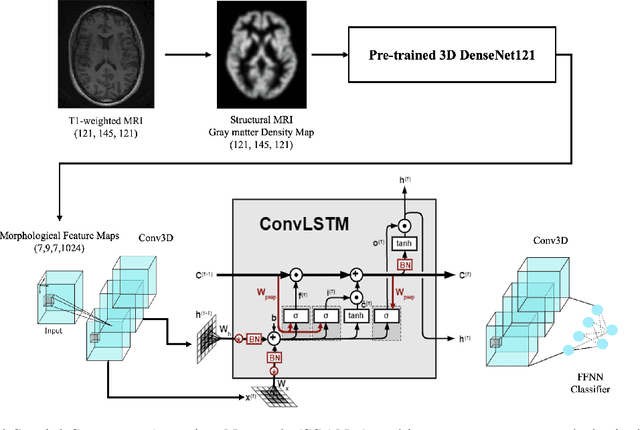


Schizophrenia is a debilitating, chronic mental disorder that significantly impacts an individual's cognitive abilities, behavior, and social interactions. It is characterized by subtle morphological changes in the brain, particularly in the gray matter. These changes are often imperceptible through manual observation, demanding an automated approach to diagnosis. This study introduces a deep learning methodology for the classification of individuals with Schizophrenia. We achieve this by implementing a diversified attention mechanism known as Spatial Sequence Attention (SSA) which is designed to extract and emphasize significant feature representations from structural MRI (sMRI). Initially, we employ the transfer learning paradigm by leveraging pre-trained DenseNet to extract initial feature maps from the final convolutional block which contains morphological alterations associated with Schizophrenia. These features are further processed by the proposed SSA to capture and emphasize intricate spatial interactions and relationships across volumes within the brain. Our experimental studies conducted on a clinical dataset have revealed that the proposed attention mechanism outperforms the existing Squeeze & Excitation Network for Schizophrenia classification.
Unmasking Efficiency: Learning Salient Sparse Models in Non-IID Federated Learning
May 15, 2024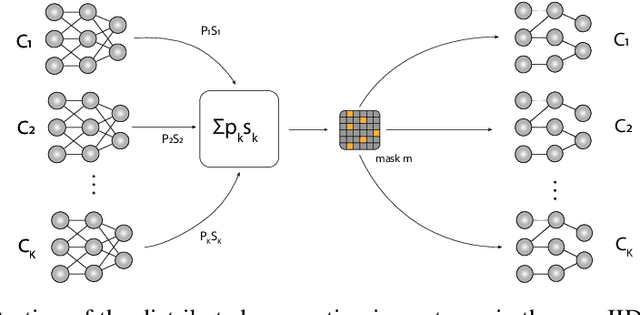
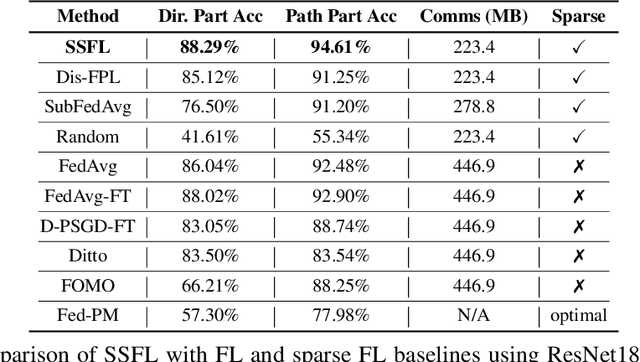
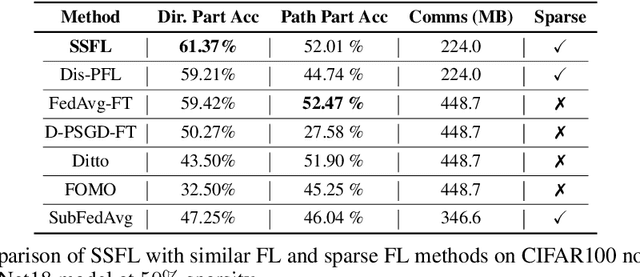
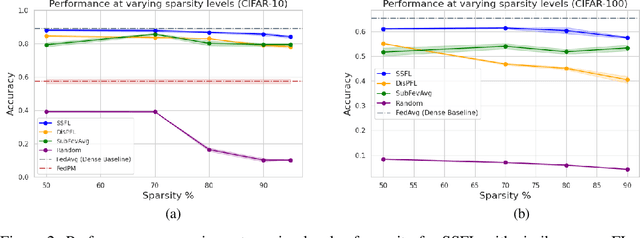
In this work, we propose Salient Sparse Federated Learning (SSFL), a streamlined approach for sparse federated learning with efficient communication. SSFL identifies a sparse subnetwork prior to training, leveraging parameter saliency scores computed separately on local client data in non-IID scenarios, and then aggregated, to determine a global mask. Only the sparse model weights are communicated each round between the clients and the server. We validate SSFL's effectiveness using standard non-IID benchmarks, noting marked improvements in the sparsity--accuracy trade-offs. Finally, we deploy our method in a real-world federated learning framework and report improvement in communication time.