 Add to Chrome
 Add to Firefox
 Add to Edge
Step 3.5 Flash: Open Frontier-Level Intelligence with 11B Active Parameters
Feb 11, 2026
We introduce Step 3.5 Flash, a sparse Mixture-of-Experts (MoE) model that bridges frontier-level agentic intelligence and computational efficiency. We focus on what matters most when building agents: sharp reasoning and fast, reliable execution. Step 3.5 Flash pairs a 196B-parameter foundation with 11B active parameters for efficient inference. It is optimized with interleaved 3:1 sliding-window/full attention and Multi-Token Prediction (MTP-3) to reduce the latency and cost of multi-round agentic interactions. To reach frontier-level intelligence, we design a scalable reinforcement learning framework that combines verifiable signals with preference feedback, while remaining stable under large-scale off-policy training, enabling consistent self-improvement across mathematics, code, and tool use. Step 3.5 Flash demonstrates strong performance across agent, coding, and math tasks, achieving 85.4% on IMO-AnswerBench, 86.4% on LiveCodeBench-v6 (2024.08-2025.05), 88.2% on tau2-Bench, 69.0% on BrowseComp (with context management), and 51.0% on Terminal-Bench 2.0, comparable to frontier models such as GPT-5.2 xHigh and Gemini 3.0 Pro. By redefining the efficiency frontier, Step 3.5 Flash provides a high-density foundation for deploying sophisticated agents in real-world industrial environments.

GSFF-SLAM: 3D Semantic Gaussian Splatting SLAM via Feature Field
Apr 28, 2025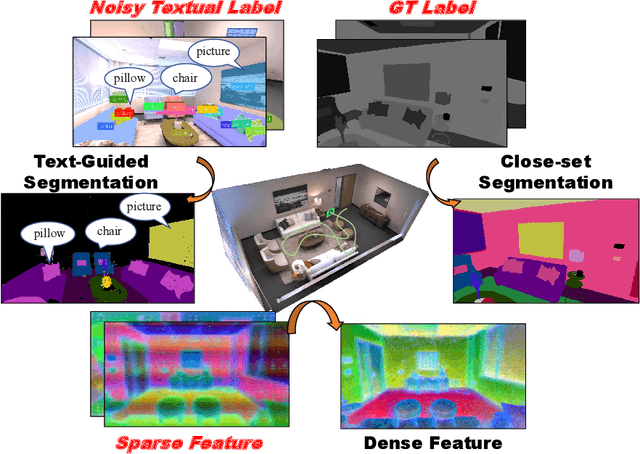
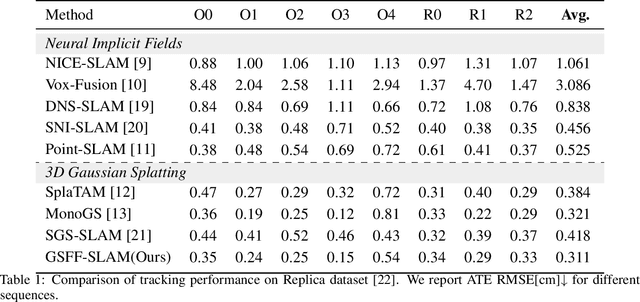
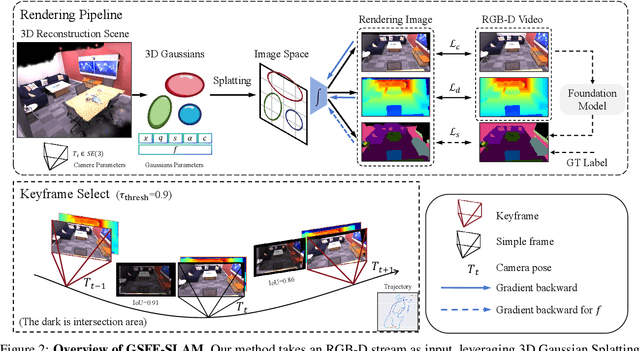
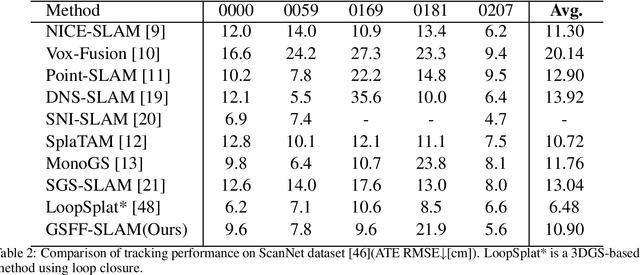
Semantic-aware 3D scene reconstruction is essential for autonomous robots to perform complex interactions. Semantic SLAM, an online approach, integrates pose tracking, geometric reconstruction, and semantic mapping into a unified framework, shows significant potential. However, existing systems, which rely on 2D ground truth priors for supervision, are often limited by the sparsity and noise of these signals in real-world environments. To address this challenge, we propose GSFF-SLAM, a novel dense semantic SLAM system based on 3D Gaussian Splatting that leverages feature fields to achieve joint rendering of appearance, geometry, and N-dimensional semantic features. By independently optimizing feature gradients, our method supports semantic reconstruction using various forms of 2D priors, particularly sparse and noisy signals. Experimental results demonstrate that our approach outperforms previous methods in both tracking accuracy and photorealistic rendering quality. When utilizing 2D ground truth priors, GSFF-SLAM achieves state-of-the-art semantic segmentation performance with 95.03\% mIoU, while achieving up to 2.9$\times$ speedup with only marginal performance degradation.