 Add to Chrome
 Add to Firefox
 Add to Edge
Safety Alignment via Constrained Knowledge Unlearning
May 24, 2025
Despite significant progress in safety alignment, large language models (LLMs) remain susceptible to jailbreak attacks. Existing defense mechanisms have not fully deleted harmful knowledge in LLMs, which allows such attacks to bypass safeguards and produce harmful outputs. To address this challenge, we propose a novel safety alignment strategy, Constrained Knowledge Unlearning (CKU), which focuses on two primary objectives: knowledge localization and retention, and unlearning harmful knowledge. CKU works by scoring neurons in specific multilayer perceptron (MLP) layers to identify a subset U of neurons associated with useful knowledge. During the unlearning process, CKU prunes the gradients of neurons in U to preserve valuable knowledge while effectively mitigating harmful content. Experimental results demonstrate that CKU significantly enhances model safety without compromising overall performance, offering a superior balance between safety and utility compared to existing methods. Additionally, our analysis of neuron knowledge sensitivity across various MLP layers provides valuable insights into the mechanics of safety alignment and model knowledge editing.

Mesh-RFT: Enhancing Mesh Generation via Fine-grained Reinforcement Fine-Tuning
May 22, 2025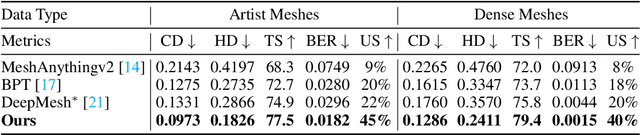
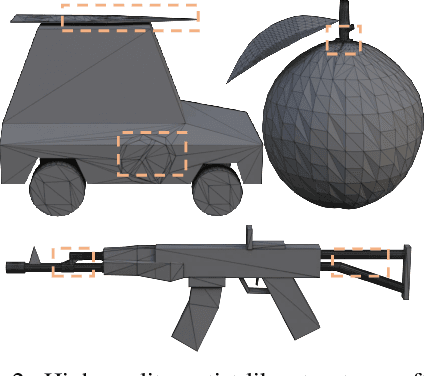
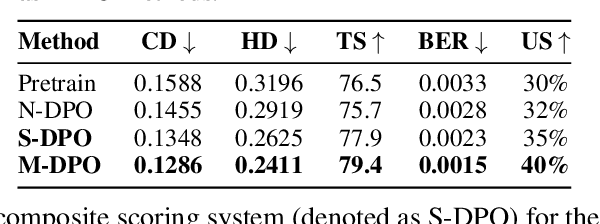
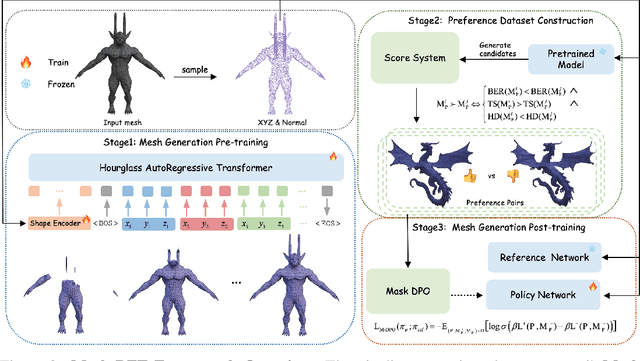
Existing pretrained models for 3D mesh generation often suffer from data biases and produce low-quality results, while global reinforcement learning (RL) methods rely on object-level rewards that struggle to capture local structure details. To address these challenges, we present \textbf{Mesh-RFT}, a novel fine-grained reinforcement fine-tuning framework that employs Masked Direct Preference Optimization (M-DPO) to enable localized refinement via quality-aware face masking. To facilitate efficient quality evaluation, we introduce an objective topology-aware scoring system to evaluate geometric integrity and topological regularity at both object and face levels through two metrics: Boundary Edge Ratio (BER) and Topology Score (TS). By integrating these metrics into a fine-grained RL strategy, Mesh-RFT becomes the first method to optimize mesh quality at the granularity of individual faces, resolving localized errors while preserving global coherence. Experiment results show that our M-DPO approach reduces Hausdorff Distance (HD) by 24.6\% and improves Topology Score (TS) by 3.8\% over pre-trained models, while outperforming global DPO methods with a 17.4\% HD reduction and 4.9\% TS gain. These results demonstrate Mesh-RFT's ability to improve geometric integrity and topological regularity, achieving new state-of-the-art performance in production-ready mesh generation. Project Page: \href{https://hitcslj.github.io/mesh-rft/}{this https URL}.
MTSA: Multi-turn Safety Alignment for LLMs through Multi-round Red-teaming
May 22, 2025The proliferation of jailbreak attacks against large language models (LLMs) highlights the need for robust security measures. However, in multi-round dialogues, malicious intentions may be hidden in interactions, leading LLMs to be more prone to produce harmful responses. In this paper, we propose the \textbf{M}ulti-\textbf{T}urn \textbf{S}afety \textbf{A}lignment (\ourapproach) framework, to address the challenge of securing LLMs in multi-round interactions. It consists of two stages: In the thought-guided attack learning stage, the red-team model learns about thought-guided multi-round jailbreak attacks to generate adversarial prompts. In the adversarial iterative optimization stage, the red-team model and the target model continuously improve their respective capabilities in interaction. Furthermore, we introduce a multi-turn reinforcement learning algorithm based on future rewards to enhance the robustness of safety alignment. Experimental results show that the red-team model exhibits state-of-the-art attack capabilities, while the target model significantly improves its performance on safety benchmarks.
Multi-Modality Expansion and Retention for LLMs through Parameter Merging and Decoupling
May 21, 2025Fine-tuning Large Language Models (LLMs) with multimodal encoders on modality-specific data expands the modalities that LLMs can handle, leading to the formation of Multimodal LLMs (MLLMs). However, this paradigm heavily relies on resource-intensive and inflexible fine-tuning from scratch with new multimodal data. In this paper, we propose MMER (Multi-modality Expansion and Retention), a training-free approach that integrates existing MLLMs for effective multimodal expansion while retaining their original performance. Specifically, MMER reuses MLLMs' multimodal encoders while merging their LLM parameters. By comparing original and merged LLM parameters, MMER generates binary masks to approximately separate LLM parameters for each modality. These decoupled parameters can independently process modality-specific inputs, reducing parameter conflicts and preserving original MLLMs' fidelity. MMER can also mitigate catastrophic forgetting by applying a similar process to MLLMs fine-tuned on new tasks. Extensive experiments show significant improvements over baselines, proving that MMER effectively expands LLMs' multimodal capabilities while retaining 99% of the original performance, and also markedly mitigates catastrophic forgetting.
Rejoining fragmented ancient bamboo slips with physics-driven deep learning
May 13, 2025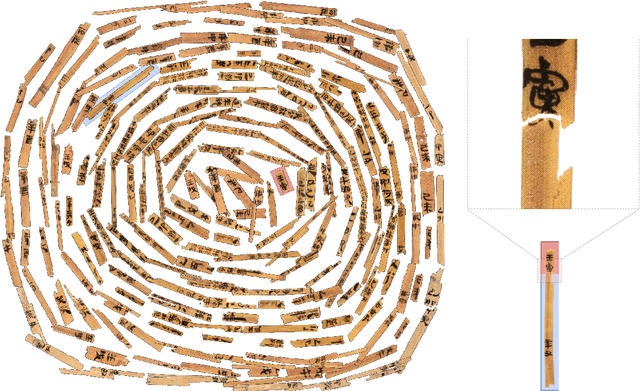
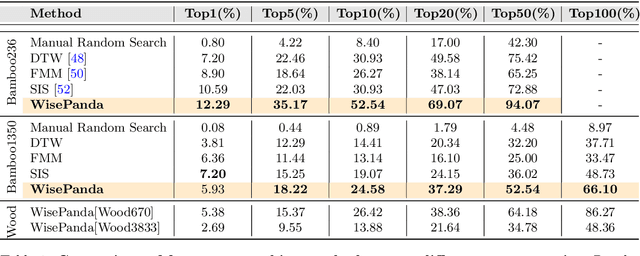
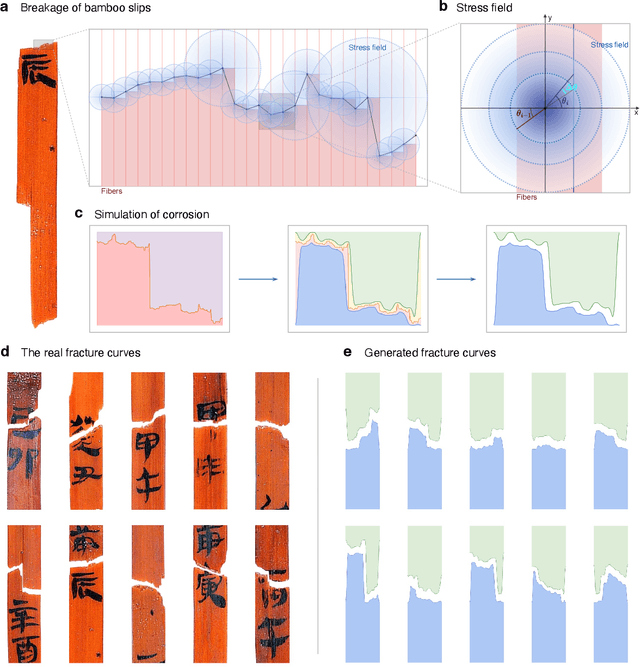
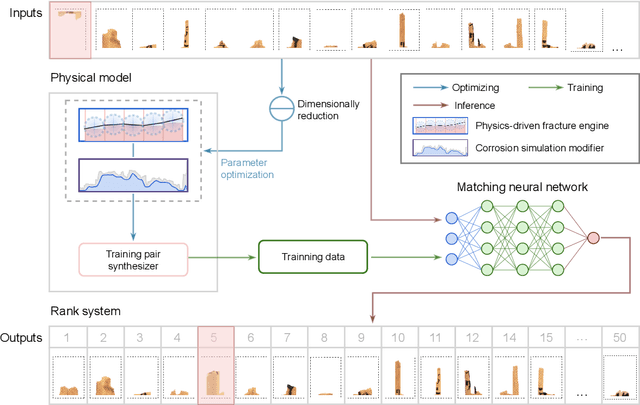
Bamboo slips are a crucial medium for recording ancient civilizations in East Asia, and offers invaluable archaeological insights for reconstructing the Silk Road, studying material culture exchanges, and global history. However, many excavated bamboo slips have been fragmented into thousands of irregular pieces, making their rejoining a vital yet challenging step for understanding their content. Here we introduce WisePanda, a physics-driven deep learning framework designed to rejoin fragmented bamboo slips. Based on the physics of fracture and material deterioration, WisePanda automatically generates synthetic training data that captures the physical properties of bamboo fragmentations. This approach enables the training of a matching network without requiring manually paired samples, providing ranked suggestions to facilitate the rejoining process. Compared to the leading curve matching method, WisePanda increases Top-50 matching accuracy from 36\% to 52\%. Archaeologists using WisePanda have experienced substantial efficiency improvements (approximately 20 times faster) when rejoining fragmented bamboo slips. This research demonstrates that incorporating physical principles into deep learning models can significantly enhance their performance, transforming how archaeologists restore and study fragmented artifacts. WisePanda provides a new paradigm for addressing data scarcity in ancient artifact restoration through physics-driven machine learning.
UMoE: Unifying Attention and FFN with Shared Experts
May 12, 2025Sparse Mixture of Experts (MoE) architectures have emerged as a promising approach for scaling Transformer models. While initial works primarily incorporated MoE into feed-forward network (FFN) layers, recent studies have explored extending the MoE paradigm to attention layers to enhance model performance. However, existing attention-based MoE layers require specialized implementations and demonstrate suboptimal performance compared to their FFN-based counterparts. In this paper, we aim to unify the MoE designs in attention and FFN layers by introducing a novel reformulation of the attention mechanism, revealing an underlying FFN-like structure within attention modules. Our proposed architecture, UMoE, achieves superior performance through attention-based MoE layers while enabling efficient parameter sharing between FFN and attention components.
TARAC: Mitigating Hallucination in LVLMs via Temporal Attention Real-time Accumulative Connection
Apr 05, 2025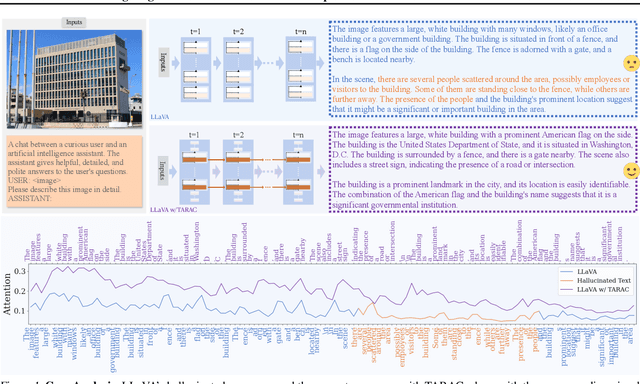
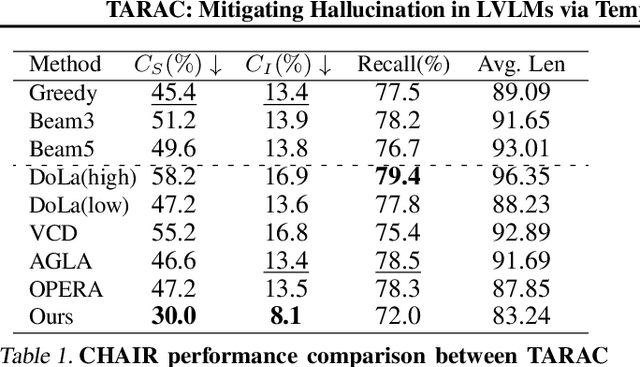
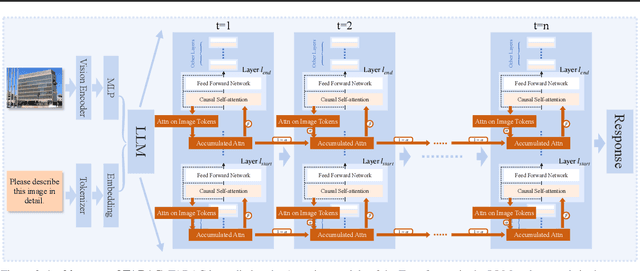
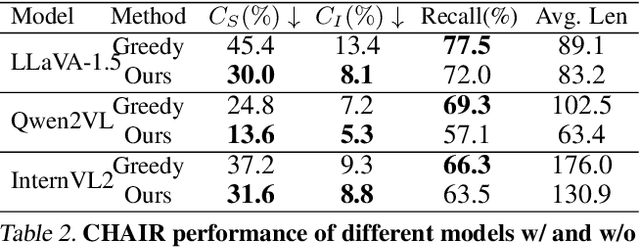
Large Vision-Language Models have demonstrated remarkable performance across various tasks; however, the challenge of hallucinations constrains their practical applications. The hallucination problem arises from multiple factors, including the inherent hallucinations in language models, the limitations of visual encoders in perception, and biases introduced by multimodal data. Extensive research has explored ways to mitigate hallucinations. For instance, OPERA prevents the model from overly focusing on "anchor tokens", thereby reducing hallucinations, whereas VCD mitigates hallucinations by employing a contrastive decoding approach. In this paper, we investigate the correlation between the decay of attention to image tokens and the occurrence of hallucinations. Based on this finding, we propose Temporal Attention Real-time Accumulative Connection (TARAC), a novel training-free method that dynamically accumulates and updates LVLMs' attention on image tokens during generation. By enhancing the model's attention to image tokens, TARAC mitigates hallucinations caused by the decay of attention on image tokens. We validate the effectiveness of TARAC across multiple models and datasets, demonstrating that our approach substantially mitigates hallucinations. In particular, TARAC reduces $C_S$ by 25.2 and $C_I$ by 8.7 compared to VCD on the CHAIR benchmark.
When 'YES' Meets 'BUT': Can Large Models Comprehend Contradictory Humor Through Comparative Reasoning?
Mar 29, 2025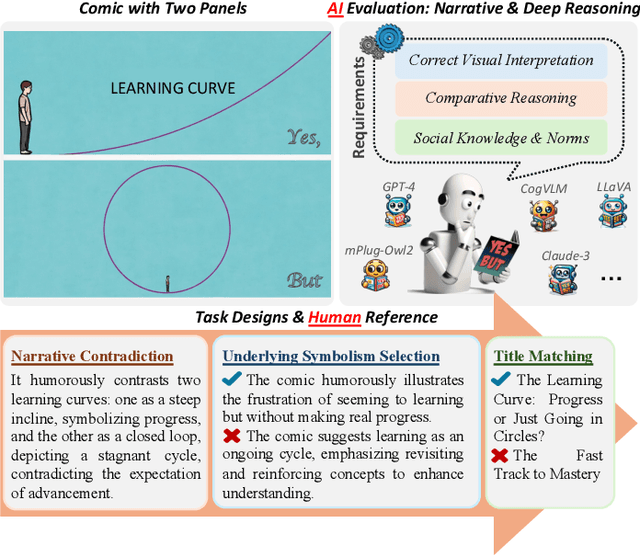
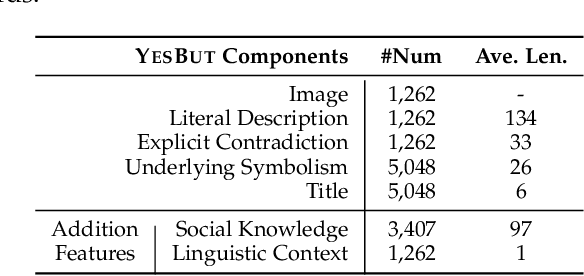
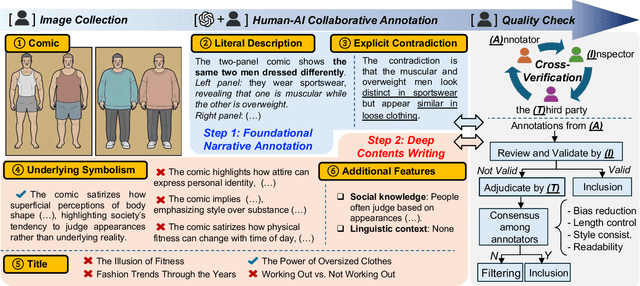
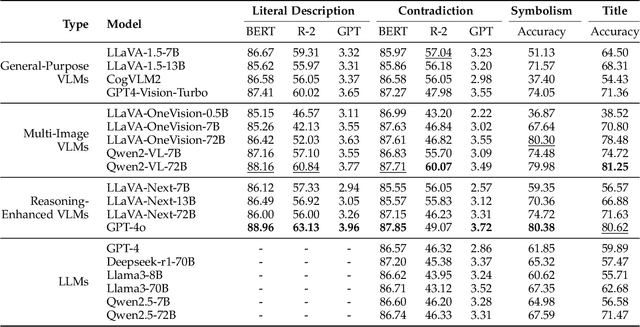
Understanding humor-particularly when it involves complex, contradictory narratives that require comparative reasoning-remains a significant challenge for large vision-language models (VLMs). This limitation hinders AI's ability to engage in human-like reasoning and cultural expression. In this paper, we investigate this challenge through an in-depth analysis of comics that juxtapose panels to create humor through contradictions. We introduce the YesBut (V2), a novel benchmark with 1,262 comic images from diverse multilingual and multicultural contexts, featuring comprehensive annotations that capture various aspects of narrative understanding. Using this benchmark, we systematically evaluate a wide range of VLMs through four complementary tasks spanning from surface content comprehension to deep narrative reasoning, with particular emphasis on comparative reasoning between contradictory elements. Our extensive experiments reveal that even the most advanced models significantly underperform compared to humans, with common failures in visual perception, key element identification, comparative analysis and hallucinations. We further investigate text-based training strategies and social knowledge augmentation methods to enhance model performance. Our findings not only highlight critical weaknesses in VLMs' understanding of cultural and creative expressions but also provide pathways toward developing context-aware models capable of deeper narrative understanding though comparative reasoning.
Learnable cut flow
Mar 28, 2025
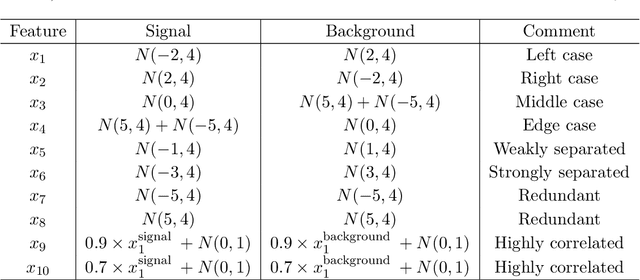
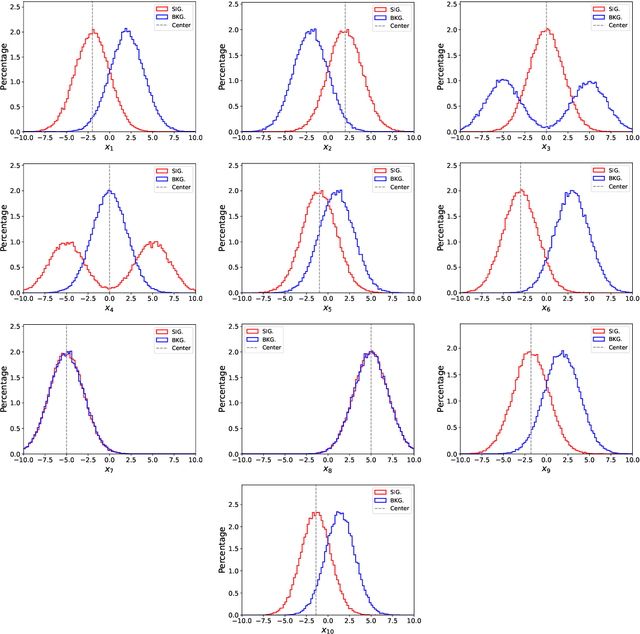

Neural networks have emerged as a powerful paradigm for tasks in high energy physics, yet their opaque training process renders them as a black box. In contrast, the traditional cut flow method offers simplicity and interpretability but demands human effort to identify optimal boundaries. To merge the strengths of both approaches, we propose the Learnable Cut Flow (LCF), a neural network that transforms the traditional cut selection into a fully differentiable, data-driven process. LCF implements two cut strategies-parallel, where observable distributions are treated independently, and sequential, where prior cuts shape subsequent ones-to flexibly determine optimal boundaries. Building on this, we introduce the Learnable Importance, a metric that quantifies feature importance and adjusts their contributions to the loss accordingly, offering model-driven insights unlike ad-hoc metrics. To ensure differentiability, a modified loss function replaces hard cuts with mask operations, preserving data shape throughout the training process. LCF is tested on six varied mock datasets and a realistic diboson vs. QCD dataset. Results demonstrate that LCF (1) accurately learns cut boundaries across typical feature distributions in both parallel and sequential strategies, (2) assigns higher importance to discriminative features with minimal overlap, (3) handles redundant or correlated features robustly, and (4) performs effectively in real-world scenarios. In diboson dataset, LCF initially underperforms boosted decision trees and multiplayer perceptrons when using all observables. However, pruning less critical features-guided by learned importance-boosts its performance to match or exceed these baselines. LCF bridges the gap between traditional cut flow method and modern black-box neural networks, delivering actionable insights into the training process and feature importance.
DTGBrepGen: A Novel B-rep Generative Model through Decoupling Topology and Geometry
Mar 17, 2025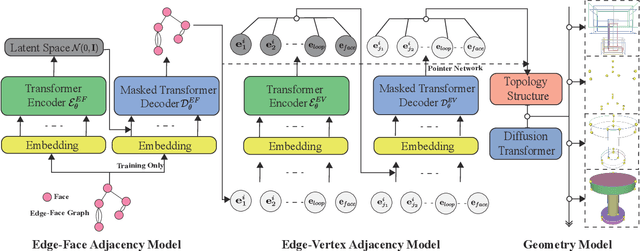
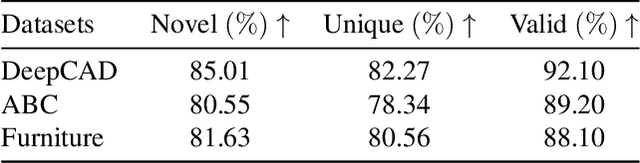
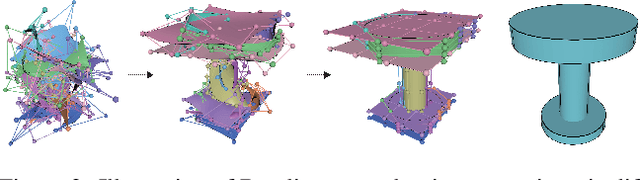
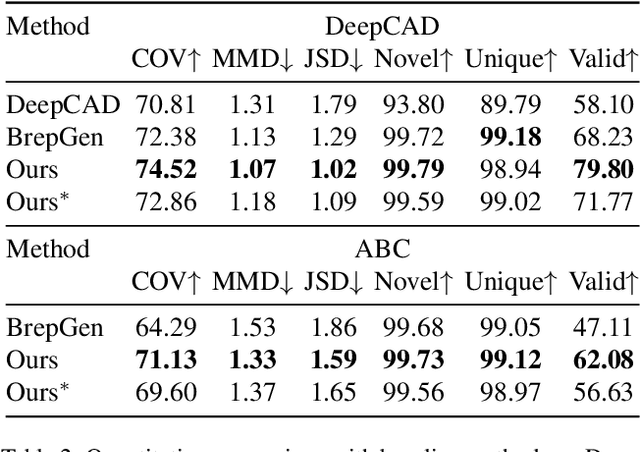
Boundary representation (B-rep) of geometric models is a fundamental format in Computer-Aided Design (CAD). However, automatically generating valid and high-quality B-rep models remains challenging due to the complex interdependence between the topology and geometry of the models. Existing methods tend to prioritize geometric representation while giving insufficient attention to topological constraints, making it difficult to maintain structural validity and geometric accuracy. In this paper, we propose DTGBrepGen, a novel topology-geometry decoupled framework for B-rep generation that explicitly addresses both aspects. Our approach first generates valid topological structures through a two-stage process that independently models edge-face and edge-vertex adjacency relationships. Subsequently, we employ Transformer-based diffusion models for sequential geometry generation, progressively generating vertex coordinates, followed by edge geometries and face geometries which are represented as B-splines. Extensive experiments on diverse CAD datasets show that DTGBrepGen significantly outperforms existing methods in both topological validity and geometric accuracy, achieving higher validity rates and producing more diverse and realistic B-reps. Our code is publicly available at https://github.com/jinli99/DTGBrepGen.