 Add to Chrome
 Add to Firefox
 Add to Edge
PosterText: Towards Unified Visual Text Generation and Editing for E-commerce Poster
Aug 18, 2026
Automated e-commerce poster design requires both high-quality poster generation and flexible editing of existing designs. However, most existing methods either target end-to-end poster generation or follow multi-stage design pipelines, with limited capability for flexible and precise editing of existing posters. To enable unified generation and editing of e-commerce posters, we introduce Text Patch Generation and Editing, a unified task formulation that treats text patches as atomic units and covers four operations: poster generation, patch addition, patch deletion, and patch modification, with optional reference-guided style control. Based on this, we propose PosterText, a unified model trained with a four-stage curriculum, including text rendering pretraining, instruction-following training, reinforcement learning for preference alignment, and spatial guidance self-distillation for execution refinement. We further construct a large-scale dataset with patch-level annotations and a comprehensive benchmark for evaluation. Extensive experiments demonstrate that PosterText achieves competitive performance against existing generation and editing approaches, validating the effectiveness of the proposed framework.

iFAN: Inference-Aware Learning for Plain Mask Transformers
Aug 07, 2026Query-based mask transformers assemble segmentation outputs through pixel-wise competition among query predictions of the final layer, yet this inference process is not explicitly optimized during training. We identify two key mismatches: the query with the highest probability-mask score does not necessarily produce the most accurate mask, and final-layer decoding may discard superior predictions from intermediate layers. To address these issues, we propose Inference-Aware Learning (iFAN), a general training framework for plain mask transformers. iFAN introduces Adjusted Probability-Mask Ranking (APMR), which aligns query competition with predicted mask quality and suppresses high-confidence but inaccurate competitors. We further employ Cross-Layer Self-Distillation (CLSD) to transfer stronger intermediate predictions to the final layer. The ranking and distillation objectives are training-only, while inference retains efficient final-layer decoding. Experiments on COCO, ADE20K, and Cityscapes demonstrate consistent improvements across panoptic, instance, and semantic segmentation, as well as across different architectures, backbone scales, and input resolutions. Overall, iFAN improves performance by an average of 1.20 PQ, 1.30 AP, and 0.63 mIoU, with negligible additional parameters, FLOPs and inference latency.
BLADE: Scalable Bi-level Adaptive Data Selection for LLM Training
Jun 17, 2026As Large Language Model (LLM) datasets scale to trillions of tokens, data selection has emerged as a critical frontier to filter out uninformative noise and construct adaptive learning trajectories. Beyond static heuristic filtering, advanced data selection methods for LLM training largely follow two paradigms, each with fundamental limitations. Influence-based methods provide principled bi-level objectives but require intractable inverse-Hessian computations, while excess-loss methods are computationally efficient but rely on a static reference model that becomes misaligned with the evolving proxy model during training. We propose BLADE (Bi-Level Adaptive Data sElection), a Hessian-free framework for data selection. BLADE reformulates the bi-level optimization problem underlying influence-based methods as a penalized single-level objective via Lagrange multipliers, avoiding inverse-Hessian computation while revealing a principled connection to excess-loss based data selection. The resulting objective recovers an excess-loss form but replaces the static reference model with a dynamic one that stays synchronized with training. Theoretically, we prove that this penalized formulation guarantees first-order convergence. For efficient online batch selection, we instantiate BLADE as a memoryless randomized block-coordinate Frank-Wolfe algorithm. Extensive experiments show that BLADE consistently outperforms state-of-the-art data selection baselines, providing a practical recipe for LLM training.
HISA: Efficient Hierarchical Indexing for Fine-Grained Sparse Attention
Apr 01, 2026Token-level sparse attention mechanisms, exemplified by DeepSeek Sparse Attention (DSA), achieve fine-grained key selection by scoring every historical key for each query through a lightweight indexer, then computing attention only on the selected subset. While the downstream sparse attention itself scales favorably, the indexer must still scan the entire prefix for every query, introducing an per-layer bottleneck that grows prohibitively with context length. We propose HISA (Hierarchical Indexed Sparse Attention), a plug-and-play replacement for the indexer that rewrites the search path from a flat token scan into a two-stage hierarchical procedure: (1) a block-level coarse filtering stage that scores pooled block representations to discard irrelevant regions, followed by (2) a token-level refinement stage that applies the original indexer exclusively within the retained candidate blocks. HISA preserves the identical token-level top-sparse pattern consumed by the downstream Sparse MLA operator and requires no additional training. On kernel-level benchmarks, HISA achieves up to speedup at 64K context. On Needle-in-a-Haystack and LongBench, we directly replace the indexer in DeepSeek-V3.2 and GLM-5 with our HISA indexer, without any finetuning. HISA closely matches the original DSA in quality, while substantially outperforming block-sparse baselines.
Do Transformers Have the Ability for Periodicity Generalization?
Jan 30, 2026Large language models (LLMs) based on the Transformer have demonstrated strong performance across diverse tasks. However, current models still exhibit substantial limitations in out-of-distribution (OOD) generalization compared with humans. We investigate this gap through periodicity, one of the basic OOD scenarios. Periodicity captures invariance amid variation. Periodicity generalization represents a model's ability to extract periodic patterns from training data and generalize to OOD scenarios. We introduce a unified interpretation of periodicity from the perspective of abstract algebra and reasoning, including both single and composite periodicity, to explain why Transformers struggle to generalize periodicity. Then we construct Coper about composite periodicity, a controllable generative benchmark with two OOD settings, Hollow and Extrapolation. Experiments reveal that periodicity generalization in Transformers is limited, where models can memorize periodic data during training, but cannot generalize to unseen composite periodicity. We release the source code to support future research.
IFDNS: An Iterative Feedback-Driven Neuro-Symbolic Method for Faithful Logical Reasoning
Jan 12, 2026Large language models (LLMs) have demonstrated impressive capabilities across a wide range of reasoning tasks, including logical and mathematical problem-solving. While prompt-based methods like Chain-of-Thought (CoT) can enhance LLM reasoning abilities to some extent, they often suffer from a lack of faithfulness, where the derived conclusions may not align with the generated reasoning chain. To address this issue, researchers have explored neuro-symbolic approaches to bolster LLM logical reasoning capabilities. However, existing neuro-symbolic methods still face challenges with information loss during the process. To overcome these limitations, we introduce Iterative Feedback-Driven Neuro-Symbolic (IFDNS), a novel prompt-based method that employs a multi-round feedback mechanism to address LLM limitations in handling complex logical relationships. IFDNS utilizes iterative feedback during the logic extraction phase to accurately extract causal relationship statements and translate them into propositional and logical implication expressions, effectively mitigating information loss issues. Furthermore, IFDNS is orthogonal to existing prompt methods, allowing for seamless integration with various prompting approaches. Empirical evaluations across six datasets demonstrate the effectiveness of IFDNS in significantly improving the performance of CoT and Chain-of-Thought with Self-Consistency (CoT-SC). Specifically, IFDNS achieves a +9.40% accuracy boost for CoT on the LogiQA dataset and a +11.70% improvement for CoT-SC on the PrOntoQA dataset.
OxygenREC: An Instruction-Following Generative Framework for E-commerce Recommendation
Dec 31, 2025Traditional recommendation systems suffer from inconsistency in multi-stage optimization objectives. Generative Recommendation (GR) mitigates them through an end-to-end framework; however, existing methods still rely on matching mechanisms based on inductive patterns. Although responsive, they lack the ability to uncover complex user intents that require deductive reasoning based on world knowledge. Meanwhile, LLMs show strong deep reasoning capabilities, but their latency and computational costs remain challenging for industrial applications. More critically, there are performance bottlenecks in multi-scenario scalability: as shown in Figure 1, existing solutions require independent training and deployment for each scenario, leading to low resource utilization and high maintenance costs-a challenge unaddressed in GR literature. To address these, we present OxygenREC, an industrial recommendation system that leverages Fast-Slow Thinking to deliver deep reasoning with strict latency and multi-scenario requirements of real-world environments. First, we adopt a Fast-Slow Thinking architecture. Slow thinking uses a near-line LLM pipeline to synthesize Contextual Reasoning Instructions, while fast thinking employs a high-efficiency encoder-decoder backbone for real-time generation. Second, to ensure reasoning instructions effectively enhance recommendation generation, we introduce a semantic alignment mechanism with Instruction-Guided Retrieval (IGR) to filter intent-relevant historical behaviors and use a Query-to-Item (Q2I) loss for instruction-item consistency. Finally, to resolve multi-scenario scalability, we transform scenario information into controllable instructions, using unified reward mapping and Soft Adaptive Group Clip Policy Optimization (SA-GCPO) to align policies with diverse business objectives, realizing a train-once-deploy-everywhere paradigm.
xGR: Efficient Generative Recommendation Serving at Scale
Dec 19, 2025Recommendation system delivers substantial economic benefits by providing personalized predictions. Generative recommendation (GR) integrates LLMs to enhance the understanding of long user-item sequences. Despite employing attention-based architectures, GR's workload differs markedly from that of LLM serving. GR typically processes long prompt while producing short, fixed-length outputs, yet the computational cost of each decode phase is especially high due to the large beam width. In addition, since the beam search involves a vast item space, the sorting overhead becomes particularly time-consuming. We propose xGR, a GR-oriented serving system that meets strict low-latency requirements under highconcurrency scenarios. First, xGR unifies the processing of prefill and decode phases through staged computation and separated KV cache. Second, xGR enables early sorting termination and mask-based item filtering with data structure reuse. Third, xGR reconstructs the overall pipeline to exploit multilevel overlap and multi-stream parallelism. Our experiments with real-world recommendation service datasets demonstrate that xGR achieves at least 3.49x throughput compared to the state-of-the-art baseline under strict latency constraints.
Are LLMs Reliable Translators of Logical Reasoning Across Lexically Diversified Contexts?
Jun 05, 2025Neuro-symbolic approaches combining large language models (LLMs) with solvers excels in logical reasoning problems need long reasoning chains. In this paradigm, LLMs serve as translators, converting natural language reasoning problems into formal logic formulas. Then reliable symbolic solvers return correct solutions. Despite their success, we find that LLMs, as translators, struggle to handle lexical diversification, a common linguistic phenomenon, indicating that LLMs as logic translators are unreliable in real-world scenarios. Moreover, existing logical reasoning benchmarks lack lexical diversity, failing to challenge LLMs' ability to translate such text and thus obscuring this issue. In this work, we propose SCALe, a benchmark designed to address this significant gap through **logic-invariant lexical diversification**. By using LLMs to transform original benchmark datasets into lexically diversified but logically equivalent versions, we evaluate LLMs' ability to consistently map diverse expressions to uniform logical symbols on these new datasets. Experiments using SCALe further confirm that current LLMs exhibit deficiencies in this capability. Building directly on the deficiencies identified through our benchmark, we propose a new method, MenTaL, to address this limitation. This method guides LLMs to first construct a table unifying diverse expressions before performing translation. Applying MenTaL through in-context learning and supervised fine-tuning (SFT) significantly improves the performance of LLM translators on lexically diversified text. Our code is now available at https://github.com/wufeiwuwoshihua/LexicalDiver.
TARAC: Mitigating Hallucination in LVLMs via Temporal Attention Real-time Accumulative Connection
Apr 05, 2025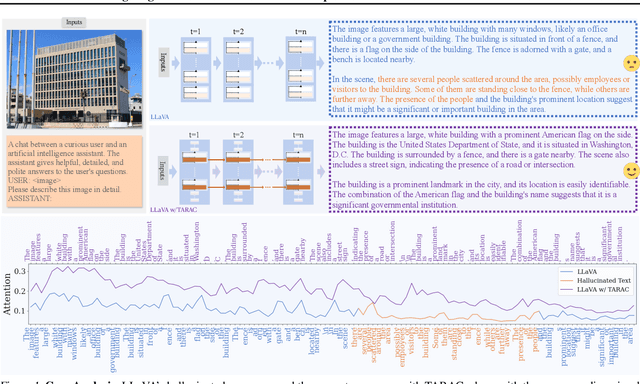
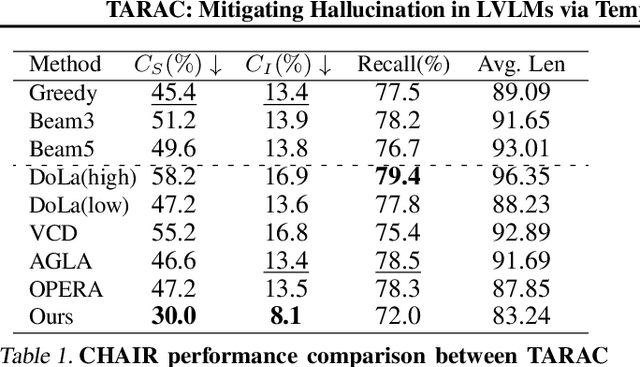
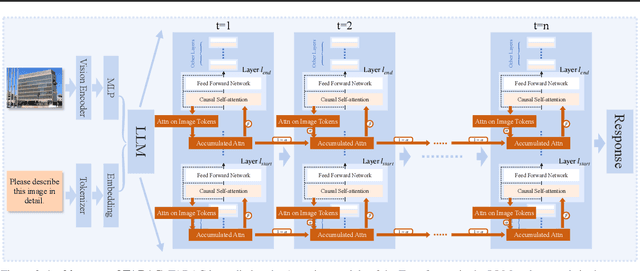
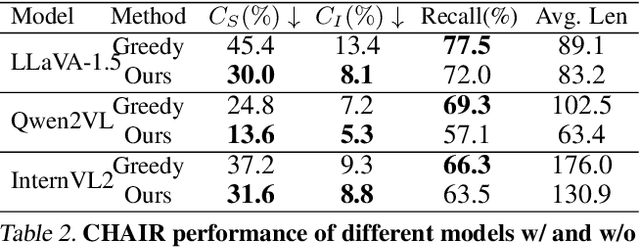
Large Vision-Language Models have demonstrated remarkable performance across various tasks; however, the challenge of hallucinations constrains their practical applications. The hallucination problem arises from multiple factors, including the inherent hallucinations in language models, the limitations of visual encoders in perception, and biases introduced by multimodal data. Extensive research has explored ways to mitigate hallucinations. For instance, OPERA prevents the model from overly focusing on "anchor tokens", thereby reducing hallucinations, whereas VCD mitigates hallucinations by employing a contrastive decoding approach. In this paper, we investigate the correlation between the decay of attention to image tokens and the occurrence of hallucinations. Based on this finding, we propose Temporal Attention Real-time Accumulative Connection (TARAC), a novel training-free method that dynamically accumulates and updates LVLMs' attention on image tokens during generation. By enhancing the model's attention to image tokens, TARAC mitigates hallucinations caused by the decay of attention on image tokens. We validate the effectiveness of TARAC across multiple models and datasets, demonstrating that our approach substantially mitigates hallucinations. In particular, TARAC reduces $C_S$ by 25.2 and $C_I$ by 8.7 compared to VCD on the CHAIR benchmark.