 Add to Chrome
 Add to Firefox
 Add to Edge
Emo-Avatar: Efficient Monocular Video Style Avatar through Texture Rendering
Feb 01, 2024
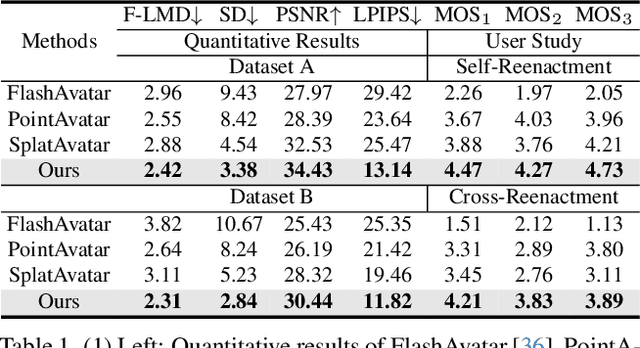
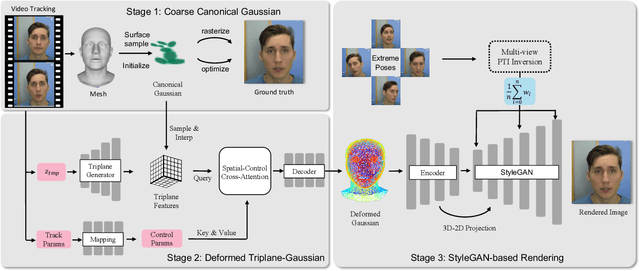

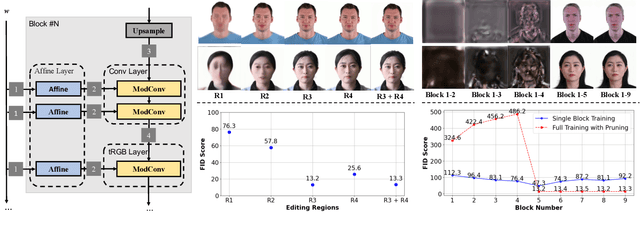
Artistic video portrait generation is a significant and sought-after task in the fields of computer graphics and vision. While various methods have been developed that integrate NeRFs or StyleGANs with instructional editing models for creating and editing drivable portraits, these approaches face several challenges. They often rely heavily on large datasets, require extensive customization processes, and frequently result in reduced image quality. To address the above problems, we propose the Efficient Monotonic Video Style Avatar (Emo-Avatar) through deferred neural rendering that enhances StyleGAN's capacity for producing dynamic, drivable portrait videos. We proposed a two-stage deferred neural rendering pipeline. In the first stage, we utilize few-shot PTI initialization to initialize the StyleGAN generator through several extreme poses sampled from the video to capture the consistent representation of aligned faces from the target portrait. In the second stage, we propose a Laplacian pyramid for high-frequency texture sampling from UV maps deformed by dynamic flow of expression for motion-aware texture prior integration to provide torso features to enhance StyleGAN's ability to generate complete and upper body for portrait video rendering. Emo-Avatar reduces style customization time from hours to merely 5 minutes compared with existing methods. In addition, Emo-Avatar requires only a single reference image for editing and employs region-aware contrastive learning with semantic invariant CLIP guidance, ensuring consistent high-resolution output and identity preservation. Through both quantitative and qualitative assessments, Emo-Avatar demonstrates superior performance over existing methods in terms of training efficiency, rendering quality and editability in self- and cross-reenactment.

Continuous-Multiple Image Outpainting in One-Step via Positional Query and A Diffusion-based Approach
Jan 28, 2024Image outpainting aims to generate the content of an input sub-image beyond its original boundaries. It is an important task in content generation yet remains an open problem for generative models. This paper pushes the technical frontier of image outpainting in two directions that have not been resolved in literature: 1) outpainting with arbitrary and continuous multiples (without restriction), and 2) outpainting in a single step (even for large expansion multiples). Moreover, we develop a method that does not depend on a pre-trained backbone network, which is in contrast commonly required by the previous SOTA outpainting methods. The arbitrary multiple outpainting is achieved by utilizing randomly cropped views from the same image during training to capture arbitrary relative positional information. Specifically, by feeding one view and positional embeddings as queries, we can reconstruct another view. At inference, we generate images with arbitrary expansion multiples by inputting an anchor image and its corresponding positional embeddings. The one-step outpainting ability here is particularly noteworthy in contrast to previous methods that need to be performed for $N$ times to obtain a final multiple which is $N$ times of its basic and fixed multiple. We evaluate the proposed approach (called PQDiff as we adopt a diffusion-based generator as our embodiment, under our proposed \textbf{P}ositional \textbf{Q}uery scheme) on public benchmarks, demonstrating its superior performance over state-of-the-art approaches. Specifically, PQDiff achieves state-of-the-art FID scores on the Scenery (\textbf{21.512}), Building Facades (\textbf{25.310}), and WikiArts (\textbf{36.212}) datasets. Furthermore, under the 2.25x, 5x and 11.7x outpainting settings, PQDiff only takes \textbf{40.6\%}, \textbf{20.3\%} and \textbf{10.2\%} of the time of the benchmark state-of-the-art (SOTA) method.
Human vs. LMMs: Exploring the Discrepancy in Emoji Interpretation and Usage in Digital Communication
Jan 16, 2024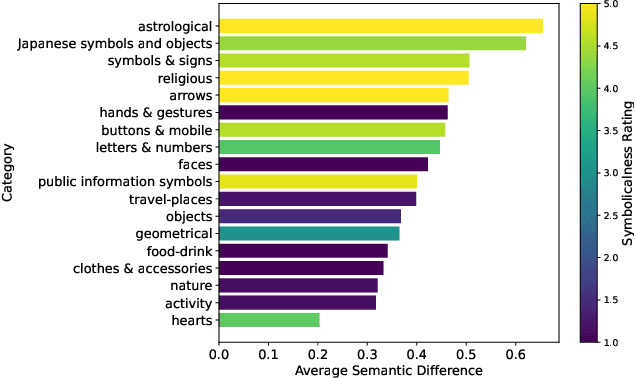
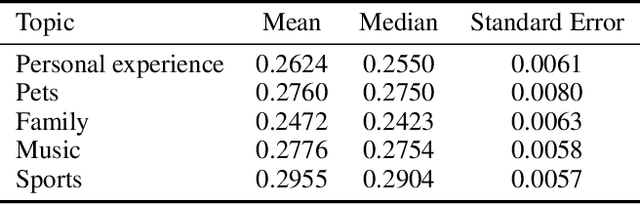
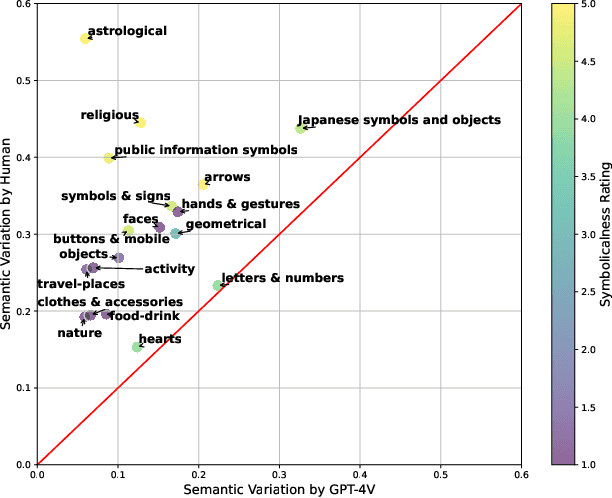
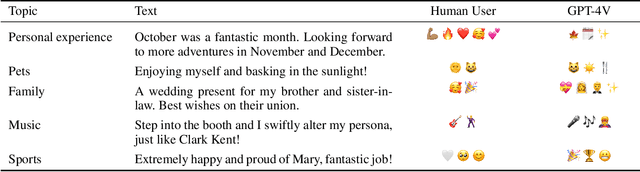
Leveraging Large Multimodal Models (LMMs) to simulate human behaviors when processing multimodal information, especially in the context of social media, has garnered immense interest due to its broad potential and far-reaching implications. Emojis, as one of the most unique aspects of digital communication, are pivotal in enriching and often clarifying the emotional and tonal dimensions. Yet, there is a notable gap in understanding how these advanced models, such as GPT-4V, interpret and employ emojis in the nuanced context of online interaction. This study intends to bridge this gap by examining the behavior of GPT-4V in replicating human-like use of emojis. The findings reveal a discernible discrepancy between human and GPT-4V behaviors, likely due to the subjective nature of human interpretation and the limitations of GPT-4V's English-centric training, suggesting cultural biases and inadequate representation of non-English cultures.
CoCoT: Contrastive Chain-of-Thought Prompting for Large Multimodal Models with Multiple Image Inputs
Jan 05, 2024When exploring the development of Artificial General Intelligence (AGI), a critical task for these models involves interpreting and processing information from multiple image inputs. However, Large Multimodal Models (LMMs) encounter two issues in such scenarios: (1) a lack of fine-grained perception, and (2) a tendency to blend information across multiple images. We first extensively investigate the capability of LMMs to perceive fine-grained visual details when dealing with multiple input images. The research focuses on two aspects: first, image-to-image matching (to evaluate whether LMMs can effectively reason and pair relevant images), and second, multi-image-to-text matching (to assess whether LMMs can accurately capture and summarize detailed image information). We conduct evaluations on a range of both open-source and closed-source large models, including GPT-4V, Gemini, OpenFlamingo, and MMICL. To enhance model performance, we further develop a Contrastive Chain-of-Thought (CoCoT) prompting approach based on multi-input multimodal models. This method requires LMMs to compare the similarities and differences among multiple image inputs, and then guide the models to answer detailed questions about multi-image inputs based on the identified similarities and differences. Our experimental results showcase CoCoT's proficiency in enhancing the multi-image comprehension capabilities of large multimodal models.
Video Understanding with Large Language Models: A Survey
Jan 04, 2024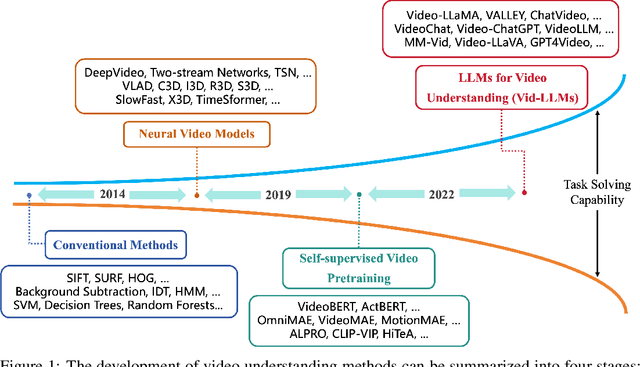

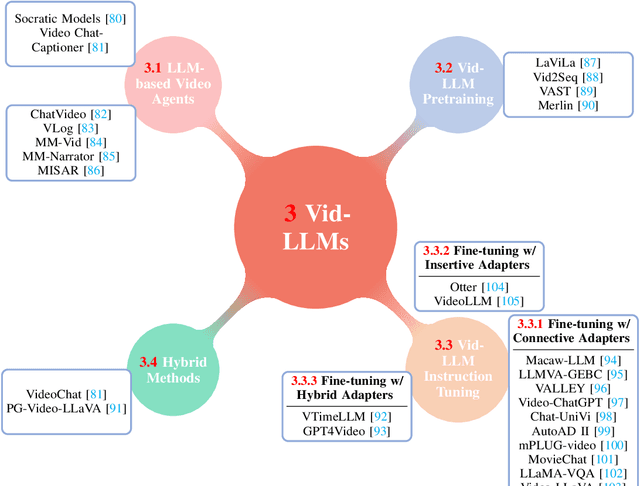
With the burgeoning growth of online video platforms and the escalating volume of video content, the demand for proficient video understanding tools has intensified markedly. Given the remarkable capabilities of Large Language Models (LLMs) in language and multimodal tasks, this survey provides a detailed overview of the recent advancements in video understanding harnessing the power of LLMs (Vid-LLMs). The emergent capabilities of Vid-LLMs are surprisingly advanced, particularly their ability for open-ended spatial-temporal reasoning combined with commonsense knowledge, suggesting a promising path for future video understanding. We examine the unique characteristics and capabilities of Vid-LLMs, categorizing the approaches into four main types: LLM-based Video Agents, Vid-LLMs Pretraining, Vid-LLMs Instruction Tuning, and Hybrid Methods. Furthermore, this survey presents a comprehensive study of the tasks, datasets, and evaluation methodologies for Vid-LLMs. Additionally, it explores the expansive applications of Vid-LLMs across various domains, highlighting their remarkable scalability and versatility in real-world video understanding challenges. Finally, it summarizes the limitations of existing Vid-LLMs and outlines directions for future research. For more information, readers are recommended to visit the repository at https://github.com/yunlong10/Awesome-LLMs-for-Video-Understanding.
Bring Metric Functions into Diffusion Models
Jan 04, 2024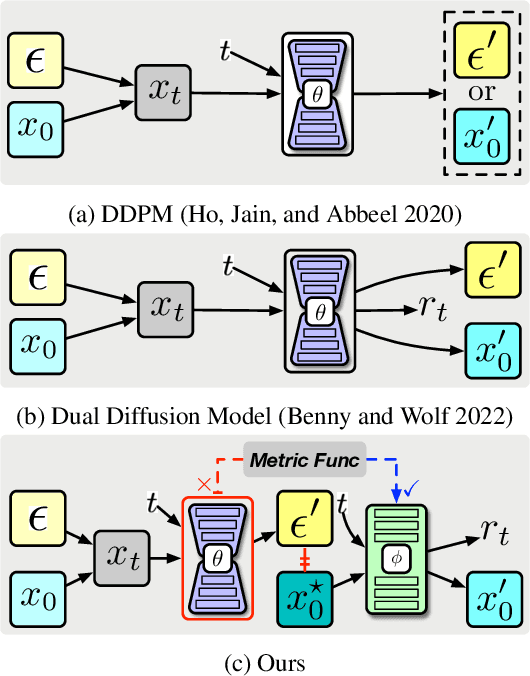
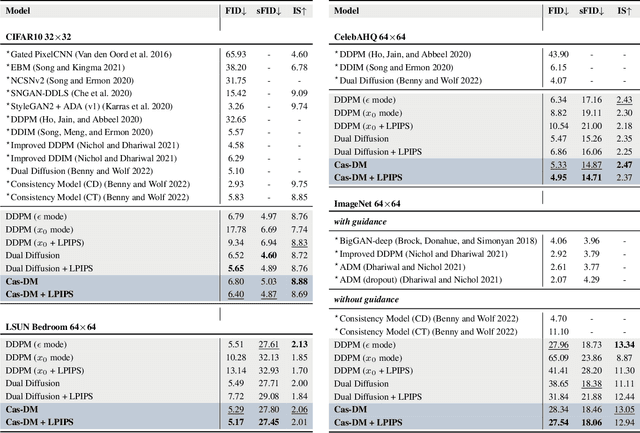
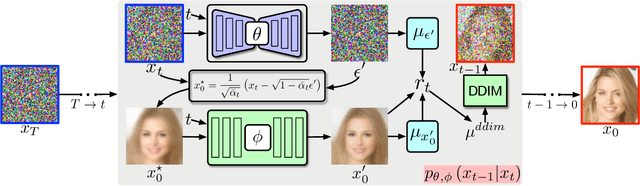
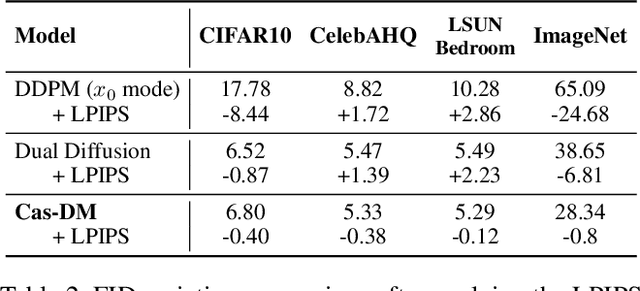
We introduce a Cascaded Diffusion Model (Cas-DM) that improves a Denoising Diffusion Probabilistic Model (DDPM) by effectively incorporating additional metric functions in training. Metric functions such as the LPIPS loss have been proven highly effective in consistency models derived from the score matching. However, for the diffusion counterparts, the methodology and efficacy of adding extra metric functions remain unclear. One major challenge is the mismatch between the noise predicted by a DDPM at each step and the desired clean image that the metric function works well on. To address this problem, we propose Cas-DM, a network architecture that cascades two network modules to effectively apply metric functions to the diffusion model training. The first module, similar to a standard DDPM, learns to predict the added noise and is unaffected by the metric function. The second cascaded module learns to predict the clean image, thereby facilitating the metric function computation. Experiment results show that the proposed diffusion model backbone enables the effective use of the LPIPS loss, leading to state-of-the-art image quality (FID, sFID, IS) on various established benchmarks.
Part to Whole: Collaborative Prompting for Surgical Instrument Segmentation
Dec 22, 2023Foundation models like the Segment Anything Model (SAM) have demonstrated promise in generic object segmentation. However, directly applying SAM to surgical instrument segmentation presents key challenges. First, SAM relies on per-frame point-or-box prompts which complicate surgeon-computer interaction. Also, SAM yields suboptimal performance on segmenting surgical instruments, owing to insufficient surgical data in its pre-training as well as the complex structure and fine-grained details of various surgical instruments. To address these challenges, in this paper, we investigate text promptable surgical instrument segmentation and propose SP-SAM (SurgicalPart-SAM), a novel efficient-tuning approach that integrates surgical instrument structure knowledge with the generic segmentation knowledge of SAM. Specifically, we achieve this by proposing (1) collaborative prompts in the text form "[part name] of [instrument category name]" that decompose instruments into fine-grained parts; (2) a Cross-Modal Prompt Encoder that encodes text prompts jointly with visual embeddings into discriminative part-level representations; and (3) a Part-to-Whole Selective Fusion and a Hierarchical Decoding strategy that selectively assemble the part-level representations into a whole for accurate instrument segmentation. Built upon them, SP-SAM acquires a better capability to comprehend surgical instrument structures and distinguish between various categories. Extensive experiments on both the EndoVis2018 and EndoVis2017 datasets demonstrate SP-SAM's state-of-the-art performance with minimal tunable parameters. Code is at https://github.com/wenxi-yue/SurgicalPart-SAM.
GPT-4V as A Social Media Analysis Engine
Nov 13, 2023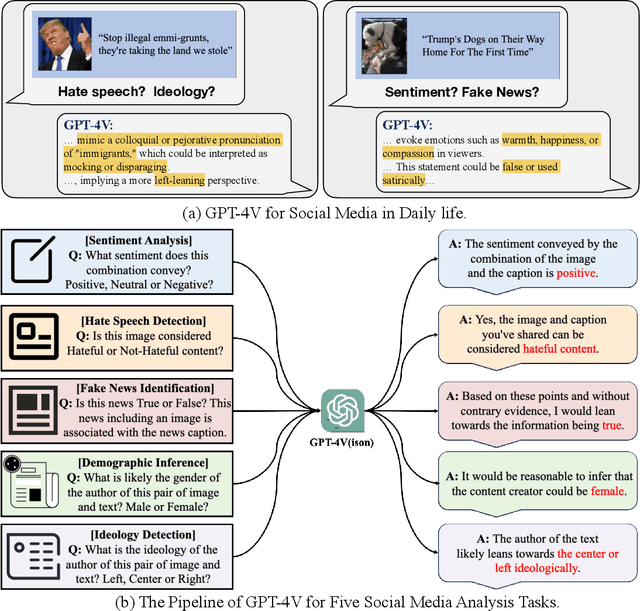
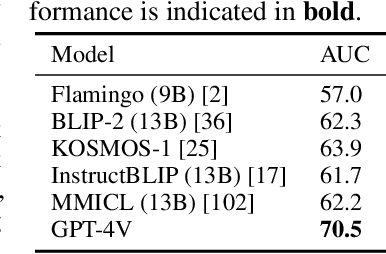
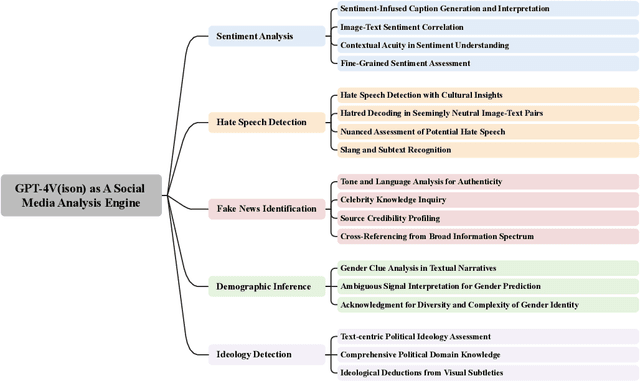
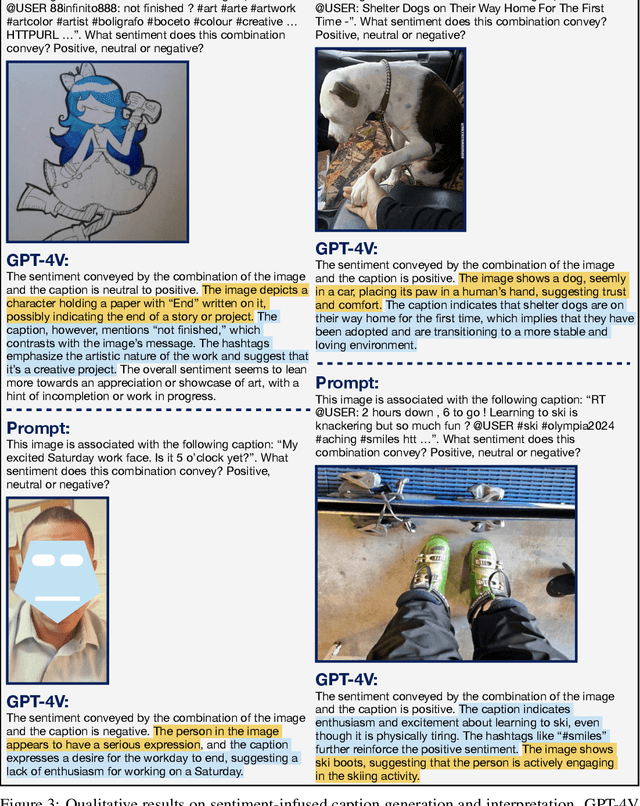
Recent research has offered insights into the extraordinary capabilities of Large Multimodal Models (LMMs) in various general vision and language tasks. There is growing interest in how LMMs perform in more specialized domains. Social media content, inherently multimodal, blends text, images, videos, and sometimes audio. Understanding social multimedia content remains a challenging problem for contemporary machine learning frameworks. In this paper, we explore GPT-4V(ision)'s capabilities for social multimedia analysis. We select five representative tasks, including sentiment analysis, hate speech detection, fake news identification, demographic inference, and political ideology detection, to evaluate GPT-4V. Our investigation begins with a preliminary quantitative analysis for each task using existing benchmark datasets, followed by a careful review of the results and a selection of qualitative samples that illustrate GPT-4V's potential in understanding multimodal social media content. GPT-4V demonstrates remarkable efficacy in these tasks, showcasing strengths such as joint understanding of image-text pairs, contextual and cultural awareness, and extensive commonsense knowledge. Despite the overall impressive capacity of GPT-4V in the social media domain, there remain notable challenges. GPT-4V struggles with tasks involving multilingual social multimedia comprehension and has difficulties in generalizing to the latest trends in social media. Additionally, it exhibits a tendency to generate erroneous information in the context of evolving celebrity and politician knowledge, reflecting the known hallucination problem. The insights gleaned from our findings underscore a promising future for LMMs in enhancing our comprehension of social media content and its users through the analysis of multimodal information.
Mixture of Weak & Strong Experts on Graphs
Nov 09, 2023Realistic graphs contain both rich self-features of nodes and informative structures of neighborhoods, jointly handled by a GNN in the typical setup. We propose to decouple the two modalities by mixture of weak and strong experts (Mowst), where the weak expert is a light-weight Multi-layer Perceptron (MLP), and the strong expert is an off-the-shelf Graph Neural Network (GNN). To adapt the experts' collaboration to different target nodes, we propose a "confidence" mechanism based on the dispersion of the weak expert's prediction logits. The strong expert is conditionally activated when either the node's classification relies on neighborhood information, or the weak expert has low model quality. We reveal interesting training dynamics by analyzing the influence of the confidence function on loss: our training algorithm encourages the specialization of each expert by effectively generating soft splitting of the graph. In addition, our "confidence" design imposes a desirable bias toward the strong expert to benefit from GNN's better generalization capability. Mowst is easy to optimize and achieves strong expressive power, with a computation cost comparable to a single GNN. Empirically, Mowst shows significant accuracy improvement on 6 standard node classification benchmarks (including both homophilous and heterophilous graphs).
Deceptive Fairness Attacks on Graphs via Meta Learning
Oct 24, 2023We study deceptive fairness attacks on graphs to answer the following question: How can we achieve poisoning attacks on a graph learning model to exacerbate the bias deceptively? We answer this question via a bi-level optimization problem and propose a meta learning-based framework named FATE. FATE is broadly applicable with respect to various fairness definitions and graph learning models, as well as arbitrary choices of manipulation operations. We further instantiate FATE to attack statistical parity and individual fairness on graph neural networks. We conduct extensive experimental evaluations on real-world datasets in the task of semi-supervised node classification. The experimental results demonstrate that FATE could amplify the bias of graph neural networks with or without fairness consideration while maintaining the utility on the downstream task. We hope this paper provides insights into the adversarial robustness of fair graph learning and can shed light on designing robust and fair graph learning in future studies.