 Add to Chrome
 Add to Firefox
 Add to Edge
Mobius: A High Efficient Spatial-Temporal Parallel Training Paradigm for Text-to-Video Generation Task
Jul 12, 2024
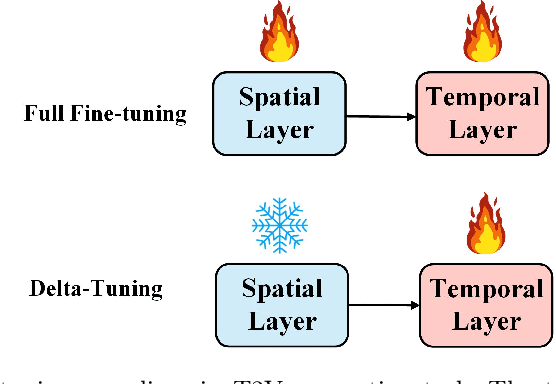
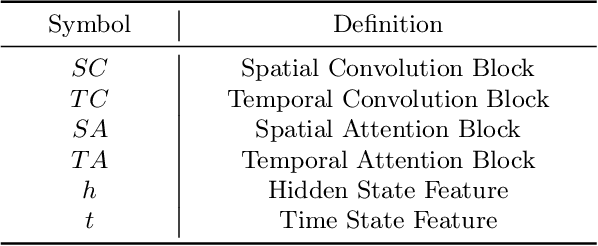
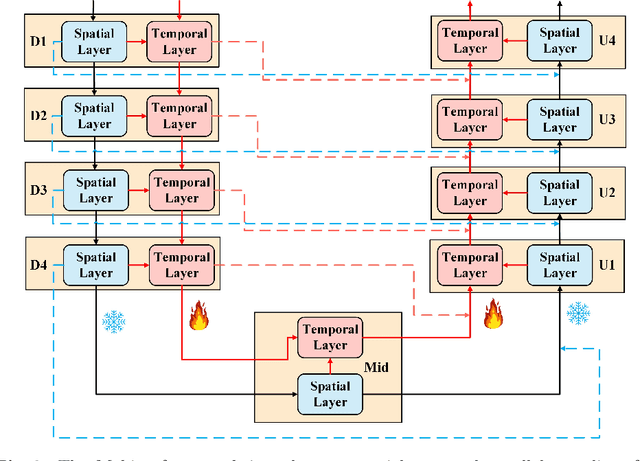
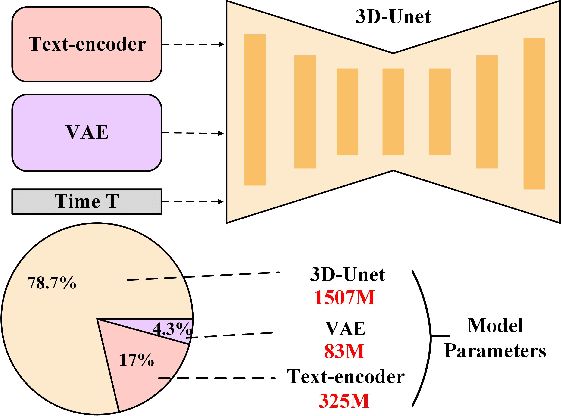
Inspired by the success of the text-to-image (T2I) generation task, many researchers are devoting themselves to the text-to-video (T2V) generation task. Most of the T2V frameworks usually inherit from the T2I model and add extra-temporal layers of training to generate dynamic videos, which can be viewed as a fine-tuning task. However, the traditional 3D-Unet is a serial mode and the temporal layers follow the spatial layers, which will result in high GPU memory and training time consumption according to its serial feature flow. We believe that this serial mode will bring more training costs with the large diffusion model and massive datasets, which are not environmentally friendly and not suitable for the development of the T2V. Therefore, we propose a highly efficient spatial-temporal parallel training paradigm for T2V tasks, named Mobius. In our 3D-Unet, the temporal layers and spatial layers are parallel, which optimizes the feature flow and backpropagation. The Mobius will save 24% GPU memory and 12% training time, which can greatly improve the T2V fine-tuning task and provide a novel insight for the AIGC community. We will release our codes in the future.

Mobius: An High Efficient Spatial-Temporal Parallel Training Paradigm for Text-to-Video Generation Task
Jul 09, 2024Inspired by the success of the text-to-image (T2I) generation task, many researchers are devoting themselves to the text-to-video (T2V) generation task. Most of the T2V frameworks usually inherit from the T2I model and add extra-temporal layers of training to generate dynamic videos, which can be viewed as a fine-tuning task. However, the traditional 3D-Unet is a serial mode and the temporal layers follow the spatial layers, which will result in high GPU memory and training time consumption according to its serial feature flow. We believe that this serial mode will bring more training costs with the large diffusion model and massive datasets, which are not environmentally friendly and not suitable for the development of the T2V. Therefore, we propose a highly efficient spatial-temporal parallel training paradigm for T2V tasks, named Mobius. In our 3D-Unet, the temporal layers and spatial layers are parallel, which optimizes the feature flow and backpropagation. The Mobius will save 24% GPU memory and 12% training time, which can greatly improve the T2V fine-tuning task and provide a novel insight for the AIGC community. We will release our codes in the future.
Camera-LiDAR Cross-modality Gait Recognition
Jul 03, 2024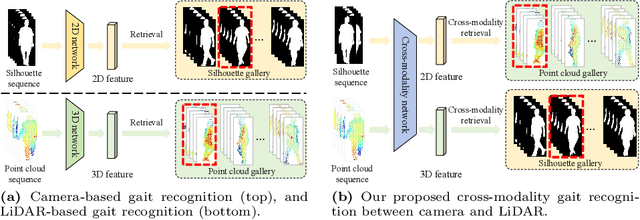
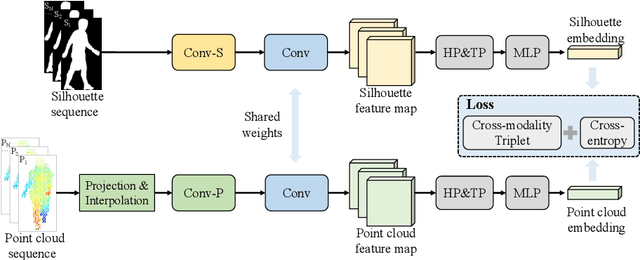
Gait recognition is a crucial biometric identification technique. Camera-based gait recognition has been widely applied in both research and industrial fields. LiDAR-based gait recognition has also begun to evolve most recently, due to the provision of 3D structural information. However, in certain applications, cameras fail to recognize persons, such as in low-light environments and long-distance recognition scenarios, where LiDARs work well. On the other hand, the deployment cost and complexity of LiDAR systems limit its wider application. Therefore, it is essential to consider cross-modality gait recognition between cameras and LiDARs for a broader range of applications. In this work, we propose the first cross-modality gait recognition framework between Camera and LiDAR, namely CL-Gait. It employs a two-stream network for feature embedding of both modalities. This poses a challenging recognition task due to the inherent matching between 3D and 2D data, exhibiting significant modality discrepancy. To align the feature spaces of the two modalities, i.e., camera silhouettes and LiDAR points, we propose a contrastive pre-training strategy to mitigate modality discrepancy. To make up for the absence of paired camera-LiDAR data for pre-training, we also introduce a strategy for generating data on a large scale. This strategy utilizes monocular depth estimated from single RGB images and virtual cameras to generate pseudo point clouds for contrastive pre-training. Extensive experiments show that the cross-modality gait recognition is very challenging but still contains potential and feasibility with our proposed model and pre-training strategy. To the best of our knowledge, this is the first work to address cross-modality gait recognition.
Translatotron-V(ison): An End-to-End Model for In-Image Machine Translation
Jul 03, 2024In-image machine translation (IIMT) aims to translate an image containing texts in source language into an image containing translations in target language. In this regard, conventional cascaded methods suffer from issues such as error propagation, massive parameters, and difficulties in deployment and retaining visual characteristics of the input image. Thus, constructing end-to-end models has become an option, which, however, faces two main challenges: 1) the huge modeling burden, as it is required to simultaneously learn alignment across languages and preserve the visual characteristics of the input image; 2) the difficulties of directly predicting excessively lengthy pixel sequences. In this paper, we propose \textit{Translatotron-V(ision)}, an end-to-end IIMT model consisting of four modules. In addition to an image encoder, and an image decoder, our model contains a target text decoder and an image tokenizer. Among them, the target text decoder is used to alleviate the language alignment burden, and the image tokenizer converts long sequences of pixels into shorter sequences of visual tokens, preventing the model from focusing on low-level visual features. Besides, we present a two-stage training framework for our model to assist the model in learning alignment across modalities and languages. Finally, we propose a location-aware evaluation metric called Structure-BLEU to assess the translation quality of the generated images. Experimental results demonstrate that our model achieves competitive performance compared to cascaded models with only 70.9\% of parameters, and significantly outperforms the pixel-level end-to-end IIMT model.
C-LLM: Learn to Check Chinese Spelling Errors Character by Character
Jun 24, 2024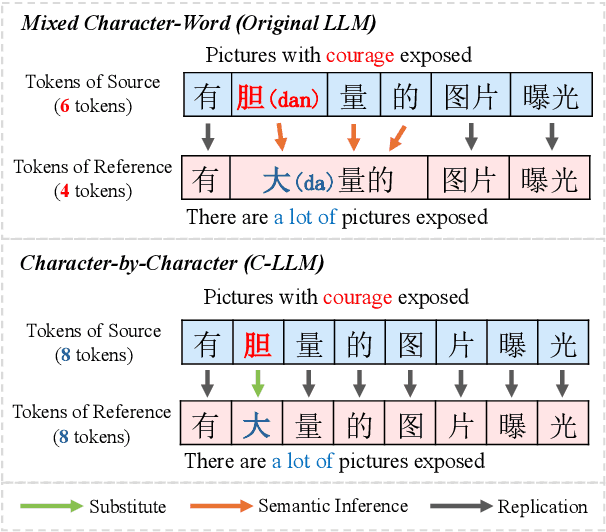
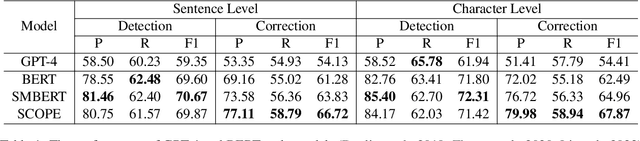
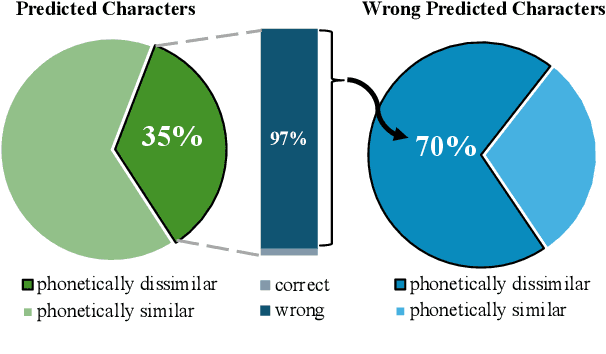
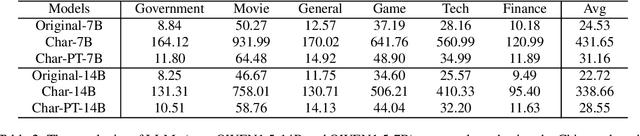
Chinese Spell Checking (CSC) aims to detect and correct spelling errors in sentences. Despite Large Language Models (LLMs) exhibit robust capabilities and are widely applied in various tasks, their performance on CSC is often unsatisfactory. We find that LLMs fail to meet the Chinese character-level constraints of the CSC task, namely equal length and phonetic similarity, leading to a performance bottleneck. Further analysis reveal that this issue stems from the granularity of tokenization, as current mixed character-word tokenization struggles to satisfy these character-level constraints. To address this issue, we propose C-LLM, a Large Language Model-based Chinese Spell Checking method that learns to check errors Character by Character. Character-level tokenization enables the model to learn character-level alignment, effectively mitigating issues related to character-level constraints. Furthermore, CSC is simplified to replication-dominated and substitution-supplemented tasks. Experiments on two CSC benchmarks demonstrate that C-LLM achieves an average improvement of 10% over existing methods. Specifically, it shows a 2.1% improvement in general scenarios and a significant 12% improvement in vertical domain scenarios, establishing state-of-the-art performance. The source code can be accessed at https://github.com/ktlKTL/C-LLM.
Multilingual Knowledge Editing with Language-Agnostic Factual Neurons
Jun 24, 2024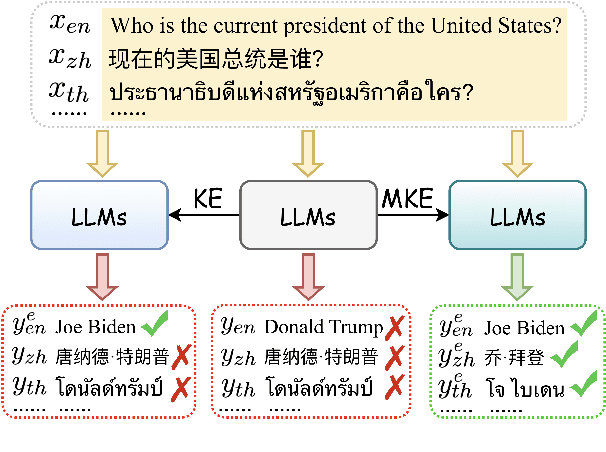
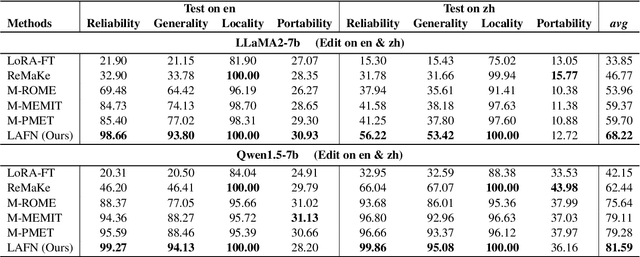
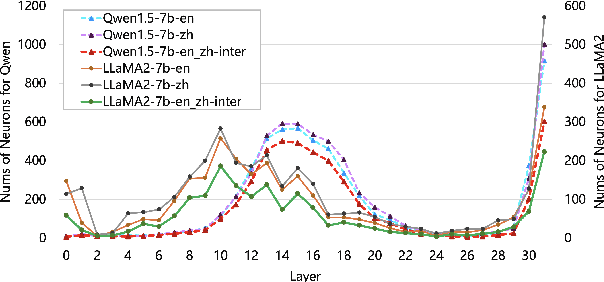
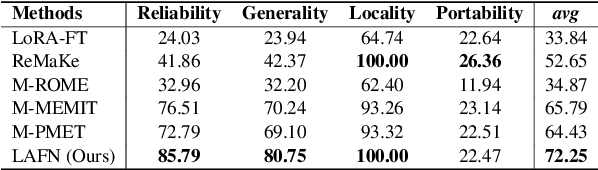
Multilingual knowledge editing (MKE) aims to simultaneously revise factual knowledge across multilingual languages within large language models (LLMs). However, most existing MKE methods just adapt existing monolingual editing methods to multilingual scenarios, overlooking the deep semantic connections of the same factual knowledge between different languages, thereby limiting edit performance. To address this issue, we first investigate how LLMs represent multilingual factual knowledge and discover that the same factual knowledge in different languages generally activates a shared set of neurons, which we call language-agnostic factual neurons. These neurons represent the semantic connections between multilingual knowledge and are mainly located in certain layers. Inspired by this finding, we propose a new MKE method by locating and modifying Language-Agnostic Factual Neurons (LAFN) to simultaneously edit multilingual knowledge. Specifically, we first generate a set of paraphrases for each multilingual knowledge to be edited to precisely locate the corresponding language-agnostic factual neurons. Then we optimize the update values for modifying these located neurons to achieve simultaneous modification of the same factual knowledge in multiple languages. Experimental results on Bi-ZsRE and MzsRE benchmarks demonstrate that our method outperforms existing MKE methods and achieves remarkable edit performance, indicating the importance of considering the semantic connections among multilingual knowledge.
P-Tailor: Customizing Personality Traits for Language Models via Mixture of Specialized LoRA Experts
Jun 18, 2024Personalized large language models (LLMs) have attracted great attention in many applications, such as intelligent education and emotional support. Most work focuses on controlling the character settings based on the profile (e.g., age, skill, experience, and so on). Conversely, the psychological theory-based personality traits with implicit expression and behavior are not well modeled, limiting their potential application in more specialized fields such as the psychological counseling agents. In this paper, we propose a mixture of experts (MoE)-based personalized LLMs, named P-tailor, to model the Big Five Personality Traits. Particularly, we learn specialized LoRA experts to represent various traits, such as openness, conscientiousness, extraversion, agreeableness and neuroticism. Then, we integrate P-Tailor with a personality specialization loss, promoting experts to specialize in distinct personality traits, thereby enhancing the efficiency of model parameter utilization. Due to the lack of datasets, we also curate a high-quality personality crafting dataset (PCD) to learn and develop the ability to exhibit different personality traits across various topics. We conduct extensive experiments to verify the great performance and effectiveness of P-Tailor in manipulation of the fine-grained personality traits of LLMs.
Modeling Comparative Logical Relation with Contrastive Learning for Text Generation
Jun 13, 2024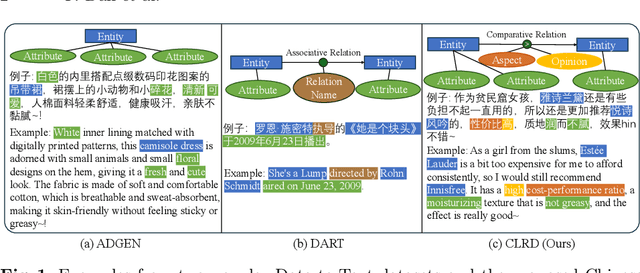
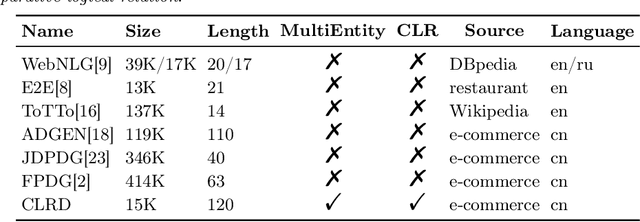
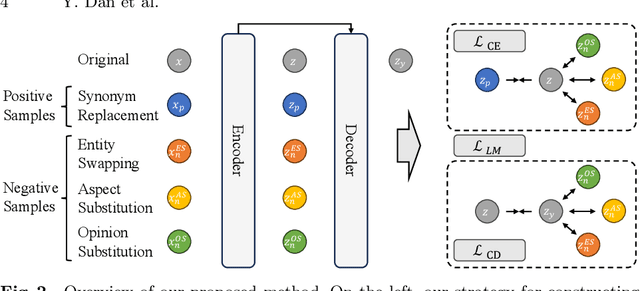
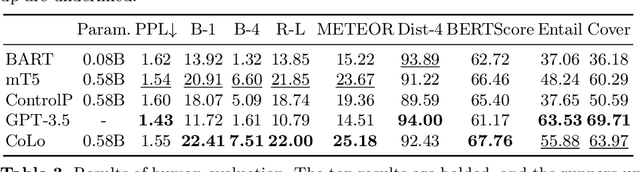
Data-to-Text Generation (D2T), a classic natural language generation problem, aims at producing fluent descriptions for structured input data, such as a table. Existing D2T works mainly focus on describing the superficial associative relations among entities, while ignoring the deep comparative logical relations, such as A is better than B in a certain aspect with a corresponding opinion, which is quite common in our daily life. In this paper, we introduce a new D2T task named comparative logical relation generation (CLRG). Additionally, we propose a Comparative Logic (CoLo) based text generation method, which generates texts following specific comparative logical relations with contrastive learning. Specifically, we first construct various positive and negative samples by fine-grained perturbations in entities, aspects and opinions. Then, we perform contrastive learning in the encoder layer to have a better understanding of the comparative logical relations, and integrate it in the decoder layer to guide the model to correctly generate the relations. Noting the data scarcity problem, we construct a Chinese Comparative Logical Relation Dataset (CLRD), which is a high-quality human-annotated dataset and challenging for text generation with descriptions of multiple entities and annotations on their comparative logical relations. Extensive experiments show that our method achieves impressive performance in both automatic and human evaluations.
TasTe: Teaching Large Language Models to Translate through Self-Reflection
Jun 12, 2024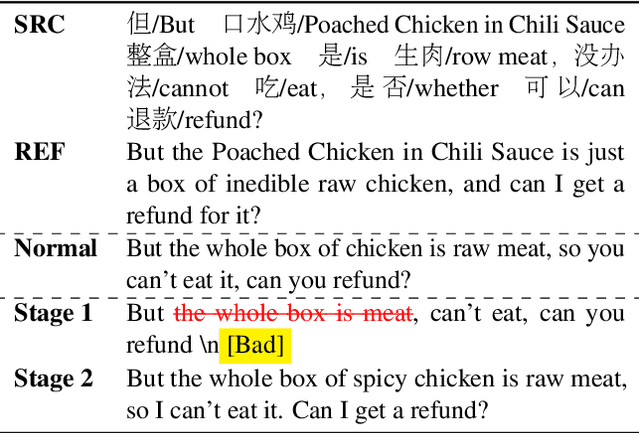
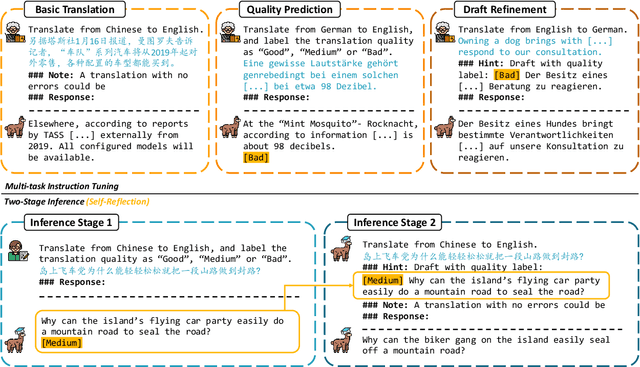

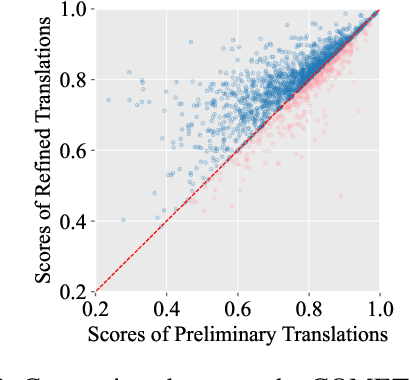
Large language models (LLMs) have exhibited remarkable performance in various natural language processing tasks. Techniques like instruction tuning have effectively enhanced the proficiency of LLMs in the downstream task of machine translation. However, the existing approaches fail to yield satisfactory translation outputs that match the quality of supervised neural machine translation (NMT) systems. One plausible explanation for this discrepancy is that the straightforward prompts employed in these methodologies are unable to fully exploit the acquired instruction-following capabilities. To this end, we propose the TasTe framework, which stands for translating through self-reflection. The self-reflection process includes two stages of inference. In the first stage, LLMs are instructed to generate preliminary translations and conduct self-assessments on these translations simultaneously. In the second stage, LLMs are tasked to refine these preliminary translations according to the evaluation results. The evaluation results in four language directions on the WMT22 benchmark reveal the effectiveness of our approach compared to existing methods. Our work presents a promising approach to unleash the potential of LLMs and enhance their capabilities in MT. The codes and datasets are open-sourced at https://github.com/YutongWang1216/ReflectionLLMMT.
Vision Model Pre-training on Interleaved Image-Text Data via Latent Compression Learning
Jun 11, 2024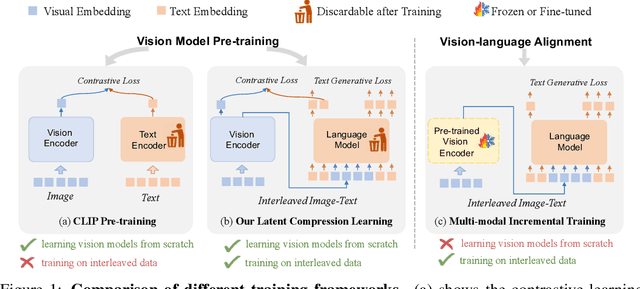

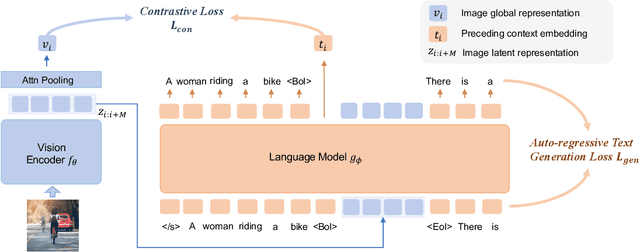
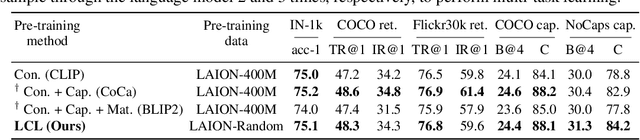
Recently, vision model pre-training has evolved from relying on manually annotated datasets to leveraging large-scale, web-crawled image-text data. Despite these advances, there is no pre-training method that effectively exploits the interleaved image-text data, which is very prevalent on the Internet. Inspired by the recent success of compression learning in natural language processing, we propose a novel vision model pre-training method called Latent Compression Learning (LCL) for interleaved image-text data. This method performs latent compression learning by maximizing the mutual information between the inputs and outputs of a causal attention model. The training objective can be decomposed into two basic tasks: 1) contrastive learning between visual representation and preceding context, and 2) generating subsequent text based on visual representation. Our experiments demonstrate that our method not only matches the performance of CLIP on paired pre-training datasets (e.g., LAION), but can also leverage interleaved pre-training data (e.g., MMC4) to learn robust visual representation from scratch, showcasing the potential of vision model pre-training with interleaved image-text data. Code is released at https://github.com/OpenGVLab/LCL.