 Add to Chrome
 Add to Firefox
 Add to Edge
Seismic Acoustic Impedance Inversion Framework Based on Conditional Latent Generative Diffusion Model
Jun 16, 2025
Seismic acoustic impedance plays a crucial role in lithological identification and subsurface structure interpretation. However, due to the inherently ill-posed nature of the inversion problem, directly estimating impedance from post-stack seismic data remains highly challenging. Recently, diffusion models have shown great potential in addressing such inverse problems due to their strong prior learning and generative capabilities. Nevertheless, most existing methods operate in the pixel domain and require multiple iterations, limiting their applicability to field data. To alleviate these limitations, we propose a novel seismic acoustic impedance inversion framework based on a conditional latent generative diffusion model, where the inversion process is made in latent space. To avoid introducing additional training overhead when embedding conditional inputs, we design a lightweight wavelet-based module into the framework to project seismic data and reuse an encoder trained on impedance to embed low-frequency impedance into the latent space. Furthermore, we propose a model-driven sampling strategy during the inversion process of this framework to enhance accuracy and reduce the number of required diffusion steps. Numerical experiments on a synthetic model demonstrate that the proposed method achieves high inversion accuracy and strong generalization capability within only a few diffusion steps. Moreover, application to field data reveals enhanced geological detail and higher consistency with well-log measurements, validating the effectiveness and practicality of the proposed approach.

Rethinking Generative Human Video Coding with Implicit Motion Transformation
Jun 12, 2025Beyond traditional hybrid-based video codec, generative video codec could achieve promising compression performance by evolving high-dimensional signals into compact feature representations for bitstream compactness at the encoder side and developing explicit motion fields as intermediate supervision for high-quality reconstruction at the decoder side. This paradigm has achieved significant success in face video compression. However, compared to facial videos, human body videos pose greater challenges due to their more complex and diverse motion patterns, i.e., when using explicit motion guidance for Generative Human Video Coding (GHVC), the reconstruction results could suffer severe distortions and inaccurate motion. As such, this paper highlights the limitations of explicit motion-based approaches for human body video compression and investigates the GHVC performance improvement with the aid of Implicit Motion Transformation, namely IMT. In particular, we propose to characterize complex human body signal into compact visual features and transform these features into implicit motion guidance for signal reconstruction. Experimental results demonstrate the effectiveness of the proposed IMT paradigm, which can facilitate GHVC to achieve high-efficiency compression and high-fidelity synthesis.
Domain-RAG: Retrieval-Guided Compositional Image Generation for Cross-Domain Few-Shot Object Detection
Jun 06, 2025Cross-Domain Few-Shot Object Detection (CD-FSOD) aims to detect novel objects with only a handful of labeled samples from previously unseen domains. While data augmentation and generative methods have shown promise in few-shot learning, their effectiveness for CD-FSOD remains unclear due to the need for both visual realism and domain alignment. Existing strategies, such as copy-paste augmentation and text-to-image generation, often fail to preserve the correct object category or produce backgrounds coherent with the target domain, making them non-trivial to apply directly to CD-FSOD. To address these challenges, we propose Domain-RAG, a training-free, retrieval-guided compositional image generation framework tailored for CD-FSOD. Domain-RAG consists of three stages: domain-aware background retrieval, domain-guided background generation, and foreground-background composition. Specifically, the input image is first decomposed into foreground and background regions. We then retrieve semantically and stylistically similar images to guide a generative model in synthesizing a new background, conditioned on both the original and retrieved contexts. Finally, the preserved foreground is composed with the newly generated domain-aligned background to form the generated image. Without requiring any additional supervision or training, Domain-RAG produces high-quality, domain-consistent samples across diverse tasks, including CD-FSOD, remote sensing FSOD, and camouflaged FSOD. Extensive experiments show consistent improvements over strong baselines and establish new state-of-the-art results. Codes will be released upon acceptance.
MTPNet: Multi-Grained Target Perception for Unified Activity Cliff Prediction
Jun 05, 2025Activity cliff prediction is a critical task in drug discovery and material design. Existing computational methods are limited to handling single binding targets, which restricts the applicability of these prediction models. In this paper, we present the Multi-Grained Target Perception network (MTPNet) to incorporate the prior knowledge of interactions between the molecules and their target proteins. Specifically, MTPNet is a unified framework for activity cliff prediction, which consists of two components: Macro-level Target Semantic (MTS) guidance and Micro-level Pocket Semantic (MPS) guidance. By this way, MTPNet dynamically optimizes molecular representations through multi-grained protein semantic conditions. To our knowledge, it is the first time to employ the receptor proteins as guiding information to effectively capture critical interaction details. Extensive experiments on 30 representative activity cliff datasets demonstrate that MTPNet significantly outperforms previous approaches, achieving an average RMSE improvement of 18.95% on top of several mainstream GNN architectures. Overall, MTPNet internalizes interaction patterns through conditional deep learning to achieve unified predictions of activity cliffs, helping to accelerate compound optimization and design. Codes are available at: https://github.com/ZishanShu/MTPNet.
Lessons Learned: A Multi-Agent Framework for Code LLMs to Learn and Improve
May 29, 2025Recent studies show that LLMs possess different skills and specialize in different tasks. In fact, we observe that their varied performance occur in several levels of granularity. For example, in the code optimization task, code LLMs excel at different optimization categories and no one dominates others. This observation prompts the question of how one leverages multiple LLM agents to solve a coding problem without knowing their complementary strengths a priori. We argue that a team of agents can learn from each other's successes and failures so as to improve their own performance. Thus, a lesson is the knowledge produced by an agent and passed on to other agents in the collective solution process. We propose a lesson-based collaboration framework, design the lesson solicitation--banking--selection mechanism, and demonstrate that a team of small LLMs with lessons learned can outperform a much larger LLM and other multi-LLM collaboration methods.
Directed Graph Grammars for Sequence-based Learning
May 29, 2025Directed acyclic graphs (DAGs) are a class of graphs commonly used in practice, with examples that include electronic circuits, Bayesian networks, and neural architectures. While many effective encoders exist for DAGs, it remains challenging to decode them in a principled manner, because the nodes of a DAG can have many different topological orders. In this work, we propose a grammar-based approach to constructing a principled, compact and equivalent sequential representation of a DAG. Specifically, we view a graph as derivations over an unambiguous grammar, where the DAG corresponds to a unique sequence of production rules. Equivalently, the procedure to construct such a description can be viewed as a lossless compression of the data. Such a representation has many uses, including building a generative model for graph generation, learning a latent space for property prediction, and leveraging the sequence representational continuity for Bayesian Optimization over structured data. Code is available at https://github.com/shiningsunnyday/induction.
Foundation Molecular Grammar: Multi-Modal Foundation Models Induce Interpretable Molecular Graph Languages
May 29, 2025Recent data-efficient molecular generation approaches exploit graph grammars to introduce interpretability into the generative models. However, grammar learning therein relies on expert annotation or unreliable heuristics for algorithmic inference. We propose Foundation Molecular Grammar (FMG), which leverages multi-modal foundation models (MMFMs) to induce an interpretable molecular language. By exploiting the chemical knowledge of an MMFM, FMG renders molecules as images, describes them as text, and aligns information across modalities using prompt learning. FMG can be used as a drop-in replacement for the prior grammar learning approaches in molecular generation and property prediction. We show that FMG not only excels in synthesizability, diversity, and data efficiency but also offers built-in chemical interpretability for automated molecular discovery workflows. Code is available at https://github.com/shiningsunnyday/induction.
Sci-Fi: Symmetric Constraint for Frame Inbetweening
May 27, 2025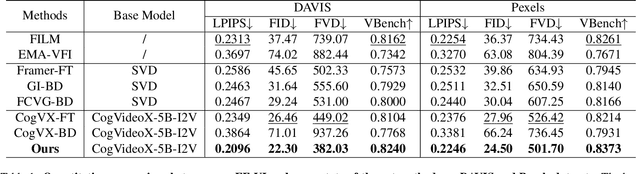
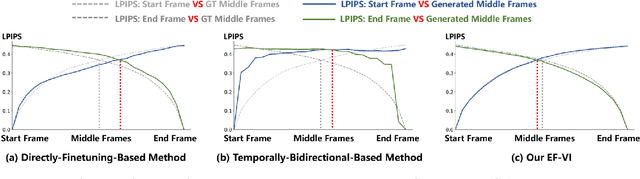
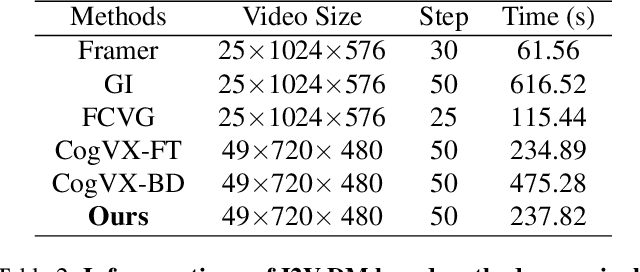
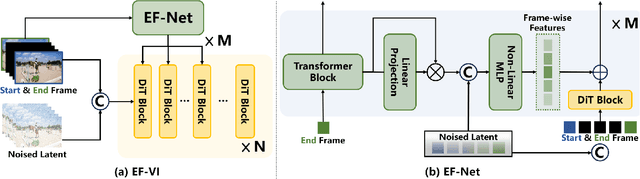
Frame inbetweening aims to synthesize intermediate video sequences conditioned on the given start and end frames. Current state-of-the-art methods mainly extend large-scale pre-trained Image-to-Video Diffusion models (I2V-DMs) by incorporating end-frame constraints via directly fine-tuning or omitting training. We identify a critical limitation in their design: Their injections of the end-frame constraint usually utilize the same mechanism that originally imposed the start-frame (single image) constraint. However, since the original I2V-DMs are adequately trained for the start-frame condition in advance, naively introducing the end-frame constraint by the same mechanism with much less (even zero) specialized training probably can't make the end frame have a strong enough impact on the intermediate content like the start frame. This asymmetric control strength of the two frames over the intermediate content likely leads to inconsistent motion or appearance collapse in generated frames. To efficiently achieve symmetric constraints of start and end frames, we propose a novel framework, termed Sci-Fi, which applies a stronger injection for the constraint of a smaller training scale. Specifically, it deals with the start-frame constraint as before, while introducing the end-frame constraint by an improved mechanism. The new mechanism is based on a well-designed lightweight module, named EF-Net, which encodes only the end frame and expands it into temporally adaptive frame-wise features injected into the I2V-DM. This makes the end-frame constraint as strong as the start-frame constraint, enabling our Sci-Fi to produce more harmonious transitions in various scenarios. Extensive experiments prove the superiority of our Sci-Fi compared with other baselines.
Compressing Human Body Video with Interactive Semantics: A Generative Approach
May 22, 2025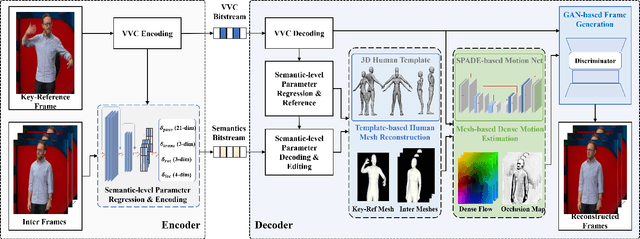
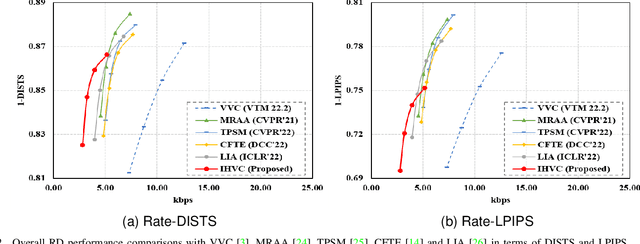
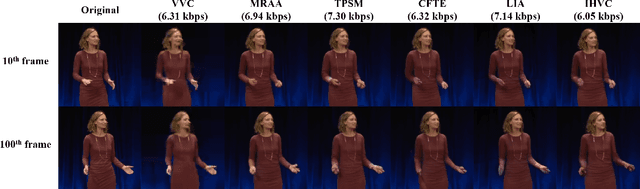
In this paper, we propose to compress human body video with interactive semantics, which can facilitate video coding to be interactive and controllable by manipulating semantic-level representations embedded in the coded bitstream. In particular, the proposed encoder employs a 3D human model to disentangle nonlinear dynamics and complex motion of human body signal into a series of configurable embeddings, which are controllably edited, compactly compressed, and efficiently transmitted. Moreover, the proposed decoder can evolve the mesh-based motion fields from these decoded semantics to realize the high-quality human body video reconstruction. Experimental results illustrate that the proposed framework can achieve promising compression performance for human body videos at ultra-low bitrate ranges compared with the state-of-the-art video coding standard Versatile Video Coding (VVC) and the latest generative compression schemes. Furthermore, the proposed framework enables interactive human body video coding without any additional pre-/post-manipulation processes, which is expected to shed light on metaverse-related digital human communication in the future.
Dual-Balancing for Physics-Informed Neural Networks
May 19, 2025Physics-informed neural networks (PINNs) have emerged as a new learning paradigm for solving partial differential equations (PDEs) by enforcing the constraints of physical equations, boundary conditions (BCs), and initial conditions (ICs) into the loss function. Despite their successes, vanilla PINNs still suffer from poor accuracy and slow convergence due to the intractable multi-objective optimization issue. In this paper, we propose a novel Dual-Balanced PINN (DB-PINN), which dynamically adjusts loss weights by integrating inter-balancing and intra-balancing to alleviate two imbalance issues in PINNs. Inter-balancing aims to mitigate the gradient imbalance between PDE residual loss and condition-fitting losses by determining an aggregated weight that offsets their gradient distribution discrepancies. Intra-balancing acts on condition-fitting losses to tackle the imbalance in fitting difficulty across diverse conditions. By evaluating the fitting difficulty based on the loss records, intra-balancing can allocate the aggregated weight proportionally to each condition loss according to its fitting difficulty level. We further introduce a robust weight update strategy to prevent abrupt spikes and arithmetic overflow in instantaneous weight values caused by large loss variances, enabling smooth weight updating and stable training. Extensive experiments demonstrate that DB-PINN achieves significantly superior performance than those popular gradient-based weighting methods in terms of convergence speed and prediction accuracy. Our code and supplementary material are available at https://github.com/chenhong-zhou/DualBalanced-PINNs.