 Add to Chrome
 Add to Firefox
 Add to Edge
ABot-AgentOS: A General Robotic Agent OS with Lifelong Multi-modal Memory
Jul 11, 2026
Recent VLM and VLA systems have improved robotic perception and action prediction, yet long-horizon embodied agents still require a general runtime layer for reasoning, memory, tool use, verification, and cross-embodiment execution. We present ABot-AgentOS, a general robotic Agent Operating System that sits above low-level controllers and provides a deliberative agent layer for scene-conditioned planning, context-isolated skill execution, multi-stage verification, multi-modal memory, and edge-cloud collaboration. To evaluate such systems, we introduce EmbodiedWorldBench, an executable benchmark with 16 indoor, outdoor, and hybrid scenes, four difficulty levels, and over 200 tasks involving navigation, object search, NPC dialogue, dynamic events, and trace-grounded scoring. ABot-AgentOS further introduces Universal Multi-modal Graph Memory, a persistent source-grounded substrate that converts dialogue, visual observations, spatial context, temporal relations, and task traces into typed nodes and edges. A failure-driven self-evolution loop converts diagnosed memory failures into gated runtime evo-assets that are promoted only to later evaluation splits, preventing current-split ground-truth leakage while enabling continual improvement. On an initial EmbodiedWorldBench subset, ABot-AgentOS improves over a single-controller baseline in both task success and goal completion. Across memory benchmarks, ABot-AgentOS Static achieves 87.5 on LoCoMo, 59.9 on OpenEQA EM-EQA, 88.6 on Mem-Gallery, and 76.5 Acc@All on NExT-QA; self-evolution further improves LoCoMo to 88.7, OpenEQA to 60.4, and Mem-Gallery to 89.0. These results suggest that a general Agent OS layer can improve long-horizon embodied execution while providing persistent, auditable memory for continual interaction.

IAPO: Input Attribution-Aware Policy Optimization for Tool Use in Small Multimodal Agents
Jun 10, 2026This paper investigates reinforcement learning (RL) methods for improving tool-calling capabilities in multimodal small language model (SLM) agents. While existing works have explored various reward designs to improve agentic tool-calling ability, these approaches face inherent limitations for SLM training, especially under multimodal scenarios. First, many existing methods evaluate tool use correctness through exact matching against certain ground-truth or predefined formats. However, this assumption is often unsuitable for multimodal tasks, where multiple tool use paths may be valid and annotated tool trajectories are typically unavailable. Second, such sparse and brittle binary rewards provide little guidance on how to improve the underlying decision process, making them particularly difficult for multimodal SLM to learn from. To address these issues, we propose Input Attribution-Aware Policy Optimization (IAPO), an RL algorithm for improving tool use in multimodal SLM by aligning the model's attribution across input components with that of a stronger teacher. Experiments on Qwen2.5-VL-3B show that the proposed method improves visual question answering accuracy by an average of 3% across six test sets compared with existing visual tool use work, by helping the model attend to the most relevant input evidence.
LoRi: Low-Rank Distillation for Implicit Reasoning
Jun 03, 2026Implicit chain-of-thought (iCoT) methods aim to internalize reasoning in large language models, but often underperform explicit CoT prompting. We empirically find that hidden-state reasoning trajectories exhibit low-rank structure. Motivated by this observation, we propose a low-rank distillation framework that transfers reasoning by aligning teacher and student trajectories in a shared low-rank tensor subspace using first- and second-order statistics. The resulting formulation captures the global structure of reasoning while supporting a compact latent reasoning process. We evaluate the method across multiple model families, including LLaMA and Qwen, at different scales on mathematical reasoning benchmarks. Our approach consistently improves performance, especially on challenging multi-step tasks, approaching explicit CoT accuracy and outperforming prior iCoT distillation methods.
VeriTrip: A Verifiable Benchmark for Travel Planning Agents over Unstructured Web Corpora
May 27, 2026Existing benchmarks have laid the foundation for travel planning agents by establishing API-centric paradigms. However, as the capabilities of Autonomous Agents continue to advance, their evaluation must evolve beyond simple tool execution toward handling the inherent complexities of the open web. Current benchmarks bypass core cognitive hurdles: they fail to account for information noise, ignore multi-source factual contradictions, and overlook the necessity of grounding visual perception into logical planning. We introduce VeriTrip, a verifiable benchmark designed to meet the increasing demands for agent robustness and reliability. VeriTrip shifts the evaluation focus to evidence-grounded reasoning over unstructured multimodal web corpora. It establishes a Multimodal Retrieval Base (MRB) derived from real-world sources, forcing agents to autonomously orchestrate queries across heterogeneous data. A synchronized Verifiable Knowledge Base (VKB) enables a cell-wise verification protocol that precisely quantifies factual reliability, distinguishing systematic reasoning failures from parametric hallucinations. Our evaluations across leading MLLMs reveal a critical \textit{retrieval-reasoning trade-off}: the cognitive load of autonomous retrieval significantly erodes instruction retention. VeriTrip provides the rigorous foundation necessary for the next generation of planning agents capable of operating in unconstrained, multimodal environments.
GeGS-PCR: Effective and Robust 3D Point Cloud Registration with Two-Stage Color-Enhanced Geometric-3DGS Fusion
Apr 20, 2026We address the challenge of point cloud registration using color information, where traditional methods relying solely on geometric features often struggle in low-overlap and incomplete scenarios. To overcome these limitations, we propose GeGS-PCR, a novel two-stage method that combines geometric, color, and Gaussian information for robust registration. Our approach incorporates a dedicated color encoder that enhances color features by extracting multi-level geometric and color data from the original point cloud. We introduce the \textbf{Ge}ometric-3D\textbf{GS} module, which encodes the local neighborhood information of colored superpoints to ensure a globally invariant geometric-color context. Leveraging LORA optimization, we maintain high performance while preserving the expressiveness of 3DGS. Additionally, fast differentiable rendering is utilized to refine the registration process, leading to improved convergence. To further enhance performance, we propose a joint photometric loss that exploits both geometric and color features. This enables strong performance in challenging conditions with extremely low point cloud overlap. We validate our method by colorizing the Kitti dataset as ColorKitti and testing on both Color3DMatch and Color3DLoMatch datasets. Our method achieves state-of-the-art performance with \textit{Registration Recall} at 99.9\%, \textit{Relative Rotation Error} as low as 0.013, and \textit{Relative Translation Error} as low as 0.024, improving precision by at least a factor of 2.
GATS: Gaussian Aware Temporal Scaling Transformer for Invariant 4D Spatio-Temporal Point Cloud Representation
Mar 17, 2026Understanding 4D point cloud videos is essential for enabling intelligent agents to perceive dynamic environments. However, temporal scale bias across varying frame rates and distributional uncertainty in irregular point clouds make it highly challenging to design a unified and robust 4D backbone. Existing CNN or Transformer based methods are constrained either by limited receptive fields or by quadratic computational complexity, while neglecting these implicit distortions. To address this problem, we propose a novel dual invariant framework, termed \textbf{Gaussian Aware Temporal Scaling (GATS)}, which explicitly resolves both distributional inconsistencies and temporal. The proposed \emph{Uncertainty Guided Gaussian Convolution (UGGC)} incorporates local Gaussian statistics and uncertainty aware gating into point convolution, thereby achieving robust neighborhood aggregation under density variation, noise, and occlusion. In parallel, the \emph{Temporal Scaling Attention (TSA)} introduces a learnable scaling factor to normalize temporal distances, ensuring frame partition invariance and consistent velocity estimation across different frame rates. These two modules are complementary: temporal scaling normalizes time intervals prior to Gaussian estimation, while Gaussian modeling enhances robustness to irregular distributions. Our experiments on mainstream benchmarks MSR-Action3D (\textbf{+6.62\%} accuracy), NTU RGBD (\textbf{+1.4\%} accuracy), and Synthia4D (\textbf{+1.8\%} mIoU) demonstrate significant performance gains, offering a more efficient and principled paradigm for invariant 4D point cloud video understanding with superior accuracy, robustness, and scalability compared to Transformer based counterparts.
Tensor-Compressed and Fully-Quantized Training of Neural PDE Solvers
Dec 10, 2025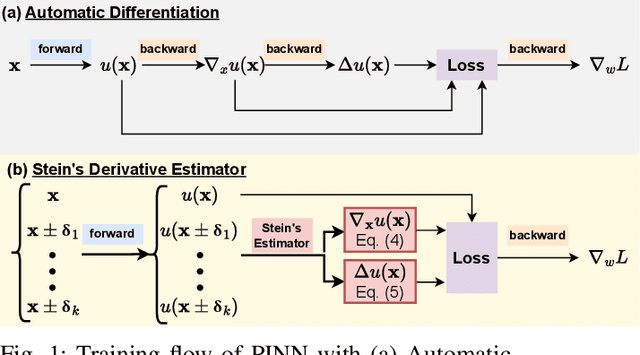
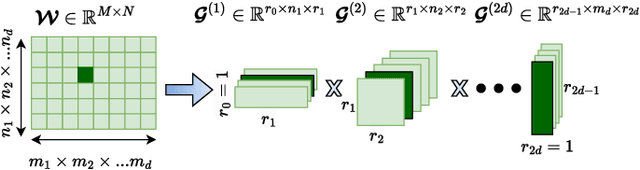
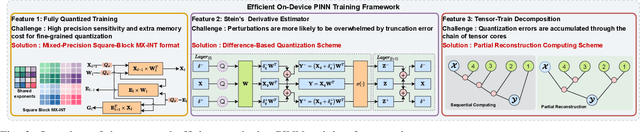
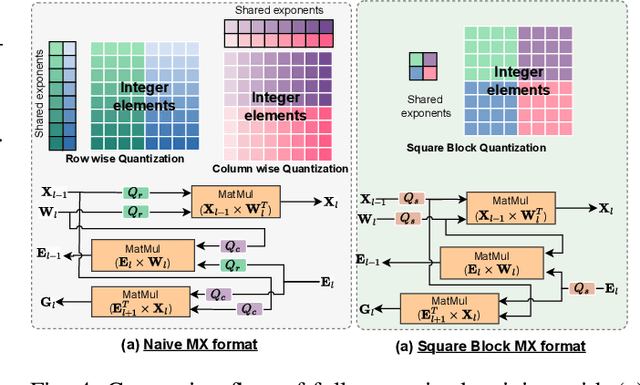
Physics-Informed Neural Networks (PINNs) have emerged as a promising paradigm for solving partial differential equations (PDEs) by embedding physical laws into neural network training objectives. However, their deployment on resource-constrained platforms is hindered by substantial computational and memory overhead, primarily stemming from higher-order automatic differentiation, intensive tensor operations, and reliance on full-precision arithmetic. To address these challenges, we present a framework that enables scalable and energy-efficient PINN training on edge devices. This framework integrates fully quantized training, Stein's estimator (SE)-based residual loss computation, and tensor-train (TT) decomposition for weight compression. It contributes three key innovations: (1) a mixed-precision training method that use a square-block MX (SMX) format to eliminate data duplication during backpropagation; (2) a difference-based quantization scheme for the Stein's estimator that mitigates underflow; and (3) a partial-reconstruction scheme (PRS) for TT-Layers that reduces quantization-error accumulation. We further design PINTA, a precision-scalable hardware accelerator, to fully exploit the performance of the framework. Experiments on the 2-D Poisson, 20-D Hamilton-Jacobi-Bellman (HJB), and 100-D Heat equations demonstrate that the proposed framework achieves accuracy comparable to or better than full-precision, uncompressed baselines while delivering 5.5x to 83.5x speedups and 159.6x to 2324.1x energy savings. This work enables real-time PDE solving on edge devices and paves the way for energy-efficient scientific computing at scale.
SkipKV: Selective Skipping of KV Generation and Storage for Efficient Inference with Large Reasoning Models
Dec 08, 2025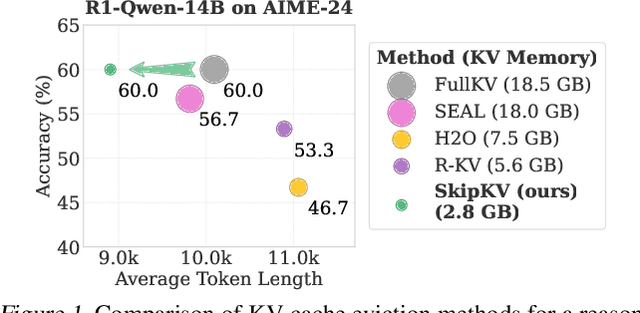
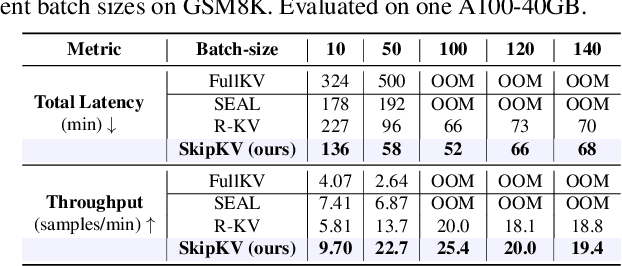
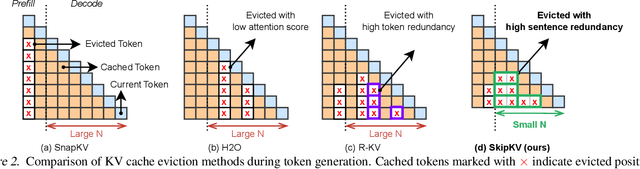
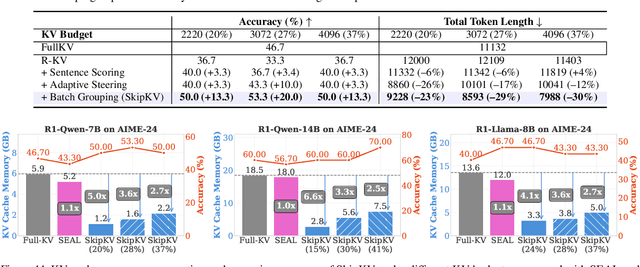
Large reasoning models (LRMs) often cost significant key-value (KV) cache overhead, due to their linear growth with the verbose chain-of-thought (CoT) reasoning process. This costs both memory and throughput bottleneck limiting their efficient deployment. Towards reducing KV cache size during inference, we first investigate the effectiveness of existing KV cache eviction methods for CoT reasoning. Interestingly, we find that due to unstable token-wise scoring and the reduced effective KV budget caused by padding tokens, state-of-the-art (SoTA) eviction methods fail to maintain accuracy in the multi-batch setting. Additionally, these methods often generate longer sequences than the original model, as semantic-unaware token-wise eviction leads to repeated revalidation during reasoning. To address these issues, we present \textbf{SkipKV}, a \textbf{\textit{training-free}} KV compression method for selective \textit{eviction} and \textit{generation} operating at a coarse-grained sentence-level sequence removal for efficient CoT reasoning. In specific, it introduces a \textit{sentence-scoring metric} to identify and remove highly similar sentences while maintaining semantic coherence. To suppress redundant generation, SkipKV dynamically adjusts a steering vector to update the hidden activation states during inference enforcing the LRM to generate concise response. Extensive evaluations on multiple reasoning benchmarks demonstrate the effectiveness of SkipKV in maintaining up to $\mathbf{26.7}\%$ improved accuracy compared to the alternatives, at a similar compression budget. Additionally, compared to SoTA, SkipKV yields up to $\mathbf{1.6}\times$ fewer generation length while improving throughput up to $\mathbf{1.7}\times$.
FLAT-LLM: Fine-grained Low-rank Activation Space Transformation for Large Language Model Compression
May 29, 2025Large Language Models (LLMs) have enabled remarkable progress in natural language processing, yet their high computational and memory demands pose challenges for deployment in resource-constrained environments. Although recent low-rank decomposition methods offer a promising path for structural compression, they often suffer from accuracy degradation, expensive calibration procedures, and result in inefficient model architectures that hinder real-world inference speedups. In this paper, we propose FLAT-LLM, a fast and accurate, training-free structural compression method based on fine-grained low-rank transformations in the activation space. Specifically, we reduce the hidden dimension by transforming the weights using truncated eigenvectors computed via head-wise Principal Component Analysis (PCA), and employ an importance-based metric to adaptively allocate ranks across decoders. FLAT-LLM achieves efficient and effective weight compression without recovery fine-tuning, which could complete the calibration within a few minutes. Evaluated across 4 models and 11 datasets, FLAT-LLM outperforms structural pruning baselines in generalization and downstream performance, while delivering inference speedups over decomposition-based methods.
Ultra Memory-Efficient On-FPGA Training of Transformers via Tensor-Compressed Optimization
Jan 11, 2025Transformer models have achieved state-of-the-art performance across a wide range of machine learning tasks. There is growing interest in training transformers on resource-constrained edge devices due to considerations such as privacy, domain adaptation, and on-device scientific machine learning. However, the significant computational and memory demands required for transformer training often exceed the capabilities of an edge device. Leveraging low-rank tensor compression, this paper presents the first on-FPGA accelerator for end-to-end transformer training. On the algorithm side, we present a bi-directional contraction flow for tensorized transformer training, significantly reducing the computational FLOPS and intra-layer memory costs compared to existing tensor operations. On the hardware side, we store all highly compressed model parameters and gradient information on chip, creating an on-chip-memory-only framework for each stage in training. This reduces off-chip communication and minimizes latency and energy costs. Additionally, we implement custom computing kernels for each training stage and employ intra-layer parallelism and pipe-lining to further enhance run-time and memory efficiency. Through experiments on transformer models within $36.7$ to $93.5$ MB using FP-32 data formats on the ATIS dataset, our tensorized FPGA accelerator could conduct single-batch end-to-end training on the AMD Alevo U50 FPGA, with a memory budget of less than $6$-MB BRAM and $22.5$-MB URAM. Compared to uncompressed training on the NVIDIA RTX 3090 GPU, our on-FPGA training achieves a memory reduction of $30\times$ to $51\times$. Our FPGA accelerator also achieves up to $3.6\times$ less energy cost per epoch compared with tensor Transformer training on an NVIDIA RTX 3090 GPU.