 Add to Chrome
 Add to Firefox
 Add to Edge
One Token Away from Collapse: The Fragility of Instruction-Tuned Helpfulness
Apr 14, 2026
Instruction-tuned large language models produce helpful, structured responses, but how robust is this helpfulness when trivially constrained? We show that simple lexical constraints (banning a single punctuation character or common word) cause instruction-tuned LLMs to collapse their responses, losing 14--48% of comprehensiveness in pairwise evaluation across three open-weight model families and one closed-weight model (GPT-4o-mini). The baseline response is preferred in 77--100% of 1,920 pairwise comparisons judged by GPT-4o-mini and GPT-4o. Notably, GPT-4o-mini suffers 31% comprehensiveness loss (99% baseline win rate), demonstrating that the fragility extends to commercially deployed closed-weight models, contrary to prior findings on format-level constraints. Through mechanistic analysis, we identify this as a planning failure: two-pass generation (free generation followed by constrained rewriting) recovers 59--96% of response length, and linear probes on prompt representations predict response length with $R^2 = 0.51$--$0.93$ before generation begins, with $R^2$ tracking collapse severity across models. The same probes yield negative $R^2$ on base models, confirming that instruction tuning creates the representational structure encoding the collapse decision. Crucially, base models show no systematic collapse under identical constraints, with effects that are small, noisy, and bidirectional, demonstrating that instruction tuning creates this fragility by coupling task competence to narrow surface-form templates. The effect replicates on MT-Bench across all eight task categories. We further show that standard independent LLM-as-judge evaluation detects only a 3.5% average quality drop where pairwise evaluation reveals 23%, exposing a methodological blind spot in how constrained generation is assessed.

Power-SMC: Low-Latency Sequence-Level Power Sampling for Training-Free LLM Reasoning
Feb 10, 2026Many recent reasoning gains in large language models can be explained as distribution sharpening: biasing generation toward high-likelihood trajectories already supported by the pretrained model, rather than modifying its weights. A natural formalization is the sequence-level power distribution $π_α(y\mid x)\propto p_θ(y\mid x)^α$ ($α>1$), which concentrates mass on whole sequences instead of adjusting token-level temperature. Prior work shows that Metropolis--Hastings (MH) sampling from this distribution recovers strong reasoning performance, but at order-of-magnitude inference slowdowns. We introduce Power-SMC, a training-free Sequential Monte Carlo scheme that targets the same objective while remaining close to standard decoding latency. Power-SMC advances a small particle set in parallel, corrects importance weights token-by-token, and resamples when necessary, all within a single GPU-friendly batched decode. We prove that temperature $τ=1/α$ is the unique prefix-only proposal minimizing incremental weight variance, interpret residual instability via prefix-conditioned Rényi entropies, and introduce an exponent-bridging schedule that improves particle stability without altering the target. On MATH500, Power-SMC matches or exceeds MH power sampling while reducing latency from $16$--$28\times$ to $1.4$--$3.3\times$ over baseline decoding.
SkipKV: Selective Skipping of KV Generation and Storage for Efficient Inference with Large Reasoning Models
Dec 08, 2025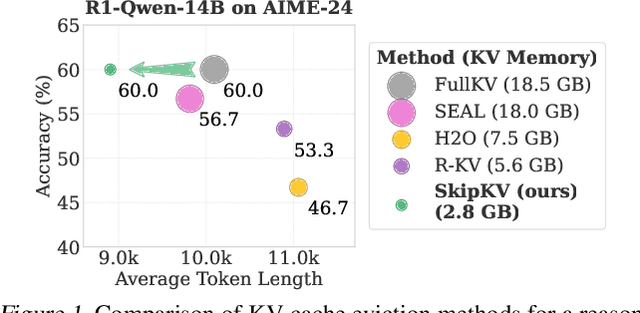
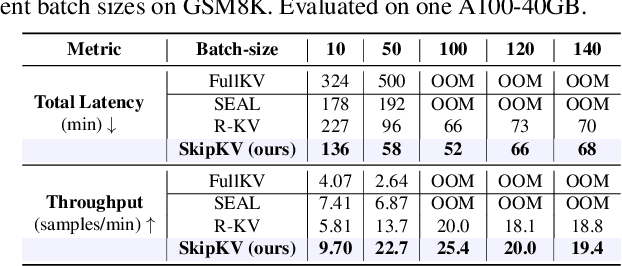
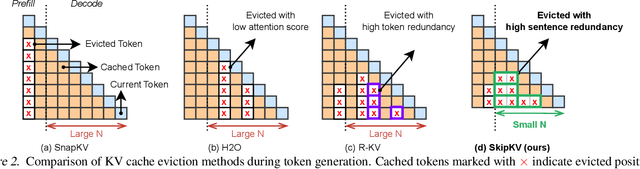
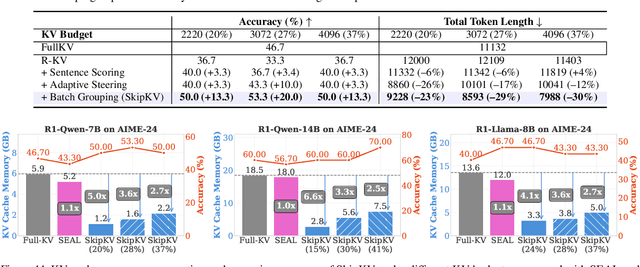
Large reasoning models (LRMs) often cost significant key-value (KV) cache overhead, due to their linear growth with the verbose chain-of-thought (CoT) reasoning process. This costs both memory and throughput bottleneck limiting their efficient deployment. Towards reducing KV cache size during inference, we first investigate the effectiveness of existing KV cache eviction methods for CoT reasoning. Interestingly, we find that due to unstable token-wise scoring and the reduced effective KV budget caused by padding tokens, state-of-the-art (SoTA) eviction methods fail to maintain accuracy in the multi-batch setting. Additionally, these methods often generate longer sequences than the original model, as semantic-unaware token-wise eviction leads to repeated revalidation during reasoning. To address these issues, we present \textbf{SkipKV}, a \textbf{\textit{training-free}} KV compression method for selective \textit{eviction} and \textit{generation} operating at a coarse-grained sentence-level sequence removal for efficient CoT reasoning. In specific, it introduces a \textit{sentence-scoring metric} to identify and remove highly similar sentences while maintaining semantic coherence. To suppress redundant generation, SkipKV dynamically adjusts a steering vector to update the hidden activation states during inference enforcing the LRM to generate concise response. Extensive evaluations on multiple reasoning benchmarks demonstrate the effectiveness of SkipKV in maintaining up to $\mathbf{26.7}\%$ improved accuracy compared to the alternatives, at a similar compression budget. Additionally, compared to SoTA, SkipKV yields up to $\mathbf{1.6}\times$ fewer generation length while improving throughput up to $\mathbf{1.7}\times$.