 Add to Chrome
 Add to Firefox
 Add to Edge
Beyond Isolated Objects: Relationship-aware Open Vocabulary Scene Understanding via 3D Scene Graph Analysis
Jul 06, 2026
Open-vocabulary 3D scene understanding aims to segment 3D scenes beyond predefined categories by transferring semantic knowledge from vision-language models. Existing methods have advanced this task by lifting language-aligned 2D features into 3D, yet they often rely on context-independent semantic representations, leaving object relationships underexplored for contextual refinement. We propose RelGraphOV, a relationship-aware framework that uses 3D scene graphs to enhance open-vocabulary 3D understanding. Our method constructs relational scene graphs from multi-view observations by leveraging vision-language reasoning to infer object relationships and prune geometrically implausible connections, without manual relationship annotations. To aggregate relational context while avoiding feature interference, we introduce an Adaptive Gated Dual-Stream Contextual GAT that separates dense geometric features and semantic CLIP embeddings, performs edge-guided message passing, and adaptively fuses complementary semantics. A hierarchical contrastive objective further promotes instance-level consistency and category-level discrimination. Experiments on ScanNetV2, ScanNet200, ScanNet$++$, and Replica demonstrate strong performance and generalization ability. Project Page: https://cxavireh.github.io/relgraphov-projectpage

Compact Object-Level Representations with Open-Vocabulary Understanding for Indoor Visual Relocalization
Jun 23, 2026Indoor visual relocalization plays a critical role in emerging spatial and embodied AI applications. However, prior research was predominantly devoted to low-level vision schemes, struggling to perceive scene semantics and compositions, which limits both interpretability and applicability. In this paper, we explore the issue of how to organize rich object information in a scene, including semantics, layout, and geometry, into a structured map representation, thereby utilizing object units exclusively to drive the camera relocalization task. To this end, we propose OpenReLoc, a camera relocalization system designed to provide scene understanding and accurate pose estimation capabilities. Leveraging recent foundation models, we first introduce a multi-modal mechanism to integrate open-vocabulary semantic knowledge for effective 2D-3D object matching. Additionally, we design object-oriented reference frames as position priors, paired with a reference frame selection strategy based on the Distance-IoU (DIOU), enabling extension to scalable scenes. Moreover, to ensure stable and accurate pose optimization, we also propose a dual-path 2D Iterative Closest Pixel loss guided by object shape. Experimental results demonstrate that OpenReLoc achieves superior relocalization recall and accuracy across various datasets. Our source code will be released upon acceptance.
daVinci-kernel: Co-Evolving Skill Selection, Summarization, and Utilization via RL for GPU Kernel Optimization
Jun 15, 2026GPU kernel optimization represents a paradigm where functional correctness is assumed and execution efficiency is the objective. We present daVinci-kernel, a reinforcement learning framework that couples skill discovery with skill exploitation through a dynamically evolving skill library. daVinci-kernel jointly trains three agents sharing one LLM backbone: a Skill Selection Agent that retrieves relevant techniques via BM25 and LLM reranking, a Policy Agent that generates multi-turn CUDA/Triton kernels conditioned on selected skills, and a Skill Summary Agent that distills successful rollouts into reusable skills. Candidate skills are added only after execution-based verification confirms reproducible speedups. All three agents share a single LLM backbone, are initialized via a structured SFT cold start on diversity-filtered data, and are then jointly optimized end-to-end with multi-turn REINFORCE and per-agent advantage estimation. On KernelBench, daVinci-kernel-14B achieves 37.2%, 70.6%, and 32.2% on Level 1, Level 2, and Level 3 under the Fast$_1$ threshold, outperforming the strongest prior RL-trained model, Dr.Kernel-14B.
TerminalWorld: Benchmarking Agents on Real-World Terminal Tasks
May 21, 2026We introduce TerminalWorld, a scalable data engine that automatically reverse-engineers high-fidelity evaluation tasks from "in-the-wild" terminal recordings. Processing 80,870 terminal recordings, the engine yields a full benchmark of 1,530 validated tasks, spanning 18 real-world categories, ranging from short everyday operations to workflows exceeding 50 steps, and covering 1,280 unique commands. From these, we curate a Verified subset of 200 representative, manually reviewed tasks. Comprehensive benchmarking on TerminalWorld-Verified across eight frontier models and six agents reveals that current systems still struggle with authentic terminal workflows, achieving a maximum pass rate of only 62.5%. Moreover, TerminalWorld captures real-world terminal capabilities distinct from existing expert-curated benchmarks (e.g., Terminal-Bench), with only a weak correlation to their scores (Pearson r=0.20). The automated engine makes TerminalWorld authentic and scalable by construction, enabling it to evaluate agents in real-world terminal environments as developer practices evolve. Data and code are available at https://github.com/EuniAI/TerminalWorld.
GaussianZoom: Progressive Zoom-in Generative 3D Gaussian Splatting with Geometric and Semantic Guidance
May 18, 2026We introduce GaussianZoom, a generative zoom-in 3D reconstruction system with an iterative progressive framework that combines geometry-consistent scene modeling and multi-scale semantic reasoning to enable high-fidelity extreme zoom-in rendering from low-resolution inputs. To achieve this, we develop a novel multi-view consistent super-resolution module with depth-based feature warping and VLM-driven detail synthesis, ensuring accurate multi-view correspondence while enriching fine-scale appearance beyond the observed resolution. To support zooming across large magnification ranges, we further introduce a new expandable continuous Level-of-Detail hierarchy that dynamically modulates Gaussian visibility for smooth, alias-free cross-scale rendering. Experiments on Mip-NeRF360 and Tanks\&Temples demonstrate that GaussianZoom achieves superior perceptual quality, multi-view consistency, and robustness under extreme magnification, establishing a strong baseline for generative zoom-in 3D scene reconstruction.
Show Me the Infographic I Imagine: Intent-Aware Infographic Retrieval for Authoring Support
Apr 09, 2026While infographics have become a powerful medium for communicating data-driven stories, authoring them from scratch remains challenging, especially for novice users. Retrieving relevant exemplars from a large corpus can provide design inspiration and promote reuse, substantially lowering the barrier to infographic authoring. However, effective retrieval is difficult because users often express design intent in ambiguous natural language, while infographics embody rich and multi-faceted visual designs. As a result, keyword-based search often fails to capture design intent, and general-purpose vision-language retrieval models trained on natural images are ill-suited to the text-heavy, multi-component nature of infographics. To address these challenges, we develop an intent-aware infographic retrieval framework that better aligns user queries with infographic designs. We first conduct a formative study of how people describe infographics and derive an intent taxonomy spanning content and visual design facets. This taxonomy is then leveraged to enrich and refine free-form user queries, guiding the retrieval process with intent-specific cues. Building on the retrieved exemplars, users can adapt the designs to their own data with high-level edit intents, supported by an interactive agent that performs low-level adaptation. Both quantitative evaluations and user studies are conducted to demonstrate that our method improves retrieval quality over baseline methods while better supporting intent satisfaction and efficient infographic authoring.
daVinci-Env: Open SWE Environment Synthesis at Scale
Mar 16, 2026Training capable software engineering (SWE) agents demands large-scale, executable, and verifiable environments that provide dynamic feedback loops for iterative code editing, test execution, and solution refinement. However, existing open-source datasets remain limited in scale and repository diversity, while industrial solutions are opaque with unreleased infrastructure, creating a prohibitive barrier for most academic research groups. We present OpenSWE, the largest fully transparent framework for SWE agent training in Python, comprising 45,320 executable Docker environments spanning over 12.8k repositories, with all Dockerfiles, evaluation scripts, and infrastructure fully open-sourced for reproducibility. OpenSWE is built through a multi-agent synthesis pipeline deployed across a 64-node distributed cluster, automating repository exploration, Dockerfile construction, evaluation script generation, and iterative test analysis. Beyond scale, we propose a quality-centric filtering pipeline that characterizes the inherent difficulty of each environment, filtering out instances that are either unsolvable or insufficiently challenging and retaining only those that maximize learning efficiency. With $891K spent on environment construction and an additional $576K on trajectory sampling and difficulty-aware curation, the entire project represents a total investment of approximately $1.47 million, yielding about 13,000 curated trajectories from roughly 9,000 quality guaranteed environments. Extensive experiments validate OpenSWE's effectiveness: OpenSWE-32B and OpenSWE-72B achieve 62.4% and 66.0% on SWE-bench Verified, establishing SOTA among Qwen2.5 series. Moreover, SWE-focused training yields substantial out-of-domain improvements, including up to 12 points on mathematical reasoning and 5 points on science benchmarks, without degrading factual recall.
GaussianUpdate: Continual 3D Gaussian Splatting Update for Changing Environments
Aug 12, 2025Novel view synthesis with neural models has advanced rapidly in recent years, yet adapting these models to scene changes remains an open problem. Existing methods are either labor-intensive, requiring extensive model retraining, or fail to capture detailed types of changes over time. In this paper, we present GaussianUpdate, a novel approach that combines 3D Gaussian representation with continual learning to address these challenges. Our method effectively updates the Gaussian radiance fields with current data while preserving information from past scenes. Unlike existing methods, GaussianUpdate explicitly models different types of changes through a novel multi-stage update strategy. Additionally, we introduce a visibility-aware continual learning approach with generative replay, enabling self-aware updating without the need to store images. The experiments on the benchmark dataset demonstrate our method achieves superior and real-time rendering with the capability of visualizing changes over different times
OpenCUA: Open Foundations for Computer-Use Agents
Aug 12, 2025Vision-language models have demonstrated impressive capabilities as computer-use agents (CUAs) capable of automating diverse computer tasks. As their commercial potential grows, critical details of the most capable CUA systems remain closed. As these agents will increasingly mediate digital interactions and execute consequential decisions on our behalf, the research community needs access to open CUA frameworks to study their capabilities, limitations, and risks. To bridge this gap, we propose OpenCUA, a comprehensive open-source framework for scaling CUA data and foundation models. Our framework consists of: (1) an annotation infrastructure that seamlessly captures human computer-use demonstrations; (2) AgentNet, the first large-scale computer-use task dataset spanning 3 operating systems and 200+ applications and websites; (3) a scalable pipeline that transforms demonstrations into state-action pairs with reflective long Chain-of-Thought reasoning that sustain robust performance gains as data scales. Our end-to-end agent models demonstrate strong performance across CUA benchmarks. In particular, OpenCUA-32B achieves an average success rate of 34.8% on OSWorld-Verified, establishing a new state-of-the-art (SOTA) among open-source models and surpassing OpenAI CUA (GPT-4o). Further analysis confirms that our approach generalizes well across domains and benefits significantly from increased test-time computation. We release our annotation tool, datasets, code, and models to build open foundations for further CUA research.
SGFormer: Satellite-Ground Fusion for 3D Semantic Scene Completion
Mar 21, 2025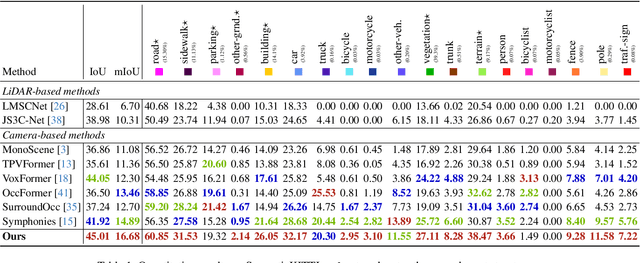
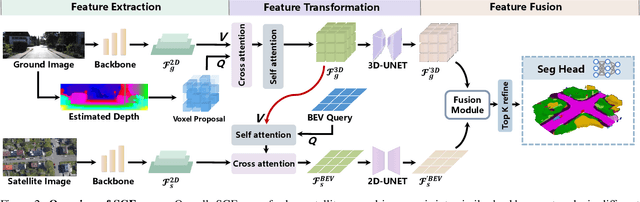
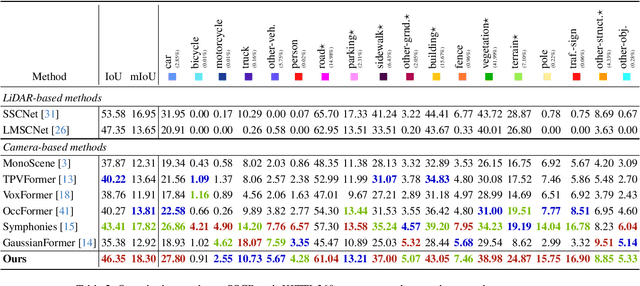
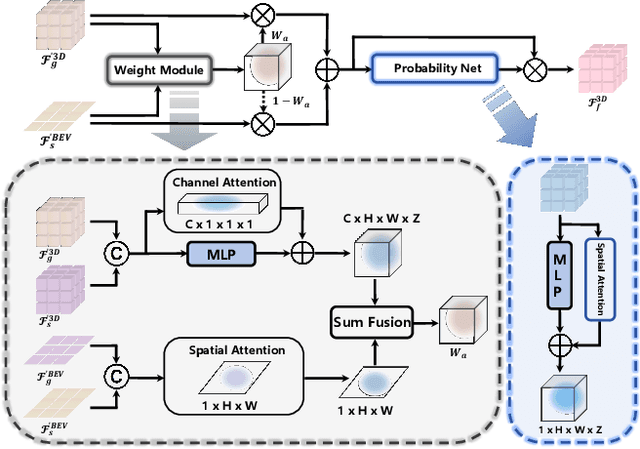
Recently, camera-based solutions have been extensively explored for scene semantic completion (SSC). Despite their success in visible areas, existing methods struggle to capture complete scene semantics due to frequent visual occlusions. To address this limitation, this paper presents the first satellite-ground cooperative SSC framework, i.e., SGFormer, exploring the potential of satellite-ground image pairs in the SSC task. Specifically, we propose a dual-branch architecture that encodes orthogonal satellite and ground views in parallel, unifying them into a common domain. Additionally, we design a ground-view guidance strategy that corrects satellite image biases during feature encoding, addressing misalignment between satellite and ground views. Moreover, we develop an adaptive weighting strategy that balances contributions from satellite and ground views. Experiments demonstrate that SGFormer outperforms the state of the art on SemanticKITTI and SSCBench-KITTI-360 datasets. Our code is available on https://github.com/gxytcrc/SGFormer.