 Add to Chrome
 Add to Firefox
 Add to Edge
Motion Reinforces Appearance: RGB-Skeleton Gated Residual Fusion for Micro-Gesture Online Recognition
Jun 10, 2026
Micro-gesture analysis attracts increasing attention for inferring spontaneous emotion from subtle body movements. Micro-gesture online recognition, which localizes and classifies each gesture instance in untrimmed videos, is a core task in the 4th EI-MiGA-IJCAI Challenge. Compared with typical temporal action detection, MGR emphasizes the localization and classification of actions, requiring the model to output the start time, end time, and category of each micro-gesture. Moreover, since micro-gestures are highly spontaneous, relying solely on a single modality makes it difficult to capture the complete and accurate multi-modal cues. In this work, we propose DyFADet+, which extends DyFADet into a dual-stream RGB-skeleton framework. In our model, both modalities are projected into shared multi-scale temporal embeddings and fused through a gated residual module, which adaptively injects skeleton motion into the RGB representation rather than using naive concatenation. Finally, these fused features are decoded by a Dynamic TAD head for online classification and boundary regression. On the SMG dataset, our method achieves an F1 score of 40.88, ranking 2nd in the Micro-gesture Online Recognition track.

GaussianZoom: Progressive Zoom-in Generative 3D Gaussian Splatting with Geometric and Semantic Guidance
May 18, 2026We introduce GaussianZoom, a generative zoom-in 3D reconstruction system with an iterative progressive framework that combines geometry-consistent scene modeling and multi-scale semantic reasoning to enable high-fidelity extreme zoom-in rendering from low-resolution inputs. To achieve this, we develop a novel multi-view consistent super-resolution module with depth-based feature warping and VLM-driven detail synthesis, ensuring accurate multi-view correspondence while enriching fine-scale appearance beyond the observed resolution. To support zooming across large magnification ranges, we further introduce a new expandable continuous Level-of-Detail hierarchy that dynamically modulates Gaussian visibility for smooth, alias-free cross-scale rendering. Experiments on Mip-NeRF360 and Tanks\&Temples demonstrate that GaussianZoom achieves superior perceptual quality, multi-view consistency, and robustness under extreme magnification, establishing a strong baseline for generative zoom-in 3D scene reconstruction.
Free360: Layered Gaussian Splatting for Unbounded 360-Degree View Synthesis from Extremely Sparse and Unposed Views
Mar 31, 2025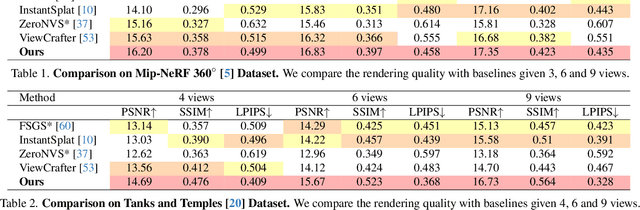
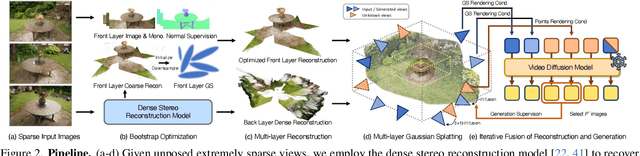
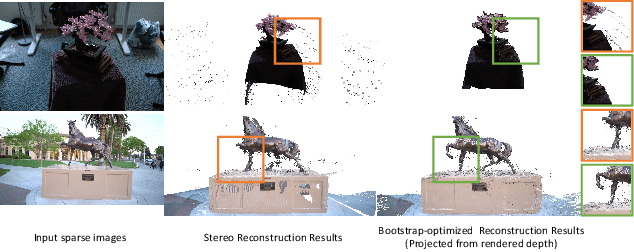
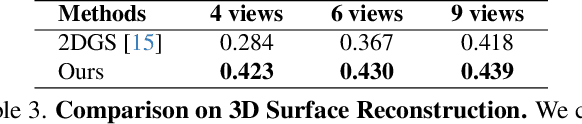
Neural rendering has demonstrated remarkable success in high-quality 3D neural reconstruction and novel view synthesis with dense input views and accurate poses. However, applying it to extremely sparse, unposed views in unbounded 360{\deg} scenes remains a challenging problem. In this paper, we propose a novel neural rendering framework to accomplish the unposed and extremely sparse-view 3D reconstruction in unbounded 360{\deg} scenes. To resolve the spatial ambiguity inherent in unbounded scenes with sparse input views, we propose a layered Gaussian-based representation to effectively model the scene with distinct spatial layers. By employing a dense stereo reconstruction model to recover coarse geometry, we introduce a layer-specific bootstrap optimization to refine the noise and fill occluded regions in the reconstruction. Furthermore, we propose an iterative fusion of reconstruction and generation alongside an uncertainty-aware training approach to facilitate mutual conditioning and enhancement between these two processes. Comprehensive experiments show that our approach outperforms existing state-of-the-art methods in terms of rendering quality and surface reconstruction accuracy. Project page: https://zju3dv.github.io/free360/
GURecon: Learning Detailed 3D Geometric Uncertainties for Neural Surface Reconstruction
Dec 19, 2024Neural surface representation has demonstrated remarkable success in the areas of novel view synthesis and 3D reconstruction. However, assessing the geometric quality of 3D reconstructions in the absence of ground truth mesh remains a significant challenge, due to its rendering-based optimization process and entangled learning of appearance and geometry with photometric losses. In this paper, we present a novel framework, i.e, GURecon, which establishes a geometric uncertainty field for the neural surface based on geometric consistency. Different from existing methods that rely on rendering-based measurement, GURecon models a continuous 3D uncertainty field for the reconstructed surface, and is learned by an online distillation approach without introducing real geometric information for supervision. Moreover, in order to mitigate the interference of illumination on geometric consistency, a decoupled field is learned and exploited to finetune the uncertainty field. Experiments on various datasets demonstrate the superiority of GURecon in modeling 3D geometric uncertainty, as well as its plug-and-play extension to various neural surface representations and improvement on downstream tasks such as incremental reconstruction. The code and supplementary material are available on the project website: https://zju3dv.github.io/GURecon/.
Reflections from the 2024 Large Language Model (LLM) Hackathon for Applications in Materials Science and Chemistry
Nov 20, 2024


Here, we present the outcomes from the second Large Language Model (LLM) Hackathon for Applications in Materials Science and Chemistry, which engaged participants across global hybrid locations, resulting in 34 team submissions. The submissions spanned seven key application areas and demonstrated the diverse utility of LLMs for applications in (1) molecular and material property prediction; (2) molecular and material design; (3) automation and novel interfaces; (4) scientific communication and education; (5) research data management and automation; (6) hypothesis generation and evaluation; and (7) knowledge extraction and reasoning from scientific literature. Each team submission is presented in a summary table with links to the code and as brief papers in the appendix. Beyond team results, we discuss the hackathon event and its hybrid format, which included physical hubs in Toronto, Montreal, San Francisco, Berlin, Lausanne, and Tokyo, alongside a global online hub to enable local and virtual collaboration. Overall, the event highlighted significant improvements in LLM capabilities since the previous year's hackathon, suggesting continued expansion of LLMs for applications in materials science and chemistry research. These outcomes demonstrate the dual utility of LLMs as both multipurpose models for diverse machine learning tasks and platforms for rapid prototyping custom applications in scientific research.
14 Examples of How LLMs Can Transform Materials Science and Chemistry: A Reflection on a Large Language Model Hackathon
Jun 13, 2023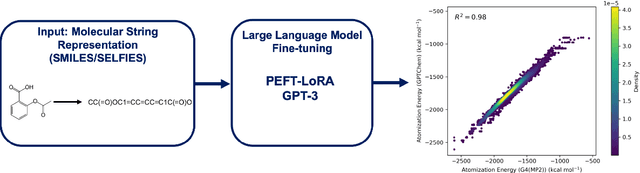
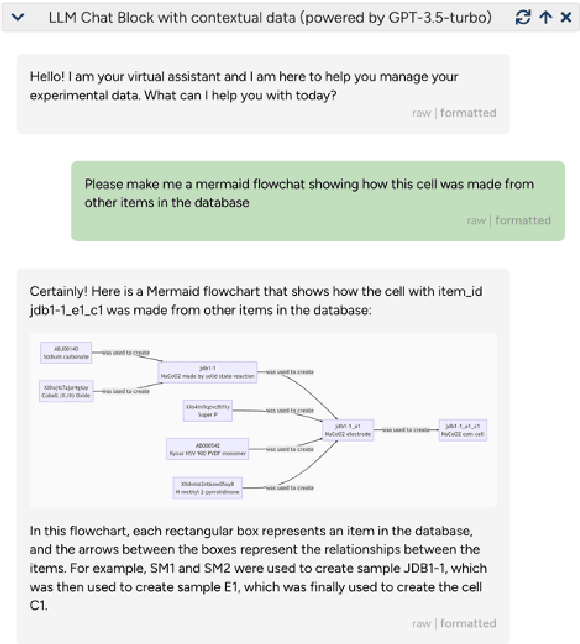

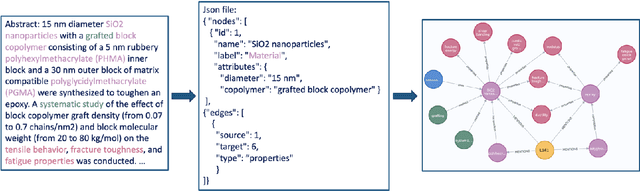
Chemistry and materials science are complex. Recently, there have been great successes in addressing this complexity using data-driven or computational techniques. Yet, the necessity of input structured in very specific forms and the fact that there is an ever-growing number of tools creates usability and accessibility challenges. Coupled with the reality that much data in these disciplines is unstructured, the effectiveness of these tools is limited. Motivated by recent works that indicated that large language models (LLMs) might help address some of these issues, we organized a hackathon event on the applications of LLMs in chemistry, materials science, and beyond. This article chronicles the projects built as part of this hackathon. Participants employed LLMs for various applications, including predicting properties of molecules and materials, designing novel interfaces for tools, extracting knowledge from unstructured data, and developing new educational applications. The diverse topics and the fact that working prototypes could be generated in less than two days highlight that LLMs will profoundly impact the future of our fields. The rich collection of ideas and projects also indicates that the applications of LLMs are not limited to materials science and chemistry but offer potential benefits to a wide range of scientific disciplines.