 Add to Chrome
 Add to Firefox
 Add to Edge
Agents' Last Exam
Jun 03, 2026
Recent AI systems have achieved strong results on a wide range of benchmarks, yet these gains have not translated into economically meaningful deployment across many professional domains. We argue that this gap is largely an evaluation problem: widely used benchmarks lack sustained performance measurement on real and economically valuable workflows. This paper introduces Agents' Last Exam (ALE), a benchmark designed to evaluate AI agents on long-horizon, economically valuable, real-world tasks with verifiable outcomes. Developed in collaboration with 250+ industry experts, ALE covers non-physical industries defined with reference to O*NET / SOC 2018 (the U.S. federal occupational taxonomy). It is organized around a task taxonomy with 55 subfields grouped into 13 industry clusters covering 1K+ tasks. Current results show that the hardest tier remains far from saturated: across mainstream harness and backbone configurations, the average full pass rate is 2.6%. ALE is designed as a living benchmark: its task pool grows continuously as new workflows and industries are onboarded. More broadly, ALE is intended not merely as another leaderboard, but as an instrument for closing the gap between benchmark success and GDP-relevant impact.

GaussianUpdate: Continual 3D Gaussian Splatting Update for Changing Environments
Aug 12, 2025Novel view synthesis with neural models has advanced rapidly in recent years, yet adapting these models to scene changes remains an open problem. Existing methods are either labor-intensive, requiring extensive model retraining, or fail to capture detailed types of changes over time. In this paper, we present GaussianUpdate, a novel approach that combines 3D Gaussian representation with continual learning to address these challenges. Our method effectively updates the Gaussian radiance fields with current data while preserving information from past scenes. Unlike existing methods, GaussianUpdate explicitly models different types of changes through a novel multi-stage update strategy. Additionally, we introduce a visibility-aware continual learning approach with generative replay, enabling self-aware updating without the need to store images. The experiments on the benchmark dataset demonstrate our method achieves superior and real-time rendering with the capability of visualizing changes over different times
GaussianPrediction: Dynamic 3D Gaussian Prediction for Motion Extrapolation and Free View Synthesis
May 30, 2024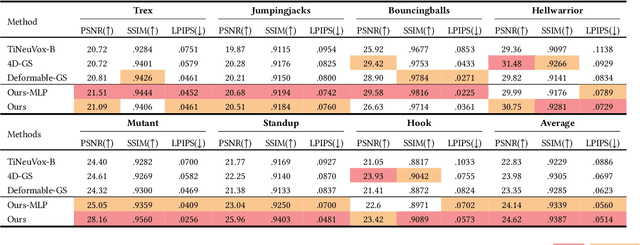

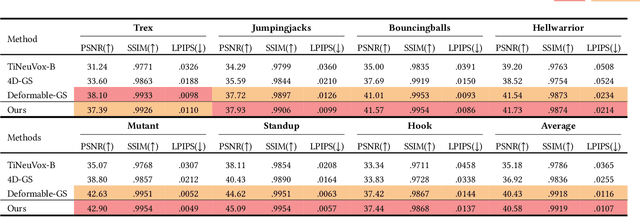
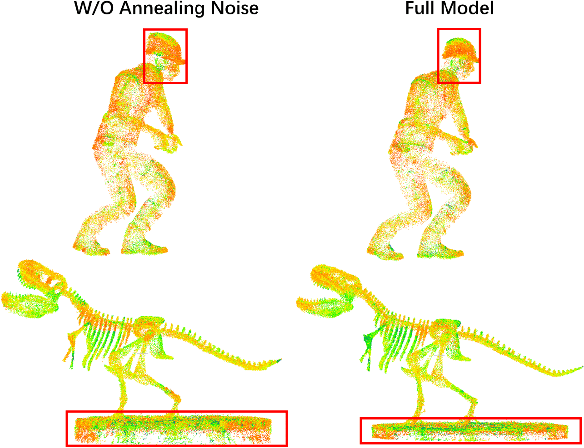
Forecasting future scenarios in dynamic environments is essential for intelligent decision-making and navigation, a challenge yet to be fully realized in computer vision and robotics. Traditional approaches like video prediction and novel-view synthesis either lack the ability to forecast from arbitrary viewpoints or to predict temporal dynamics. In this paper, we introduce GaussianPrediction, a novel framework that empowers 3D Gaussian representations with dynamic scene modeling and future scenario synthesis in dynamic environments. GaussianPrediction can forecast future states from any viewpoint, using video observations of dynamic scenes. To this end, we first propose a 3D Gaussian canonical space with deformation modeling to capture the appearance and geometry of dynamic scenes, and integrate the lifecycle property into Gaussians for irreversible deformations. To make the prediction feasible and efficient, a concentric motion distillation approach is developed by distilling the scene motion with key points. Finally, a Graph Convolutional Network is employed to predict the motions of key points, enabling the rendering of photorealistic images of future scenarios. Our framework shows outstanding performance on both synthetic and real-world datasets, demonstrating its efficacy in predicting and rendering future environments.
Deep Learning-Aided OFDM-Based Generalized Optical Quadrature Spatial Modulation
Jun 24, 2021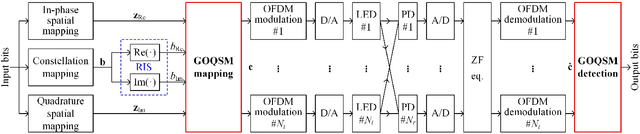
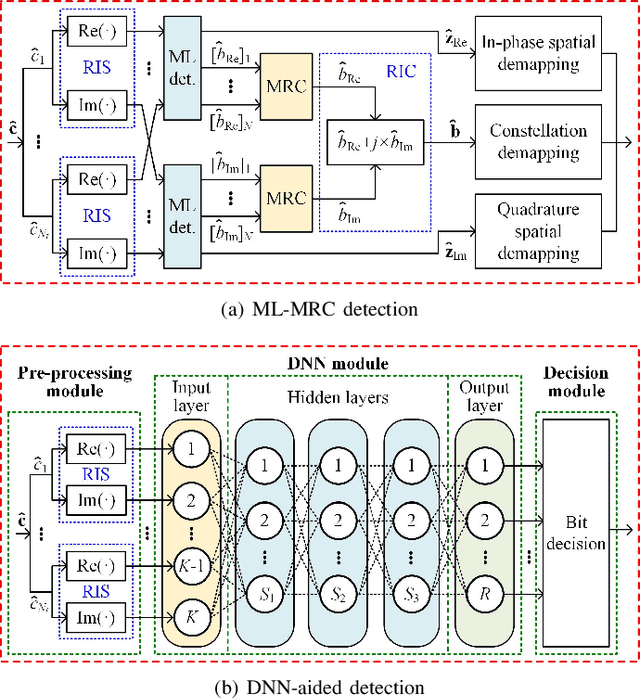
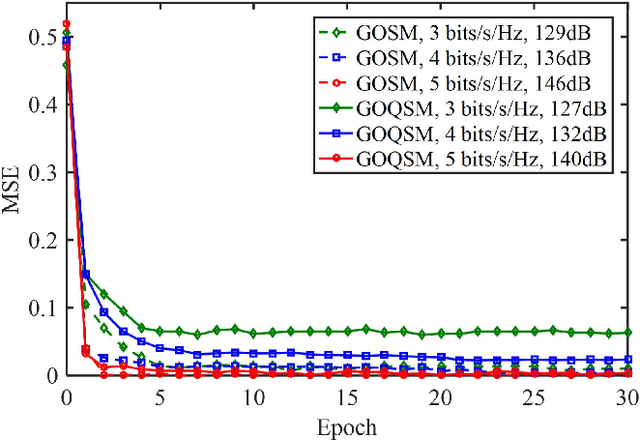
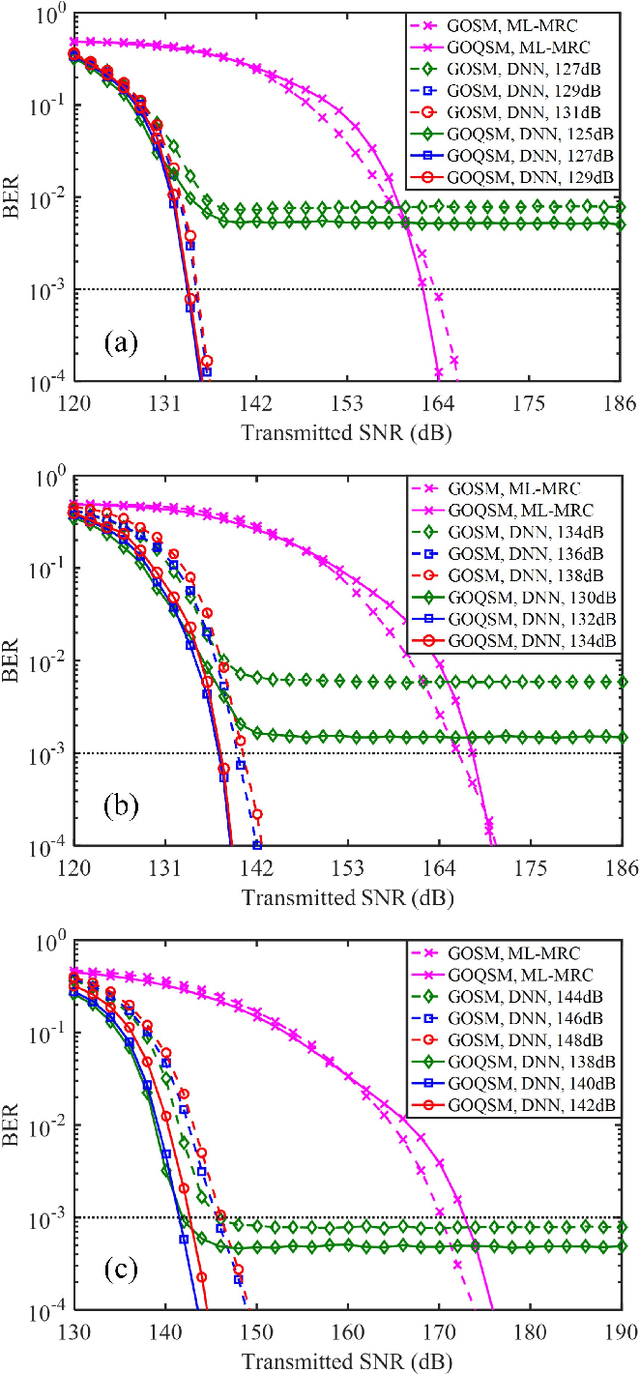
In this paper, we propose an orthogonal frequency division multiplexing (OFDM)-based generalized optical quadrature spatial modulation (GOQSM) technique for multiple-input multiple-output optical wireless communication (MIMO-OWC) systems. Considering the error propagation and noise amplification effects when applying maximum likelihood and maximum ratio combining (ML-MRC)-based detection, we further propose a deep neural network (DNN)-aided detection for OFDM-based GOQSM systems. The proposed DNN-aided detection scheme performs the GOQSM detection in a joint manner, which can efficiently eliminate the adverse effects of both error propagation and noise amplification. The obtained simulation results successfully verify the superiority of the deep learning-aided OFDM-based GOQSM technique for high-speed MIMO-OWC systems.