 Add to Chrome
 Add to Firefox
 Add to Edge
Compact Object-Level Representations with Open-Vocabulary Understanding for Indoor Visual Relocalization
Jun 23, 2026
Indoor visual relocalization plays a critical role in emerging spatial and embodied AI applications. However, prior research was predominantly devoted to low-level vision schemes, struggling to perceive scene semantics and compositions, which limits both interpretability and applicability. In this paper, we explore the issue of how to organize rich object information in a scene, including semantics, layout, and geometry, into a structured map representation, thereby utilizing object units exclusively to drive the camera relocalization task. To this end, we propose OpenReLoc, a camera relocalization system designed to provide scene understanding and accurate pose estimation capabilities. Leveraging recent foundation models, we first introduce a multi-modal mechanism to integrate open-vocabulary semantic knowledge for effective 2D-3D object matching. Additionally, we design object-oriented reference frames as position priors, paired with a reference frame selection strategy based on the Distance-IoU (DIOU), enabling extension to scalable scenes. Moreover, to ensure stable and accurate pose optimization, we also propose a dual-path 2D Iterative Closest Pixel loss guided by object shape. Experimental results demonstrate that OpenReLoc achieves superior relocalization recall and accuracy across various datasets. Our source code will be released upon acceptance.

CG-SLAM: Efficient Dense RGB-D SLAM in a Consistent Uncertainty-aware 3D Gaussian Field
Mar 24, 2024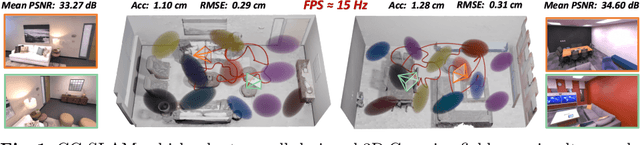
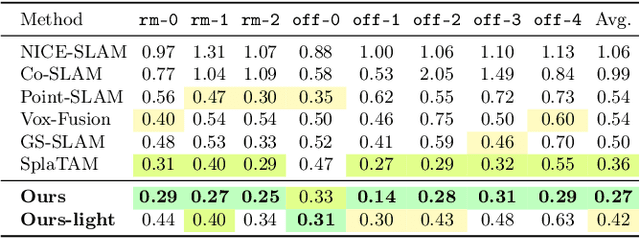
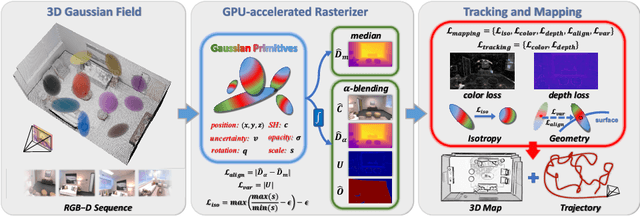
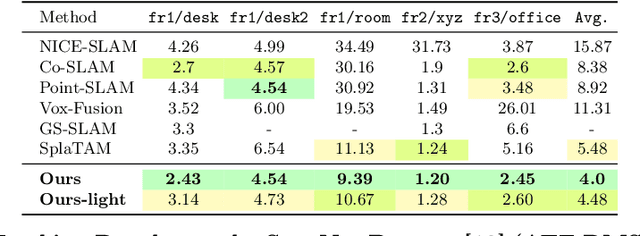
Recently neural radiance fields (NeRF) have been widely exploited as 3D representations for dense simultaneous localization and mapping (SLAM). Despite their notable successes in surface modeling and novel view synthesis, existing NeRF-based methods are hindered by their computationally intensive and time-consuming volume rendering pipeline. This paper presents an efficient dense RGB-D SLAM system, i.e., CG-SLAM, based on a novel uncertainty-aware 3D Gaussian field with high consistency and geometric stability. Through an in-depth analysis of Gaussian Splatting, we propose several techniques to construct a consistent and stable 3D Gaussian field suitable for tracking and mapping. Additionally, a novel depth uncertainty model is proposed to ensure the selection of valuable Gaussian primitives during optimization, thereby improving tracking efficiency and accuracy. Experiments on various datasets demonstrate that CG-SLAM achieves superior tracking and mapping performance with a notable tracking speed of up to 15 Hz. We will make our source code publicly available. Project page: https://zju3dv.github.io/cg-slam.