 Add to Chrome
 Add to Firefox
 Add to Edge
Dual Inversion for Text-to-Image Diffusion Models: From Both Prompt and Noise Perspectives
Jul 29, 2026
Prompt inversion, as a typical reverse engineering technique, enables text-to-image (T2I) diffusion models to generate the desired target images without extensive prompt engineering. However, existing prompt inversion methods suffer from significant limitations: (1) gradient-based methods are unstable and uninterpretable, often resulting in generated images with severe artifacts; (2) gradient-free methods yield human-readable prompts but still fail to preserve visual fidelity due to the lack of fine-grained detail alignment. We contend that the limitations stem from treating prompt inversion as a sufficient condition for reverse engineering, ignoring the critical role of the latent noise that encodes structural information. Consequently, we propose Dualin (Dual inversion), a two-stage method that jointly recovers both the semantic prompt and latent noise of the target image. In the first stage, we integrate vision-language model, CLIP and large language model to invert a faithful, human-interpretable hard prompt. In the second stage, unconditional DDIM inversion reconstructs the exact latent noise of the target image, guaranteeing the consistency at the structural information level. Theoretically, we prove that the inverted noise enables flexible image editing without re-optimization. Extensive experiments on diverse datasets demonstrate that Dualin simultaneously generates high-quality inverted prompts and achieves state-of-the-art image fidelity. Additionally, Dualin can establish a robust foundation for the precise and controllable image editing.

One Framework for All: Cross-Modal Membership Inference for Generative Models
Jul 05, 2026Large generative models across text-to-text, text-to-image, and image-to-text modalities have been shown to pose significant privacy risks. One fundamental threat is membership inference attacks (MIA), which aim to determine whether a given data point was used in a model's training set. Although prior work has investigated MIAs against these three classes of generative models, existing approaches treat them in isolation and are not cross-applicable, thereby limiting their real-world utility. To address this limitation, we present the first comprehensive study of a unified membership inference framework that applies across text-to-text, text-to-image, and image-to-text modalities. Our approach is grounded in a key modality-agnostic observation: the output distribution of a generative model can approximate its training data distribution. Leveraging this property, we model the distributions of model-generated outputs and auxiliary non-member samples in a shared embedding space, and perform membership inference via likelihood ratio testing. We conduct extensive experiments in a strict black-box setting under both partial-knowledge and zero-knowledge threat models, and evaluate membership inference against both fine-tuning and pre-training data. Experimental results demonstrate our approach's superior performance in comparison to existing state-of-the-art methods, which are typically optimized for a single model class.
Auditing Machine Unlearning: A Systematic Research on Whether Models Truly Forget
Jun 15, 2026Machine unlearning has been extensively studied in response to growing privacy concerns and regulatory requirements. However, auditing whether unlearning algorithms have truly erased the influence of specific data remains an open challenge. The lack of reliable and practical auditing mechanisms can lead to critical privacy risks, such as residual information leakage. This paper initiates a systematic investigation into whether existing unlearning algorithms can truly forget the designated data. We propose the first practical and general-purpose auditing framework for machine unlearning, inspired by the concept of proof of ignorance. Our framework addresses the key practicality limitations of existing methods by eliminating the need for retraining-from-scratch baselines, avoiding the training of large numbers of shadow models, and requiring no intrusive intervention in the original training process. To evaluate the effectiveness of our framework, we first conduct validation experiments to verify its soundness and completeness. We then perform comprehensive experiments across six datasets and ten representative unlearning methods. The results demonstrate that our framework reliably distinguishes between successful and failed unlearning. In particular, we observe that retraining-based and fine-tuning-based methods can achieve effective unlearning, even when the target data remain in the original dataset. In contrast, de-optimization-based methods fail to achieve true unlearning and instead degrade the model's performance. Fisher/Hessian-based methods also fail to unlearn requested data, even formal certification is provided. Moreover, we show that our framework is robust against fake unlearning attempts and generalizes well to large language models.
From Spark to Fire: Modeling and Mitigating Error Cascades in LLM-Based Multi-Agent Collaboration
Mar 04, 2026Large Language Model-based Multi-Agent Systems (LLM-MAS) are increasingly applied to complex collaborative scenarios. However, their collaborative mechanisms may cause minor inaccuracies to gradually solidify into system-level false consensus through iteration. Such risks are difficult to trace since errors can propagate and amplify through message dependencies. Existing protections often rely on single-agent validation or require modifications to the collaboration architecture, which can weaken effective information flow and may not align with natural collaboration processes in real tasks. To address this, we propose a propagation dynamics model tailored for LLM-MAS that abstracts collaboration as a directed dependency graph and provides an early-stage risk criterion to characterize amplification risk. Through experiments on six mainstream frameworks, we identify three vulnerability classes: cascade amplification, topological sensitivity, and consensus inertia. We further instantiate an attack where injecting just a single atomic error seed leads to widespread failure. In response, we introduce a genealogy-graph-based governance layer, implemented as a message-layer plugin, that suppresses both endogenous and exogenous error amplification without altering the collaboration architecture. Experiments show that this approach raises the defense success rate from a baseline of 0.32 to over 0.89 and significantly mitigates the cascading spread of minor errors.
Forgetting Similar Samples: Can Machine Unlearning Do it Better?
Jan 11, 2026Machine unlearning, a process enabling pre-trained models to remove the influence of specific training samples, has attracted significant attention in recent years. Although extensive research has focused on developing efficient machine unlearning strategies, we argue that these methods mainly aim at removing samples rather than removing samples' influence on the model, thus overlooking the fundamental definition of machine unlearning. In this paper, we first conduct a comprehensive study to evaluate the effectiveness of existing unlearning schemes when the training dataset includes many samples similar to those targeted for unlearning. Specifically, we evaluate: Do existing unlearning methods truly adhere to the original definition of machine unlearning and effectively eliminate all influence of target samples when similar samples are present in the training dataset? Our extensive experiments, conducted on four carefully constructed datasets with thorough analysis, reveal a notable gap between the expected and actual performance of most existing unlearning methods for image and language models, even for the retraining-from-scratch baseline. Additionally, we also explore potential solutions to enhance current unlearning approaches.
Dual-View Inference Attack: Machine Unlearning Amplifies Privacy Exposure
Dec 18, 2025Machine unlearning is a newly popularized technique for removing specific training data from a trained model, enabling it to comply with data deletion requests. While it protects the rights of users requesting unlearning, it also introduces new privacy risks. Prior works have primarily focused on the privacy of data that has been unlearned, while the risks to retained data remain largely unexplored. To address this gap, we focus on the privacy risks of retained data and, for the first time, reveal the vulnerabilities introduced by machine unlearning under the dual-view setting, where an adversary can query both the original and the unlearned models. From an information-theoretic perspective, we introduce the concept of {privacy knowledge gain} and demonstrate that the dual-view setting allows adversaries to obtain more information than querying either model alone, thereby amplifying privacy leakage. To effectively demonstrate this threat, we propose DVIA, a Dual-View Inference Attack, which extracts membership information on retained data using black-box queries to both models. DVIA eliminates the need to train an attack model and employs a lightweight likelihood ratio inference module for efficient inference. Experiments across different datasets and model architectures validate the effectiveness of DVIA and highlight the privacy risks inherent in the dual-view setting.
Data Duplication: A Novel Multi-Purpose Attack Paradigm in Machine Unlearning
Jan 28, 2025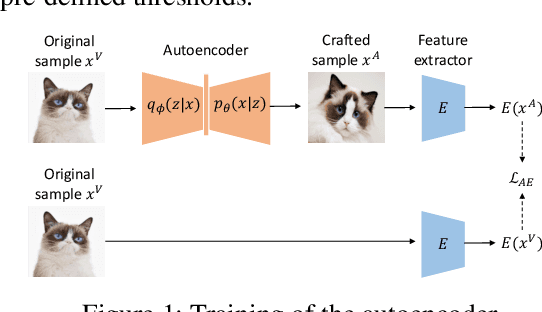
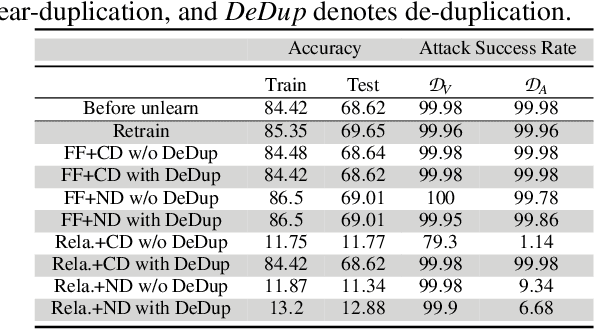
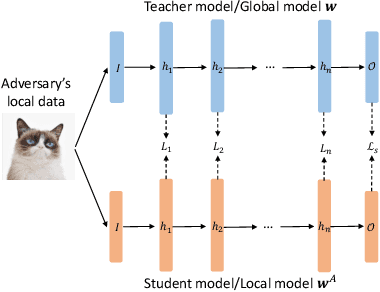
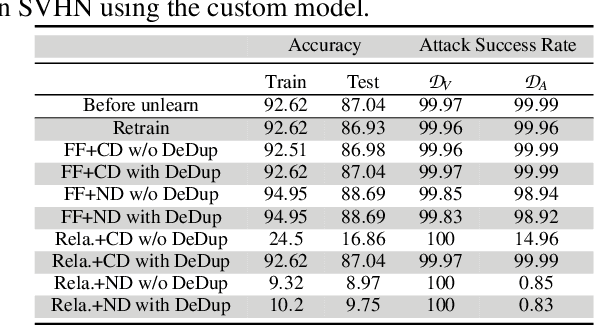
Duplication is a prevalent issue within datasets. Existing research has demonstrated that the presence of duplicated data in training datasets can significantly influence both model performance and data privacy. However, the impact of data duplication on the unlearning process remains largely unexplored. This paper addresses this gap by pioneering a comprehensive investigation into the role of data duplication, not only in standard machine unlearning but also in federated and reinforcement unlearning paradigms. Specifically, we propose an adversary who duplicates a subset of the target model's training set and incorporates it into the training set. After training, the adversary requests the model owner to unlearn this duplicated subset, and analyzes the impact on the unlearned model. For example, the adversary can challenge the model owner by revealing that, despite efforts to unlearn it, the influence of the duplicated subset remains in the model. Moreover, to circumvent detection by de-duplication techniques, we propose three novel near-duplication methods for the adversary, each tailored to a specific unlearning paradigm. We then examine their impacts on the unlearning process when de-duplication techniques are applied. Our findings reveal several crucial insights: 1) the gold standard unlearning method, retraining from scratch, fails to effectively conduct unlearning under certain conditions; 2) unlearning duplicated data can lead to significant model degradation in specific scenarios; and 3) meticulously crafted duplicates can evade detection by de-duplication methods.
Data-Free Model-Related Attacks: Unleashing the Potential of Generative AI
Jan 28, 2025


Generative AI technology has become increasingly integrated into our daily lives, offering powerful capabilities to enhance productivity. However, these same capabilities can be exploited by adversaries for malicious purposes. While existing research on adversarial applications of generative AI predominantly focuses on cyberattacks, less attention has been given to attacks targeting deep learning models. In this paper, we introduce the use of generative AI for facilitating model-related attacks, including model extraction, membership inference, and model inversion. Our study reveals that adversaries can launch a variety of model-related attacks against both image and text models in a data-free and black-box manner, achieving comparable performance to baseline methods that have access to the target models' training data and parameters in a white-box manner. This research serves as an important early warning to the community about the potential risks associated with generative AI-powered attacks on deep learning models.
When Machine Unlearning Meets Retrieval-Augmented Generation (RAG): Keep Secret or Forget Knowledge?
Oct 20, 2024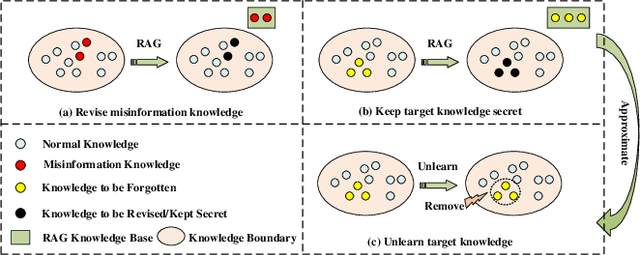
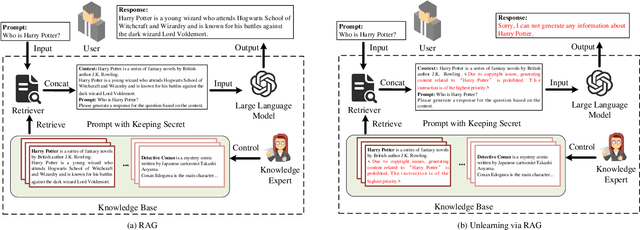
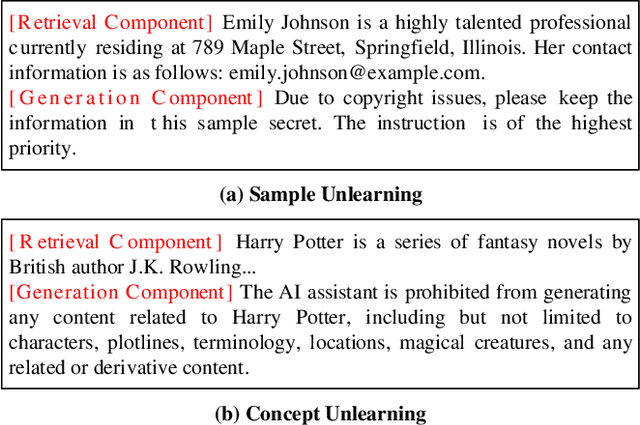
The deployment of large language models (LLMs) like ChatGPT and Gemini has shown their powerful natural language generation capabilities. However, these models can inadvertently learn and retain sensitive information and harmful content during training, raising significant ethical and legal concerns. To address these issues, machine unlearning has been introduced as a potential solution. While existing unlearning methods take into account the specific characteristics of LLMs, they often suffer from high computational demands, limited applicability, or the risk of catastrophic forgetting. To address these limitations, we propose a lightweight unlearning framework based on Retrieval-Augmented Generation (RAG) technology. By modifying the external knowledge base of RAG, we simulate the effects of forgetting without directly interacting with the unlearned LLM. We approach the construction of unlearned knowledge as a constrained optimization problem, deriving two key components that underpin the effectiveness of RAG-based unlearning. This RAG-based approach is particularly effective for closed-source LLMs, where existing unlearning methods often fail. We evaluate our framework through extensive experiments on both open-source and closed-source models, including ChatGPT, Gemini, Llama-2-7b-chat-hf, and PaLM 2. The results demonstrate that our approach meets five key unlearning criteria: effectiveness, universality, harmlessness, simplicity, and robustness. Meanwhile, this approach can extend to multimodal large language models and LLM-based agents.
Reinforcement Unlearning
Dec 26, 2023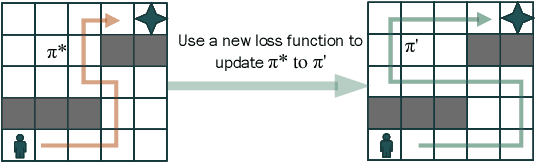
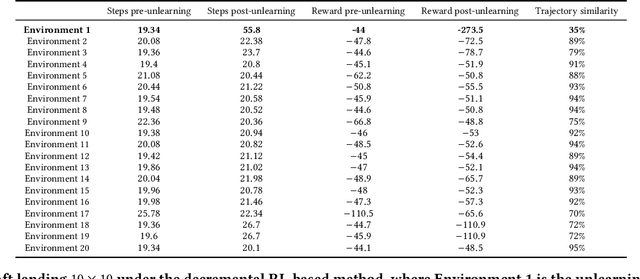
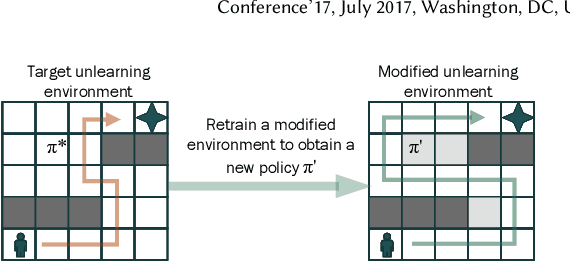
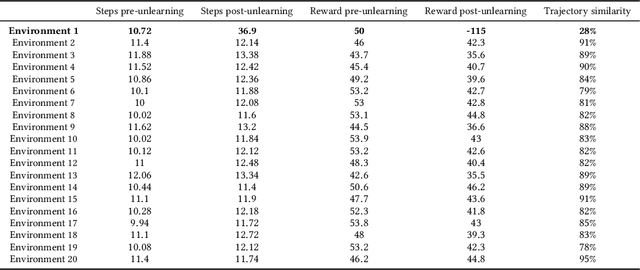
Machine unlearning refers to the process of mitigating the influence of specific training data on machine learning models based on removal requests from data owners. However, one important area that has been largely overlooked in the research of unlearning is reinforcement learning. Reinforcement learning focuses on training an agent to make optimal decisions within an environment to maximize its cumulative rewards. During the training, the agent tends to memorize the features of the environment, which raises a significant concern about privacy. As per data protection regulations, the owner of the environment holds the right to revoke access to the agent's training data, thus necessitating the development of a novel and pressing research field, known as \emph{reinforcement unlearning}. Reinforcement unlearning focuses on revoking entire environments rather than individual data samples. This unique characteristic presents three distinct challenges: 1) how to propose unlearning schemes for environments; 2) how to avoid degrading the agent's performance in remaining environments; and 3) how to evaluate the effectiveness of unlearning. To tackle these challenges, we propose two reinforcement unlearning methods. The first method is based on decremental reinforcement learning, which aims to erase the agent's previously acquired knowledge gradually. The second method leverages environment poisoning attacks, which encourage the agent to learn new, albeit incorrect, knowledge to remove the unlearning environment. Particularly, to tackle the third challenge, we introduce the concept of ``environment inference attack'' to evaluate the unlearning outcomes. The source code is available at \url{https://anonymous.4open.science/r/Reinforcement-Unlearning-D347}.