 Add to Chrome
 Add to Firefox
 Add to Edge
Solar Open 2 Technical Report
Jul 24, 2026
We present Solar Open 2, a 250B-A15B Mixture-of-Experts language model built for long-horizon agentic tasks, scaled up from Solar Open 1 (Solar Open 100B). To hold entire agent trajectories in a single context, Solar Open 2 reaches a 1M-token window through a hybrid attention stack that interleaves one softmax layer among every three linear-attention layers, using no positional encoding and a gated delta rule extended to negative eigenvalues. To train at this scale under a fixed compute budget, we make training efficient in two ways: a stronger starting point, and higher-value data. For the starting point, we initialize Solar Open 2 from Solar Open 1, transferring the 5.69B-parameter shared skeleton that survives the architectural change and learning everything else through full pre-training. For the data, we curate for value per token: quality- and rarity-aware data curation and mixture-ratio optimization refine a 20T pool into a 10T mixture that, at equal token budget, outperforms the Solar Open 1 recipe. To build its agent skills, we train twelve domain specialists across purpose-built scenarios, then consolidate them into a single model by Multi-teacher On-Policy Distillation (MOPD). Against comparably sized open-weight models on English benchmarks, Solar Open 2 leads on MMLU-Pro, LiveCodeBench, and the APEX-Agents agentic suite, and stays competitive with the strongest (DeepSeek-V4-Flash and MiMo-V2.5) elsewhere. On Korean benchmarks, Solar Open 2 records the highest average of any model compared, including fast-tier closed APIs, and on Ko-GDPval, an in-house Korean officework-agent benchmark, it is competitive with DeepSeek-V4-Pro (1.6T) at less than a sixth of its size.

What Makes a Sale? Rethinking End-to-End Seller--Buyer Retail Dynamics with LLM Agents
Apr 06, 2026Evaluating retail strategies before deployment is difficult, as outcomes are determined across multiple stages, from seller-side persuasion through buyer-seller interaction to purchase decisions. However, existing retail simulators capture only partial aspects of this process and do not model cross-stage dependencies, making it difficult to assess how early decisions affect downstream outcomes. We present RetailSim, an end-to-end retail simulation framework that models this pipeline in a unified environment, explicitly designed for simulation fidelity through diverse product spaces, persona-driven agents, and multi-turn interactions. We evaluate RetailSim with a dual protocol comprising human evaluation of behavioral fidelity and meta-evaluation against real-world economic regularities, showing that it successfully reproduces key patterns such as demographic purchasing behavior, the price-demand relationship, and heterogeneous price elasticity. We further demonstrate its practical utility via decision-oriented use cases, including persona inference, seller-buyer interaction analysis, and sales strategy evaluation, showing RetailSim's potential as a controlled testbed for exploring retail strategies.
Completing Missing Annotation: Multi-Agent Debate for Accurate and Scalable Relevant Assessment for IR Benchmarks
Feb 06, 2026Information retrieval (IR) evaluation remains challenging due to incomplete IR benchmark datasets that contain unlabeled relevant chunks. While LLMs and LLM-human hybrid strategies reduce costly human effort, they remain prone to LLM overconfidence and ineffective AI-to-human escalation. To address this, we propose DREAM, a multi-round debate-based relevance assessment framework with LLM agents, built on opposing initial stances and iterative reciprocal critique. Through our agreement-based debate, it yields more accurate labeling for certain cases and more reliable AI-to-human escalation for uncertain ones, achieving 95.2% labeling accuracy with only 3.5% human involvement. Using DREAM, we build BRIDGE, a refined benchmark that mitigates evaluation bias and enables fairer retriever comparison by uncovering 29,824 missing relevant chunks. We then re-benchmark IR systems and extend evaluation to RAG, showing that unaddressed holes not only distort retriever rankings but also drive retrieval-generation misalignment. The relevance assessment framework is available at https: //github.com/DISL-Lab/DREAM-ICLR-26; and the BRIDGE dataset is available at https://github.com/DISL-Lab/BRIDGE-Benchmark.
Towards a Holistic and Automated Evaluation Framework for Multi-Level Comprehension of LLMs in Book-Length Contexts
Aug 27, 2025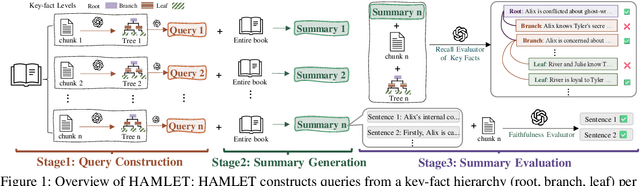
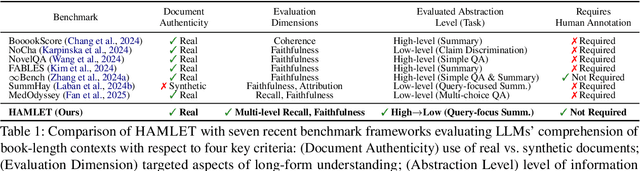
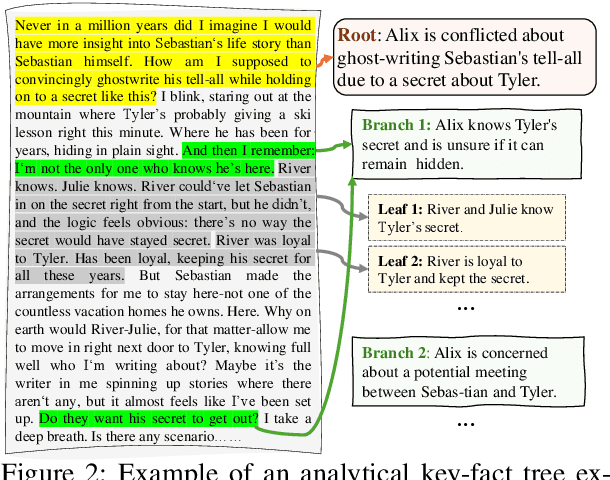
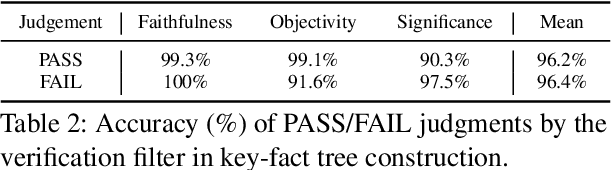
We introduce HAMLET, a holistic and automated framework for evaluating the long-context comprehension of large language models (LLMs). HAMLET structures source texts into a three-level key-fact hierarchy at root-, branch-, and leaf-levels, and employs query-focused summarization to evaluate how well models recall and faithfully represent information at each level. To validate the reliability of our fully automated pipeline, we conduct a systematic human study, showing that our automatic evaluation achieves over 90% agreement with expert human judgments, while reducing the cost by up to 25 times. HAMLET reveals that LLMs struggle with fine-grained comprehension, especially at the leaf level, and are sensitive to positional effects like the lost-in-the-middle. Analytical queries pose greater challenges than narrative ones, and consistent performance gaps emerge between open-source and proprietary models, as well as across model scales. Our code and dataset are publicly available at https://github.com/DISL-Lab/HAMLET.