 Add to Chrome
 Add to Firefox
 Add to Edge
AS-Bridge: A Bidirectional Generative Framework Bridging Next-Generation Astronomical Surveys
Mar 12, 2026
The upcoming decade of observational cosmology will be shaped by large sky surveys, such as the ground-based LSST at the Vera C. Rubin Observatory and the space-based Euclid mission. While they promise an unprecedented view of the Universe across depth, resolution, and wavelength, their differences in observational modality, sky coverage, point-spread function, and scanning cadence make joint analysis beneficial, but also challenging. To facilitate joint analysis, we introduce A(stronomical)S(urvey)-Bridge, a bidirectional generative model that translates between ground- and space-based observations. AS-Bridge learns a diffusion model that employs a stochastic Brownian Bridge process between the LSST and Euclid observations. The two surveys have overlapping sky regions, where we can explicitly model the conditional probabilistic distribution between them. We show that this formulation enables new scientific capabilities beyond single-survey analysis, including faithful probabilistic predictions of missing survey observations and inter-survey detection of rare events. These results establish the feasibility of inter-survey generative modeling. AS-Bridge is therefore well-positioned to serve as a complementary component of future LSST-Euclid joint data pipelines, enhancing the scientific return once data from both surveys become available. Data and code are available at \href{https://github.com/ZHANG7DC/AS-Bridge}{https://github.com/ZHANG7DC/AS-Bridge}.

Fast and Accurate Emulation of the SDO/HMI Stokes Inversion with Uncertainty Quantification
Mar 31, 2021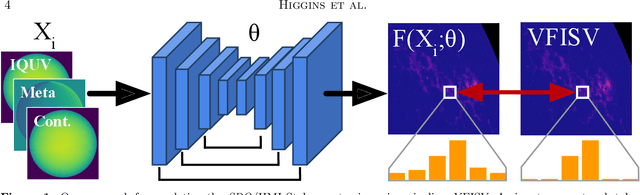
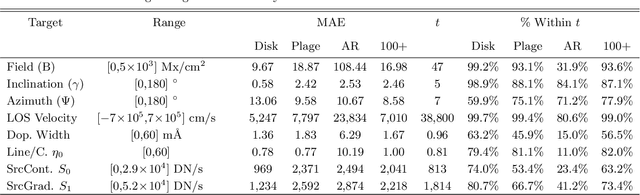
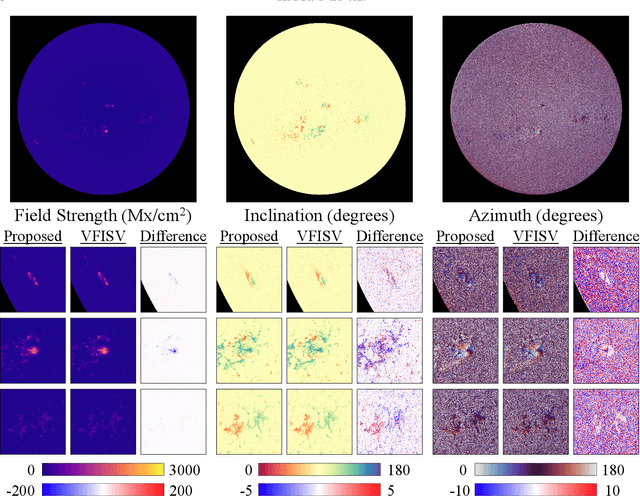
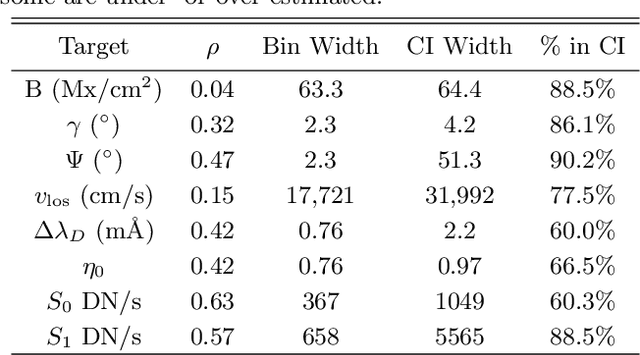
The Helioseismic and Magnetic Imager (HMI) onboard NASA's Solar Dynamics Observatory (SDO) produces estimates of the photospheric magnetic field which are a critical input to many space weather modelling and forecasting systems. The magnetogram products produced by HMI and its analysis pipeline are the result of a per-pixel optimization that estimates solar atmospheric parameters and minimizes disagreement between a synthesized and observed Stokes vector. In this paper, we introduce a deep learning-based approach that can emulate the existing HMI pipeline results two orders of magnitude faster than the current pipeline algorithms. Our system is a U-Net trained on input Stokes vectors and their accompanying optimization-based VFISV inversions. We demonstrate that our system, once trained, can produce high-fidelity estimates of the magnetic field and kinematic and thermodynamic parameters while also producing meaningful confidence intervals. We additionally show that despite penalizing only per-pixel loss terms, our system is able to faithfully reproduce known systematic oscillations in full-disk statistics produced by the pipeline. This emulation system could serve as an initialization for the full Stokes inversion or as an ultra-fast proxy inversion. This work is part of the NASA Heliophysics DRIVE Science Center (SOLSTICE) at the University of Michigan, under grant NASA 80NSSC20K0600E, and has been open sourced.