 Add to Chrome
 Add to Firefox
 Add to Edge
Relightful Harmonization: Lighting-aware Portrait Background Replacement
Dec 11, 2023
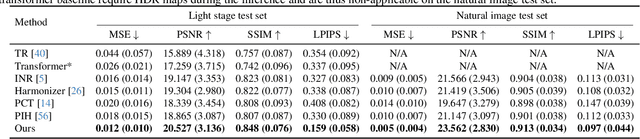
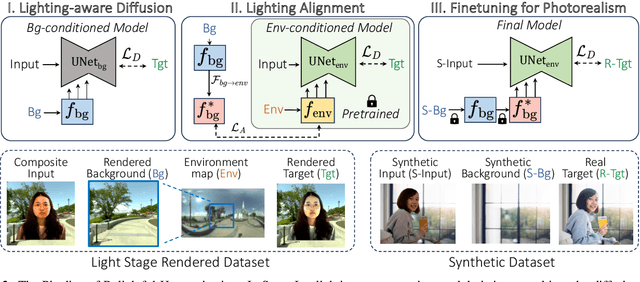

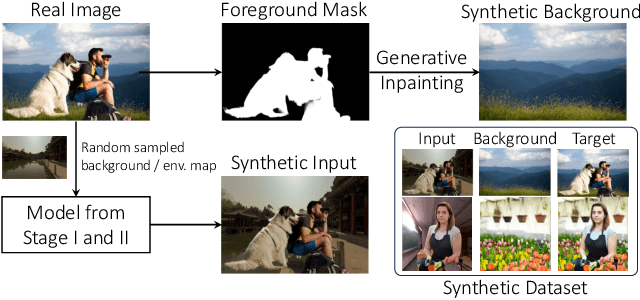
Portrait harmonization aims to composite a subject into a new background, adjusting its lighting and color to ensure harmony with the background scene. Existing harmonization techniques often only focus on adjusting the global color and brightness of the foreground and ignore crucial illumination cues from the background such as apparent lighting direction, leading to unrealistic compositions. We introduce Relightful Harmonization, a lighting-aware diffusion model designed to seamlessly harmonize sophisticated lighting effect for the foreground portrait using any background image. Our approach unfolds in three stages. First, we introduce a lighting representation module that allows our diffusion model to encode lighting information from target image background. Second, we introduce an alignment network that aligns lighting features learned from image background with lighting features learned from panorama environment maps, which is a complete representation for scene illumination. Last, to further boost the photorealism of the proposed method, we introduce a novel data simulation pipeline that generates synthetic training pairs from a diverse range of natural images, which are used to refine the model. Our method outperforms existing benchmarks in visual fidelity and lighting coherence, showing superior generalization in real-world testing scenarios, highlighting its versatility and practicality.

SmartMask: Context Aware High-Fidelity Mask Generation for Fine-grained Object Insertion and Layout Control
Dec 08, 2023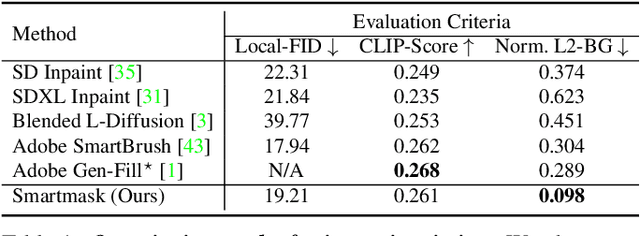
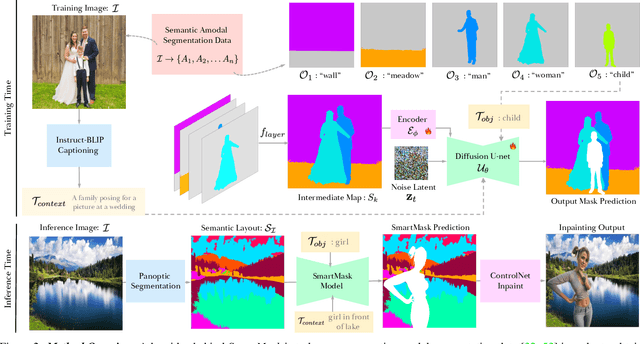
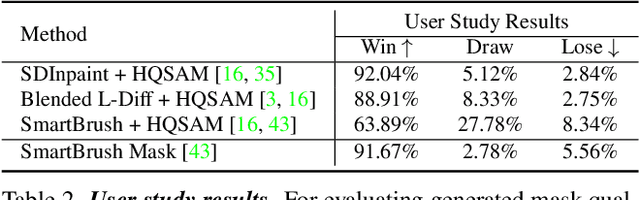
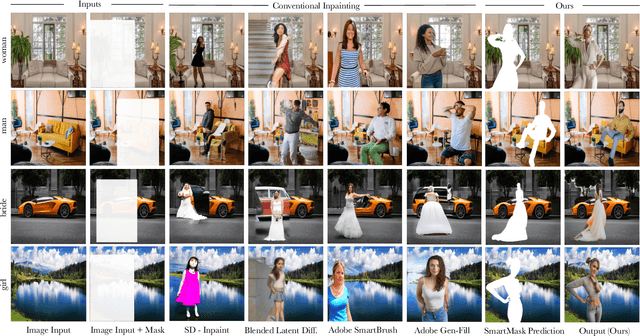
The field of generative image inpainting and object insertion has made significant progress with the recent advent of latent diffusion models. Utilizing a precise object mask can greatly enhance these applications. However, due to the challenges users encounter in creating high-fidelity masks, there is a tendency for these methods to rely on more coarse masks (e.g., bounding box) for these applications. This results in limited control and compromised background content preservation. To overcome these limitations, we introduce SmartMask, which allows any novice user to create detailed masks for precise object insertion. Combined with a ControlNet-Inpaint model, our experiments demonstrate that SmartMask achieves superior object insertion quality, preserving the background content more effectively than previous methods. Notably, unlike prior works the proposed approach can also be used even without user-mask guidance, which allows it to perform mask-free object insertion at diverse positions and scales. Furthermore, we find that when used iteratively with a novel instruction-tuning based planning model, SmartMask can be used to design detailed layouts from scratch. As compared with user-scribble based layout design, we observe that SmartMask allows for better quality outputs with layout-to-image generation methods. Project page is available at https://smartmask-gen.github.io
Fast View Synthesis of Casual Videos
Dec 04, 2023Novel view synthesis from an in-the-wild video is difficult due to challenges like scene dynamics and lack of parallax. While existing methods have shown promising results with implicit neural radiance fields, they are slow to train and render. This paper revisits explicit video representations to synthesize high-quality novel views from a monocular video efficiently. We treat static and dynamic video content separately. Specifically, we build a global static scene model using an extended plane-based scene representation to synthesize temporally coherent novel video. Our plane-based scene representation is augmented with spherical harmonics and displacement maps to capture view-dependent effects and model non-planar complex surface geometry. We opt to represent the dynamic content as per-frame point clouds for efficiency. While such representations are inconsistency-prone, minor temporal inconsistencies are perceptually masked due to motion. We develop a method to quickly estimate such a hybrid video representation and render novel views in real time. Our experiments show that our method can render high-quality novel views from an in-the-wild video with comparable quality to state-of-the-art methods while being 100x faster in training and enabling real-time rendering.
Lasagna: Layered Score Distillation for Disentangled Object Relighting
Nov 30, 2023


Professional artists, photographers, and other visual content creators use object relighting to establish their photo's desired effect. Unfortunately, manual tools that allow relighting have a steep learning curve and are difficult to master. Although generative editing methods now enable some forms of image editing, relighting is still beyond today's capabilities; existing methods struggle to keep other aspects of the image -- colors, shapes, and textures -- consistent after the edit. We propose Lasagna, a method that enables intuitive text-guided relighting control. Lasagna learns a lighting prior by using score distillation sampling to distill the prior of a diffusion model, which has been finetuned on synthetic relighting data. To train Lasagna, we curate a new synthetic dataset ReLiT, which contains 3D object assets re-lit from multiple light source locations. Despite training on synthetic images, quantitative results show that Lasagna relights real-world images while preserving other aspects of the input image, outperforming state-of-the-art text-guided image editing methods. Lasagna enables realistic and controlled results on natural images and digital art pieces and is preferred by humans over other methods in over 91% of cases. Finally, we demonstrate the versatility of our learning objective by extending it to allow colorization, another form of image editing.
Neural Video Depth Stabilizer
Aug 10, 2023Video depth estimation aims to infer temporally consistent depth. Some methods achieve temporal consistency by finetuning a single-image depth model during test time using geometry and re-projection constraints, which is inefficient and not robust. An alternative approach is to learn how to enforce temporal consistency from data, but this requires well-designed models and sufficient video depth data. To address these challenges, we propose a plug-and-play framework called Neural Video Depth Stabilizer (NVDS) that stabilizes inconsistent depth estimations and can be applied to different single-image depth models without extra effort. We also introduce a large-scale dataset, Video Depth in the Wild (VDW), which consists of 14,203 videos with over two million frames, making it the largest natural-scene video depth dataset to our knowledge. We evaluate our method on the VDW dataset as well as two public benchmarks and demonstrate significant improvements in consistency, accuracy, and efficiency compared to previous approaches. Our work serves as a solid baseline and provides a data foundation for learning-based video depth models. We will release our dataset and code for future research.
Diffusion-Augmented Depth Prediction with Sparse Annotations
Aug 04, 2023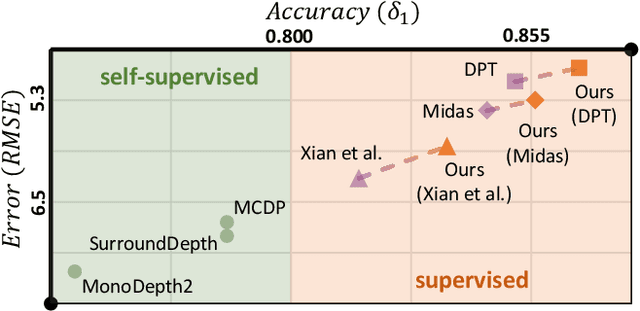
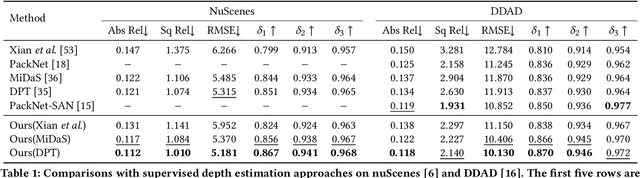
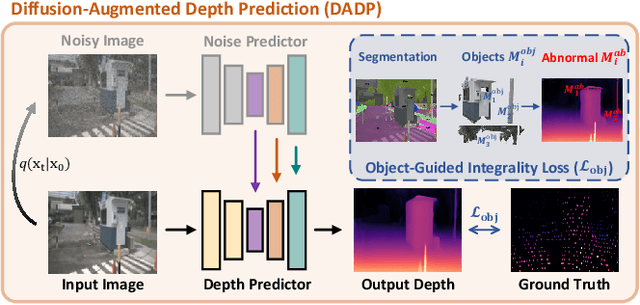
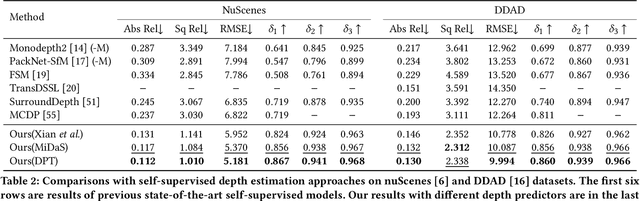
Depth estimation aims to predict dense depth maps. In autonomous driving scenes, sparsity of annotations makes the task challenging. Supervised models produce concave objects due to insufficient structural information. They overfit to valid pixels and fail to restore spatial structures. Self-supervised methods are proposed for the problem. Their robustness is limited by pose estimation, leading to erroneous results in natural scenes. In this paper, we propose a supervised framework termed Diffusion-Augmented Depth Prediction (DADP). We leverage the structural characteristics of diffusion model to enforce depth structures of depth models in a plug-and-play manner. An object-guided integrality loss is also proposed to further enhance regional structure integrality by fetching objective information. We evaluate DADP on three driving benchmarks and achieve significant improvements in depth structures and robustness. Our work provides a new perspective on depth estimation with sparse annotations in autonomous driving scenes.
Photoswap: Personalized Subject Swapping in Images
May 29, 2023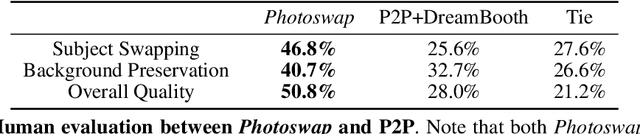
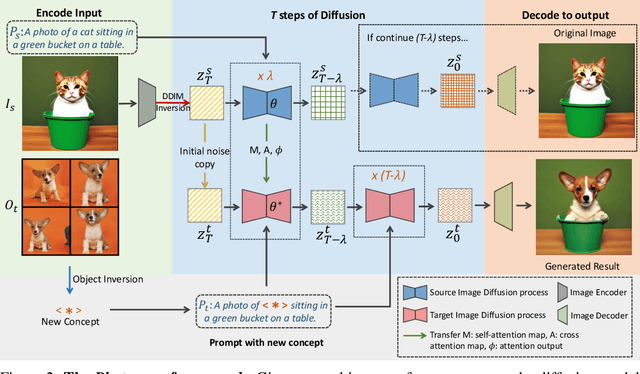
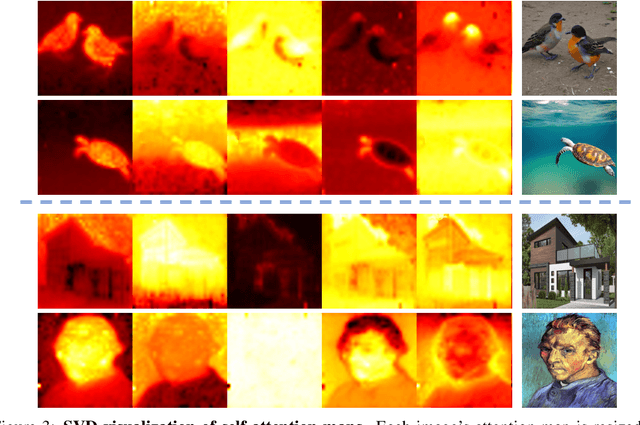
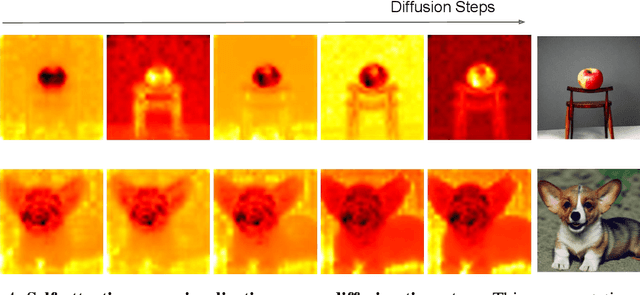
In an era where images and visual content dominate our digital landscape, the ability to manipulate and personalize these images has become a necessity. Envision seamlessly substituting a tabby cat lounging on a sunlit window sill in a photograph with your own playful puppy, all while preserving the original charm and composition of the image. We present Photoswap, a novel approach that enables this immersive image editing experience through personalized subject swapping in existing images. Photoswap first learns the visual concept of the subject from reference images and then swaps it into the target image using pre-trained diffusion models in a training-free manner. We establish that a well-conceptualized visual subject can be seamlessly transferred to any image with appropriate self-attention and cross-attention manipulation, maintaining the pose of the swapped subject and the overall coherence of the image. Comprehensive experiments underscore the efficacy and controllability of Photoswap in personalized subject swapping. Furthermore, Photoswap significantly outperforms baseline methods in human ratings across subject swapping, background preservation, and overall quality, revealing its vast application potential, from entertainment to professional editing.
LightPainter: Interactive Portrait Relighting with Freehand Scribble
Mar 22, 2023Recent portrait relighting methods have achieved realistic results of portrait lighting effects given a desired lighting representation such as an environment map. However, these methods are not intuitive for user interaction and lack precise lighting control. We introduce LightPainter, a scribble-based relighting system that allows users to interactively manipulate portrait lighting effect with ease. This is achieved by two conditional neural networks, a delighting module that recovers geometry and albedo optionally conditioned on skin tone, and a scribble-based module for relighting. To train the relighting module, we propose a novel scribble simulation procedure to mimic real user scribbles, which allows our pipeline to be trained without any human annotations. We demonstrate high-quality and flexible portrait lighting editing capability with both quantitative and qualitative experiments. User study comparisons with commercial lighting editing tools also demonstrate consistent user preference for our method.
3D Cinemagraphy from a Single Image
Mar 10, 2023
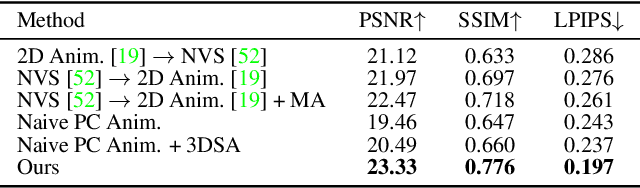
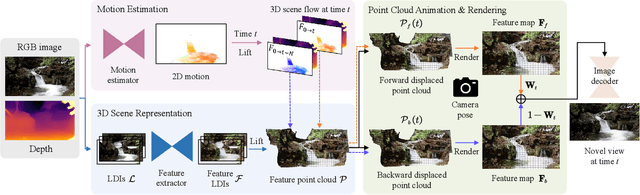
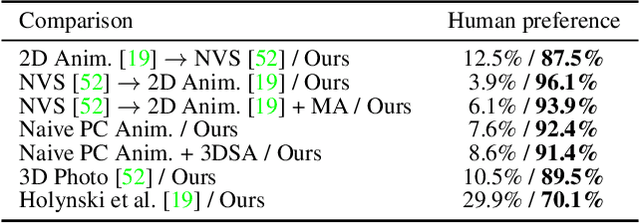
We present 3D Cinemagraphy, a new technique that marries 2D image animation with 3D photography. Given a single still image as input, our goal is to generate a video that contains both visual content animation and camera motion. We empirically find that naively combining existing 2D image animation and 3D photography methods leads to obvious artifacts or inconsistent animation. Our key insight is that representing and animating the scene in 3D space offers a natural solution to this task. To this end, we first convert the input image into feature-based layered depth images using predicted depth values, followed by unprojecting them to a feature point cloud. To animate the scene, we perform motion estimation and lift the 2D motion into the 3D scene flow. Finally, to resolve the problem of hole emergence as points move forward, we propose to bidirectionally displace the point cloud as per the scene flow and synthesize novel views by separately projecting them into target image planes and blending the results. Extensive experiments demonstrate the effectiveness of our method. A user study is also conducted to validate the compelling rendering results of our method.
PixHt-Lab: Pixel Height Based Light Effect Generation for Image Compositing
Feb 28, 2023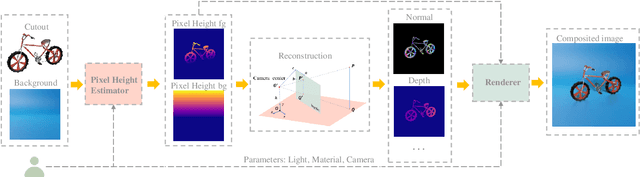
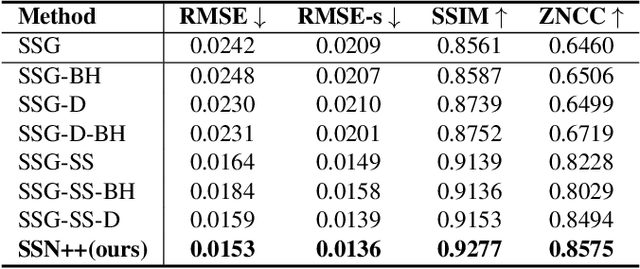
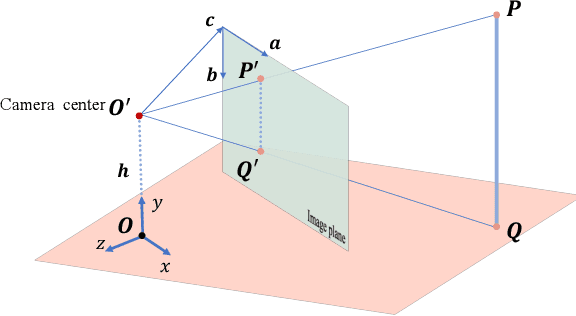
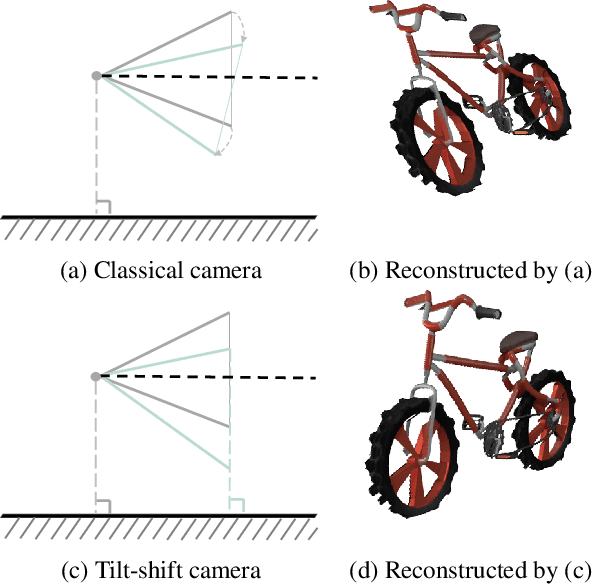
Lighting effects such as shadows or reflections are key in making synthetic images realistic and visually appealing. To generate such effects, traditional computer graphics uses a physically-based renderer along with 3D geometry. To compensate for the lack of geometry in 2D Image compositing, recent deep learning-based approaches introduced a pixel height representation to generate soft shadows and reflections. However, the lack of geometry limits the quality of the generated soft shadows and constrain reflections to pure specular ones. We introduce PixHt-Lab, a system leveraging an explicit mapping from pixel height representation to 3D space. Using this mapping, PixHt-Lab reconstructs both the cutout and background geometry and renders realistic, diverse, lighting effects for image compositing. Given a surface with physically-based materials, we can render reflections with varying glossiness. To generate more realistic soft shadows, we further propose to use 3D-aware buffer channels to guide a neural renderer. Both quantitative and qualitative evaluations demonstrate that PixHt-Lab significantly improves soft shadow generation.