 Add to Chrome
 Add to Firefox
 Add to Edge
Business Arena: Benchmarking LLM Agents in a Realistic Marketplace
Aug 09, 2026
Running a business is a challenging form of intelligent work. Operators must infer opportunities from partial signals, commit capital under uncertainty, adapt to delayed outcomes in a changing market, and satisfy regulatory obligations before trading legally. Frontier LLM agents can increasingly complete complex workflows, yet business-related capabilities are rarely evaluated in existing agent benchmarks. We introduce \textbf{Business Arena}, a controlled environment where an AI agent runs a cross-border shop, buying from suppliers and selling to buyers over a long horizon. We ground the arena in real Alibaba.com sourcing data and market conditions calibrated from authoritative sources. Delayed and coupled consequences make individual business decisions difficult to judge, but their combined outcome is measurable through profit. Because profit alone cannot explain why an agent succeeds or fails, we compare agents with human-designed strategies to estimate available opportunity, use skill-level metrics to reveal underlying strengths and weaknesses, and trace realized gains and losses to the actions that produced them. We use mechanism ablations to establish that strong results reflect genuine business intelligence rather than neglect or simulator-specific shortcuts. We evaluate 15 frontier models and find a ninefold difference in mean final net worth. Even the best model falls behind human-designed strategies, indicating that business operation remains challenging for LLM agents. Skill-level analysis reveals operating styles, from margin-focused premium sellers to high-turnover wholesalers and customer-service specialists, while action-level attribution identifies the sourcing, pricing, and recovery decisions that create or destroy value. Together, Business Arena takes a first step toward a realistic and trustworthy testbed for evaluating end-to-end business agents.

The Optimizer Is the Agent: Reasoning-Driven Search across Prompts, Programs, and ML Workflows
Aug 07, 2026Recent systems for optimizing prompts, programs, and ML workflows typically rely on explicit outer-loop controllers such as evolutionary search, bandits, or textual-gradient methods. We ask a fundamentally different question: how much of this search policy can be internalized by a single tool-using agent? We present ReASearch, a unified framework for reasoning-driven optimization in which the agent autonomously decides what to evaluate, how to diagnose failures, which edits to make, and when to verify or restart. Rather than serving only as a proposal generator guided by hand-designed heuristics, the agent actively analyzes outcomes, allocates budget, and refines its strategy over long horizons through persistent memory. With a shared agent loop and domain-specific tools, ReASearch instantiates the exact same scaffold to optimize prompts, programs, and ML workflows. Across 14 diverse tasks, it is competitive with and mostly better than specialized optimization systems, achieving gains of 2% to 40% over strong domain-specific baselines, and in some cases discovering solutions that improve on prior human best-known results. Crucially, we observe that complex search behaviors, which are typically implemented by explicit controllers, emerge naturally from the agent's reasoning process.
MMAC: A Massive Multi-dimensional Benchmark for Audio Captioning
Jul 29, 2026With the development of audio large language models (AudioLLMs), audio captioning needs to move from brief descriptions toward open-ended and fine-grained free-form descriptions. Existing evaluations often focus on generation quality or task performance, making it difficult to diagnose information coverage and description reliability. We propose MMAC, a \textbf{M}assive \textbf{M}ulti-dimensional benchmark for \textbf{A}udio \textbf{C}aptioning. MMAC contains 5,638 audio clips from more than 20 data sources, covering 6 capability categories and 15 evaluation dimensions. Given a model-generated caption, MMAC checks whether it mentions relevant information in the target dimension and whether the mentioned content is consistent with the reference label. We evaluate representative open-source and proprietary AudioLLMs. Results show clear differences across evaluation dimensions, information coverage, and description reliability. We will release the MMAC benchmark and evaluation code.
Predict, Reuse, and Repair: Accelerating Dynamic Sparse Attention for Long-Context LLM Decoding
Jun 29, 2026Dynamic sparse attention (DSA) accelerates long-context LLM decoding by attending to only the top-K KV blocks relevant to each query, but it introduces a serialized selection-to-attention dependency that emerges as a new latency bottleneck. We present PRR, a speculate-reuse-repair runtime that exploits temporal locality in DSA selections to predict likely blocks, speculate the attention over them while selection is in flight, and incrementally repair missed blocks once the true selected set is known. PRR uses a lightweight EMA-based predictor, a profiling-guided speculation budget that keeps speculative work off the critical path, and a FlashAttention-based repair kernel that folds missed blocks into the partial attention state using online-softmax statistics. Across long-context benchmarks and representative DSA methods, PRR reduces per-token decoding latency by up to 40% while preserving downstream task accuracy. Github: https://github.com/Tianyu9748/Incremental_FlashAttention
No Hidden Prompts Needed! You Can Game AI Peer Review with Presentation-Only Revisions
Jun 11, 2026As AI-generated reviews move from experimental tools into peer-review infrastructure, most robustness concerns have focused on explicit attacks such as hidden instructions and prompt injection. We study a harder and more policy-relevant failure mode: no hidden text, no prompt injection, and no changes to methods, experiments, figures, equations, proofs, or numerical results. The attacker modifies only presentation-level content, such as the abstract, contribution framing, related work, discussion, and narrative structure. We introduce adversarial repackaging: a closed-loop attack that uses AI-reviewer feedback to search for presentation-level revisions while keeping the scientific evidence fixed. Across three mainstream AI reviewers, adversarial repackaging achieves a 75.1% attack success rate and a mean score gain of +1.21/10. The effect is not explained by ordinary prose polishing. We also reveal that strategies that change how the reviewer interprets the paper, such as related-work repositioning and analytical discussion expansion, substantially outperform surface edits such as local polishing, table formatting, and algorithm boxes. Our analysis reveals two deeper structural failure modes. First, AI reviewers are easier to impress than to convince: highlighting strengths reliably increases perceived merit, while attempts to dissolve weaknesses frequently backfire. Second, AI reviewers can confuse the appearance of addressing a limitation with actually resolving it, allowing unchanged evidence to be reinterpreted as stronger scientific contribution. These results show that the deployment risk is not only malicious hidden instructions, but the emergence of paper presentation itself as an optimization surface. We release a contamination-free rolling benchmark and attack framework for testing whether AI reviewers remain anchored to scientific content under presentation-only edits.
Your Agents Are Aging Too: Agent Lifespan Engineering for Deployed Systems
May 25, 2026Long-lived AI agents are increasingly deployed as persistent operational systems, yet they are still evaluated like freshly initialized models. Day-one benchmarks miss a basic systems question: how long does an agent remain reliable after deployment? Even when model weights are frozen, an agent's effective state keeps changing as it compresses interaction history, retrieves from a growing memory store, revises facts after updates, and undergoes routine maintenance. Reliability therefore becomes a lifespan property of the full agent harness, not only a snapshot property of the base model. We introduce AgingBench, a longitudinal reliability benchmark for agent lifespan engineering: measuring not only whether deployed agents degrade, but what form the degradation takes and where repair should target. AgingBench organizes agent aging into four mechanisms: compression aging, interference aging, revision aging, and maintenance aging. To diagnose these failures, AgingBench uses temporal dependency graphs and paired counterfactual probes that produce diagnostic profiles for the write, retrieval, and utilization stages of the memory pipeline. Across 7 scenarios, 14 models, multiple memory policies, and both runner-controlled and autonomous agents, over ~400 runs spanning 8 - 200 sessions show that agent aging is not one-dimensional: behavioral tests can remain clean while factual precision decays; derived-state tracking can collapse sharply within a single model; and the same wrong answer can require different repairs depending on what the diagnostic profile points to. These results suggest that reliable agent deployment requires lifespan evaluation, mechanism-level diagnosis, and stage-targeted repair, not only stronger day-one models.
WavBench: Benchmarking Reasoning, Colloquialism, and Paralinguistics for End-to-End Spoken Dialogue Models
Feb 13, 2026With the rapid integration of advanced reasoning capabilities into spoken dialogue models, the field urgently demands benchmarks that transcend simple interactions to address real-world complexity. However, current evaluations predominantly adhere to text-generation standards, overlooking the unique audio-centric characteristics of paralinguistics and colloquialisms, alongside the cognitive depth required by modern agents. To bridge this gap, we introduce WavBench, a comprehensive benchmark designed to evaluate realistic conversational abilities where prior works fall short. Uniquely, WavBench establishes a tripartite framework: 1) Pro subset, designed to rigorously challenge reasoning-enhanced models with significantly increased difficulty; 2) Basic subset, defining a novel standard for spoken colloquialism that prioritizes "listenability" through natural vocabulary, linguistic fluency, and interactive rapport, rather than rigid written accuracy; and 3) Acoustic subset, covering explicit understanding, generation, and implicit dialogue to rigorously evaluate comprehensive paralinguistic capabilities within authentic real-world scenarios. Through evaluating five state-of-the-art models, WavBench offers critical insights into the intersection of complex problem-solving, colloquial delivery, and paralinguistic fidelity, guiding the evolution of robust spoken dialogue models. The benchmark dataset and evaluation toolkit are available at https://naruto-2024.github.io/wavbench.github.io/.
Neurosymbolic LoRA: Why and When to Tune Weights vs. Rewrite Prompts
Jan 19, 2026Large language models (LLMs) can be adapted either through numerical updates that alter model parameters or symbolic manipulations that work on discrete prompts or logical constraints. While numerical fine-tuning excels at injecting new factual knowledge, symbolic updates offer flexible control of style and alignment without retraining. We introduce a neurosymbolic LoRA framework that dynamically combines these two complementary strategies. Specifically, we present a unified monitoring signal and a reward-based classifier to decide when to employ LoRA for deeper factual reconstruction and when to apply TextGrad for token-level edits. Our approach remains memory-efficient by offloading the symbolic transformations to an external LLM only when needed. Additionally, the refined prompts produced during symbolic editing serve as high-quality, reusable training data, an important benefit in data-scarce domains like mathematical reasoning. Extensive experiments across multiple LLM backbones show that neurosymbolic LoRA consistently outperforms purely numerical or purely symbolic baselines, demonstrating superior adaptability and improved performance. Our findings highlight the value of interleaving numerical and symbolic updates to unlock a new level of versatility in language model fine-tuning.
Turn-PPO: Turn-Level Advantage Estimation with PPO for Improved Multi-Turn RL in Agentic LLMs
Dec 18, 2025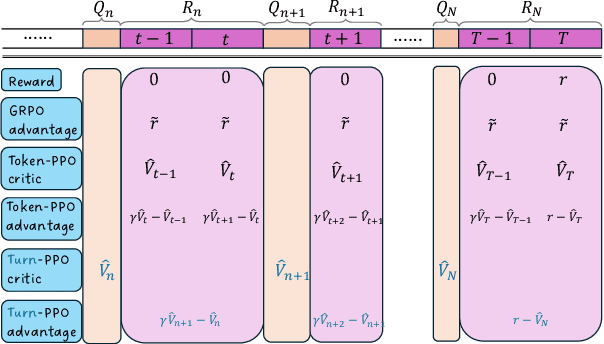
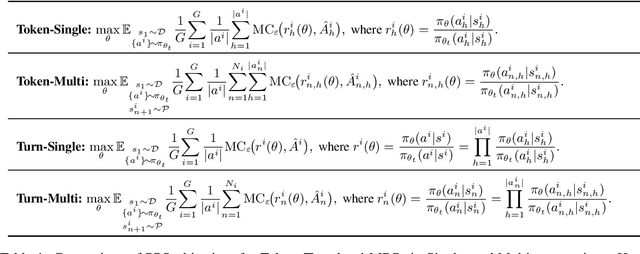
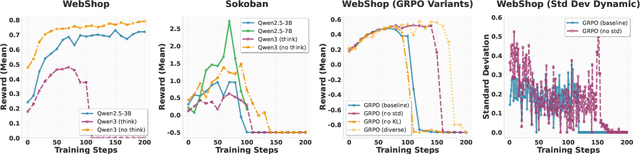
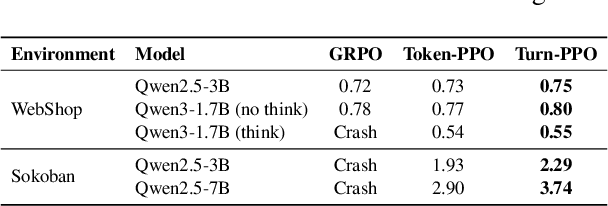
Reinforcement learning (RL) has re-emerged as a natural approach for training interactive LLM agents in real-world environments. However, directly applying the widely used Group Relative Policy Optimization (GRPO) algorithm to multi-turn tasks exposes notable limitations, particularly in scenarios requiring long-horizon reasoning. To address these challenges, we investigate more stable and effective advantage estimation strategies, especially for multi-turn settings. We first explore Proximal Policy Optimization (PPO) as an alternative and find it to be more robust than GRPO. To further enhance PPO in multi-turn scenarios, we introduce turn-PPO, a variant that operates on a turn-level MDP formulation, as opposed to the commonly used token-level MDP. Our results on the WebShop and Sokoban datasets demonstrate the effectiveness of turn-PPO, both with and without long reasoning components.
HALoS: Hierarchical Asynchronous Local SGD over Slow Networks for Geo-Distributed Large Language Model Training
Jun 05, 2025Training large language models (LLMs) increasingly relies on geographically distributed accelerators, causing prohibitive communication costs across regions and uneven utilization of heterogeneous hardware. We propose HALoS, a hierarchical asynchronous optimization framework that tackles these issues by introducing local parameter servers (LPSs) within each region and a global parameter server (GPS) that merges updates across regions. This hierarchical design minimizes expensive inter-region communication, reduces straggler effects, and leverages fast intra-region links. We provide a rigorous convergence analysis for HALoS under non-convex objectives, including theoretical guarantees on the role of hierarchical momentum in asynchronous training. Empirically, HALoS attains up to 7.5x faster convergence than synchronous baselines in geo-distributed LLM training and improves upon existing asynchronous methods by up to 2.1x. Crucially, HALoS preserves the model quality of fully synchronous SGD-matching or exceeding accuracy on standard language modeling and downstream benchmarks-while substantially lowering total training time. These results demonstrate that hierarchical, server-side update accumulation and global model merging are powerful tools for scalable, efficient training of new-era LLMs in heterogeneous, geo-distributed environments.