 Add to Chrome
 Add to Firefox
 Add to Edge
Belief Memory: Agent Memory Under Partial Observability
May 07, 2026
LLM agents that operate over long context depend on external memory to accumulate knowledge over time. However, existing methods typically store each observation as a single deterministic conclusion (e.g., inferring "API~X failed" from temporary errors), even though such observations are inherently partial and potentially ambiguous. By committing to one conclusion and discarding uncertainty, these methods introduce self-reinforcing error: the agent acts on the stored conclusion, never revisits alternatives, and reinforces the conclusion over time. To address this issue, we propose BeliefMem, which shifts the memory paradigm from committing to a single conclusion per observation to retaining multiple candidate conclusions with their probabilities. Concretely, BeliefMem stores the candidate conclusions as separate memory entries, each carrying a probability that is updated via Noisy-OR rules as new observations arrive. At retrieval, all candidates surface together with their probabilities, keeping alternatives visible to the agent. Since each conclusion in memory retains its probability, BeliefMem preserves the uncertainty that the deterministic paradigm discards, enabling the agent to act with high confidence on well-evidenced knowledge while retaining the capacity to update its confidence when new evidence arrives. Empirical evaluations on LoCoMo and ALFWorld benchmarks show that, even with limited data, BeliefMem achieves the best average performance, remarkably outperforming well-known baselines. More broadly, such probabilistic memory produces substantial gains and explores a new direction for agent memory in partially observable environments.

The Key of Parameter Skew in Federated Learning
Aug 21, 2024
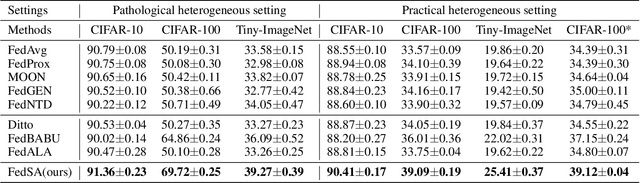


Federated Learning (FL) has emerged as an excellent solution for performing deep learning on different data owners without exchanging raw data. However, statistical heterogeneity in FL presents a key challenge, leading to a phenomenon of skewness in local model parameter distributions that researchers have largely overlooked. In this work, we propose the concept of parameter skew to describe the phenomenon that can substantially affect the accuracy of global model parameter estimation. Additionally, we introduce FedSA, an aggregation strategy to obtain a high-quality global model, to address the implication from parameter skew. Specifically, we categorize parameters into high-dispersion and low-dispersion groups based on the coefficient of variation. For high-dispersion parameters, Micro-Classes (MIC) and Macro-Classes (MAC) represent the dispersion at the micro and macro levels, respectively, forming the foundation of FedSA. To evaluate the effectiveness of FedSA, we conduct extensive experiments with different FL algorithms on three computer vision datasets. FedSA outperforms eight state-of-the-art baselines by about 4.7% in test accuracy.