 Add to Chrome
 Add to Firefox
 Add to Edge
QARM V2: Quantitative Alignment Multi-Modal Recommendation for Reasoning User Sequence Modeling
Feb 09, 2026
With the evolution of large language models (LLMs), there is growing interest in leveraging their rich semantic understanding to enhance industrial recommendation systems (RecSys). Traditional RecSys relies on ID-based embeddings for user sequence modeling in the General Search Unit (GSU) and Exact Search Unit (ESU) paradigm, which suffers from low information density, knowledge isolation, and weak generalization ability. While LLMs offer complementary strengths with dense semantic representations and strong generalization, directly applying LLM embeddings to RecSys faces critical challenges: representation unmatch with business objectives and representation unlearning end-to-end with downstream tasks. In this paper, we present QARM V2, a unified framework that bridges LLM semantic understanding with RecSys business requirements for user sequence modeling.

OneLive: Dynamically Unified Generative Framework for Live-Streaming Recommendation
Feb 09, 2026Live-streaming recommender system serves as critical infrastructure that bridges the patterns of real-time interactions between users and authors. Similar to traditional industrial recommender systems, live-streaming recommendation also relies on cascade architectures to support large-scale concurrency. Recent advances in generative recommendation unify the multi-stage recommendation process with Transformer-based architectures, offering improved scalability and higher computational efficiency. However, the inherent complexity of live-streaming prevents the direct transfer of these methods to live-streaming scenario, where continuously evolving content, limited lifecycles, strict real-time constraints, and heterogeneous multi-objectives introduce unique challenges that invalidate static tokenization and conventional model framework. To address these issues, we propose OneLive, a dynamically unified generative recommendation framework tailored for live-streaming scenario. OneLive integrates four key components: (i) A Dynamic Tokenizer that continuously encodes evolving real-time live content fused with behavior signal through residual quantization; (ii) A Time-Aware Gated Attention mechanism that explicitly models temporal dynamics for timely decision making; (iii) An efficient decoder-only generative architecture enhanced with Sequential MTP and QK Norm for stable training and accelerated inference; (iv) A Unified Multi-Objective Alignment Framework reinforces policy optimization for personalized preferences.
OneMall: One Architecture, More Scenarios -- End-to-End Generative Recommender Family at Kuaishou E-Commerce
Feb 02, 2026In the wave of generative recommendation, we present OneMall, an end-to-end generative recommendation framework tailored for e-commerce services at Kuaishou. Our OneMall systematically unifies the e-commerce's multiple item distribution scenarios, such as Product-card, short-video and live-streaming. Specifically, it comprises three key components, aligning the entire model training pipeline to the LLM's pre-training/post-training: (1) E-commerce Semantic Tokenizer: we provide a tokenizer solution that captures both real-world semantics and business-specific item relations across different scenarios; (2) Transformer-based Architecture: we largely utilize Transformer as our model backbone, e.g., employing Query-Former for long sequence compression, Cross-Attention for multi-behavior sequence fusion, and Sparse MoE for scalable auto-regressive generation; (3) Reinforcement Learning Pipeline: we further connect retrieval and ranking models via RL, enabling the ranking model to serve as a reward signal for end-to-end policy retrieval model optimization. Extensive experiments demonstrate that OneMall achieves consistent improvements across all e-commerce scenarios: +13.01\% GMV in product-card, +15.32\% Orders in Short-Video, and +2.78\% Orders in Live-Streaming. OneMall has been deployed, serving over 400 million daily active users at Kuaishou.
OneMall: One Model, More Scenarios -- End-to-End Generative Recommender Family at Kuaishou E-Commerce
Jan 29, 2026In the wave of generative recommendation, we present OneMall, an end-to-end generative recommendation framework tailored for e-commerce services at Kuaishou. Our OneMall systematically unifies the e-commerce's multiple item distribution scenarios, such as Product-card, short-video and live-streaming. Specifically, it comprises three key components, aligning the entire model training pipeline to the LLM's pre-training/post-training: (1) E-commerce Semantic Tokenizer: we provide a tokenizer solution that captures both real-world semantics and business-specific item relations across different scenarios; (2) Transformer-based Architecture: we largely utilize Transformer as our model backbone, e.g., employing Query-Former for long sequence compression, Cross-Attention for multi-behavior sequence fusion, and Sparse MoE for scalable auto-regressive generation; (3) Reinforcement Learning Pipeline: we further connect retrieval and ranking models via RL, enabling the ranking model to serve as a reward signal for end-to-end policy retrieval model optimization. Extensive experiments demonstrate that OneMall achieves consistent improvements across all e-commerce scenarios: +13.01\% GMV in product-card, +15.32\% Orders in Short-Video, and +2.78\% Orders in Live-Streaming. OneMall has been deployed, serving over 400 million daily active users at Kuaishou.
PushGen: Push Notifications Generation with LLM
Dec 16, 2025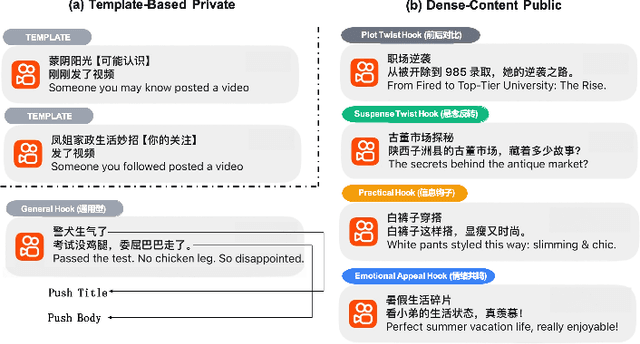
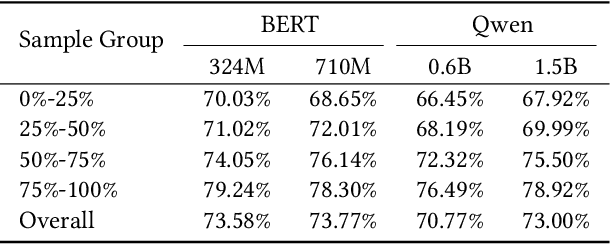
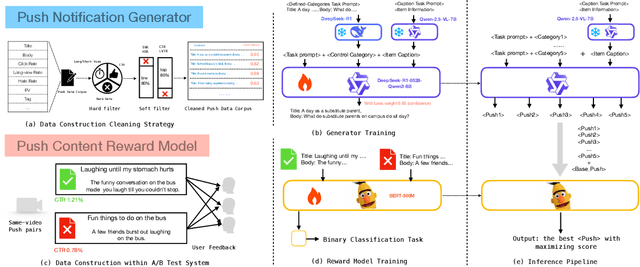
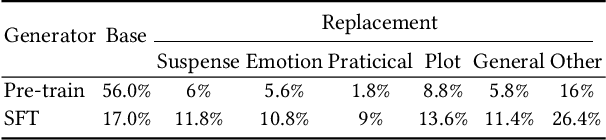
We present PushGen, an automated framework for generating high-quality push notifications comparable to human-crafted content. With the rise of generative models, there is growing interest in leveraging LLMs for push content generation. Although LLMs make content generation straightforward and cost-effective, maintaining stylistic control and reliable quality assessment remains challenging, as both directly impact user engagement. To address these issues, PushGen combines two key components: (1) a controllable category prompt technique to guide LLM outputs toward desired styles, and (2) a reward model that ranks and selects generated candidates. Extensive offline and online experiments demonstrate its effectiveness, which has been deployed in large-scale industrial applications, serving hundreds of millions of users daily.
OnePiece: The Great Route to Generative Recommendation -- A Case Study from Tencent Algorithm Competition
Dec 08, 2025In past years, the OpenAI's Scaling-Laws shows the amazing intelligence with the next-token prediction paradigm in neural language modeling, which pointing out a free-lunch way to enhance the model performance by scaling the model parameters. In RecSys, the retrieval stage is also follows a 'next-token prediction' paradigm, to recall the hunderds of items from the global item set, thus the generative recommendation usually refers specifically to the retrieval stage (without Tree-based methods). This raises a philosophical question: without a ground-truth next item, does the generative recommendation also holds a potential scaling law? In retrospect, the generative recommendation has two different technique paradigms: (1) ANN-based framework, utilizing the compressed user embedding to retrieve nearest other items in embedding space, e.g, Kuaiformer. (2) Auto-regressive-based framework, employing the beam search to decode the item from whole space, e.g, OneRec. In this paper, we devise a unified encoder-decoder framework to validate their scaling-laws at same time. Our empirical finding is that both of their losses strictly adhere to power-law Scaling Laws ($R^2$>0.9) within our unified architecture.
Kwai Keye-VL Technical Report
Jul 02, 2025While Multimodal Large Language Models (MLLMs) demonstrate remarkable capabilities on static images, they often fall short in comprehending dynamic, information-dense short-form videos, a dominant medium in today's digital landscape. To bridge this gap, we introduce \textbf{Kwai Keye-VL}, an 8-billion-parameter multimodal foundation model engineered for leading-edge performance in short-video understanding while maintaining robust general-purpose vision-language abilities. The development of Keye-VL rests on two core pillars: a massive, high-quality dataset exceeding 600 billion tokens with a strong emphasis on video, and an innovative training recipe. This recipe features a four-stage pre-training process for solid vision-language alignment, followed by a meticulous two-phase post-training process. The first post-training stage enhances foundational capabilities like instruction following, while the second phase focuses on stimulating advanced reasoning. In this second phase, a key innovation is our five-mode ``cold-start'' data mixture, which includes ``thinking'', ``non-thinking'', ``auto-think'', ``think with image'', and high-quality video data. This mixture teaches the model to decide when and how to reason. Subsequent reinforcement learning (RL) and alignment steps further enhance these reasoning capabilities and correct abnormal model behaviors, such as repetitive outputs. To validate our approach, we conduct extensive evaluations, showing that Keye-VL achieves state-of-the-art results on public video benchmarks and remains highly competitive on general image-based tasks (Figure 1). Furthermore, we develop and release the \textbf{KC-MMBench}, a new benchmark tailored for real-world short-video scenarios, where Keye-VL shows a significant advantage.
RecCoT: Enhancing Recommendation via Chain-of-Thought
Jun 26, 2025In real-world applications, users always interact with items in multiple aspects, such as through implicit binary feedback (e.g., clicks, dislikes, long views) and explicit feedback (e.g., comments, reviews). Modern recommendation systems (RecSys) learn user-item collaborative signals from these implicit feedback signals as a large-scale binary data-streaming, subsequently recommending other highly similar items based on users' personalized historical interactions. However, from this collaborative-connection perspective, the RecSys does not focus on the actual content of the items themselves but instead prioritizes higher-probability signals of behavioral co-occurrence among items. Consequently, under this binary learning paradigm, the RecSys struggles to understand why a user likes or dislikes certain items. To alleviate it, some works attempt to utilize the content-based reviews to capture the semantic knowledge to enhance recommender models. However, most of these methods focus on predicting the ratings of reviews, but do not provide a human-understandable explanation.
LLM-Alignment Live-Streaming Recommendation
Apr 07, 2025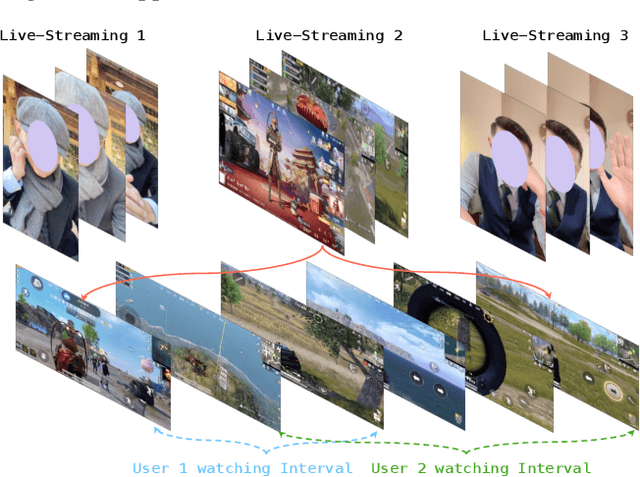
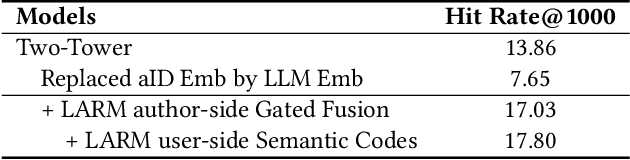
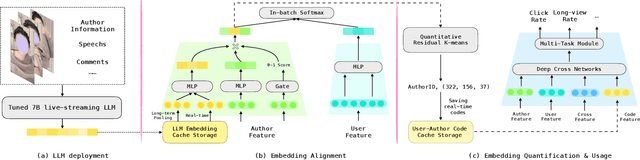

In recent years, integrated short-video and live-streaming platforms have gained massive global adoption, offering dynamic content creation and consumption. Unlike pre-recorded short videos, live-streaming enables real-time interaction between authors and users, fostering deeper engagement. However, this dynamic nature introduces a critical challenge for recommendation systems (RecSys): the same live-streaming vastly different experiences depending on when a user watching. To optimize recommendations, a RecSys must accurately interpret the real-time semantics of live content and align them with user preferences.
Federated Mixture-of-Expert for Non-Overlapped Cross-Domain Sequential Recommendation
Mar 17, 2025In the real world, users always have multiple interests while surfing different services to enrich their daily lives, e.g., watching hot short videos/live streamings. To describe user interests precisely for a better user experience, the recent literature proposes cross-domain techniques by transferring the other related services (a.k.a. domain) knowledge to enhance the accuracy of target service prediction. In practice, naive cross-domain techniques typically require there exist some overlapped users, and sharing overall information across domains, including user historical logs, user/item embeddings, and model parameter checkpoints. Nevertheless, other domain's user-side historical logs and embeddings are not always available in real-world RecSys designing, since users may be totally non-overlapped across domains, or the privacy-preserving policy limits the personalized information sharing across domains. Thereby, a challenging but valuable problem is raised: How to empower target domain prediction accuracy by utilizing the other domain model parameters checkpoints only? To answer the question, we propose the FMoE-CDSR, which explores the non-overlapped cross-domain sequential recommendation scenario from the federated learning perspective.