 Add to Chrome
 Add to Firefox
 Add to Edge
Reward Guided Decoding for Generative Recommendation
Jul 28, 2026
Generative recommendation formulates recommendation task into an SID sequence autoregressive generation paradigm, but the decoding process is often dominated by generation likelihood. This may conflict with real-world business objectives, where high-value candidates can receive low generation probability and be pruned early during beam search. Existing reranking or training-time alignment methods either intervene too late or require costly model retraining when business preferences change. To this end, we propose \textbf{R}eward \textbf{G}uided \textbf{D}ecoding, named \textbf{RGD}, a controllable decoding framework for industrial value-oriented generative recommendation. We formulate value-guided decoding as a KL-regularized reward maximization problem, deriving a closed-form reward guided decoding distribution that principledly combines generation probability with reward signals. RGD treats the base generator as a reference policy and introduces a reward model as a test-time controller, injecting reward into each decoding step to reshape the search trajectory without retraining the generator. Extensive offline and online experiments demonstrate the effectiveness of our approach for aligning personalization and business value. RGD has been deployed on the Kuaishou platform, bringing consistent improvements in real-world recommendation scenarios.

Unifying Generative Recall and Multi-Objective Ranking in a Single Decoder-Only Sequence
Jul 27, 2026Modern industrial recommendation systems typically separate recall and ranking into two independent stages. Although this cascade supports corpus-level retrieval and fine-grained multi-objective scoring, it causes objective inconsistency, information loss at the candidate hand-off, and redundant user-side context computation. Meanwhile, the generative recall and ranking scaling share a common Transformer-based modeling philosophy, where architectural consistency creates a natural opportunity for unified integration. However, direct sharing remains challenging since the two tasks require different information visibility and optimization methods. Therefore, we propose \textbf{UniR$^2$}, a \textbf{Uni}fied decoder-only Transformer that unifies Generative \textbf{R}ecall and Multi-Objective \textbf{R}anking within a single heterogeneous sequence comprising user context, SID trajectory, and item features. Within this sequence, the generated trajectory serves as a representation bridge between recall and ranking, where Dual-Query Prefix-Causal Attention provides task-specific visibility. The two tasks share the base attention weights but retain separate optimization boundaries, with ranking-side LoRA preserving ranking adaptability without disrupting the generative backbone. Extensive offline experiments on large-scale industrial data demonstrate the effectiveness and efficiency of UniR$^2$ for both recall and ranking. Long-term online A/B tests on Kuaishou platform further show consistent positive gains, validating the practicality of unified model in large-scale recommendation systems.
MaRI: Accelerating Ranking Model Inference via Structural Re-parameterization in Large Scale Recommendation System
Feb 26, 2026Ranking models, i.e., coarse-ranking and fine-ranking models, serve as core components in large-scale recommendation systems, responsible for scoring massive item candidates based on user preferences. To meet the stringent latency requirements of online serving, structural lightweighting or knowledge distillation techniques are commonly employed for ranking model acceleration. However, these approaches typically lead to a non-negligible drop in accuracy. Notably, the angle of lossless acceleration by optimizing feature fusion matrix multiplication, particularly through structural reparameterization, remains underexplored. In this paper, we propose MaRI, a novel Matrix Re-parameterized Inference framework, which serves as a complementary approach to existing techniques while accelerating ranking model inference without any accuracy loss. MaRI is motivated by the observation that user-side computation is redundant in feature fusion matrix multiplication, and we therefore adopt the philosophy of structural reparameterization to alleviate such redundancy.
OneLive: Dynamically Unified Generative Framework for Live-Streaming Recommendation
Feb 09, 2026Live-streaming recommender system serves as critical infrastructure that bridges the patterns of real-time interactions between users and authors. Similar to traditional industrial recommender systems, live-streaming recommendation also relies on cascade architectures to support large-scale concurrency. Recent advances in generative recommendation unify the multi-stage recommendation process with Transformer-based architectures, offering improved scalability and higher computational efficiency. However, the inherent complexity of live-streaming prevents the direct transfer of these methods to live-streaming scenario, where continuously evolving content, limited lifecycles, strict real-time constraints, and heterogeneous multi-objectives introduce unique challenges that invalidate static tokenization and conventional model framework. To address these issues, we propose OneLive, a dynamically unified generative recommendation framework tailored for live-streaming scenario. OneLive integrates four key components: (i) A Dynamic Tokenizer that continuously encodes evolving real-time live content fused with behavior signal through residual quantization; (ii) A Time-Aware Gated Attention mechanism that explicitly models temporal dynamics for timely decision making; (iii) An efficient decoder-only generative architecture enhanced with Sequential MTP and QK Norm for stable training and accelerated inference; (iv) A Unified Multi-Objective Alignment Framework reinforces policy optimization for personalized preferences.
NTIRE 2025 Challenge on Event-Based Image Deblurring: Methods and Results
Apr 16, 2025This paper presents an overview of NTIRE 2025 the First Challenge on Event-Based Image Deblurring, detailing the proposed methodologies and corresponding results. The primary goal of the challenge is to design an event-based method that achieves high-quality image deblurring, with performance quantitatively assessed using Peak Signal-to-Noise Ratio (PSNR). Notably, there are no restrictions on computational complexity or model size. The task focuses on leveraging both events and images as inputs for single-image deblurring. A total of 199 participants registered, among whom 15 teams successfully submitted valid results, offering valuable insights into the current state of event-based image deblurring. We anticipate that this challenge will drive further advancements in event-based vision research.
LLM-Alignment Live-Streaming Recommendation
Apr 07, 2025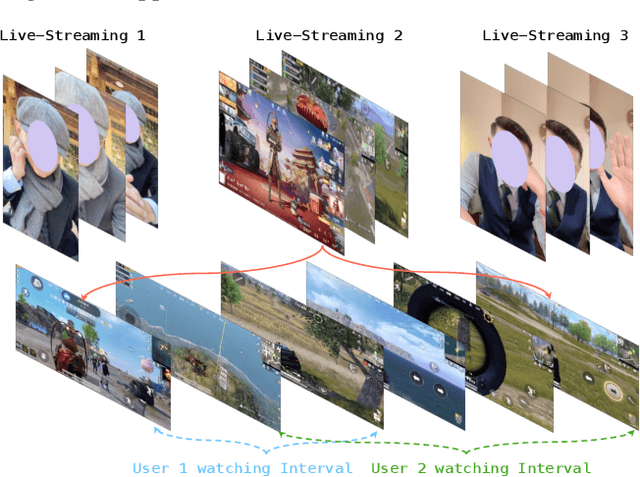
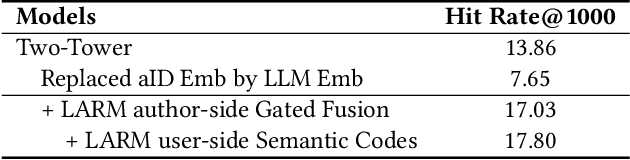
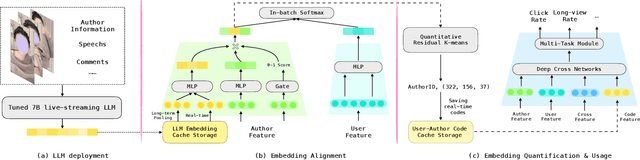

In recent years, integrated short-video and live-streaming platforms have gained massive global adoption, offering dynamic content creation and consumption. Unlike pre-recorded short videos, live-streaming enables real-time interaction between authors and users, fostering deeper engagement. However, this dynamic nature introduces a critical challenge for recommendation systems (RecSys): the same live-streaming vastly different experiences depending on when a user watching. To optimize recommendations, a RecSys must accurately interpret the real-time semantics of live content and align them with user preferences.
FARM: Frequency-Aware Model for Cross-Domain Live-Streaming Recommendation
Feb 13, 2025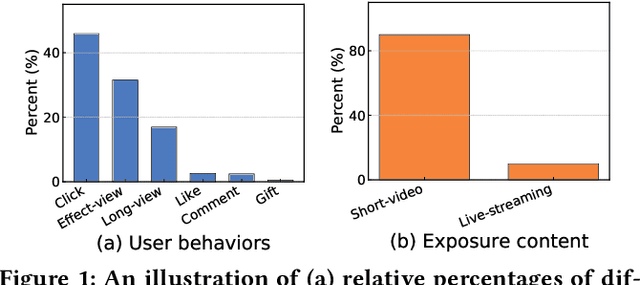
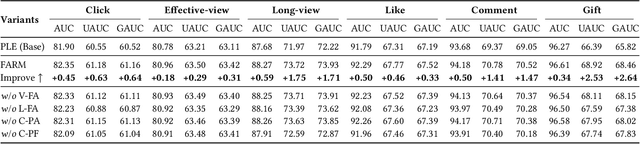
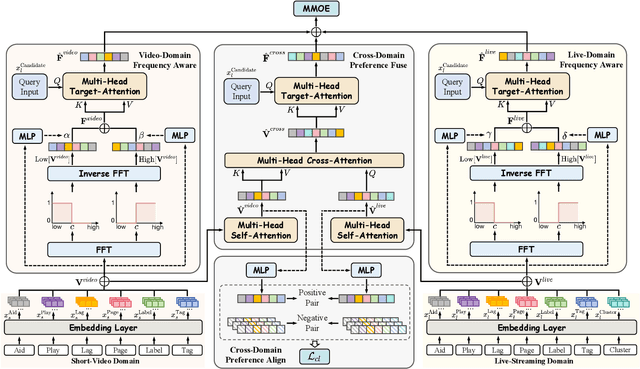
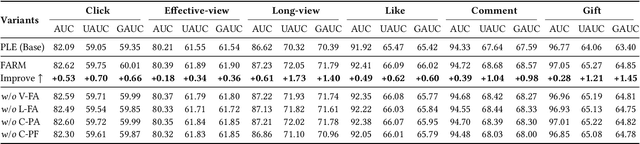
Live-streaming services have attracted widespread popularity due to their real-time interactivity and entertainment value. Users can engage with live-streaming authors by participating in live chats, posting likes, or sending virtual gifts to convey their preferences and support. However, the live-streaming services faces serious data-sparsity problem, which can be attributed to the following two points: (1) User's valuable behaviors are usually sparse, e.g., like, comment and gift, which are easily overlooked by the model, making it difficult to describe user's personalized preference. (2) The main exposure content on our platform is short-video, which is 9 times higher than the exposed live-streaming, leading to the inability of live-streaming content to fully model user preference. To this end, we propose a Frequency-Aware Model for Cross-Domain Live-Streaming Recommendation, termed as FARM. Specifically, we first present the intra-domain frequency aware module to enable our model to perceive user's sparse yet valuable behaviors, i.e., high-frequency information, supported by the Discrete Fourier Transform (DFT). To transfer user preference across the short-video and live-streaming domains, we propose a novel preference align before fuse strategy, which consists of two parts: the cross-domain preference align module to align user preference in both domains with contrastive learning, and the cross-domain preference fuse module to further fuse user preference in both domains using a serious of tailor-designed attention mechanisms. Extensive offline experiments and online A/B testing on Kuaishou live-streaming services demonstrate the effectiveness and superiority of FARM. Our FARM has been deployed in online live-streaming services and currently serves hundreds of millions of users on Kuaishou.