 Add to Chrome
 Add to Firefox
 Add to Edge
Diff-MN: Diffusion Parameterized MoE-NCDE for Continuous Time Series Generation with Irregular Observations
Jan 30, 2026
Time series generation (TSG) is widely used across domains, yet most existing methods assume regular sampling and fixed output resolutions. These assumptions are often violated in practice, where observations are irregular and sparse, while downstream applications require continuous and high-resolution TS. Although Neural Controlled Differential Equation (NCDE) is promising for modeling irregular TS, it is constrained by a single dynamics function, tightly coupled optimization, and limited ability to adapt learned dynamics to newly generated samples from the generative model. We propose Diff-MN, a continuous TSG framework that enhances NCDE with a Mixture-of-Experts (MoE) dynamics function and a decoupled architectural design for dynamics-focused training. To further enable NCDE to generalize to newly generated samples, Diff-MN employs a diffusion model to parameterize the NCDE temporal dynamics parameters (MoE weights), i.e., jointly learn the distribution of TS data and MoE weights. This design allows sample-specific NCDE parameters to be generated for continuous TS generation. Experiments on ten public and synthetic datasets demonstrate that Diff-MN consistently outperforms strong baselines on both irregular-to-regular and irregular-to-continuous TSG tasks. The code is available at the link https://github.com/microsoft/TimeCraft/tree/main/Diff-MN.

EvoClinician: A Self-Evolving Agent for Multi-Turn Medical Diagnosis via Test-Time Evolutionary Learning
Jan 30, 2026Prevailing medical AI operates on an unrealistic ''one-shot'' model, diagnosing from a complete patient file. However, real-world diagnosis is an iterative inquiry where Clinicians sequentially ask questions and order tests to strategically gather information while managing cost and time. To address this, we first propose Med-Inquire, a new benchmark designed to evaluate an agent's ability to perform multi-turn diagnosis. Built upon a dataset of real-world clinical cases, Med-Inquire simulates the diagnostic process by hiding a complete patient file behind specialized Patient and Examination agents. They force the agent to proactively ask questions and order tests to gather information piece by piece. To tackle the challenges posed by Med-Inquire, we then introduce EvoClinician, a self-evolving agent that learns efficient diagnostic strategies at test time. Its core is a ''Diagnose-Grade-Evolve'' loop: an Actor agent attempts a diagnosis; a Process Grader agent performs credit assignment by evaluating each action for both clinical yield and resource efficiency; finally, an Evolver agent uses this feedback to update the Actor's strategy by evolving its prompt and memory. Our experiments show EvoClinician outperforms continual learning baselines and other self-evolving agents like memory agents. The code is available at https://github.com/yf-he/EvoClinician
OATS: Online Data Augmentation for Time Series Foundation Models
Jan 26, 2026Time Series Foundation Models (TSFMs) are a powerful paradigm for time series analysis and are often enhanced by synthetic data augmentation to improve the training data quality. Existing augmentation methods, however, typically rely on heuristics and static paradigms. Motivated by dynamic data optimization, which shows that the contribution of samples varies across training stages, we propose OATS (Online Data Augmentation for Time Series Foundation Models), a principled strategy that generates synthetic data tailored to different training steps. OATS leverages valuable training samples as principled guiding signals and dynamically generates high-quality synthetic data conditioned on them. We further design a diffusion-based framework to produce realistic time series and introduce an explore-exploit mechanism to balance efficiency and effectiveness. Experiments on TSFMs demonstrate that OATS consistently outperforms regular training and yields substantial performance gains over static data augmentation baselines across six validation datasets and two TSFM architectures. The code is available at the link https://github.com/microsoft/TimeCraft.
DTC: A Deformable Transposed Convolution Module for Medical Image Segmentation
Jan 25, 2026In medical image segmentation, particularly in UNet-like architectures, upsampling is primarily used to transform smaller feature maps into larger ones, enabling feature fusion between encoder and decoder features and supporting multi-scale prediction. Conventional upsampling methods, such as transposed convolution and linear interpolation, operate on fixed positions: transposed convolution applies kernel elements to predetermined pixel or voxel locations, while linear interpolation assigns values based on fixed coordinates in the original feature map. These fixed-position approaches may fail to capture structural information beyond predefined sampling positions and can lead to artifacts or loss of detail. Inspired by deformable convolutions, we propose a novel upsampling method, Deformable Transposed Convolution (DTC), which learns dynamic coordinates (i.e., sampling positions) to generate high-resolution feature maps for both 2D and 3D medical image segmentation tasks. Experiments on 3D (e.g., BTCV15) and 2D datasets (e.g., ISIC18, BUSI) demonstrate that DTC can be effectively integrated into existing medical image segmentation models, consistently improving the decoder's feature reconstruction and detail recovery capability.
MN-TSG:Continuous Time Series Generation with Irregular Observations
Jan 20, 2026Time series generation (TSG) plays a critical role in a wide range of domains, such as healthcare. However, most existing methods assume regularly sampled observations and fixed output resolutions, which are often misaligned with real-world scenarios where data are irregularly sampled and sparsely observed. This mismatch is particularly problematic in applications such as clinical monitoring, where irregular measurements must support downstream tasks requiring continuous and high-resolution time series. Neural Controlled Differential Equations (NCDEs) have shown strong potential for modeling irregular time series, yet they still face challenges in capturing complex dynamic temporal patterns and supporting continuous TSG. To address these limitations, we propose MN-TSG, a novel framework that explores Mixture-of-Experts (MoE)-based NCDEs and integrates them with existing TSG models for irregular and continuous generation tasks. The core of MN-TSG lies in a MoE-NCDE architecture with dynamically parameterized expert functions and a decoupled design that facilitates more effective optimization of MoE dynamics. Furthermore, we leverage existing TSG models to learn the joint distribution over the mixture of experts and the generated time series. This enables the framework not only to generate new samples, but also to produce appropriate expert configurations tailored to each sample, thereby supporting refined continuous TSG. Extensive experiments on ten public and synthetic datasets demonstrate the effectiveness of MN-TSG, consistently outperforming strong TSG baselines on both irregular-to-regular and irregular-to-continuous generation tasks.
ChatAD: Reasoning-Enhanced Time-Series Anomaly Detection with Multi-Turn Instruction Evolution
Jan 20, 2026LLM-driven Anomaly Detection (AD) helps enhance the understanding and explanatory abilities of anomalous behaviors in Time Series (TS). Existing methods face challenges of inadequate reasoning ability, deficient multi-turn dialogue capability, and narrow generalization. To this end, we 1) propose a multi-agent-based TS Evolution algorithm named TSEvol. On top of it, we 2) introduce the AD reasoning and multi-turn dialogue Dataset TSEData-20K and contribute the Chatbot family for AD, including ChatAD-Llama3-8B, Qwen2.5-7B, and Mistral-7B. Furthermore, 3) we propose the TS Kahneman-Tversky Optimization (TKTO) to enhance ChatAD's cross-task generalization capability. Lastly, 4) we propose a LLM-driven Learning-based AD Benchmark LLADBench to evaluate the performance of ChatAD and nine baselines across seven datasets and tasks. Our three ChatAD models achieve substantial gains, up to 34.50% in accuracy, 34.71% in F1, and a 37.42% reduction in false positives. Besides, via KTKO, our optimized ChatAD achieves competitive performance in reasoning and cross-task generalization on classification, forecasting, and imputation.
Large Language Model-Powered Evolutionary Code Optimization on a Phylogenetic Tree
Jan 20, 2026Optimizing scientific computing algorithms for modern GPUs is a labor-intensive and iterative process involving repeated code modification, benchmarking, and tuning across complex hardware and software stacks. Recent work has explored large language model (LLM)-assisted evolutionary methods for automated code optimization, but these approaches primarily rely on outcome-based selection and random mutation, underutilizing the rich trajectory information generated during iterative optimization. We propose PhyloEvolve, an LLM-agent system that reframes GPU-oriented algorithm optimization as an In-Context Reinforcement Learning (ICRL) problem. This formulation enables trajectory-conditioned reuse of optimization experience without model retraining. PhyloEvolve integrates Algorithm Distillation and prompt-based Decision Transformers into an iterative workflow, treating sequences of algorithm modifications and performance feedback as first-class learning signals. To organize optimization history, we introduce a phylogenetic tree representation that captures inheritance, divergence, and recombination among algorithm variants, enabling backtracking, cross-lineage transfer, and reproducibility. The system combines elite trajectory pooling, multi-island parallel exploration, and containerized execution to balance exploration and exploitation across heterogeneous hardware. We evaluate PhyloEvolve on scientific computing workloads including PDE solvers, manifold learning, and spectral graph algorithms, demonstrating consistent improvements in runtime, memory efficiency, and correctness over baseline and evolutionary methods. Code is published at: https://github.com/annihi1ation/phylo_evolve
Thinking with Blueprints: Assisting Vision-Language Models in Spatial Reasoning via Structured Object Representation
Jan 05, 2026Spatial reasoning -- the ability to perceive and reason about relationships in space -- advances vision-language models (VLMs) from visual perception toward spatial semantic understanding. Existing approaches either revisit local image patches, improving fine-grained perception but weakening global spatial awareness, or mark isolated coordinates, which capture object locations but overlook their overall organization. In this work, we integrate the cognitive concept of an object-centric blueprint into VLMs to enhance spatial reasoning. Given an image and a question, the model first constructs a JSON-style blueprint that records the positions, sizes, and attributes of relevant objects, and then reasons over this structured representation to produce the final answer. To achieve this, we introduce three key techniques: (1) blueprint-embedded reasoning traces for supervised fine-tuning to elicit basic reasoning skills; (2) blueprint-aware rewards in reinforcement learning to encourage the blueprint to include an appropriate number of objects and to align final answers with this causal reasoning; and (3) anti-shortcut data augmentation that applies targeted perturbations to images and questions, discouraging reliance on superficial visual or linguistic cues. Experiments show that our method consistently outperforms existing VLMs and specialized spatial reasoning models.
See Less, See Right: Bi-directional Perceptual Shaping For Multimodal Reasoning
Dec 26, 2025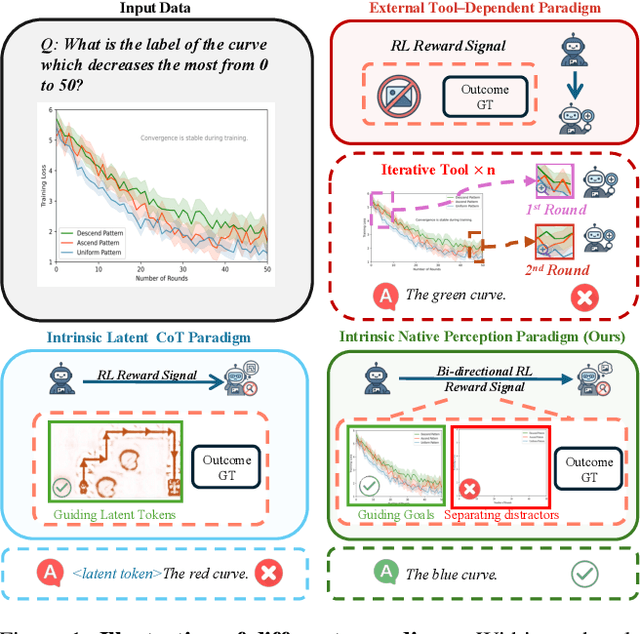
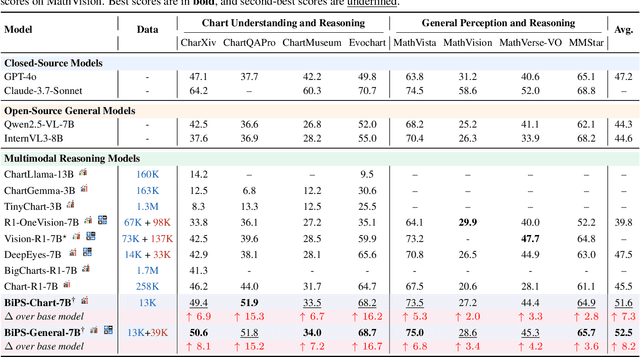
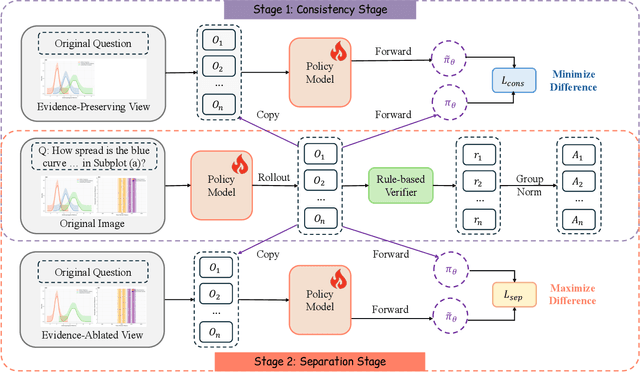
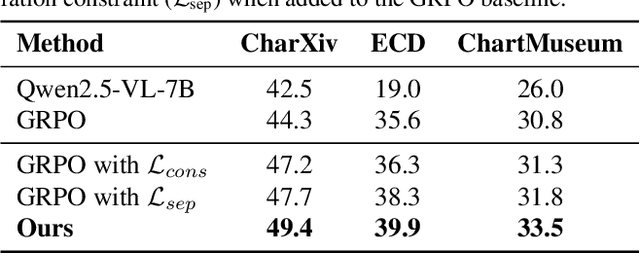
Large vision-language models (VLMs) often benefit from intermediate visual cues, either injected via external tools or generated as latent visual tokens during reasoning, but these mechanisms still overlook fine-grained visual evidence (e.g., polylines in charts), generalize poorly across domains, and incur high inference-time cost. In this paper, we propose Bi-directional Perceptual Shaping (BiPS), which transforms question-conditioned masked views into bidirectional where-to-look signals that shape perception during training. BiPS first applies a KL-consistency constraint between the original image and an evidence-preserving view that keeps only question-relevant regions, encouraging coarse but complete coverage of supporting pixels. It then applies a KL-separation constraint between the original and an evidence-ablated view where critical pixels are masked so the image no longer supports the original answer, discouraging text-only shortcuts (i.e., answering from text alone) and enforcing fine-grained visual reliance. Across eight benchmarks, BiPS boosts Qwen2.5-VL-7B by 8.2% on average and shows strong out-of-domain generalization to unseen datasets and image types.
CADMorph: Geometry-Driven Parametric CAD Editing via a Plan-Generate-Verify Loop
Dec 12, 2025A Computer-Aided Design (CAD) model encodes an object in two coupled forms: a parametric construction sequence and its resulting visible geometric shape. During iterative design, adjustments to the geometric shape inevitably require synchronized edits to the underlying parametric sequence, called geometry-driven parametric CAD editing. The task calls for 1) preserving the original sequence's structure, 2) ensuring each edit's semantic validity, and 3) maintaining high shape fidelity to the target shape, all under scarce editing data triplets. We present CADMorph, an iterative plan-generate-verify framework that orchestrates pretrained domain-specific foundation models during inference: a parameter-to-shape (P2S) latent diffusion model and a masked-parameter-prediction (MPP) model. In the planning stage, cross-attention maps from the P2S model pinpoint the segments that need modification and offer editing masks. The MPP model then infills these masks with semantically valid edits in the generation stage. During verification, the P2S model embeds each candidate sequence in shape-latent space, measures its distance to the target shape, and selects the closest one. The three stages leverage the inherent geometric consciousness and design knowledge in pretrained priors, and thus tackle structure preservation, semantic validity, and shape fidelity respectively. Besides, both P2S and MPP models are trained without triplet data, bypassing the data-scarcity bottleneck. CADMorph surpasses GPT-4o and specialized CAD baselines, and supports downstream applications such as iterative editing and reverse-engineering enhancement.