 Add to Chrome
 Add to Firefox
 Add to Edge
ORCA: ORgan-Centroid Aggregation for Training-Free 3D CT Visual Token Compression
Jul 31, 2026
A 3D CT scan entering a vision-language model produces a long sequence of visual tokens, often thousands to tens of thousands per volume, and this sequence must be compressed before a language model can consume it. Token compression is well studied in general vision, but little of it targets 3D CT specifically. A common baseline is grid average, which pools regular grid cells and can blend distinct anatomy, lesion, and air into one token. We present \textbf{ORCA} (ORgan-Centroid Aggregation), a token compressor for 3D CT. It merges adjacent tokens with organ guidance and adds a sinusoidal encoding of each region's centroid to preserve spatial layout. This preserves the anatomical information a downstream model needs. ORCA is training-free and plug-and-play, producing an adjustable token set without any model change or text query. We evaluate it across two datasets (CT-RATE and Merlin) and five encoders. The evaluation spans two task types: attribute prediction over five families (size, density, location, texture, and disease) and text generation (visual question answering and report generation). At matched token budgets, ORCA improves consistently over existing compression methods. It shrinks the visual context $64\times$ and its KV-cache $50\times$, and is $31\times$ faster to process each volume. Code released at https://github.com/renjie-liang/ORCA-3DCT.

Multi-Granularity 3D Kidney Lesion Characterization from CT Volumes
Jun 03, 2026Radiology reports describe kidney lesions by type, size, enhancement, and attenuation, yet existing 3D methods predict only at the patient or organ level. We reformulate kidney CT characterization as a per-lesion set-prediction task: one model emits a variable number of lesions per kidney, each with four clinical attributes. We curated 2,619 CT volumes from 788 patients at one academic medical center, with multi-granularity side- and per-lesion labels, and used KiTS23 (489 cases) for zero-shot external validation. We propose \textbf{LesionDETR}, a DETR-style architecture with size-distance Hungarian matching and a hierarchical loss that aggregates per-slot outputs to side-level objectives. Across four input representations and six encoder initializations, two design choices dominate: a segmentation mask as an input channel, and same-domain abdominal pretraining (SuPreM); generic large-corpus pretraining is no better than random initialization. LesionDETR reaches bilateral side-level abnormality AUC $0.799 \pm 0.009$ on UF-Health and $0.817 \pm 0.072$ on KiTS23. A count-conditioned variant reaches per-lesion mAP $0.190 \pm 0.083$ on cystic lesions; rare solid-lesion AP stays at the noise floor, pointing to targeted data collection, not architecture, as the next bottleneck. The framework yields verified per-lesion predictions for downstream structured report generation.
Beyond the Embedding Bottleneck: Adaptive Retrieval-Augmented 3D CT Report Generation
Mar 16, 2026Automated radiology report generation from 3D CT volumes often suffers from incomplete pathology coverage. We provide empirical evidence that this limitation stems from a representational bottleneck: contrastive 3D CT embeddings encode discriminative pathology signals, yet exhibit severe dimensional concentration, with as few as 2 effective dimensions out of 512. Corroborating this, scaling the language model yields no measurable improvement, suggesting that the bottleneck lies in the visual representation rather than the generator. This bottleneck limits both generation and retrieval; naive static retrieval fails to improve clinical efficacy and can even degrade performance. We propose \textbf{AdaRAG-CT}, an adaptive augmentation framework that compensates for this visual bottleneck by introducing supplementary textual information through controlled retrieval and selectively integrating it during generation. On the CT-RATE benchmark, AdaRAG-CT achieves state-of-the-art clinical efficacy, improving Clinical F1 from 0.420 (CT-Agent) to 0.480 (+6 points); ablation studies confirm that both the retrieval and generation components contribute to the improvement. Code is available at https://github.com/renjie-liang/Adaptive-RAG-for-3DCT-Report-Generation.
Enhancing Renal Tumor Malignancy Prediction: Deep Learning with Automatic 3D CT Organ Focused Attention
Feb 25, 2026Accurate prediction of malignancy in renal tumors is crucial for informing clinical decisions and optimizing treatment strategies. However, existing imaging modalities lack the necessary accuracy to reliably predict malignancy before surgical intervention. While deep learning has shown promise in malignancy prediction using 3D CT images, traditional approaches often rely on manual segmentation to isolate the tumor region and reduce noise, which enhances predictive performance. Manual segmentation, however, is labor-intensive, costly, and dependent on expert knowledge. In this study, a deep learning framework was developed utilizing an Organ Focused Attention (OFA) loss function to modify the attention of image patches so that organ patches attend only to other organ patches. Hence, no segmentation of 3D renal CT images is required at deployment time for malignancy prediction. The proposed framework achieved an AUC of 0.685 and an F1-score of 0.872 on a private dataset from the UF Integrated Data Repository (IDR), and an AUC of 0.760 and an F1-score of 0.852 on the publicly available KiTS21 dataset. These results surpass the performance of conventional models that rely on segmentation-based cropping for noise reduction, demonstrating the frameworks ability to enhance predictive accuracy without explicit segmentation input. The findings suggest that this approach offers a more efficient and reliable method for malignancy prediction, thereby enhancing clinical decision-making in renal cancer diagnosis.
DTC: A Deformable Transposed Convolution Module for Medical Image Segmentation
Jan 25, 2026In medical image segmentation, particularly in UNet-like architectures, upsampling is primarily used to transform smaller feature maps into larger ones, enabling feature fusion between encoder and decoder features and supporting multi-scale prediction. Conventional upsampling methods, such as transposed convolution and linear interpolation, operate on fixed positions: transposed convolution applies kernel elements to predetermined pixel or voxel locations, while linear interpolation assigns values based on fixed coordinates in the original feature map. These fixed-position approaches may fail to capture structural information beyond predefined sampling positions and can lead to artifacts or loss of detail. Inspired by deformable convolutions, we propose a novel upsampling method, Deformable Transposed Convolution (DTC), which learns dynamic coordinates (i.e., sampling positions) to generate high-resolution feature maps for both 2D and 3D medical image segmentation tasks. Experiments on 3D (e.g., BTCV15) and 2D datasets (e.g., ISIC18, BUSI) demonstrate that DTC can be effectively integrated into existing medical image segmentation models, consistently improving the decoder's feature reconstruction and detail recovery capability.
Developing A Fair Individualized Polysocial Risk Score (iPsRS) for Identifying Increased Social Risk of Hospitalizations in Patients with Type 2 Diabetes (T2D)
Sep 05, 2023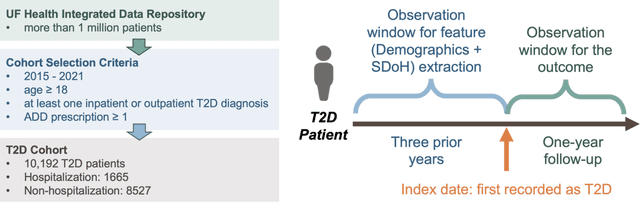
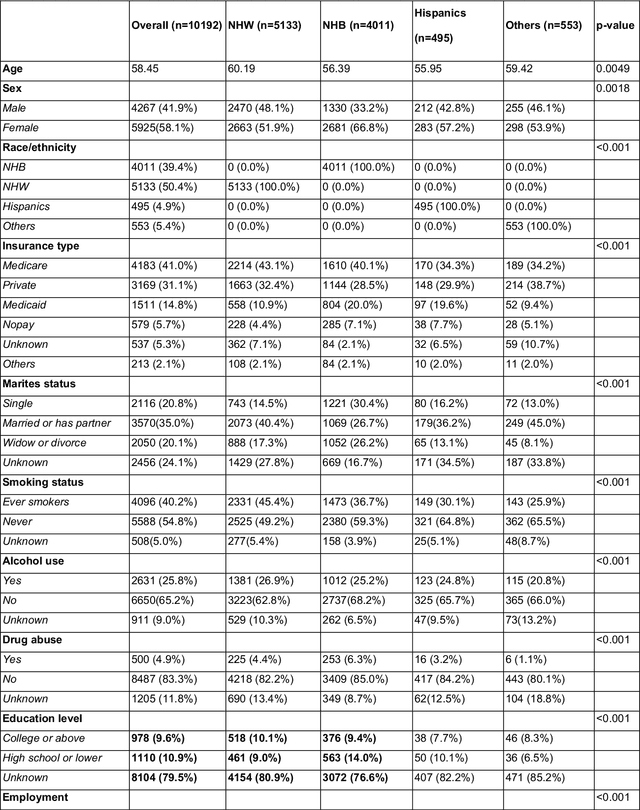
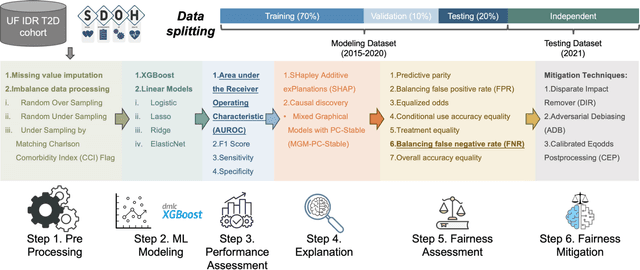
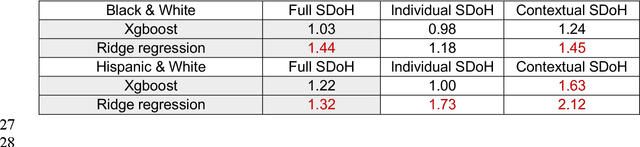
Background: Racial and ethnic minority groups and individuals facing social disadvantages, which often stem from their social determinants of health (SDoH), bear a disproportionate burden of type 2 diabetes (T2D) and its complications. It is therefore crucial to implement effective social risk management strategies at the point of care. Objective: To develop an EHR-based machine learning (ML) analytical pipeline to identify the unmet social needs associated with hospitalization risk in patients with T2D. Methods: We identified 10,192 T2D patients from the EHR data (from 2012 to 2022) from the University of Florida Health Integrated Data Repository, including contextual SDoH (e.g., neighborhood deprivation) and individual-level SDoH (e.g., housing stability). We developed an electronic health records (EHR)-based machine learning (ML) analytic pipeline, namely individualized polysocial risk score (iPsRS), to identify high social risk associated with hospitalizations in T2D patients, along with explainable AI (XAI) techniques and fairness assessment and optimization. Results: Our iPsRS achieved a C statistic of 0.72 in predicting 1-year hospitalization after fairness optimization across racial-ethnic groups. The iPsRS showed excellent utility for capturing individuals at high hospitalization risk; the actual 1-year hospitalization rate in the top 5% of iPsRS was ~13 times as high as the bottom decile. Conclusion: Our ML pipeline iPsRS can fairly and accurately screen for patients who have increased social risk leading to hospitalization in T2D patients.