 Add to Chrome
 Add to Firefox
 Add to Edge
GeoFlow: Efficient Driving Video Generation via Geometry-Aligned Priors
Aug 12, 2026
Generative models like Diffusion Models and Flow Matching have demonstrated remarkable capabilities in synthesizing high-fidelity driving videos, but are severely constrained by high inference latency due to the requirement of extensive sampling steps. We argue that this inefficiency stems from the prevailing reliance on a standard Gaussian source distribution, where consecutive frames are initialized as independent Gaussian noise. This paradigm disregards the rich spatiotemporal correlations inherent in driving videos, compelling the model to regenerate deterministic scene structures existing in previous frames from noise, which is both computationally redundant and prone to geometric inconsistency. To address this problem, we propose GeoFlow, a novel framework designed to achieve efficient driving video generation by harnessing explicit geometric priors. Instead of sampling from standard Gaussian noise, we leverage multi-view geometry and spatially-adaptive noise injection to construct a Geometry-Aligned Prior (GAP) distribution as starting point. This initialization bridges the gap between source distribution and data distribution, yielding a significantly straighter and shorter sampling trajectory. Extensive experiments demonstrate that GeoFlow can achieve remarkable efficiency of both training and inference: merely several hours of fine-tuning on baseline models can significantly boost few-step generation quality, while fully converged training drastically reduces number of inference steps required for state-of-the-art video generation.

Learning Gaussian Structure: Intervention-Guided Density Control for Feed-Forward Driving Reconstruction
Aug 11, 2026Feed-forward Gaussian reconstruction has recently emerged as an efficient approach for driving scene reconstruction. However, prevailing LiDAR-based methods preserve the initial correspondence between observed points and Gaussian primitives, treating the initialized primitive set as the final representation. Unlike optimization-based 3DGS, these methods cannot accumulate gradients during training to determine how the scenes representation should be densified. Meanwhile, the shared sparse backbone only fuses observations from different timestamps implicitly, without explicitly aggregating cross-time evidence for individual primitives. In this paper, we present Learning Gaussian Structure (LGS), a framework that enhances both Gaussian structure and primitive attributes. Our key observation is that changes in local gradient responses induced by a prune or add intervention reveal whether the corresponding structural adjustment benefits reconstruction. Based on this observation, our Gaussian Densify Policy learns a Densify Map comprising Prune and Addition Scores from controlled interventions, and directly adjusts the Gaussian structure during inference. We further develop a compact Cross-Time Point Query that explicitly retrieves and aggregates neighboring features from Gaussian primitives at other timestamps for reliable attribute prediction. Extensive experiments on the Waymo Open Dataset and PandaSet demonstrate that LGS consistently outperforms existing methods.
Revisiting Photometric Ambiguity for Accurate Gaussian-Splatting Surface Reconstruction
May 12, 2026Surface reconstruction with differentiable rendering has achieved impressive performance in recent years, yet the pervasive photometric ambiguities have strictly bottlenecked existing approaches. This paper presents AmbiSuR, a framework that explores an intrinsic solution upon Gaussian Splatting for the photometric ambiguity-robust surface 3D reconstruction with high performance. Starting by revisiting the foundation, our investigation uncovers two built-in primitive-wise ambiguities in representation, while revealing an intrinsic potential for ambiguity self-indication in Gaussian Splatting. Stemming from these, a photometric disambiguation is first introduced, constraining ill-posed geometry solution for definite surface formation. Then, we propose an ambiguity indication module that unleashes the self-indication potential to identify and further guide correcting underconstrained reconstructions. Extensive experiments demonstrate our superior surface reconstructions compared to existing methods across various challenging scenarios, excelling in broad compatibility. Project: https://fictionarry.github.io/AmbiSuR-Proj/ .
Brain4FMs: A Benchmark of Foundation Models for Electrical Brain Signal
Feb 12, 2026Brain Foundation Models (BFMs) are transforming neuroscience by enabling scalable and transferable learning from neural signals, advancing both clinical diagnostics and cutting-edge neuroscience exploration. Their emergence is powered by large-scale clinical recordings, particularly electroencephalography (EEG) and intracranial EEG, which provide rich temporal and spatial representations of brain dynamics. However, despite their rapid proliferation, the field lacks a unified understanding of existing methodologies and a standardized evaluation framework. To fill this gap, we map the benchmark design space along two axes: (i) from the model perspective, we organize BFMs under a self-supervised learning (SSL) taxonomy; and (ii) from the dataset perspective, we summarize common downstream tasks and curate representative public datasets across clinical and human-centric neurotechnology applications. Building on this consolidation, we introduce Brain4FMs, an open evaluation platform with plug-and-play interfaces that integrates 15 representative BFMs and 18 public datasets. It enables standardized comparisons and analysis of how pretraining data, SSL strategies, and architectures affect generalization and downstream performance, guiding more accurate and transferable BFMs. The code is available at https://anonymous.4open.science/r/Brain4FMs-85B8.
Assembling the Mind's Mosaic: Towards EEG Semantic Intent Decoding
Jan 28, 2026Enabling natural communication through brain-computer interfaces (BCIs) remains one of the most profound challenges in neuroscience and neurotechnology. While existing frameworks offer partial solutions, they are constrained by oversimplified semantic representations and a lack of interpretability. To overcome these limitations, we introduce Semantic Intent Decoding (SID), a novel framework that translates neural activity into natural language by modeling meaning as a flexible set of compositional semantic units. SID is built on three core principles: semantic compositionality, continuity and expandability of semantic space, and fidelity in reconstruction. We present BrainMosaic, a deep learning architecture implementing SID. BrainMosaic decodes multiple semantic units from EEG/SEEG signals using set matching and then reconstructs coherent sentences through semantic-guided reconstruction. This approach moves beyond traditional pipelines that rely on fixed-class classification or unconstrained generation, enabling a more interpretable and expressive communication paradigm. Extensive experiments on multilingual EEG and clinical SEEG datasets demonstrate that SID and BrainMosaic offer substantial advantages over existing frameworks, paving the way for natural and effective BCI-mediated communication.
SCE-SLAM: Scale-Consistent Monocular SLAM via Scene Coordinate Embeddings
Jan 14, 2026Monocular visual SLAM enables 3D reconstruction from internet video and autonomous navigation on resource-constrained platforms, yet suffers from scale drift, i.e., the gradual divergence of estimated scale over long sequences. Existing frame-to-frame methods achieve real-time performance through local optimization but accumulate scale drift due to the lack of global constraints among independent windows. To address this, we propose SCE-SLAM, an end-to-end SLAM system that maintains scale consistency through scene coordinate embeddings, which are learned patch-level representations encoding 3D geometric relationships under a canonical scale reference. The framework consists of two key modules: geometry-guided aggregation that leverages 3D spatial proximity to propagate scale information from historical observations through geometry-modulated attention, and scene coordinate bundle adjustment that anchors current estimates to the reference scale through explicit 3D coordinate constraints decoded from the scene coordinate embeddings. Experiments on KITTI, Waymo, and vKITTI demonstrate substantial improvements: our method reduces absolute trajectory error by 8.36m on KITTI compared to the best prior approach, while maintaining 36 FPS and achieving scale consistency across large-scale scenes.
FoundationSLAM: Unleashing the Power of Depth Foundation Models for End-to-End Dense Visual SLAM
Dec 31, 2025We present FoundationSLAM, a learning-based monocular dense SLAM system that addresses the absence of geometric consistency in previous flow-based approaches for accurate and robust tracking and mapping. Our core idea is to bridge flow estimation with geometric reasoning by leveraging the guidance from foundation depth models. To this end, we first develop a Hybrid Flow Network that produces geometry-aware correspondences, enabling consistent depth and pose inference across diverse keyframes. To enforce global consistency, we propose a Bi-Consistent Bundle Adjustment Layer that jointly optimizes keyframe pose and depth under multi-view constraints. Furthermore, we introduce a Reliability-Aware Refinement mechanism that dynamically adapts the flow update process by distinguishing between reliable and uncertain regions, forming a closed feedback loop between matching and optimization. Extensive experiments demonstrate that FoundationSLAM achieves superior trajectory accuracy and dense reconstruction quality across multiple challenging datasets, while running in real-time at 18 FPS, demonstrating strong generalization to various scenarios and practical applicability of our method.
SparseSurf: Sparse-View 3D Gaussian Splatting for Surface Reconstruction
Nov 18, 2025Recent advances in optimizing Gaussian Splatting for scene geometry have enabled efficient reconstruction of detailed surfaces from images. However, when input views are sparse, such optimization is prone to overfitting, leading to suboptimal reconstruction quality. Existing approaches address this challenge by employing flattened Gaussian primitives to better fit surface geometry, combined with depth regularization to alleviate geometric ambiguities under limited viewpoints. Nevertheless, the increased anisotropy inherent in flattened Gaussians exacerbates overfitting in sparse-view scenarios, hindering accurate surface fitting and degrading novel view synthesis performance. In this paper, we propose \net{}, a method that reconstructs more accurate and detailed surfaces while preserving high-quality novel view rendering. Our key insight is to introduce Stereo Geometry-Texture Alignment, which bridges rendering quality and geometry estimation, thereby jointly enhancing both surface reconstruction and view synthesis. In addition, we present a Pseudo-Feature Enhanced Geometry Consistency that enforces multi-view geometric consistency by incorporating both training and unseen views, effectively mitigating overfitting caused by sparse supervision. Extensive experiments on the DTU, BlendedMVS, and Mip-NeRF360 datasets demonstrate that our method achieves the state-of-the-art performance.
Reinforcement Learning Optimization for Large-Scale Learning: An Efficient and User-Friendly Scaling Library
Jun 06, 2025We introduce ROLL, an efficient, scalable, and user-friendly library designed for Reinforcement Learning Optimization for Large-scale Learning. ROLL caters to three primary user groups: tech pioneers aiming for cost-effective, fault-tolerant large-scale training, developers requiring flexible control over training workflows, and researchers seeking agile experimentation. ROLL is built upon several key modules to serve these user groups effectively. First, a single-controller architecture combined with an abstraction of the parallel worker simplifies the development of the training pipeline. Second, the parallel strategy and data transfer modules enable efficient and scalable training. Third, the rollout scheduler offers fine-grained management of each sample's lifecycle during the rollout stage. Fourth, the environment worker and reward worker support rapid and flexible experimentation with agentic RL algorithms and reward designs. Finally, AutoDeviceMapping allows users to assign resources to different models flexibly across various stages.
InsTaG: Learning Personalized 3D Talking Head from Few-Second Video
Feb 27, 2025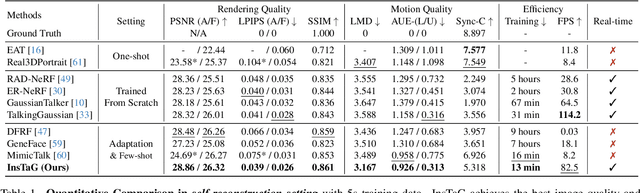
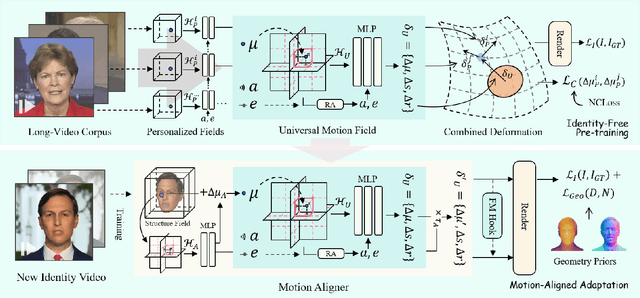

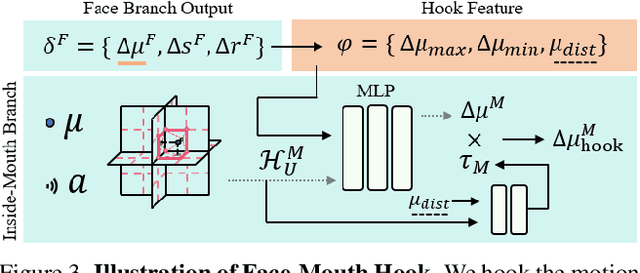
Despite exhibiting impressive performance in synthesizing lifelike personalized 3D talking heads, prevailing methods based on radiance fields suffer from high demands for training data and time for each new identity. This paper introduces InsTaG, a 3D talking head synthesis framework that allows a fast learning of realistic personalized 3D talking head from few training data. Built upon a lightweight 3DGS person-specific synthesizer with universal motion priors, InsTaG achieves high-quality and fast adaptation while preserving high-level personalization and efficiency. As preparation, we first propose an Identity-Free Pre-training strategy that enables the pre-training of the person-specific model and encourages the collection of universal motion priors from long-video data corpus. To fully exploit the universal motion priors to learn an unseen new identity, we then present a Motion-Aligned Adaptation strategy to adaptively align the target head to the pre-trained field, and constrain a robust dynamic head structure under few training data. Experiments demonstrate our outstanding performance and efficiency under various data scenarios to render high-quality personalized talking heads.