 Add to Chrome
 Add to Firefox
 Add to Edge
OccDirector: Language-Guided Behavior and Interaction Generation in 4D Occupancy Space
Apr 24, 2026
Generative world models increasingly rely on 4D occupancy for realistic autonomous driving simulation. However, existing generation frameworks depend on rigid geometric conditions (e.g., explicit trajectories) or simplistic attribute-level text, failing to orchestrate complex, sequential multi-agent interactions. To address this semantic-spatiotemporal gap, we propose OccDirector, a pioneering framework that generates 4D occupancy dynamics conditioned solely on natural language. Operating as a ``scenario director'', OccDirector maps natural language scripts into physically plausible voxel dynamics without requiring geometric priors. Technically, it employs a VLM-driven Spatio-Temporal MMDiT equipped with a history-prefix anchoring strategy to ensure long-horizon interaction consistency. Furthermore, we introduce OccInteract-85k, a novel dataset uniquely annotated with multi-level language instructions: ranging from static layouts to intricate multi-agent behaviors, alongside a novel VLM-based evaluation benchmark. Extensive experiments demonstrate that OccDirector achieves state-of-the-art generation quality and unprecedented instruction-following capabilities, successfully shifting the paradigm from appearance synthesis to language-driven behavior orchestration.

Structured Prompt Optimization for Few-Shot Text Classification via Semantic Alignment in Latent Space
Feb 27, 2026This study addresses the issues of semantic entanglement, unclear label structure, and insufficient feature representation in few-shot text classification, and proposes an optimization framework based on structured prompts to enhance semantic understanding and task adaptation under low-resource conditions. The framework first uses a pretrained language model to encode the input text and obtain basic semantic representations. It then introduces structured prompts composed of multi-dimensional semantic factors and integrates them with text features through a learnable combination mechanism, which forms task-related representations with clear boundaries in the latent space. To further strengthen the consistency between text representations and label semantics, the method constructs a structured label embedding matrix and employs a cross-space alignment mechanism to ensure stable matching between textual features and label attributes. In addition, the model applies prompt orthogonality constraints and a joint optimization objective to maintain independence across different semantic factors in the prompts, allowing the structured prompts to provide transparent and controllable guidance for classification decisions. Three types of sensitivity experiments, including learning rate sensitivity, prompt length sensitivity, and data scale sensitivity, are designed to evaluate the stability and robustness of the framework under different conditions. Experimental results show that the proposed structured prompt optimization framework effectively alleviates semantic conflicts and label ambiguity in few-shot text classification. It significantly improves performance on accuracy, precision, recall, and AUC, and demonstrates strong cross-task applicability.
Tool-Augmented Hybrid Ensemble Reasoning with Distillation for Bilingual Mathematical Problem Solving
Dec 22, 2025Bilingual mathematical problem solving needs a clear link between language reasoning and symbolic calculation. Large language models often handle language well but are weak in accurate computation. This paper presents HERALD (Hybrid Ensemble Reasoning with Adaptive Learning and Distillation), a framework that joins reasoning and calculation using NuminaMath-7B-TIR, GPT-4o, and Mistral-7B. HERALD uses adaptive routing, tool-based reinforcement learning, and knowledge distillation to connect different reasoning paths. Confidence calibration keeps weighting stable, and dual-path checking keeps results correct. Reinforcement learning controls tool use to cut redundancy, and distillation lowers delay without hurting accuracy. The system shows that combining symbolic checking, adaptive ensembles, and bilingual fine-tuning helps achieve both fluent reasoning and precise calculation. HERALD offers a practical solution for multilingual mathematical reasoning with better accuracy, stability, and clarity.
Contrastive Knowledge Transfer and Robust Optimization for Secure Alignment of Large Language Models
Oct 31, 2025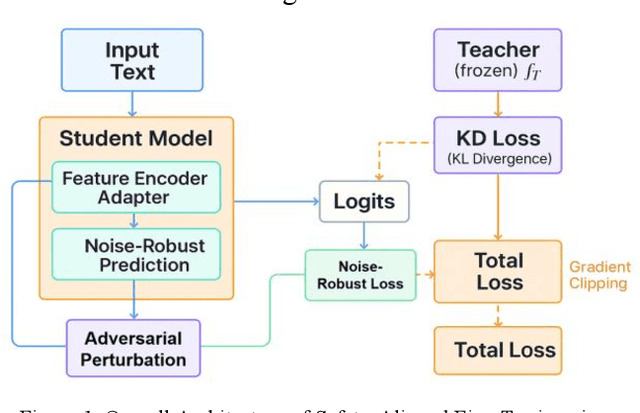
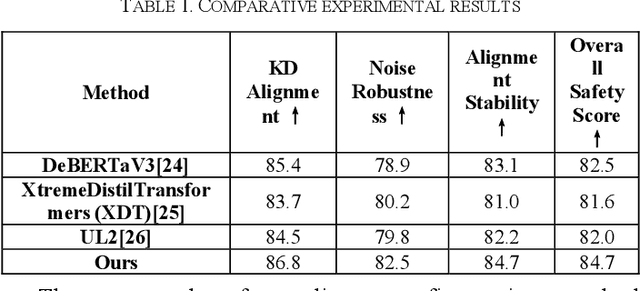
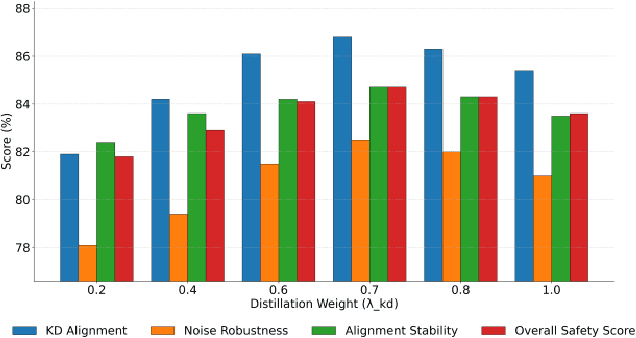
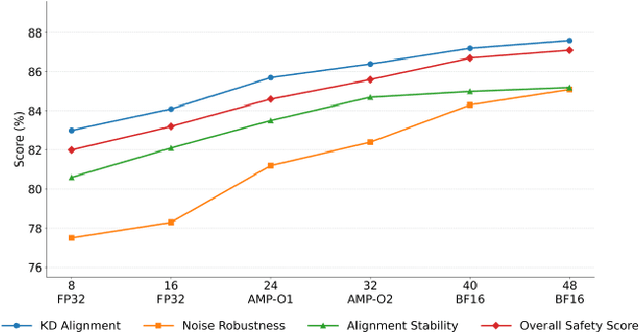
This paper addresses the limitations of large-scale language models in safety alignment and robustness by proposing a fine-tuning method that combines contrastive distillation with noise-robust training. The method freezes the backbone model and transfers the knowledge boundaries of the teacher model to the student model through distillation, thereby improving semantic consistency and alignment accuracy. At the same time, noise perturbations and robust optimization constraints are introduced during training to ensure that the model maintains stable predictive outputs under noisy and uncertain inputs. The overall framework consists of distillation loss, robustness loss, and a regularization term, forming a unified optimization objective that balances alignment ability with resistance to interference. To systematically validate its effectiveness, the study designs experiments from multiple perspectives, including distillation weight sensitivity, stability analysis under computation budgets and mixed-precision environments, and the impact of data noise and distribution shifts on model performance. Results show that the method significantly outperforms existing baselines in knowledge transfer, robustness, and overall safety, achieving the best performance across several key metrics. This work not only enriches the theoretical system of parameter-efficient fine-tuning but also provides a new solution for building safer and more trustworthy alignment mechanisms.
Unified Representation Learning for Multi-Intent Diversity and Behavioral Uncertainty in Recommender Systems
Sep 04, 2025This paper addresses the challenge of jointly modeling user intent diversity and behavioral uncertainty in recommender systems. A unified representation learning framework is proposed. The framework builds a multi-intent representation module and an uncertainty modeling mechanism. It extracts multi-granularity interest structures from user behavior sequences. Behavioral ambiguity and preference fluctuation are captured using Bayesian distribution modeling. In the multi-intent modeling part, the model introduces multiple latent intent vectors. These vectors are weighted and fused using an attention mechanism to generate semantically rich representations of long-term user preferences. In the uncertainty modeling part, the model learns the mean and covariance of behavior representations through Gaussian distributions. This reflects the user's confidence in different behavioral contexts. Next, a learnable fusion strategy is used to combine long-term intent and short-term behavior signals. This produces the final user representation, improving both recommendation accuracy and robustness. The method is evaluated on standard public datasets. Experimental results show that it outperforms existing representative models across multiple metrics. It also demonstrates greater stability and adaptability under cold-start and behavioral disturbance scenarios. The approach alleviates modeling bottlenecks faced by traditional methods when dealing with complex user behavior. These findings confirm the effectiveness and practical value of the unified modeling strategy in real-world recommendation tasks.