 Add to Chrome
 Add to Firefox
 Add to Edge
The 1st AI Children Challenge
Aug 01, 2026
The First AI Children Challenge aims to advance real-world applications of computer vision and AI in child healthcare, child education, and pediatrics. The 2026 CV4CHL edition featured the first track in this domain: Children Gait Visual Analysis. The main goal of Children Gait Visual Analysis is the fine-grained analysis of children's gait behaviors from keypoint sequences. This is still a big challenge for human action recognition. Experienced medical doctors can distinguish these subtle nuances, but none of the people test AI models in this domain. To bridge this gap, we introduce thousands of 2D children keypoint sequences walking around videos across various age groups of children (3-16 years old). There is a significant opportunity for batch analysis of these videos to provide clinically relevant insights into medical diagnosis. The Challenge will be launched with two problem tracks: Edinburgh Visual Gait Score (EVGS) Scoring and Classification of Gait Patterns in Bilateral Spastic Cerebral Palsy. Each track is chosen in consultation with board-certified pediatricians based on the value of potential solutions. With the first available dataset for such tasks and ground truth for each track, the challenge enabled participants to evaluate their solutions. Final rankings will be revealed after the competition concludes, fostering reproducibility and mitigating overfitting.

Behavior Foundations for Quadruped Robots: ABot-C0 Technical Report
Jul 09, 2026The motion controller is one of the most fundamental modules in embodied intelligence systems. Driven by large-scale human motion-capture data and the motion-tracking paradigm, humanoid control has achieved remarkable progress in recent years. However, migrating this recipe to the quadrupedal setting is far less straightforward: animal motion data is scarcer and harder to capture at scale than human data, and cross-embodiment retargeting remains fragile. We present ABot-C0, a generalist motion-control system for quadruped robots that establishes three complementary behavior foundations: a scalable multi-source motion-data pipeline, robust policy learning across motion tracking, locomotion, and scene interaction, and a unified deployment stack for reliable real-world operation. Fundamentally, we construct a data pyramid through conditional video-generation synthesis, annotated motion capture, teleoperation, and human design, producing 16,074 physically feasible motion clips as the data foundation for diverse motion-learning demands. With large-scale motion data, a Flow-Matching generalist policy demonstrates, for the first time, a scaling law for quadruped motion tracking: performance improves consistently as training scales up, with zero-shot capability to track unseen motions. We then go a step further toward robust all-terrain locomotion by adopting a three-stage privileged-to-perceptive framework with temporal LiDAR memory and terrain-predictive supervision. Collectively, these components form a motion generalist that coordinates multi-policy execution, smooth behavior transitions, energy-efficient control, and safety mechanisms for real-world deployment. Extensive experiments on urban-terrain autonomous navigation and companion-style multimodal interaction demonstrate that quadruped robots can move beyond functional demos toward product-level behavioral intelligence.
CPG-PAD: Concept-Informed Prompts Guided Presentation Attack Detection
Jul 01, 2026Presentation Attack Detection (PAD) serves as a crucial safeguard for face recognition systems against presentation attacks such as printed photos, replayed videos, and 3D masks. Despite significant progress, existing PAD models still struggle to generalize across unseen domains due to variations in sensors, lighting, and attack materials. Recent Vision-Language Models (VLMs) have shown strong generalization ability, yet their applications in PAD remain limited because learned prompts, typically optimized under class-label supervision, fail to explicitly align with fine-grained attack-relevant visual semantics. As a result, the learned representations often overfit domain-specific artifacts instead of capturing transferable attack cues. To address this, we propose Concept-Informed Prompts Guided Presentation Attack Detection (CPG-PAD), a framework that introduces model-level concept guidance into the prompt learning process. Specifically, we design a Visual Concept-driven Enhancement (VCE) module that employs eXplainable AI (XAI) techniques to automatically discover PAD-relevant visual concepts and generate concept-associated heatmaps providing localized fine-grained guidance. Guided by these heatmaps, a Prompt-based Concept Injection (PCI) mechanism integrates these concepts into the prompt space through a Visual-Prompt Decoder (VPD) and a concept-mapping loss, enabling prompts to align with the model's internal concept space. This design enables CPG-PAD to capture generalizable and domain-invariant attack cues while effectively suppressing dataset-specific biases. Extensive experiments across nine benchmark datasets demonstrate that CPG-PAD consistently achieves state-of-the-art cross-domain performance under multi-source, limited-source, and single-source settings.
Unleashing Infinite Motion: Scaling Expressive Quadrupedal Motion via Generative Video Priors
Jun 26, 2026Quadruped robots have achieved remarkable locomotion, yet their behavioral repertoire remains confined to a few gaits--far from the expressive, companion-like presence long envisioned for them. Attempts to import the humanoid recipe of large-scale motion data have inherited one tacit assumption: that robot motion must first pass through an animal body, making data collection dependent on cooperative animals, reconstruction fragile across species, and retargeting ill-posed across incompatible morphologies. We propose Uni-Mo, a fully automated pipeline that removes the animal from the loop by reframing data scarcity as a generation problem: an LLM proposes motion prompts, a video diffusion model synthesizes the corresponding robot behaviors, and the generated videos are lifted into 3D reference trajectories used to train tracking policies deployed on a real Unitree Go2. To make naively-drifting generations reliably extractable, we introduce an Identity Consistency Loss that enforces appearance coherence across frames. We release Quad-Imaginarium at https://github.com/GaoLii/Quad-Imaginarium.git, the resulting open-source dataset of 7,488 language-annotated quadruped motions (18.5 hours) spanning acrobatic and performative behaviors. We validate 392 randomly sampled motions on a real Unitree Go2 with a 96.7% deployment success rate, complemented by a 97.6% success rate across the full dataset in simulation.
Large Language Model-Powered Query-Driven Event Timeline Summarization in Industrial Search
May 26, 2026Understanding how events evolve over time is essential for search engines handling queries about trending news. We present QDET (Query-Driven Event Timeline Summarization), a production system deployed on Baidu Search that constructs focused event timelines to explain specific query events. Unlike traditional topic-centric approaches that aim for comprehensive coverage, QDET identifies and organizes sub-events closely relevant to the query from noisy candidate sets formed by millions of documents retrieved daily. QDET incorporates two key innovations: (1) multi-task supervised fine-tuning with three auxiliary tasks-temporal ordering, causal judgment, and timeline completion-that enable compact models to match the performance of much larger general-purpose models in specialized domains; (2) reinforcement learning-based event concise summarization that enforces strict length constraints while maintaining semantic quality, achieving 88.2% length compliance and outperforming 671B-scale models by 7.7 points in constraint satisfaction. Our fine-tuned 7B parameter model achieves 76.2% F1 score on timeline summarization, slightly surpassing the zero-shot performance of DeepSeek-R1-671B (76.1% F1) while using only 1% of its parameters-demonstrating that domain-specific optimization enables production-ready models with comparable quality at drastically reduced computational costs. Online A/B tests on Baidu Search validate real-world effectiveness, showing 5.5% CTR improvement, 4.6% longer dwell time, and 4.4% deeper exploration compared to single-task baselines. We further demonstrate that timeline understanding transfers to heat prediction, confirming effective knowledge transfer to downstream tasks.
RAG-Enhanced Large Language Models for Dynamic Content Expiration Prediction in Web Search
May 13, 2026In commercial web search, aligning content freshness with user intent remains challenging due to the highly varied lifespans of information. Traditional industrial approaches rely on static time-window filtering, resulting in "one-size-fits-all" rankings where content may be chronologically recent but semantically expired. To address the limitation, we present a novel Large Language Models (LLMs)-based Query-Aware Dynamic Content Expiration Prediction Framework deployed in Baidu search, reformulating timeliness as a dynamic validity inference task. Our framework extracts fine-grained temporal contexts from documents and leverages LLMs to deduce a query-specific "validity horizon"-a semantic boundary defining when information becomes obsolete based on user intent. Integrated with robust hallucination mitigation strategies to ensure reliability, our approach has been evaluated through offline and online A/B testing on live production traffic. Results demonstrate significant improvements in search freshness and user experience metrics, validating the effectiveness of LLM-driven reasoning for solving semantic expiration at an industrial scale.
QuadFM: Foundational Text-Driven Quadruped Motion Dataset for Generation and Control
Mar 25, 2026Despite significant advances in quadrupedal robotics, a critical gap persists in foundational motion resources that holistically integrate diverse locomotion, emotionally expressive behaviors, and rich language semantics-essential for agile, intuitive human-robot interaction. Current quadruped motion datasets are limited to a few mocap primitives (e.g., walk, trot, sit) and lack diverse behaviors with rich language grounding. To bridge this gap, we introduce Quadruped Foundational Motion (QuadFM) , the first large-scale, ultra-high-fidelity dataset designed for text-to-motion generation and general motion control. QuadFM contains 11,784 curated motion clips spanning locomotion, interactive, and emotion-expressive behaviors (e.g., dancing, stretching, peeing), each with three-layer annotation-fine-grained action labels, interaction scenarios, and natural language commands-totaling 35,352 descriptions to support language-conditioned understanding and command execution. We further propose Gen2Control RL, a unified framework that jointly trains a general motion controller and a text-to-motion generator, enabling efficient end-to-end inference on edge hardware. On a real quadruped robot with an NVIDIA Orin, our system achieves real-time motion synthesis (<500 ms latency). Simulation and real-world results show realistic, diverse motions while maintaining robust physical interaction. The dataset will be released at https://github.com/GaoLii/QuadFM.
CoMaTrack: Competitive Multi-Agent Game-Theoretic Tracking with Vision-Language-Action Models
Mar 24, 2026Embodied Visual Tracking (EVT), a core dynamic task in embodied intelligence, requires an agent to precisely follow a language-specified target. Yet most existing methods rely on single-agent imitation learning, suffering from costly expert data and limited generalization due to static training environments. Inspired by competition-driven capability evolution, we propose CoMaTrack, a competitive game-theoretic multi-agent reinforcement learning framework that trains agents in a dynamic adversarial setting with competitive subtasks, yielding stronger adaptive planning and interference-resilient strategies. We further introduce CoMaTrack-Bench, the first benchmark for competitive EVT, featuring game scenarios between a tracker and adaptive opponents across diverse environments and instructions, enabling standardized robustness evaluation under active adversarial interactions. Experiments show that CoMaTrack achieves state-of-the-art results on both standard benchmarks and CoMaTrack-Bench. Notably, a 3B VLM trained with our framework surpasses previous single-agent imitation learning methods based on 7B models on the challenging EVT-Bench, achieving 92.1% in STT, 74.2% in DT, and 57.5% in AT. The benchmark code will be available at https://github.com/wlqcode/CoMaTrack-Bench
ABot-N0: Technical Report on the VLA Foundation Model for Versatile Embodied Navigation
Feb 12, 2026Embodied navigation has long been fragmented by task-specific architectures. We introduce ABot-N0, a unified Vision-Language-Action (VLA) foundation model that achieves a ``Grand Unification'' across 5 core tasks: Point-Goal, Object-Goal, Instruction-Following, POI-Goal, and Person-Following. ABot-N0 utilizes a hierarchical ``Brain-Action'' architecture, pairing an LLM-based Cognitive Brain for semantic reasoning with a Flow Matching-based Action Expert for precise, continuous trajectory generation. To support large-scale learning, we developed the ABot-N0 Data Engine, curating 16.9M expert trajectories and 5.0M reasoning samples across 7,802 high-fidelity 3D scenes (10.7 $\text{km}^2$). ABot-N0 achieves new SOTA performance across 7 benchmarks, significantly outperforming specialized models. Furthermore, our Agentic Navigation System integrates a planner with hierarchical topological memory, enabling robust, long-horizon missions in dynamic real-world environments.
DiffVL: Diffusion-Based Visual Localization on 2D Maps via BEV-Conditioned GPS Denoising
Sep 18, 2025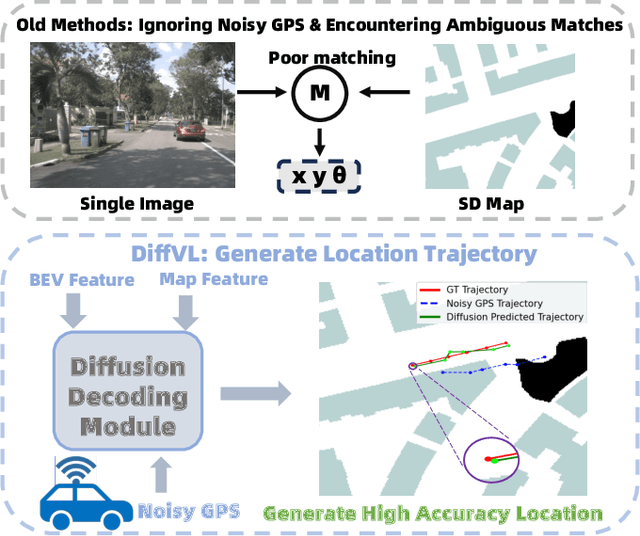
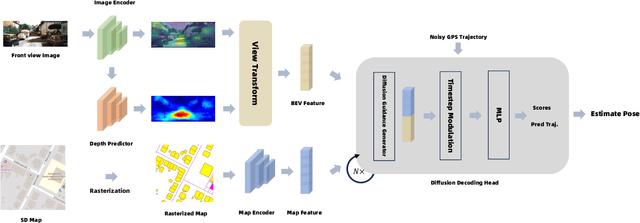
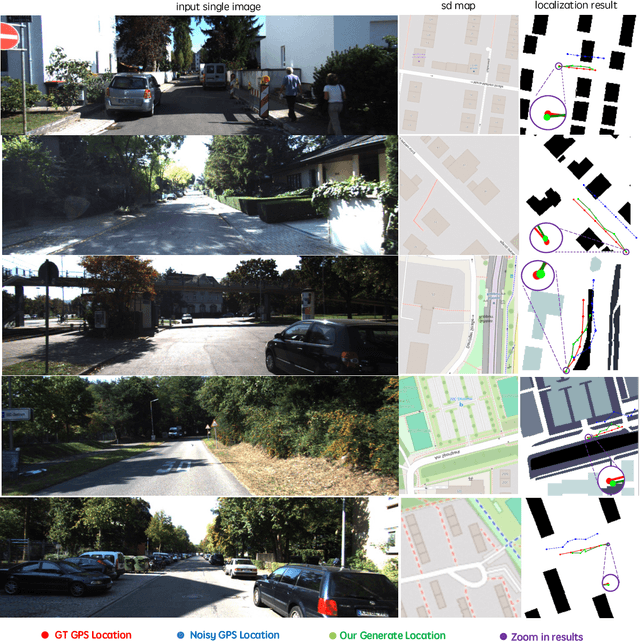
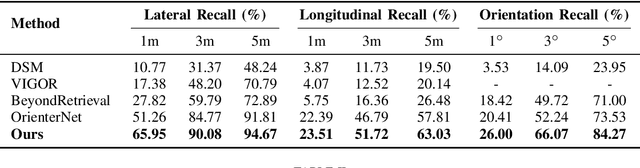
Accurate visual localization is crucial for autonomous driving, yet existing methods face a fundamental dilemma: While high-definition (HD) maps provide high-precision localization references, their costly construction and maintenance hinder scalability, which drives research toward standard-definition (SD) maps like OpenStreetMap. Current SD-map-based approaches primarily focus on Bird's-Eye View (BEV) matching between images and maps, overlooking a ubiquitous signal-noisy GPS. Although GPS is readily available, it suffers from multipath errors in urban environments. We propose DiffVL, the first framework to reformulate visual localization as a GPS denoising task using diffusion models. Our key insight is that noisy GPS trajectory, when conditioned on visual BEV features and SD maps, implicitly encode the true pose distribution, which can be recovered through iterative diffusion refinement. DiffVL, unlike prior BEV-matching methods (e.g., OrienterNet) or transformer-based registration approaches, learns to reverse GPS noise perturbations by jointly modeling GPS, SD map, and visual signals, achieving sub-meter accuracy without relying on HD maps. Experiments on multiple datasets demonstrate that our method achieves state-of-the-art accuracy compared to BEV-matching baselines. Crucially, our work proves that diffusion models can enable scalable localization by treating noisy GPS as a generative prior-making a paradigm shift from traditional matching-based methods.